Licensed master electrician · Call 414-207-0109
A 20 kWh battery, or 20 kilowatt-hours of storage, will last anywhere from a few hours to a few days. It depends on what you’re running, how much energy you use per hour, and whether it’s getting recharged.
If you’re only powering essentials: fridge, lights, Wi-Fi, furnace fan, you can expect anywhere from 24 to 48 hours of runtime. But if you’re trying to run the whole house, including central air or electric appliances, that same 20 kWh could be gone in less than 6 hours.
So it all comes down to load and efficiency.
First, What Does 20 kWh Actually Mean?
20 kWh means the battery can store 20,000 watt-hours of electricity. But most batteries don’t give you 100% of that. There’s always some buffer to protect battery health. Depending on the brand and type of lithium iron phosphate (LFP), lithium nickel manganese cobalt (NMC), etc, you’ll get about 90–95% usable battery capacity.
So you’re working with 18,000 to 19,000 watt-hours.
Real-World Usage: What Can You Power and For How Long?
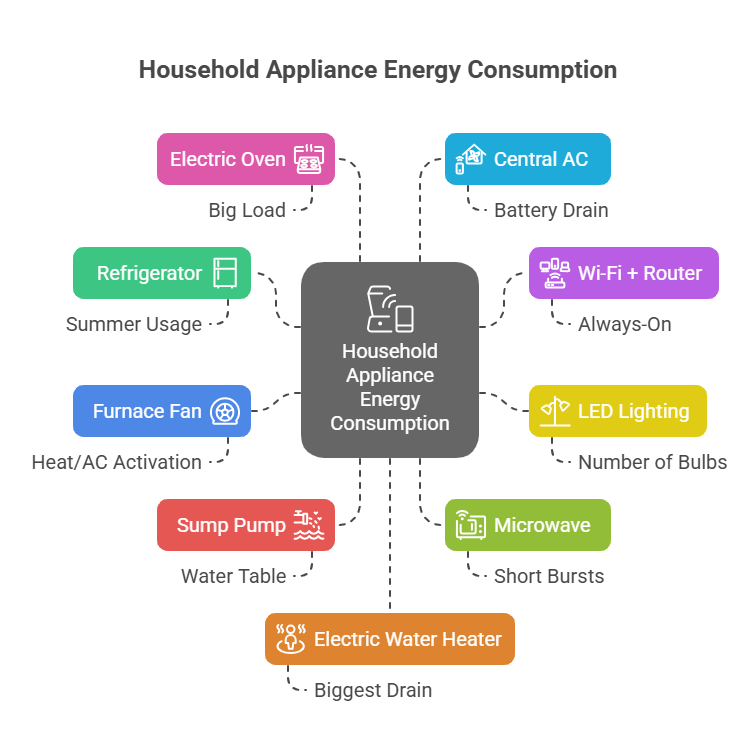
Let’s run some numbers. Here’s what common household appliances use, roughly:
| Appliance/Device | Average Daily Use (kWh) | Notes |
| Refrigerator | 1.5 – 2.5 | More in the summer |
| Wi-Fi + Router | 0.3 – 0.6 | Always-on |
| LED lighting (whole home) | 1 – 2 | Depends on the number and duration |
| Furnace fan (gas) | 1.5 – 2.0 | Only runs when the heat/AC is on |
| Sump pump | 0.5 – 3.0 | Depends on the water table & weather |
| Microwave | 1.0 – 1.5 per hour | Short bursts |
| Electric oven | 2.5 – 4.5 per hour | Big load |
| Central AC | 3 – 5 per hour | Kills battery fast |
| Electric water heater | 3 – 4 per hour | One of the biggest drains |
If you’re conservative and only powering:
- A fridge
- Wi-Fi and router
- 5-10 LED light bulbs
- A furnace blower fan
- Occasional microwave use
You might use 5-7 kWh per day. That means a 20 kWh battery can last 2-3 days under light load.
But If You Power Everything Like Normal?
You’ll run through that battery fast. An average U.S. home uses 25–30 kWh/day. In winter with electric heat or in summer with AC, it’s more.
So, in whole-home backup mode, no load control, a 20 kWh battery might give you 6–10 hours of power, and that’s it.
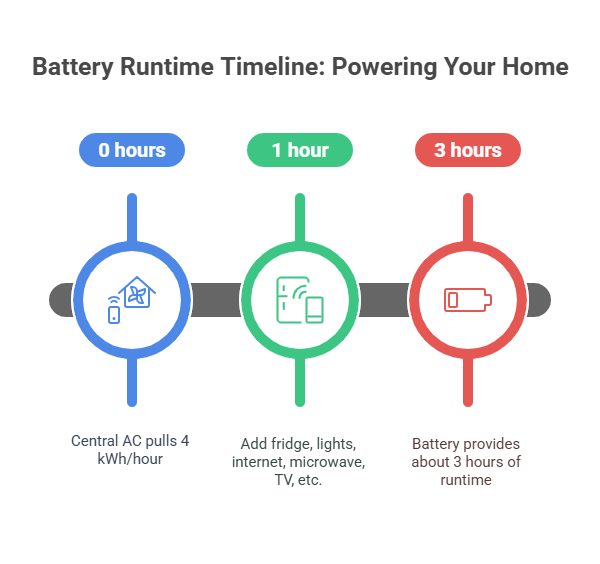
Example:
- Central AC pulls ~4 kWh/hour
- Add the fridge, lights, internet, microwave, TV, etc.
- You’re easily at 5–6 kWh per hour
- 20 kWh divided by 6 = about 3 hours of runtime
That’s why we always talk about critical load panels when we do installs. You can’t treat a battery backup like an unlimited power source. It’s a storage tank. Once it’s empty, you’re done unless solar is refilling it.
Does Solar Charging Change the Equation?
Yes, a lot. If you’ve got a solar array producing 6-8 kWh/day (common for a 6-7 kW system in Wisconsin with average sun), you can stretch your runtime over multiple days.
You could:
- Use 6-7 kWh overnight
- Recharge during the day
- Stay off-grid in a rolling cycle
But it depends on the weather. If it’s cloudy for 3 days, you won’t refill that battery enough to keep going. So we size systems based on winter production, not just the best-case-scenario summer.
What We Tell Homeowners in Wisconsin
We’ve done installs across the state, homes, cabins, and shops. The conversation is always the same: “What do you want running when the grid is down?”
If you say “everything,” well, 20 kWh won’t cut it. You’ll either need multiple batteries or way tighter load control. But if you just want to run the basics for a couple of days until the grid comes back, 20 kWh can do that if we plan it right.
For most of our Wisconsin customers:
- One 20kWh battery = 24-48 hours of basic usage
- Two 20kWh batteries = whole-home coverage for 12-18 hours or longer with solar
- Add solar + smart load control = multi-day or continuous backup
Quick Summary
How long will a 20 kWh battery last?
- Light load / Essentials only: 1.5 to 3 days
- Whole-home usage: 3 to 6 hours
- With solar recharging, it can go indefinitely in good conditions
What shortens runtime?
- Heating and cooling
- Hot water
- Anything electric-resistance-based
- Forgetting to shed non-essentials
What helps?
- Smart panels
- Critical load separation
- Battery management system with load shifting
- Right-sized solar input for recharging
If you’re not sure whether 20 kWh is enough, we can take a look at your actual power usage, see how it breaks down across seasons, and build something that makes sense, not something that might work.
Need help sizing a system? Reach out. No pressure. We’ll walk through it. Lehmann Electrical offer effective solar services, including installation, inspection, and battery backup. You can check the cost with our solar savings calculator.
FAQ
Can a 20 kWh battery power a whole house?
Yes, but not for long. Most full-sized homes in Wisconsin use 25 to 30 kWh per day. A 20kWh battery might only give you 6 to 10 hours of whole-home backup unless you’re using load control or have solar to recharge it.
With a 20 kWh battery, what can I run?
The refrigerator, Wi-Fi, a few lights, and sometimes a furnace fan are the only necessities that most people use. As a result, 20 kWh lasts for two to three days, with daily use remaining between 6 and 8 kWh. Electric ovens and air conditioners are heavy appliances that quickly deplete it.
Will solar panels keep a 20 kWh battery charged?
Yes, if the weather cooperates. A properly sized solar system can recharge your battery during the day. If it’s sunny, you can stretch backup power over multiple days. But in winter or during storms, solar production might not be enough.
Is 20 kWh of battery backup worth it?
If you want to run critical appliances during a power outage for a couple of days, yes. It’s reliable, silent, and doesn’t rely on gas. But for whole-home backup, you’ll need more capacity or be ready to manage your loads carefully.
Why homeowners call Lehmann Electrical & Design
- Led by licensed master electrician Jacob Lehmann
- A+ rating with the BBB and 4.9 stars on Google
- 12-month workmanship warranty on the work we do
- Permits pulled and inspections scheduled as part of the job
- Milwaukee, Wauwatosa and Waukesha County, from 12012 W Fairview Ave, Wauwatosa
Ready to talk about battery backup?
Tell us what you want to keep running in an outage, and we will come and look.
Licensed master electrician. 12-month workmanship warranty.
Read our recent solar blogs & pro tips
How does the solar heating system work
How is solar heating used in households
Monthly bill for solar panels
Is Solar Energy A Good or Bad Thing to Buy
How Long Does Solar Installation Take
How Much Do Solar Panels Cost In Wisconsin
How Much Does 1 Solar Panel Cost
Residential solar panels cost
Next step
Talk to us about battery backup
Tell us what you want to keep running in an outage.
Licensed master electrician12‑month warranty4.9 on Google
Milwaukee, Wauwatosa and Waukesha County. Prefer to talk? Call 414-207-0109