Licensed master electrician · Call 414-207-0109
A home battery that will not charge is usually being told not to charge rather than failing to charge. The most frequent reasons are a mode or reserve setting in the app, no surplus power available to store, a tripped breaker or open disconnect on the battery circuit, a communications dropout between the battery and its gateway, or a temperature limit holding the cells back. A true cell failure is possible but it is the last thing to suspect, not the first.
Your battery has three things it needs before it will accept a single watt: a live and closed electrical path, a signal telling it that charging is permitted, and cell conditions inside the manufacturer’s allowed window. Take away any one of those and the battery sits at whatever state of charge it happens to be at, showing no fault at all in many cases.
That is why so many “not charging” calls are not battery problems. A Tesla Powerwall in Backup-only mode, for example, will charge to its reserve and then stop on purpose, because that is what the mode asks it to do. A battery paired with a solar array charges from surplus production, so a run of gray Wisconsin days in November can look identical to a hardware fault. And a battery whose disconnect or breaker has opened looks, from the app, like a unit that has simply stopped talking.
The useful question is not “why won’t the battery charge” but “what is the battery being allowed to do right now, and is the circuit feeding it actually closed?” Answer those two and you have narrowed the cause to a short list. A homeowner can answer the first from an app in under a minute. The second belongs to a licensed electrician, because it lives behind a panel cover or inside a combiner.
What is usually causing it
Here are the causes worth working through, roughly in the order they tend to turn up on a residential system.
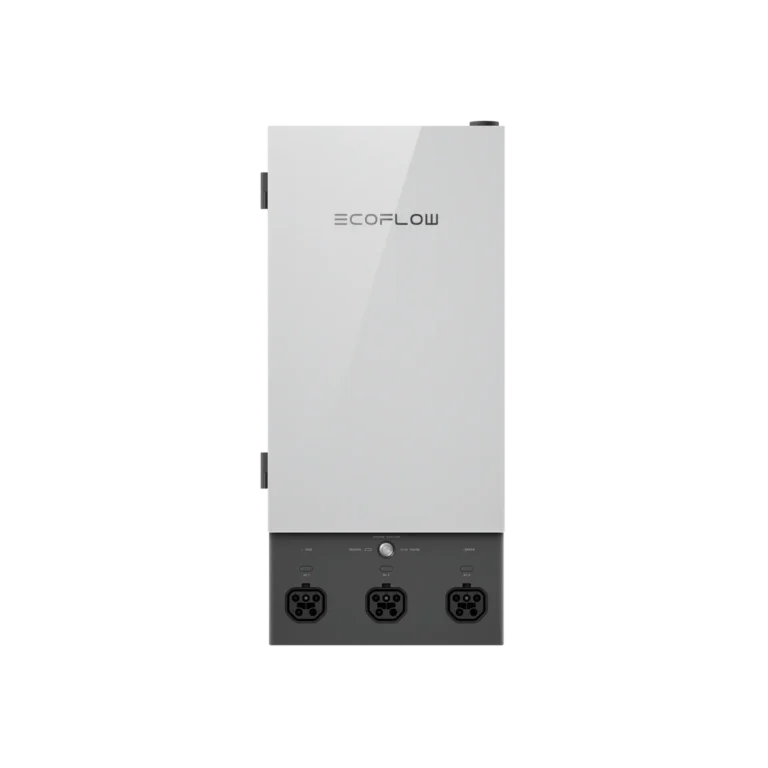
Mode, reserve and schedule settings. Backup reserve, storm watch, time-based control and self-powered modes all change when the battery charges and how far. A reserve set near full behaves very differently from one set near empty. If someone in the house changed a setting, or an app update reset one, charging behavior changes with it.
No surplus to store. A solar-coupled battery charges from production the house is not using. Snow on the array, heavy cloud, a shaded string, an inverter that has faulted, or simply a house consuming everything the panels make will all leave nothing over. The battery is doing exactly what it was designed to do.
Grid charging disabled. Many installations are configured not to pull from the utility, either by choice or by the terms of an interconnection agreement. If solar is down and grid charging is off, the battery has no source.
Open breaker, disconnect or fuse. Battery systems have more disconnecting means than most homeowners expect: a breaker in the main panel or a subpanel, a rapid-shutdown or system disconnect near the equipment, and internal fusing. Any one of them open stops charging. A breaker that has tripped may be reset once, firmly to OFF and then to ON. If it trips again, leave it off and have it inspected.
Communication loss. The battery, the gateway, the inverter and the utility meter talk to each other. A dead Wi-Fi link, a failed current transformer on the service conductors, or a gateway that has lost its configuration can leave the battery idle because it no longer knows what the house or the grid is doing.
Temperature. Lithium chemistries refuse to charge below roughly freezing and throttle in high heat. A battery in an unheated garage or on an exterior wall through a Milwaukee January may be perfectly healthy and still hold off charging until it warms. This is the single most common reason a lithium battery in southeastern Wisconsin “stops charging” in winter.
Firmware or a latched fault. An interrupted update or a fault the system has latched will suspend charging until it is cleared. Clearing it often requires the installer’s access, not the owner’s.
Genuine degradation. Batteries lose usable capacity over years. Degradation shows up as shorter runtime and a lower full-charge figure, not as a battery that refuses to charge at all. “New battery already flat” almost never means bad cells; it means a setting, a source or a circuit.
| What you are seeing | Most likely category | Who resolves it |
|---|---|---|
| Charges partway, then stops | Reserve or mode setting | Homeowner, in the app |
| Charges only on sunny days | Grid charging disabled | Electrician, configuration |
| Zero charging, unit offline in app | Communication or open disconnect | Electrician |
| Charging pauses in cold weather | Temperature limit | Usually nothing, by design |
| Full charge reads lower each year | Capacity degradation | Electrician, assessment |
| Burning smell, buzzing, scorch marks | Fault condition | Stop, leave off, call immediately |
If you notice a burning or hot-plastic smell, discoloration or scorch marks, buzzing, or crackling anywhere near the battery, inverter, disconnect or panel, stop using the equipment, leave the breaker off, and call an electrician. Do not touch the enclosure to judge how hot it is. Smell, sight and sound tell you what you need to know.
What is safe to check yourself, and what is not
Safe for a homeowner: everything you can reach through the manufacturer’s app or a display, plus a look at the equipment from a normal standing distance.
- Check the operating mode and the backup reserve percentage.
- Check whether grid charging is enabled.
- Check solar production for the same period. No production means no surplus.
- Check for any active alert, fault code or pending firmware update.
- Restore the home internet connection if the system shows offline, and give it fifteen minutes to reconnect.
- Note the outdoor and equipment-area temperature.
- Look for visible damage, water staining, pest activity or debris around the enclosure.
Not safe, and not yours to do: anything behind a panel cover, anything on the service conductors, anything on the battery’s DC wiring, and any attempt to open, reset internally or “revive” a lithium battery. Advice that circulates online about freezing, jump-starting or trickle-reviving a battery applies to small consumer cells and lead-acid starting batteries. Applied to a wall-mounted home energy storage unit it is dangerous, and a home battery has no user-serviceable interior.
One point homeowners regularly get wrong: turning the main breaker off does not make the panel safe. The service conductors feeding the panel and the line-side lugs of the main breaker stay energized with the main off. A homeowner cannot de-energize them. The utility can, usually by pulling the meter, and so can a separate service disconnect if one is fitted ahead of the panel. That is why this work needs a licensed electrician and, in most cases, a permit from your municipality.
Wisconsin electrical work is governed by Wisconsin SPS 316, which adopts the 2023 NEC (in effect since September 1, 2026). Permits are issued locally, by Milwaukee, Wauwatosa, Waukesha or whichever municipality you are in, and that municipality enforces SPS 316. Existing installations are not required to be brought up to the new edition unless the work is altered.
Battery still not taking a charge?
A licensed electrician checks the inverter, the battery’s own breaker and the settings that decide when it is allowed to charge.
Licensed master electrician. 12-month workmanship warranty.
When it points to a bigger problem
A battery that will not charge points beyond itself when the symptom is repeating, spreading or accompanied by anything sensory.
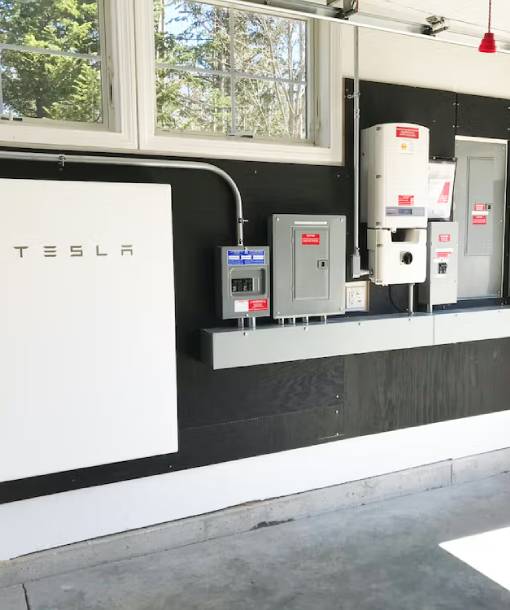
Repeating means a breaker on the battery circuit that trips again after a single reset. That is a wiring fault, a ground fault or a failed device, and it stays off until inspected. Most residential breakers are thermal-magnetic, using a heat-sensitive strip for sustained overload and a magnetic coil for short circuits, so a trip with essentially no load on the circuit points at a fault in the wiring or equipment far more often than a tired breaker.
Spreading means other symptoms arriving alongside: lights flickering when the battery tries to switch, other circuits misbehaving, the system failing to transfer to backup during an outage, or a metering mismatch where the app’s numbers do not match reality. Those suggest the gateway, the transfer arrangement, the current transformers or the neutral and bonding scheme, not the battery.
Sensory means smell, sound or discoloration, already covered above, and it is the one case where the correct response is to stop rather than to investigate.
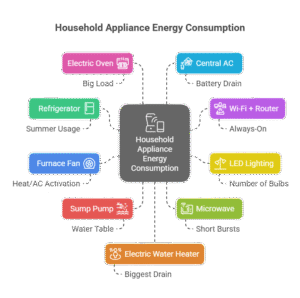
There is also a quieter version of a bigger problem: a system that charges but no longer holds what it should. Usable capacity tracked over a year is the honest measure, and it is worth understanding how long a battery actually powers a home before deciding the unit has failed. Runtime always depends on what you are running. The same battery that carries a furnace fan, a refrigerator and a few lights for a long stretch will empty quickly if an electric water heater or a central air conditioner is on the backup side.
What an electrician does about it
An electrician works from the source outward, because that is the order the evidence falls in.
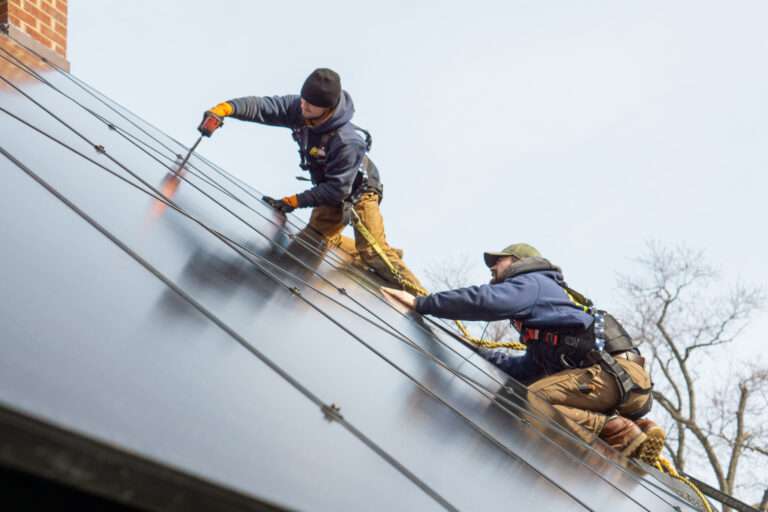
The visit starts with the system’s own logs and configuration, which usually explain the behavior outright. From there the electrician verifies the AC and DC disconnects, measures voltage on the battery circuit, confirms the breaker is the right size and in good condition, and checks the current transformers and gateway wiring that tell the battery what the house and grid are doing. Metering is compared against measured values. Bonding and grounding are checked, since a ground fault on a battery circuit produces exactly the intermittent, hard-to-pin behavior homeowners describe.
If the cause is configuration, the fix is a settings change and a documented explanation of what the modes do. If it is a failed component, the electrician identifies it, handles the manufacturer’s warranty process where one applies, and replaces it. If the battery is undersized or wired to more backup load than it can carry, the answer is a load conversation and possibly a revised backup panel arrangement, not a bigger breaker. A breaker protects the wire, and upsizing one to stop a trip creates a fire risk instead of solving anything.
Work that touches the panel, the service or the storage equipment itself is done under permit with your municipality, to Wisconsin SPS 316. Lehmann Electrical & Design is led by a licensed master electrician and holds an A+ rating with the BBB, with 4.9 stars on Google. Workmanship is covered by a 12-month warranty.
If your battery has stopped charging and the app has not explained why, a diagnostic visit is the fastest route to an answer. The same trip can also cover whether your current storage setup matches how you actually use power, and what a properly sized battery installation would look like for your home. Reach us through the contact form or at 414-207-0109 to book an estimate anywhere in Milwaukee and Waukesha County.
Why homeowners call Lehmann Electrical & Design
- Led by licensed master electrician Jacob Lehmann
- A+ rating with the BBB and 4.9 stars on Google
- 12-month workmanship warranty on the work we do
- Permits pulled and inspections scheduled as part of the job
- Milwaukee, Wauwatosa and Waukesha County, from 12012 W Fairview Ave, Wauwatosa
Ready to have the system checked?
Send the battery brand, what the app is reporting and when it last charged normally.
Licensed master electrician. 12-month workmanship warranty.
Frequently asked questions
▾Why is my Powerwall not charging?
Check the operating mode and backup reserve first. In Backup-only mode a Powerwall charges to its reserve and deliberately stops. Then check whether grid charging is permitted, and whether solar produced anything that day. If the unit shows offline, the cause is usually a communications loss or an open disconnect. Persistent zero-charge with no explanation in the app needs an installer or licensed electrician to inspect the gateway and circuit.
▾How long does it take to charge a home battery from empty?
It depends entirely on how much power is available to it. A battery charging from surplus solar on a clear day fills far faster than one charging from a small remainder on an overcast day, and grid charging depends on the rate the system is configured to allow. If charging is far slower than it used to be under the same conditions, that change is worth investigating rather than the absolute time.
▾My battery is brand new and already went flat. What happened?
Almost always a configuration issue rather than a defect. A new installation may be commissioned with grid charging disabled, a reserve set low, or a mode that only charges from surplus that has not appeared yet. Sometimes the metering sensors are wired so the system misreads house consumption. Contact whoever commissioned the system, and if that is not resolving it, an independent inspection of the settings and sensors will find it.
▾Can I revive a home battery that will not charge?
No, and you should not try. Reviving tricks that circulate for small rechargeable cells and car batteries do not transfer to lithium home storage, which has no user-serviceable interior and stores enough energy to cause serious injury. Do not open the enclosure, apply outside power, or attempt a forced charge. A battery that genuinely will not accept charge is a diagnostic and warranty matter for a licensed electrician.
▾Why does my battery stop charging in cold weather?
Lithium cells will not accept charge below roughly freezing, and the battery management system blocks charging to protect them. Units in unheated garages, on exterior walls or in uninsulated spaces hit that limit regularly through a Wisconsin winter. Many models self-heat and resume once warm. If the pause is brief and matches the cold, it is normal. If the battery never resumes as temperatures rise, have the installation location and heating function checked.
Next step
Get the system checked
Send the battery brand, what the app reports and when it last charged.
Licensed master electrician12-month warranty4.9 on Google
Milwaukee, Wauwatosa and Waukesha County. Prefer to talk? Call 414-207-0109