Licensed master electrician · Call 414-207-0109
An induction range needs a dedicated 240-volt circuit, typically 40 or 50 amps, sized to the breaker rating in the range’s installation manual. Freestanding and slide-in ranges usually plug into a four-wire range receptacle, while separate induction cooktops are usually hardwired. If you are replacing a gas range, the kitchen has only a 120-volt outlet, so a new circuit has to run from the panel, and a load calculation shows whether the panel can carry it.
Induction cooking heats the pan directly with a magnetic field, so it is fast and the cooktop stays cooler than a radiant electric top. Electrically, though, an induction range asks for much the same as any full-size electric range. What changes the job is what the kitchen has now: an old electric range circuit that may or may not suit the new range, or a gas range with no 240-volt supply at all.
What an induction range needs
A full-size induction range needs its own 240-volt circuit with nothing else on it, protected by a two-pole breaker sized to the range’s requirements. Amperage, the amount of current a circuit is built to carry, is set by the manufacturer: the nameplate on the range gives its power rating, the installation manual gives the breaker size it calls for, and the circuit is built to match.
| Appliance | Typical circuit | Usual connection |
|---|---|---|
| Gas range (for comparison) | 120 volts | An ordinary outlet for the igniter, clock and lights |
| Freestanding or slide-in induction range | Dedicated 240 volts, typically 40 or 50 amps | A four-wire range receptacle and a range cord |
| Induction cooktop on its own | Dedicated 240 volts, sized from its manual | Hardwired to a junction box beneath the counter |
| Wall oven paired with a cooktop | Dedicated 240 volts, sized from its manual | Usually hardwired |
The wire is sized with the breaker. A 40-amp circuit typically uses 8-gauge copper conductors and a 50-amp circuit 6-gauge copper, following the ratings for NM cable, the plastic-sheathed cable used for house wiring, and depending on the length of the run. That pairing matters, because the breaker exists to protect the wire. If a new range calls for a larger breaker than the existing circuit has, the answer is new wire sized for it, never a bigger breaker on the old wire.
Our article on appliances that need a dedicated circuit shows how a range compares with the dishwasher, dryer, water heater and other loads in the house.
Switching from gas to induction
Yes, you can replace a gas range with an induction range. It takes a new 240-volt circuit, a panel with the space and capacity for it, and a qualified gas professional to cap the gas line. The circuit is needed because a gas range runs on an ordinary 120-volt outlet that cannot power an induction range. The new circuit runs from the panel to the range location, with a new range receptacle or a junction box for a cooktop.
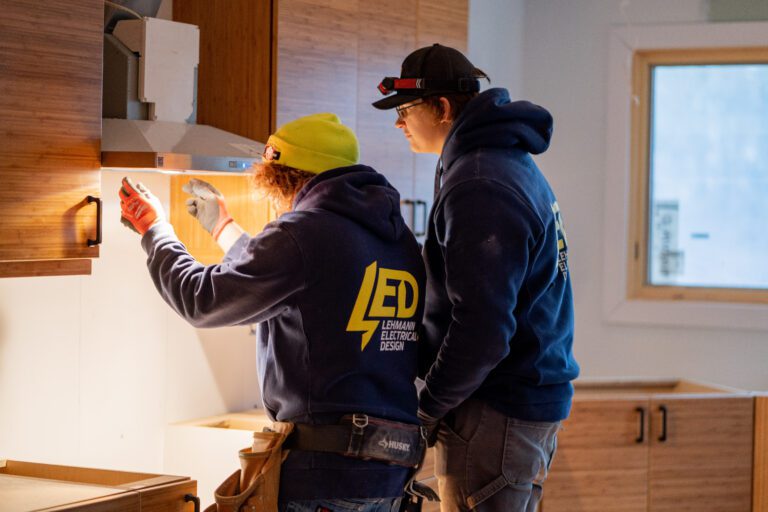
> A gas range only needs electricity for its igniter, clock, lights and controls, so the outlet behind it is a standard 120-volt receptacle on a light-duty circuit. An induction range draws its cooking power from electricity alone. Nothing about the gas range’s outlet can be adapted to feed it; the job is a new 240-volt circuit from the panel, sized for the range, and a check that the panel has the space and capacity for it.
How involved the run is depends on the house. In a home with an unfinished basement, the cable can travel through the basement ceiling and come up behind the range. A finished basement, a second-floor kitchen or a panel on the far side of the house means more wall and ceiling access. If you are remodeling, the cleanest time to add the circuit is while the walls are open, which is one reason it belongs in the plan for rewiring a kitchen.
The gas line is separate work. A licensed plumber or another qualified gas professional caps and tests the gas supply once the gas range comes out. Your electrician handles the circuit and coordinates timing so the kitchen is not without a range longer than it needs to be.
Plug-in or hardwired, and older range circuits
Freestanding and slide-in induction ranges usually connect with a range cord plugged into a receptacle behind the range, while cooktops and wall ovens are usually hardwired. Some ranges come without a cord, so the cord is bought to match the receptacle and connected at the range’s terminal block. A four-wire cord also means removing the factory bond between the neutral and the range frame, as the manual describes, which is why the cord is part of the installation rather than an afterthought.
Older Milwaukee-area homes may have a three-wire range circuit, with two hot conductors and a combined neutral and ground, rather than the four-wire circuit used today, which carries a separate ground. Under Wisconsin SPS 316, which adopts the 2023 NEC (in effect since September 1, 2026), a new range circuit is four-wire. The 2023 NEC (section 250.140) allows an existing three-wire range circuit to stay in place for a replacement range only under specific conditions about how it was installed, so your electrician checks it rather than assuming either way.
The 2023 NEC, adopted by Wisconsin SPS 316, requires GFCI protection for kitchen receptacles on circuits rated 50 amps or less, which takes in a plug-in range’s 240-volt receptacle; a hardwired cooktop is treated differently. Your electrician confirms what your municipality’s inspector expects. GFCI stands for ground fault circuit interrupter, a device that cuts power when it detects current leaking by any path, including through a person.
If you are replacing an electric range with an induction one, compare the new range’s required breaker size with the existing circuit. When they match and the circuit is in good condition, the swap can be simple. When they do not, or the receptacle is worn or scorched, the circuit needs work first. If you see scorch marks, discoloration or melting at the range receptacle or cord, or smell burning or hot plastic, stop using the range, switch its breaker off, leave it off, and call an electrician.
Switching to induction?
Send us the range model and a photo of your panel, and we will tell you what circuit it needs.
Licensed master electrician. 12-month workmanship warranty.
Will your panel handle it?
A load calculation decides whether your panel and electrical service can take an induction range. It is an arithmetic check, done by an electrician, of the house’s existing demand against the size of the service, the main supply that feeds your panel from the utility.
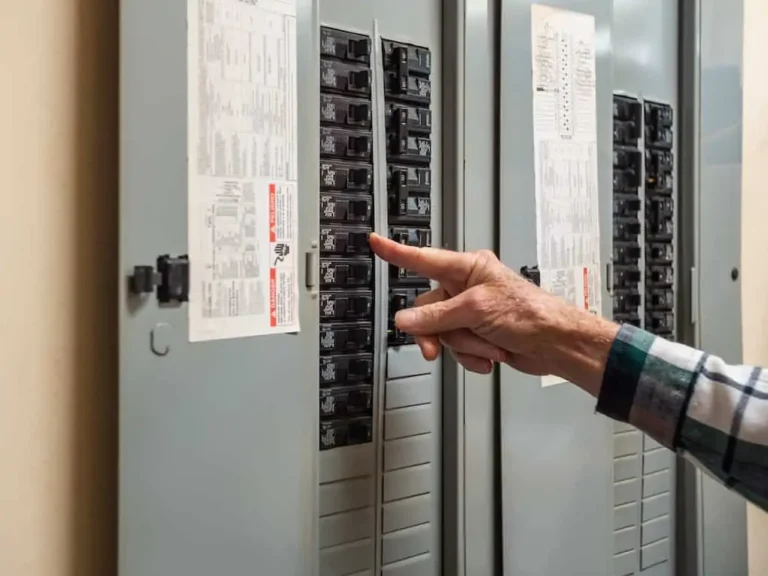
Two separate questions come up:
- Space. A 240-volt range needs a two-pole breaker, which takes two spaces in the panel. If the panel is full, options include tandem breakers where the panel is listed for them, a subpanel fed from the main panel, or a larger panel.
- Capacity. The load calculation method in the 2023 NEC (section 220.55), adopted by Wisconsin SPS 316, does not count a range at its full nameplate rating, because a range rarely runs every cooking zone and the oven at full power together. Even so, a range is among the largest loads in a house, and in a home that already has electric heat, central air, an electric dryer or an EV charger, it can tip the total over what the service supplies.
Older homes in the area may still have 60-amp or 100-amp service. If yours is on 100 amps, whether that is enough depends on the whole house, not on the range alone, which we cover in whether 100-amp service is enough.
If the calculation shows the service is too small, an electrical panel upgrade can be planned at the same time as the range circuit.
Permits and inspection
A new 240-volt range circuit normally needs an electrical permit from your municipality, which enforces Wisconsin SPS 316, followed by an inspection of the work. Your electrician pulls the permit and arranges the inspection. A closed permit also documents the work for your insurer and for a future buyer.
Running a new range circuit means work inside the panel. Switching off the main breaker does not make that safe: the service conductors and the main breaker’s line-side connections stay energized, and only the utility can shut those off, usually by pulling the meter. That is one of several reasons this is a job for a licensed electrician.
What decides the cost
The cost of an induction range circuit comes down to how far the circuit travels and what the panel needs. The main factors are:
- Distance and access. A short run through an open basement ceiling is simpler than a long run through finished walls and ceilings.
- Panel space and capacity. A panel with room and capacity to spare needs only a new breaker. A full panel may need a subpanel, and an undersized service may need an upgrade.
- The existing circuit. Reusing a suitable electric range circuit costs less than replacing an undersized or three-wire one.
- Receptacle or hardwired. A range receptacle and a cooktop junction box are different pieces of work.
- Patching and the gas line. Wall repair and capping the gas line are separate trades, so ask who is covering each.
Our new circuit installation service covers range and cooktop circuits from the panel to the kitchen. When you request a quote, the useful details are the range or cooktop model, whether the kitchen has gas or electric now, your panel’s service size, and where the panel is relative to the kitchen.
Lehmann Electrical & Design is led by Jacob W. Lehmann, a Wisconsin master electrician, license 1283316, working under Wisconsin electrical contractor license 1492849. The company holds an A+ rating with the BBB, 4.9 stars on Google, and backs its work with a 12-month workmanship warranty.
Choosing an induction range? Send us the model you are considering and a photo of your panel, and request a quote or call 414-207-0109. We will tell you what circuit it needs and whether your panel can carry it. We work across Milwaukee and Waukesha County.
Why homeowners call Lehmann Electrical & Design
- Led by licensed master electrician Jacob Lehmann
- A+ rating with the BBB and 4.9 stars on Google
- 12-month workmanship warranty on the work we do
- Permits pulled and inspections scheduled as part of the job
- Milwaukee, Wauwatosa and Waukesha County, from 12012 W Fairview Ave, Wauwatosa
Ready for the new range circuit?
We run the 240-volt circuit, check the panel can carry it, and handle the permit and inspection.
Licensed master electrician. 12-month workmanship warranty.
Frequently asked questions
▾How many amps does an induction range need?
Full-size induction ranges typically call for a dedicated 240-volt circuit of 40 or 50 amps. The nameplate gives the range’s rating and the installation manual gives the breaker size, and it varies with the size of the range and how much power its cooking zones and oven draw together. The circuit’s wire is sized to match the breaker, so check the requirement before buying if your kitchen already has a range circuit.
▾What size breaker do I need for an induction range?
The one the range’s installation manual calls for, typically a 40-amp or 50-amp two-pole breaker on a dedicated 240-volt circuit. The breaker must match the wire: a 40-amp circuit typically uses 8-gauge copper and a 50-amp circuit 6-gauge copper. If the new range calls for a larger breaker than your existing circuit has, the fix is new wire sized for it, never a bigger breaker on the old wire.
▾Do I need a special outlet for an induction range?
A freestanding or slide-in induction range usually plugs into a 240-volt range receptacle, the large four-wire outlet installed for electric ranges, using a range cord. It cannot plug into the ordinary 120-volt outlet behind a gas range. Separate induction cooktops are usually hardwired to a junction box instead. Your electrician installs the receptacle or junction box to match the range’s installation manual.
▾Do induction stoves require special wiring?
Not special wiring, but the same heavy-duty wiring any full-size electric range needs: a dedicated 240-volt circuit with wire sized to the breaker the range calls for. If you already have an electric range on a circuit that matches the new range’s requirement, the existing wiring may serve. If you are coming from gas, or the existing circuit is undersized or three-wire, new wiring is needed.
▾Can an induction range run on 120 volts?
A standard full-size induction range cannot; it is built for a 240-volt circuit. A few newer models with a built-in battery are designed to plug into a 120-volt outlet, and portable single-zone induction plates also run on 120 volts. Those are exceptions, and a battery model’s manual still says what circuit its outlet needs, which may be a dedicated one, so check before assuming your kitchen outlet will do.
▾How many amps does an induction cooktop use?
It depends on the size of the cooktop and the number of cooking zones. A separate induction cooktop needs its own 240-volt circuit, sized from the breaker rating in its installation manual, and larger cooktops can call for as much as a full range. A cooktop paired with a wall oven usually means two circuits, one for each, so plan for both if you are replacing a gas cooktop and oven.
▾Will my panel support an induction range?
Only a load calculation can answer that. An electrician adds up the house’s existing demand, using the method in the 2023 NEC adopted by Wisconsin SPS 316, and compares it with your service size. The panel also needs two free spaces for the range’s breaker. Some panels have room and capacity to spare, while a 100-amp service already carrying electric heat, central air or an EV charger may need an upgrade.
Next step
Get your range circuit quoted
Tell us the range model and your panel size.
Licensed master electrician12‑month warranty4.9 on Google
Milwaukee, Wauwatosa and Waukesha County. Prefer to talk? Call 414-207-0109