Licensed master electrician · Call 414-207-0109
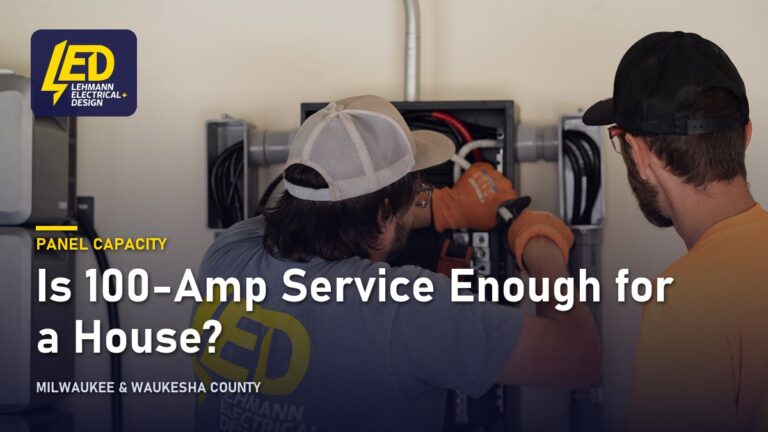
A 100-amp service can be enough for a smaller house that heats, cooks and dries clothes with gas and runs modest central air. It gets tight quickly once you add a Level 2 EV charger, a heat pump with electric backup heat, an electric range or a hot tub on top of everyday loads. The honest answer for your house comes from a load calculation, a written tally of what the house draws, not from the number printed on the main breaker.
Plenty of homes around Milwaukee and Waukesha County still run on 100-amp service, and many of them work fine day to day. The question usually comes up at a decision point: buying an electric vehicle, replacing a furnace with a heat pump, finishing a basement or adding a hot tub. That is the right moment to ask it, because the answer changes what the next project costs.
What 100 amps actually supplies
A 100-amp service can deliver about 24,000 watts at any one moment, spread across the two 120-volt halves of your panel. That figure is simple arithmetic: 100 amps multiplied by 240 volts.
Amperage is the amount of electrical current a wire or device can carry at once. The service entrance is everything that brings power from the utility into the house: the overhead or underground conductors, the meter socket and the main breaker. When people say a house has “100-amp service,” they mean that whole chain is rated to carry 100 amps, and the main breaker is there to stop it carrying more.
| Service size | Theoretical capacity at 240 volts | Where it usually fits |
|---|---|---|
| 60 amps | 14,400 watts | Older homes, often with fuses; tight even for basic modern use |
| 100 amps | 24,000 watts | Smaller homes with gas heat, gas cooking and few large electric loads |
| 150 amps | 36,000 watts | A middle step, sometimes used where 200 is not needed |
| 200 amps | 48,000 watts | Room for an EV charger, central air or a heat pump and electric appliances together |
Two things keep that theoretical number from being the whole story.
First, a service is not meant to run flat out for hours. Loads that run three hours or more, such as EV charging or electric heat, are counted at 125 percent when the service and circuits are sized, which is the same as saying a continuous load should use no more than 80 percent of the rating.
Second, the breakers in your panel will add up to far more than 100 amps, and that is normal. Not everything runs at once. The lights, the microwave, the dryer and the furnace blower take turns, and the system is designed around how a house actually behaves, not around every breaker being maxed out together.
So what can 100-amp service handle? Lighting, receptacles, a refrigerator, a gas furnace blower, a washer, a gas dryer, a dishwasher and a moderate central air conditioner, with room left over in many homes. Each large electric load added on top of that eats into the margin fast.
How a load calculation settles it
A load calculation adds up what your house is expected to draw, applies the allowances the electrical code permits for loads that do not run at the same time, and compares the result with your service rating. If the result fits with margin, 100 amps is enough. If it does not, it is not, however well the house has behaved so far.
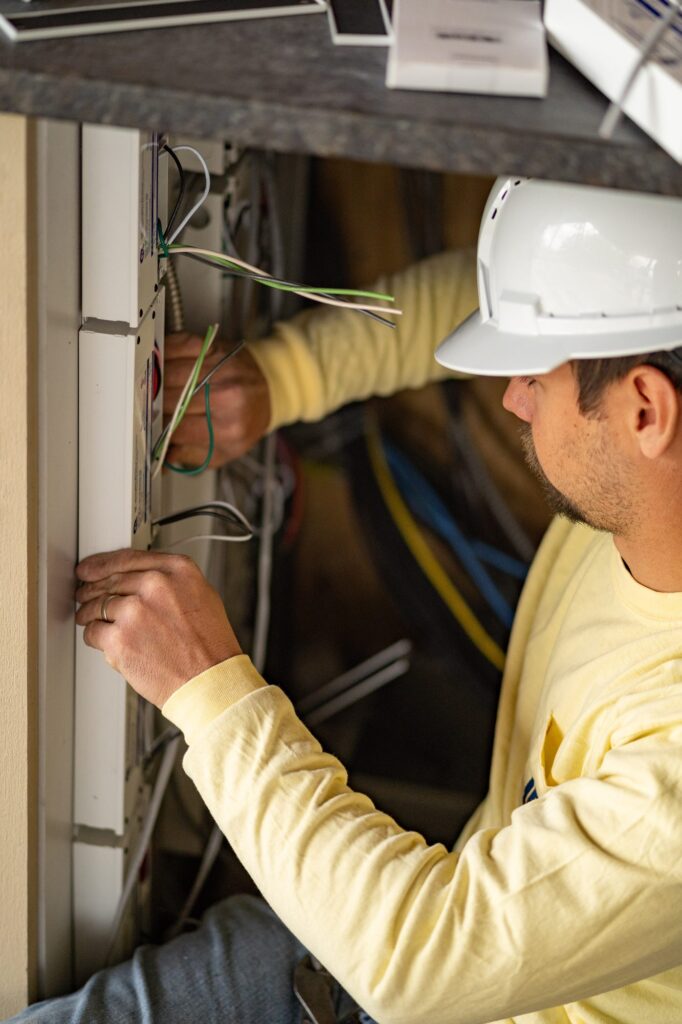
The method comes from Article 220 of the National Electrical Code. Wisconsin SPS 316, which adopts the 2023 NEC (in effect since September 1, 2026), is the rule set your municipality enforces, so that is the edition an electrician works to when deciding whether a new load fits.
The calculation weighs:
- Floor area, which stands in for general lighting and everyday receptacles.
- The kitchen and laundry circuits every house carries.
- Fixed appliances: water heater, dishwasher, disposal, dryer, range or cooktop.
- Heating or cooling, whichever is larger, since they do not run together.
- Anything new you are planning, such as an EV charger or a hot tub, at its full rating.
For an existing house, the NEC also has a method that uses measured peak demand instead of estimates, where that data exists. Either way, the result is a number in amps, written down, that you can compare with the 100 amps on the main breaker.
> Whether 100-amp service is enough for a house is decided by arithmetic, not by symptoms. A house that has never tripped its main breaker can still be too small for the EV charger or heat pump you are about to add, and a house with flickering lights can have plenty of capacity and a loose connection instead. A load calculation turns the question into a number, and the number is what decides whether you need an upgrade, a load management device or nothing at all.
The loads that push a house past 100 amps
Five loads account for the jump from “fine” to “too small”: an EV charger, a heat pump with electric backup heat, central air, an electric range or water heater, and a hot tub. One of them on a 100-amp service may fit. Two or three together usually will not without help.
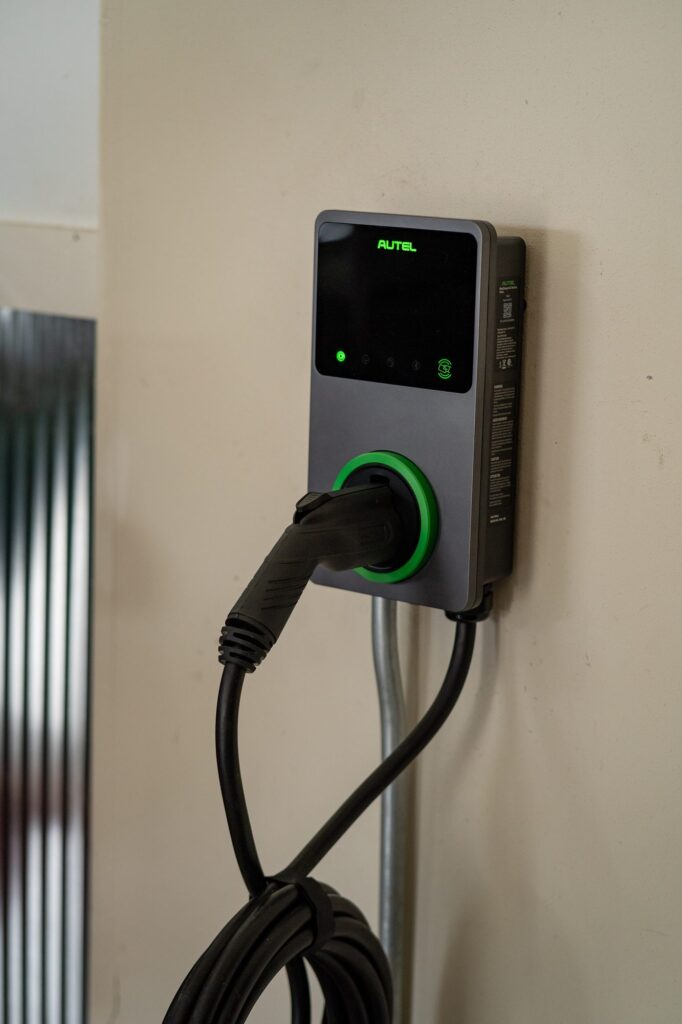
| Load | Typical dedicated circuit | Why it matters on 100 amps |
|---|---|---|
| Level 2 EV charger (32 amp output) | 40-amp, 240-volt | Draws about 7,700 watts for hours, and as a continuous load it is counted at 125 percent |
| Heat pump or central air | Sized from the unit’s nameplate | The compressor is manageable; electric backup heat strips can draw more than the heat pump itself |
| Electric range | 40- or 50-amp, 240-volt | Large, though the code allows a reduced allowance because burners rarely all run at once |
| Electric tank water heater | Often 30-amp, 240-volt | Long run times, often at the same hours as everything else |
| Hot tub | 40- to 60-amp, 240-volt, per the data plate | Heater and pumps run for long stretches, all year |
Can a 100-amp panel handle an EV charger? Sometimes, if the rest of the house is mostly gas and the charger is set to a modest current. A charger putting out 32 amps uses roughly a third of the service by itself, for hours at a time, which leaves little for a dryer, an oven and the furnace on a winter evening. EV charger installation starts with exactly this check, because the charger’s setting is chosen to fit what the service can spare.
Is 100-amp service enough for central air or a heat pump? Central air on its own usually fits a 100-amp house with gas heat. A heat pump replacing a gas furnace is different: in a Wisconsin winter it may lean on electric backup heat, and those resistance strips are among the largest loads a house can have. The unit’s nameplate and the backup heat size both go into the calculation before anything is ordered.
Hot tubs deserve their own mention, because a 50-amp spa circuit on a 100-amp service is half the rating on one appliance. We cover the spa side in detail in what a hot tub needs, including the disconnect and bonding.
Options short of a service upgrade
A full service upgrade is not the only answer. When the load calculation comes out close, three options can let a 100-amp house take on a new load without replacing the service.
Turn the charger down. Many Level 2 chargers can be set to a lower output during installation. A charger set to 24 or 16 amps still refills a typical commute overnight and asks far less of the service.
Add load management. The 2023 NEC, which Wisconsin adopts through SPS 316, includes provisions for energy management systems: listed devices that watch the house’s total draw and throttle or pause the charger when the oven, dryer and heat are all running. Whether a particular device lets your existing service carry the charger is decided by the electrician on site and accepted by your inspector, not assumed from the box.
Share a circuit. Listed circuit-sharing devices let an EV charger and a dryer take turns on one 240-volt circuit, so the new load never stacks on the old one.
One thing that does not add capacity is a subpanel. A subpanel gives you more breaker spaces, but it is fed from the main panel and shares the same 100 amps. If the problem is capacity rather than space, a subpanel moves it, it does not solve it.
Signs your service is already too small
The clearest sign is a main breaker that trips. A single branch circuit tripping points to that circuit, but a main breaker opening means the whole house asked for more than the service can give.
Other signs worth a look:
- Big loads cannot run together. The dryer and the oven, or the air conditioner and the microwave, trip something when they overlap.
- Lights dim noticeably and stay dim when a large appliance starts. A brief dip as a compressor starts can be normal; a sustained drop is not.
- No breaker spaces left, or breakers with two wires under one screw where the breaker is not made for it.
- A fuse panel or a 60-amp service. Insurers and home inspectors may flag these at sale time.
- Extension cords and power strips doing the work of missing circuits.
If you reset a tripped breaker, do it once at most: push it firmly to OFF, then back to ON. If it trips again, leave it off until it is inspected. Never fit a larger breaker to stop the tripping; the breaker protects the wire, and a bigger one lets the wire overheat instead.
If you smell burning or hot plastic at the panel, see scorch marks or discoloration, or hear buzzing or crackling, stop using the circuit, leave the breaker off and call an electrician. Do not touch the panel to judge whether it is hot; smell, sound and appearance tell you more. For a rough read before anyone visits, our panel upgrade calculator walks through the main loads in a few minutes.
Adding an EV charger or a heat pump?
Tell us what the house runs now and what you are adding, and we will run the load calculation on your service.
Licensed master electrician. 12-month workmanship warranty.
What decides the cost
What an upgrade from 100 amps costs depends on how much of the service has to change, not just the panel. We do not publish a figure, because two houses on the same street can need very different work.
| Factor | What it changes |
|---|---|
| Panel only, or the whole service | Replacing the meter socket and service entrance conductors adds materials and a utility visit |
| Overhead or underground service | An overhead mast is more accessible than a buried service lateral |
| Utility coordination | The utility has to disconnect and reconnect power, and its schedule sets the day |
| Grounding and bonding | Older homes may need grounding electrodes or bonding brought up to current requirements |
| Panel location and access | A panel in a finished wall or a cramped closet takes more time to replace or relocate |
| Number of circuits | Every circuit is moved to the new panel and checked |
| Permit and inspection | Required for a service upgrade and scheduled with your municipality |
The alternative paths have their own costs, too. A load management device or a lower charger setting can avoid an upgrade entirely, which is why the load calculation comes first. When an upgrade is the right call, electrical panel upgrades are quoted from the actual service, the route and the utility’s requirements.
Do you need 100 or 200 amp service? If your plans include an EV charger plus a heat pump, or a hot tub plus electric cooking, 200 amps is the usual target, because it doubles the theoretical capacity and leaves room for the next project. If the house is mostly gas and stays that way, a 100-amp service that passes a load calculation can keep serving you.
Thinking about an EV charger, a heat pump or a hot tub on 100 amps? Have a list of the big appliances you run and the one you are planning, and request a quote or call 414-207-0109. We work across Milwaukee and Waukesha County.
Why homeowners call Lehmann Electrical & Design
- Led by licensed master electrician Jacob Lehmann
- A+ rating with the BBB and 4.9 stars on Google
- 12-month workmanship warranty on the work we do
- Permits pulled and inspections scheduled as part of the job
- Milwaukee, Wauwatosa and Waukesha County, from 12012 W Fairview Ave, Wauwatosa
Not sure 100 amps will carry it?
Send us a photo of your panel label and the appliance you are planning.
Licensed master electrician. 12-month workmanship warranty.
Frequently asked questions
▾Is 100 amp service enough for a small house?
Often, yes, if the house heats, cooks and dries clothes with gas. A small house with gas appliances and a modest central air unit can sit comfortably inside 100 amps. The answer changes when the small house goes electric: an electric range, an electric water heater and a Level 2 EV charger together can outgrow 100 amps even in a modest floor plan. A load calculation shows where yours stands.
▾What does 100 amp service mean?
It means the conductors from the utility, the meter socket and the main breaker are rated to carry 100 amps at 240 volts, about 24,000 watts at once. The main breaker opens if the house asks for more. It does not mean each circuit gets 100 amps; it is the ceiling for the whole house, shared across every circuit in the panel.
▾Can a 100 amp panel handle an EV charger?
It can, when the load calculation leaves room. The charger is usually set to a lower output, such as 16 or 24 amps, or paired with a load management device that slows charging when the rest of the house is busy. If the house already runs electric heat, cooking and drying, an upgrade is the more reliable route.
▾Is 100 amp service enough for a heat pump?
A heat pump compressor often fits; the electric backup heat is what strains a 100-amp service. In cold weather, backup heat strips can draw several thousand watts each, on top of the compressor. The nameplate of the unit and the size of the backup heat both go into the load calculation, and the result decides whether the service is adequate or the backup needs a different arrangement.
▾Is 200 amp service enough for a house?
For a typical single-family house, 200 amps covers an EV charger, central air or a heat pump and electric appliances together, with margin for the future. Very large all-electric homes, or homes with two chargers, a hot tub and electric backup heat, can still need a load calculation to confirm 200 amps is enough, and occasionally a larger service.
Next step
Get your service checked
Tell us your panel size and what you are adding.
Licensed master electrician12‑month warranty4.9 on Google
Milwaukee, Wauwatosa and Waukesha County. Prefer to talk? Call 414-207-0109