Licensed master electrician · Call 414-207-0109
A subpanel is a smaller breaker panel fed from your main electrical panel by a single feeder circuit. It does not add capacity to your home’s electrical service, it redistributes it, giving you breaker spaces and a local shutoff where you need them. You typically need one when your main panel is physically full, when you are wiring a garage, addition, basement or outbuilding, or when a group of new circuits lives far from the main panel.
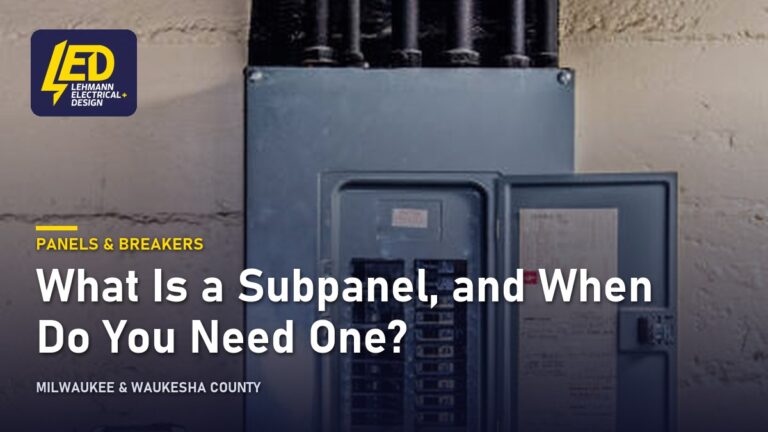
Think of your main panel as the single point where your electrical service, meaning the power the utility brings to the house, splits into individual circuits. Each circuit gets a breaker, and each breaker needs a slot. When the slots run out, or when the circuits you are adding are 60 feet away in a detached garage, a subpanel is the clean answer. One properly sized feeder runs from the main panel to the subpanel, and the subpanel breaks that feeder out into as many branch circuits as the new space needs.
Here is the part homeowners most often get wrong: a subpanel does not give you more power. If your house has a 100 amp service, adding a subpanel still leaves you with 100 amps total. Amperage is the measure of how much electrical current can flow at once, and the service entrance, the conductors and main breaker that bring utility power into the panel, is what caps it. A subpanel divides the pie differently. It does not bake a bigger pie.
That distinction decides which job you actually need. If you have spare capacity but no spare breaker spaces, a subpanel solves it. If a load calculation shows the service itself is undersized, then you need an upgrade to the main panel and service, with or without a subpanel afterward.
What is usually causing the need for one
Four situations account for most residential subpanels.
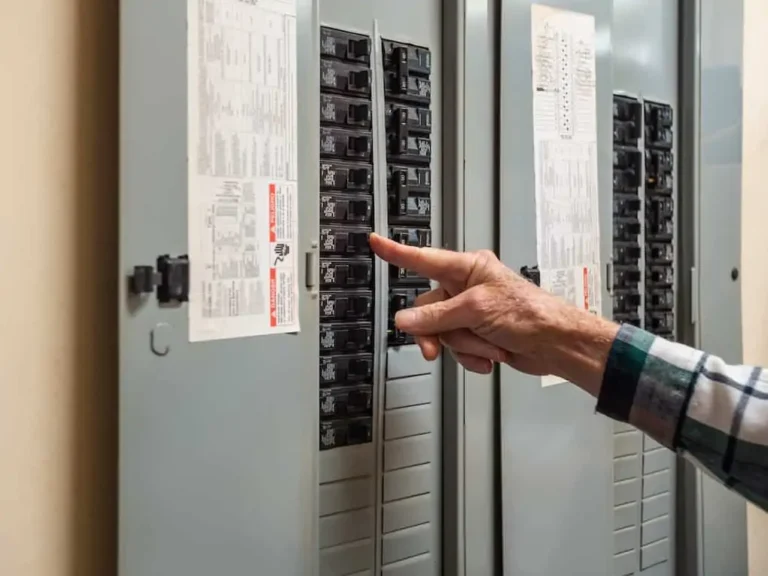
The main panel is out of space. Older 100 amp panels were often built with 16 or 20 spaces, and a modern house fills them fast: a couple of kitchen circuits, bathroom circuits, a laundry circuit, dedicated circuits for a microwave and a dishwasher. Some panels accept tandem breakers, which fit two circuits in one slot, where the panel’s own listing allows it. Many do not, or they have already used up their permitted tandems.
You are finishing or adding a space. A finished basement, a bedroom addition, or a converted attic needs its own lighting and receptacle circuits plus, frequently, heating or cooling equipment. Running eight separate home runs back to the main panel is expensive in labor and wire. One feeder and a local subpanel is usually cheaper and tidier.
You are wiring a detached garage or workshop. A subpanel out there gives you a disconnect you can reach without walking back to the house, which matters when a saw or compressor misbehaves.
You have a heavy load in one area. Shop equipment, a well pump, a sauna, a pool pump. Grouping these on a subpanel near the loads shortens the branch circuit runs.
One sizing rule worth understanding, because it drives how electricians plan a subpanel: a continuous load, one that runs at full current for three or more hours, is in effect limited to 80 percent of its breaker’s rating, because the breaker must be rated at not less than the noncontinuous load plus 125 percent of the continuous load (NEC 210.20(A), unchanged in the 2023 NEC that Wisconsin adopts). A 32 amp load on a 40 amp breaker is correct, not marginal. Feeder sizing comes from the Article 220 demand calculation rather than from that branch-circuit rule, which is why a planned subpanel feeder often looks oversized compared with the equipment it serves.
What is safe to check yourself, and what is not
Everything useful here stays outside the panel cover, and none of it needs tools.
Worth noting before an electrician visits:
- What the panel directory lists, how many breaker positions are filled, and whether any blank spaces remain.
- The main breaker’s number, usually 100, 150 or 200. That is the main breaker’s rating, which is not the same as the service capacity if the conductors were never upsized.
- Write down what large appliances you have and are planning: electric range, electric dryer, air conditioning tonnage, electric water heater, heat pump.
- Note the panel’s brand. Some older brands are known to have breaker and bus problems and are worth mentioning to an electrician.
- Use your senses from a normal standing distance. A burning or hot-plastic smell, scorch marks, brown or blackened discoloration, buzzing or crackling are all reasons to stop. If you have any of those, stop using the affected circuit or device, leave that breaker off, and call a licensed electrician. Do not touch the panel or a suspect outlet to judge how warm it is.
Not safe, and not legal for a homeowner to decide alone:
Removing the panel’s inner cover, adding a breaker, landing a feeder, separating neutrals and grounds in a subpanel, or touching anything on the line side of the meter. With the main breaker switched off, the service conductors feeding it and the main breaker’s line-side lugs remain energized. A homeowner cannot de-energize them. Only the utility can, usually by pulling the meter, or a separate service disconnect ahead of the panel if one is fitted. That is not a detail to work around, it is the reason panel work is licensed work.
Also not a homeowner judgment call: whether you need a subpanel or a service upgrade. That is answered by a load calculation, a formal arithmetic exercise that totals your home’s square footage, fixed appliances and largest loads against the capacity of your service. Symptoms alone, such as flickering lights or a breaker that trips when the dryer and the microwave run together, do not prove the service is too small.
And if a breaker trips, reset it once at most. Push it firmly to OFF, then to ON. If it trips again, leave it off and have it inspected. Never install a larger breaker to stop tripping. The breaker protects the wire, and a bigger breaker just lets the wire overheat before anything shuts off. The correct fix for a chronically overloaded circuit is an additional dedicated circuit, not a bigger breaker.
Panel full and more to add?
A licensed electrician works out whether a subpanel solves it or whether the service itself is the limit, which is the difference between two very different jobs.
Licensed master electrician. 12-month workmanship warranty.
When it points to a bigger problem
Sometimes “I need a subpanel” is the symptom and something larger is the cause. Where the service itself turns out to be the limit, what a panel upgrade costs and how long it takes covers that job, and a panel that buzzes or hums is telling you something a subpanel will not fix.
| What you see | What it may actually mean |
|---|---|
| Panel is full and the main breaker is 60 or 100 amps on a large house | Service is undersized; a load calculation may call for a service upgrade |
| Fuses instead of breakers | Service is likely 60 amps or less and original to the house |
| Cloth-insulated or ungrounded two-wire cable at the panel | Knob and tube or early branch wiring, which changes the scope considerably |
| Double-tapped breakers, two wires under one breaker screw | Someone has already run out of space informally |
| Repeated tripping across several circuits | Possible shared neutral problems or a genuine capacity shortfall |
| Burning smell, scorching, buzzing, crackling | Stop using the circuit, leave the breaker off, call an electrician now |
A subpanel bolted onto a service that is already at its limit just moves the bottleneck. Honest sequencing matters: evaluate the service first, then decide where the new breaker spaces go.
Permits also come into this. Electrical permits are issued by your local municipality, and they enforce Wisconsin SPS 316, which adopts the 2023 NEC and has been in effect since September 1, 2026. Work installed under the previous 2017 NEC does not have to be brought up to the new edition simply because it exists, but what gets altered or added now is held to the current edition. If you are wondering whether your project needs a permit pulled, the short version is that panel and feeder work does.
What an electrician does about it
The visit starts with measurement, not a sales pitch. An electrician reads your main breaker rating and panel schedule, inventories the fixed loads, and runs a load calculation. That calculation, not a guess from symptoms, decides whether you get a subpanel, a service upgrade, or both.
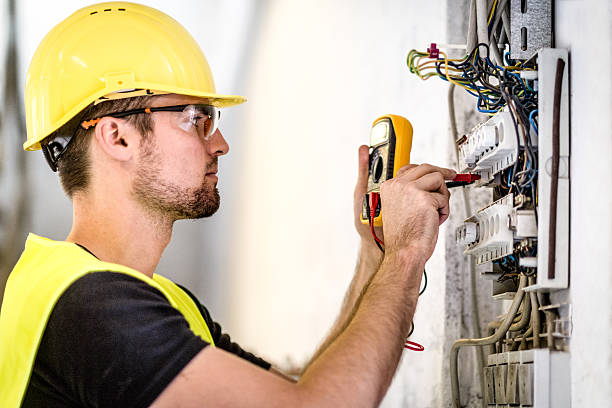
If a subpanel is the right call, the work involves sizing the feeder breaker and conductors for the loads the subpanel will carry, mounting the subpanel with the working clearance the code edition in force requires, running the feeder, and keeping the neutral and ground conductors separated at the subpanel, which is a real and frequently botched requirement. New branch circuits get landed, including AFCI protection where the 120 volt living-area circuits call for it, and GFCI protection where location requires it. AFCI stands for arc-fault circuit interrupter, a breaker or device that watches for the electrical signature of arcing. GFCI, ground-fault circuit interrupter, cuts power when 4 to 6 milliamps of current escapes the circuit by any path, including through a person or through damp material. Then everything gets labeled, tested and presented for inspection.
If the service is the real constraint, the scope grows: a new main panel, new service conductors, and coordination with the utility and the inspector.
On cost and timing. No honest electrician quotes a panel or subpanel from a phone description, because the price is driven by things you cannot see over the phone: the existing panel’s condition, where the meter sits, whether the service conductors need replacing, how far the feeder has to travel, and what your municipality requires for inspection. A subpanel fed from an adequate existing service is a smaller job than a full service upgrade. Expect a written, itemized estimate after someone has looked at the panel, and expect a date-specific plan for the power-off window and the inspection.
Lehmann Electrical & Design is led by Jacob Lehmann, a licensed master electrician, holds an A+ rating with the BBB and 4.9 stars on Google, and backs its work with a 12-month workmanship warranty. If your panel is full or you are planning a garage, basement or addition, ask us to look at the panel and run the numbers or call 414-207-0109. We serve Milwaukee and Waukesha County.
Why homeowners call Lehmann Electrical & Design
- Led by licensed master electrician Jacob Lehmann
- A+ rating with the BBB and 4.9 stars on Google
- 12-month workmanship warranty on the work we do
- Permits pulled and inspections scheduled as part of the job
- Milwaukee, Wauwatosa and Waukesha County, from 12012 W Fairview Ave, Wauwatosa
Want to know which one you need?
Send the main breaker rating, how many spaces are left and what you are adding.
Licensed master electrician. 12-month workmanship warranty.
Frequently asked questions
▾What does an electrical panel upgrade mean, and how is it different from a subpanel?
A panel upgrade replaces your existing main panel, and usually the service conductors and meter equipment, with a higher-capacity assembly, for example moving from 100 amps to 200 amps. It increases the total power available to the house. A subpanel adds breaker spaces fed from the capacity you already have. Upgrade for more power, subpanel for more spaces and better distribution.
▾What does an electrical panel upgrade entail?
Typically: a load calculation, a permit from your municipality, disconnection of the service by the utility, removal of the old panel, installation of the new panel and main breaker, replacement of service entrance conductors and grounding and bonding as needed, transfer and labeling of every branch circuit, AFCI and GFCI protection where the current code edition requires it, reconnection by the utility, then municipal inspection.
▾How much does an electrical panel upgrade cost?
Cost depends on the existing service size, panel location, meter position, whether the service conductors and mast need replacing, grounding condition, and local permit and inspection requirements. Those cannot be assessed remotely, so we do not publish a figure that would mislead you. We provide a written itemized estimate after an on-site look at your panel and service, with the scope spelled out before any work is scheduled.
▾How long does an electrical panel replacement or service upgrade take?
The on-site work for a straightforward residential panel replacement is commonly a single day, with the power off for part of it. The full timeline is longer, because it includes the permit, utility scheduling for the disconnect and reconnect, and the municipal inspection. A subpanel installation on an adequate existing service is usually shorter. Your electrician should give you specific dates and a power-off window before starting.
▾Can I just add a subpanel instead of upgrading my service?
Only if a load calculation shows your existing service has capacity to spare. If it does, a subpanel is often the better value. If the calculation shows the service is already near its limit, a subpanel moves the problem without solving it, and you would end up paying for both jobs. The calculation comes first, always.
Next step
Find out which you need
Send your main breaker rating and what you are adding.
Licensed master electrician12-month warranty4.9 on Google
Milwaukee, Wauwatosa and Waukesha County. Prefer to talk? Call 414-207-0109