Licensed master electrician · Call 414-207-0109
A 200 amp panel does not have a fixed circuit count. The number is set by the panel’s own listing label, not by its amperage. Residential 200 amp panels are typically built with 20 to 42 full-size spaces, and tandem-rated models can be listed for maximum circuit counts above 60. The real limit is the total load on those circuits, which a licensed electrician determines with a load calculation rather than by counting breakers.
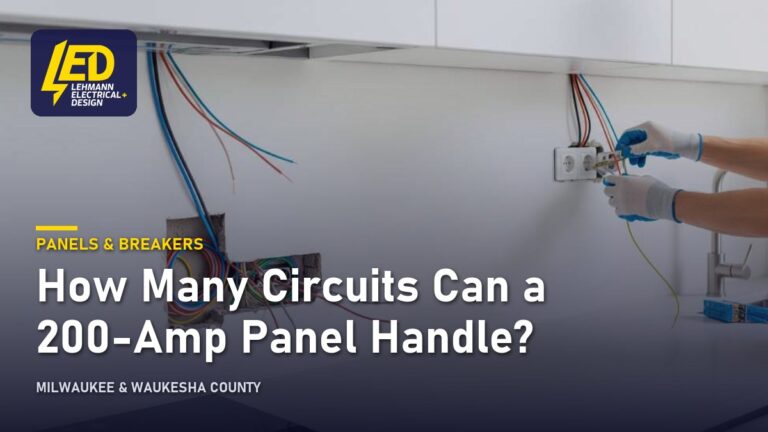
Amperage and circuit count are two different things, and that is the part most homeowners get tangled in. Amperage is the amount of electrical current a conductor or device can carry safely. A 200 amp service means the service entrance, the wires and equipment that bring utility power from the meter into the home, is rated to deliver 200 amps at 240 volts, and the 200 amp main breaker is the overcurrent device that enforces that rating. Circuit count is a mechanical question: how many breaker positions the manufacturer built into that particular enclosure and listed it to accept.
So the honest answer to “how many breakers can a 200 amp panel handle” is: read the label. Two numbers appear on it, and they are not the same number.
| Term on the label | What it means | Typical residential figure |
|---|---|---|
| Spaces (or poles) | Full-size breaker positions physically built into the enclosure | 8, 12, 16, 20, 24, 30, 40 or 42 |
| Maximum circuits | The highest number of circuits the panel is listed to carry, counting tandems | Equal to spaces on some models, up to roughly double on tandem-rated ones |
| Main breaker rating | The overcurrent device protecting the whole panel | 200 A, stamped on the handle |
A 200 amp panel is sold in a wide range of sizes. An 8-space or 12-space 200 amp main breaker loadcenter exists and is used where the panel mostly feeds subpanels. At the other end, 40-space units listed for 80 circuits are common across the major manufacturers. You cannot infer the circuit count from the 200 amp figure in either direction.
Two terms worth knowing. A full-size breaker occupies one space. A tandem breaker, also called a twin or duplex breaker, fits two separate 120 volt circuits into one space. Tandems are perfectly legitimate where the panel is listed for them, and the label marks which positions accept them, often with a shaded diagram. Where the label does not permit a tandem in a given position, installing one anyway violates the installation instructions the panel is listed under, which is the requirement in NEC 110.3(B), and it is a routine inspection failure.
There is also a hard ceiling that has nothing to do with free slots. If the label gives a maximum circuit count of 40, you cannot reach 50 by adding more tandems, even if positions are physically open. Forty is forty.
What is usually causing the question
People rarely ask this out of curiosity. They ask because they have run out of room, or because they are planning something new and want to know whether the panel can take it.
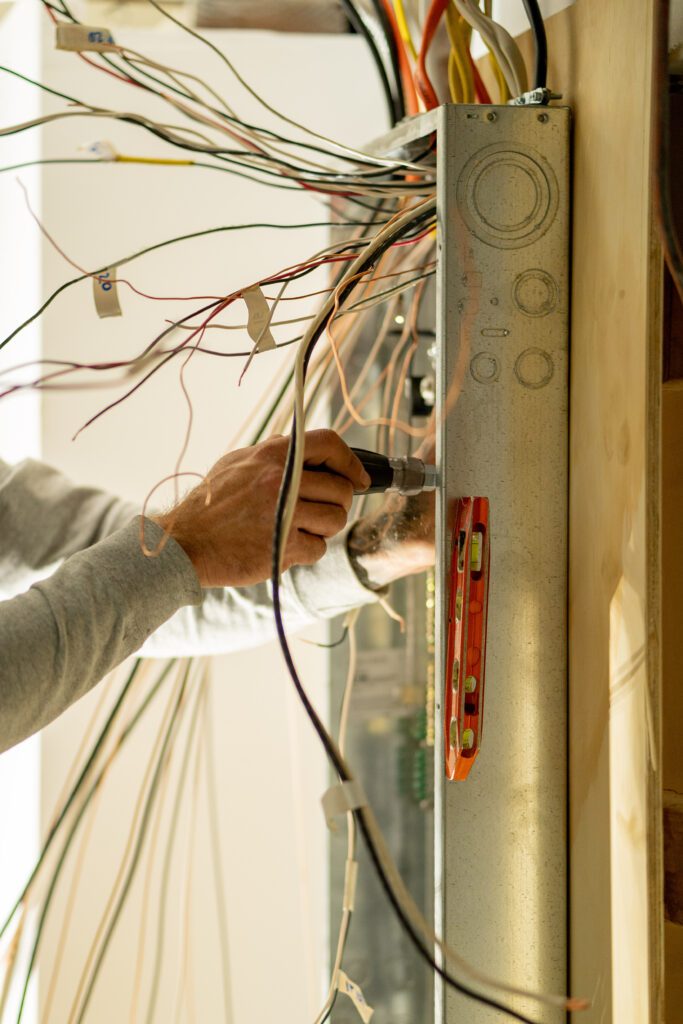
The situations that bring up the question tend to look like this:
- A remodel adds circuits. A kitchen update alone can need two small appliance circuits, a dishwasher circuit, a disposal circuit, a microwave circuit and separate lighting.
- A basement or attic gets finished. New living space means new receptacle and lighting circuits, and those circuits carry AFCI requirements. An AFCI, or arc fault circuit interrupter, is a breaker or device that detects the signature of an arcing fault in the wiring and shuts the circuit down.
- The panel is visually full. Every position has a breaker in it, and there is nowhere obvious to land a new wire.
- A hot tub, workshop or added heat pump needs a 240 volt circuit. A double-pole breaker eats two spaces, so a panel with tandems filling the last positions has no room at all for one.
- Breakers are tripping. This is a different problem, and it is worth separating. Tripping is almost never a sign that the panel has too many circuits. It usually means one circuit is loaded beyond what its wire can carry, or there is a fault on it.
On that last point, one sizing rule is worth stating plainly because it explains why a correctly installed circuit does not nuisance trip. A continuous load, meaning one drawing maximum current for three hours or more, is sized to occupy no more than 80 percent of the breaker’s rating. That comes from NEC 210.20(A), carried unchanged into the 2023 NEC that Wisconsin SPS 316 adopts, in effect since September 1, 2026. So 24 amps on a 30 amp circuit, or 32 amps on a 40 amp circuit, is correct and should hold indefinitely. Breakers trip above their rating, following their trip curve, not at 80 percent of it.
And never answer a tripping breaker by fitting a larger one. The breaker protects the wire behind it, not the appliance in front of it. The remedy for an overloaded circuit is another circuit.
What is safe to check yourself, and what is not
You can read the label and count what is there. You cannot and should not go behind the inner cover.
Safe for a homeowner:
- Open the panel door, the hinged cover over the breaker handles, and look for the manufacturer’s label. On most residential panels it is printed on the inside of the door or on the face of the dead front. If you cannot find the space count and maximum circuit count without removing the inner cover, stop there and ask an electrician to read it for you. Some brands place the circuit-count information where only a licensed electrician should be looking.
- Count the breakers you can see, and note which are double-pole, taking two spaces.
- Compare the directory on the door with reality. That is done by switching one breaker off at a time and noting what loses power, which needs nothing more than the panel door open.
- Reset a tripped breaker once. Push the handle firmly to OFF, then back to ON. If it trips again, leave it off and have the circuit inspected. Do not keep resetting it. A GFCI device gets one reset too, and if it will not hold there is a real leakage fault or a failed device.
- Note the main breaker’s rating. A 200 amp main breaker is stamped 200.
Not safe, and not legal without a license and a permit:
- Removing the dead front, the inner metal cover that the breaker handles pass through. Behind it are energized bus bars and terminals.
- Adding, moving or swapping any breaker.
- Anything touching the service conductors, the meter, or the line side of the main.
> Switching the main breaker off does not make the panel safe. The service conductors coming in and the main breaker’s line-side lugs stay energized with the main off. A homeowner has no way to de-energize them. The utility can, usually by pulling the meter, and so can a separate service disconnect if one is fitted ahead of the panel. That is exactly why panel work is licensed, permitted work.
And a stop instruction worth taking literally. If you smell burning or hot plastic near the panel, or see discoloration or scorch marks, or hear buzzing or crackling, stop using the affected circuit or device, leave that breaker off, and call an electrician. Do not touch the panel or the device to judge how hot it is. Use your nose, your eyes and your ears instead. A breaker that runs mildly warm under sustained load is normal; smell, sound and scorching are not.
Not sure whether your panel has room?
A licensed electrician counts the usable spaces, runs the load calculation and tells you whether you need a space, a subpanel or a bigger service.
Licensed master electrician. 12-month workmanship warranty.
When it points to a bigger problem
A full panel is sometimes just a full panel. Where the service itself is the limit rather than the space, what a panel upgrade costs and how long it takes sets out that job, and what to expect from a service panel estimate covers how it gets quoted. Sometimes it is the visible symptom of a service that is undersized for how the house is now used.
The difference matters because the fixes are not the same. Running out of positions in an otherwise healthy 200 amp panel can often be solved with a subpanel, a smaller panel fed from the main one that provides additional circuit positions. That is a much smaller job than replacing a service. But if the calculated load is already close to 200 amps, a subpanel adds positions without adding capacity, and the service itself has to be addressed.
Signs that the issue runs deeper than position count include a main breaker that trips, aluminum branch wiring, cloth-insulated or knob and tube wiring feeding into the panel, double-tapped breakers with two wires under a lug not listed for two, visible corrosion, or an enclosure so crowded that conductors are bent tighter than their minimum radius. Panel brand and vintage matter as well. Older Federal Pacific Stab-Lok, Zinsco and Sylvania, and Challenger equipment all have documented histories that electricians treat with caution, so ask your electrician to identify the brand and vintage of what you have rather than guessing from the label color.
Older housing stock around here makes this a live question. Plenty of pre-1970 Milwaukee bungalows and duplexes still run on a 100 amp service, sometimes with a fuse panel or an early breaker panel, and the panel was sized for a house with one window air conditioner and no electric dryer. Those homes are not unsafe by definition, but they run out of room long before a 200 amp panel does.
The deciding tool is a load calculation. A load calculation is the standardized arithmetic set out in NEC Article 220, either the standard calculation or the optional calculation for dwellings, which totals the home’s general lighting and receptacle load, its appliance loads, its heating and cooling, and applies demand factors to produce a number in amps. It is the only defensible way to answer “how many amps can a 200 amp panel handle in my house.” The nameplate answer is 200. The useful question is how much of that 200 your home already commits. You can get a rough sense of where you stand with a quick load estimate tool before anyone visits, though a formal calculation is done on site against the actual equipment.
Nobody should assert that a service upgrade is needed from symptoms alone. Flickering lights, a warm panel or an occasional trip can all have causes that have nothing to do with service size.
What an electrician does about it
The visit starts with measurement, not with a quote. A licensed electrician reads the panel label, documents what is actually installed, checks the condition of the enclosure and conductors, and runs a load calculation against the home’s real equipment list and any planned additions. That produces one of four outcomes.

| Finding | Typical remedy | Scope |
|---|---|---|
| Positions free, calculated load fine | Add the circuit | A few hours |
| Positions full, load fine, tandems permitted | Convert eligible positions to tandems, add circuit | Half day or less, longer if AFCI or GFCI breakers are needed |
| Positions full, load fine, tandems not permitted | Install a subpanel | Typically one day |
| Calculated load near or over the service rating | Replace the panel, or upgrade the service | Usually one to two days |
Tandem conversion deserves a note. Moving existing circuits onto tandems is not always a straight swap, because the affected circuits may need AFCI or GFCI breakers under current requirements, and combination AFCI/GFCI devices are not available in every tandem configuration for every panel. That changes both the parts list and the labor, which is why the scope is settled at the assessment rather than over the phone.
A subpanel is not an unlimited extension either. Each enclosure is still governed by its own panelboard rating and the overcurrent protection rules in NEC 408.36, and the feeder to a subpanel is sized to the calculated load it will carry. Adding a second panel adds positions, not amps.
Permits are issued by your local municipality, Milwaukee, Wauwatosa, Waukesha and the rest, and that municipality enforces Wisconsin SPS 316, which adopts the 2023 NEC, in effect since September 1, 2026. Work permitted before that date fell under the 2017 NEC. Existing installations are generally not required to be brought up to the newer edition unless they are altered, and your municipality’s inspector decides how far an alteration reaches into adjacent work.
On the question of what “panel upgrade” actually means: it covers two distinct jobs that get lumped together. Replacing the panel means swapping the enclosure and breakers while keeping the same service size, usually to gain positions, add modern AFCI and GFCI protection, or retire problem equipment. A GFCI, or ground fault circuit interrupter, cuts power when 4 to 6 milliamps of current leaks away from the intended path, including through a person or damp material, with no metal contact required. A service upgrade means increasing the amperage itself, which brings in the utility, the meter and the service entrance conductors, not just the box on the wall. Our work on panel replacements and service upgrades covers both, and the load calculation decides which one you need.
Timelines depend on which of those it is. A straight panel swap at the same service size is often a single day with the power off for part of it. A service upgrade adds utility coordination, including We Energies scheduling if the meter has to be pulled or relocated, plus the municipal inspection, so plan on one to two days of on-site work and some scheduling around it.
What drives the cost
We do not publish a figure for this work, because the spread between two houses on the same street is real and a number without an assessment behind it is not useful to you. What we can do is rank what moves it, roughly from largest to smallest:
- Panel replacement versus service upgrade. Keeping 200 amps and swapping the enclosure is a different job from raising the service amperage, which pulls in the utility and the service entrance conductors.
- Condition of the service entrance. Deteriorated conductors, an undersized mast or an aging weatherhead add work that has nothing to do with the panel itself.
- Meter relocation. Moving the meter means utility coordination and exterior work. Leaving it where it is does not.
- Overhead mast versus underground lateral. The two routes carry different labor and different utility involvement.
- Circuit rework inside the panel. Short conductors, double-taps, shared neutrals on multiwire circuits and missing AFCI or GFCI protection all add time.
- Panel location. A basement panel on an open wall is faster than one boxed into a finished closet.
- Permit and inspection fees. Set by your municipality, not by us.
You get a written figure after the assessment, with the scope itemized, not a range over the phone.
Lehmann Electrical & Design is led by master electrician Jacob Lehmann, holds an A+ rating with the BBB, carries 4.9 stars on Google, and backs its work with a 12-month workmanship warranty. We serve Milwaukee and Waukesha County, and you can see how we handle service upgrades in Waukesha County if that is where you are. If your panel is full or you are planning work that needs new circuits, book an assessment and load calculation or call 414-207-0109.
Why homeowners call Lehmann Electrical & Design
- Led by licensed master electrician Jacob Lehmann
- A+ rating with the BBB and 4.9 stars on Google
- 12-month workmanship warranty on the work we do
- Permits pulled and inspections scheduled as part of the job
- Milwaukee, Wauwatosa and Waukesha County, from 12012 W Fairview Ave, Wauwatosa
Want the load calculation done properly?
Send your main breaker rating, how many spaces are filled and what you are adding.
Licensed master electrician. 12-month workmanship warranty.
Frequently asked questions
▾How many circuits can be on a 200 amp panel?
Whatever the panel’s label states as its maximum circuit count. Residential 200 amp panels are commonly built with 20 to 42 full-size spaces, and tandem-rated models carry listed maximums that can exceed 60, with 40-space/80-circuit units widely sold. Amperage does not set the number. If the label gives a maximum of 40 circuits, 40 is the limit no matter how many positions look open.
▾How many amps can a 200 amp panel handle?
200 amps at 240 volts, which is the rating of the service entrance and the main breaker that protects it. The practical question is how much of that your home already uses. A load calculation under NEC Article 220 totals your lighting, receptacle, appliance, heating and cooling loads with standard demand factors to produce that figure. If the calculated load approaches 200 amps, adding circuits requires more capacity, not just more positions.
▾How many circuits can you have on a 200 amp service?
The service rating and the circuit count are independent, and a 200 amp service can feed a main panel plus one or more subpanels. That combined count can exceed 42. It is not unlimited, though: each enclosure is still held to its own panelboard rating and to NEC 408.36, each subpanel feeder is sized to the load it carries, and the total calculated load still has to fit inside 200 amps.
▾How long does an electrical panel replacement or service upgrade take?
A panel replacement at the same service size is commonly a single day of on-site work, with power off for a portion of it. A service upgrade, where the amperage itself increases, involves the utility, the meter and the service entrance conductors, so expect one to two days of work plus utility coordination and inspection scheduling. Panel location and the condition of the service entrance shift both numbers.
▾What does an electrical panel upgrade mean?
It means one of two things. Replacing the panel keeps the same service amperage and swaps the enclosure and breakers, typically to gain circuit positions, add modern AFCI and GFCI protection, or retire problem equipment. A service upgrade increases the amperage, which involves the utility and the service entrance, not just the breaker box. The load calculation determines which one your home actually needs.
▾Can I just add tandem breakers to make room?
Only where the panel’s label lists tandems for the specific positions you want to use, and only as licensed, permitted work. Beyond the listing question, the circuits you move may need AFCI or GFCI protection under Wisconsin SPS 316, which adopts the 2023 NEC, in effect since September 1, 2026, and the right combination device is not available for every panel. An electrician checks both before committing to that approach.
Next step
Get the load calculated
Send your main breaker rating and what you are adding.
Licensed master electrician12-month warranty4.9 on Google
Milwaukee, Wauwatosa and Waukesha County. Prefer to talk? Call 414-207-0109