Licensed master electrician · Call 414-207-0109
A bathroom fan that has stopped working is usually one of four things: a failed motor, a bad switch, a tripped GFCI outlet or breaker feeding the circuit, or a loose or corroded wiring connection in the fan housing. If the fan hums but the blades do not spin, the motor or its bearings are failing. If the fan is completely dead and the light on the same switch still works, the problem is almost always in the fan unit itself.

Bathroom exhaust fans are simple machines, which is why they have a short list of failure points. The motor runs on a 120 volt branch circuit, usually shared with the bathroom light or with the bathroom receptacles. Amperage, the measure of current a circuit draws, is low on a fan, so overloads are rare. What kills them is time, moisture and vibration.
Here is a quick way to narrow it down before anyone opens anything:
| What you observe | Most likely cause | Who should handle it |
|---|---|---|
| Totally dead, no sound at all | Open circuit, tripped GFCI or breaker, failed switch, or loose connection | Check the breaker and GFCI once; wiring is an electrician’s job |
| Hums but blades do not turn | Seized motor or bad capacitor | Replace the fan or motor assembly, electrician |
| Spins slowly or noisily | Worn bearings, packed dust, or a failing motor | Electrician, usually a replacement |
| Runs but moves no air | Blocked duct, disconnected duct, or stuck backdraft damper | Electrician or HVAC, depends on the duct |
| Light works, fan does not | Fan motor or the fan half of a dual switch | Electrician |
| Burning or hot-plastic smell, buzzing, scorch marks | Overheating motor or a failing connection | Stop using it, leave the breaker off, call an electrician |
That last row is not a troubleshooting step. If there is a burning or hot-plastic smell, discoloration, scorch marks, buzzing or crackling anywhere near the fan, the switch or the panel, stop using the circuit or the device, leave the breaker off, and call a licensed electrician. Do not touch the fan or the switch plate to judge how hot it is.
What is usually causing it
A seized or burned-out motor. Bathroom fan motors are small, sleeve-bearing units that live in a humid box full of lint. A fan that hums without spinning has a motor that cannot start. Sometimes a capacitor has failed, sometimes the bearings have dried out and locked. Either way, a motor that has reached this point does not come back with oil or a nudge.
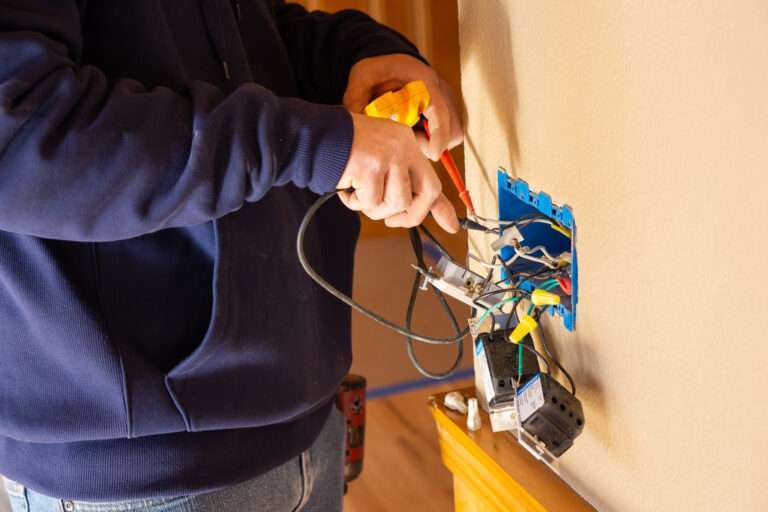
A failed switch. Wall switches wear out mechanically. If a bathroom has a two-gang or three-function switch for light, fan and heater, the fan portion can fail while the rest keeps working. Worn switches sometimes feel mushy or make a faint click without the usual snap.
A tripped GFCI or breaker. Bathroom receptacles are required to be GFCI-protected in current work, though older bathrooms here often have none. A GFCI, which stands for ground-fault circuit interrupter, trips when a few milliamps of current leak out of the circuit by any path, including through damp drywall or through a person. No metal-to-metal contact is required. If a bathroom fan is fed downstream of a GFCI outlet, that tripped device kills the fan too. The same is true for a tripped breaker on a shared circuit, which is often why a fan and an outlet go dead at the same moment. The reasons a receptacle goes dead overlap heavily with the reasons a fan does, and the logic behind a dead outlet in the same room applies here as well.
A loose or corroded connection. Fans vibrate for years. Wire nuts back off, push-in connections loosen, and the damp air in a bathroom corrodes terminals. An intermittent fan that works some days and not others is very often a connection problem, not a motor problem.
A blocked or disconnected duct. A fan that runs normally but does not clear the mirror may be pushing air into an attic through a duct that has come apart, or against a backdraft damper that has frozen shut with dust and grease.
What is safe to check yourself, and what is not
You can safely do three things. Everything after that belongs to someone with a license.
Safe to check:
- The breaker. The panel door, which is the outer door rather than the cover, shows whether a breaker is sitting in the middle or off position. Reset it once: push firmly to OFF, then to ON. If it trips again, leave it off and have it inspected. A breaker that trips a second time is telling you about a fault in the wiring, not about itself.
- The GFCI. Press the TEST button, then RESET, on any bathroom receptacle and on GFCIs in nearby bathrooms, the garage and the basement, since one device can protect several rooms. A GFCI also resets once. If it will not hold, there is a real leakage fault or the device itself has failed. Stop and have it inspected.
- The grille. Pull the cover off and look. A fan choked with a decade of lint will run hot and move nothing. A vacuum and the plastic cover in warm soapy water are not electrical work.
Not safe without a licensed electrician, and work that needs a permit and an inspection:
- Removing the panel cover. With the main breaker off, the service conductors coming into the house and the line-side lugs of the main breaker stay energized. A homeowner cannot de-energize them. Only the utility can, usually by pulling the meter, or a separate service disconnect ahead of the panel if one is fitted.
- Opening the fan housing and working on the wiring connections above a bathroom ceiling.
- Replacing a switch, a fan unit or a fan-light combination.
- Running a new circuit because the existing one trips. Never fit a larger breaker or fuse to stop tripping. The breaker is sized to protect the wire behind it, and a bigger one simply lets the wire overheat before anything shuts off. The fix for a genuinely overloaded circuit is a new circuit.
> If the fan is dead, the breaker holds, and every GFCI in the house resets cleanly, the fault is inside the fan, inside the switch box, or in a splice you cannot see. That is the point to stop. A bathroom ceiling is a wet-location box above a hard surface, and the wiring behind the fan is often spliced to the lighting circuit in ways that are not obvious from below. An electrician will isolate the circuit, test for voltage at the fan and the switch, and find out in minutes whether you are buying a fan or a repair.
Fan dead, or running but moving nothing?
A licensed electrician checks whether it is the switch, the circuit or the fan itself, and whether the duct is actually venting outside.
Licensed master electrician. 12-month workmanship warranty.
When it points to a bigger problem
Most dead bathroom fans are a dead fan. A few are a symptom. If the GFCI on that circuit is the part that keeps letting go, what trips a GFCI outlet is the better starting point. Treat these as reasons to have the circuit looked at rather than just the fan swapped:
- The breaker trips with the fan switched off or nothing plugged in. Standard residential breakers are thermal-magnetic, meaning a heat-sensitive strip handles sustained overload and a magnetic coil handles short circuits. A breaker tripping with no load is more often a wiring fault, a short or a ground fault, than a worn-out breaker.
- The GFCI keeps tripping after the fan is replaced. That is a real leakage fault somewhere on the circuit, not an oversensitive device. Moisture in a ceiling box, a nicked conductor, or a failing fixture elsewhere on the same run are all candidates.
- The fan, the light and an outlet all died together. That is a shared neutral or a single open connection upstream, and it will keep spreading.
- Cloth-insulated or ungrounded wiring in the ceiling. Knob-and-tube and early cloth-wrapped cable show up regularly in older Milwaukee and Waukesha County housing stock. Splicing a modern fan onto brittle insulation is how ceiling fires start.
- Warning signs at the panel or the switch. Burning smell, discolored or scorched plates, buzzing, crackling. Leave the breaker off and call.
Permits for electrical work are issued by your local municipality, Milwaukee, Wauwatosa, Waukesha and so on, which enforces Wisconsin SPS 316, the state’s electrical code. SPS 316 adopts the 2023 NEC and has been in effect since September 1, 2026. Work permitted before that date was done under the 2017 NEC, and existing installations do not have to be brought up to the newer edition unless they are altered. Once you alter a circuit, the new work is judged against the current code.
What an electrician does about it
The visit starts with testing, not with parts. An electrician confirms voltage is reaching the switch box, then the fan, and uses that to divide the problem into “the fan is bad” or “the supply to the fan is bad.” From there the work is one of a few paths:
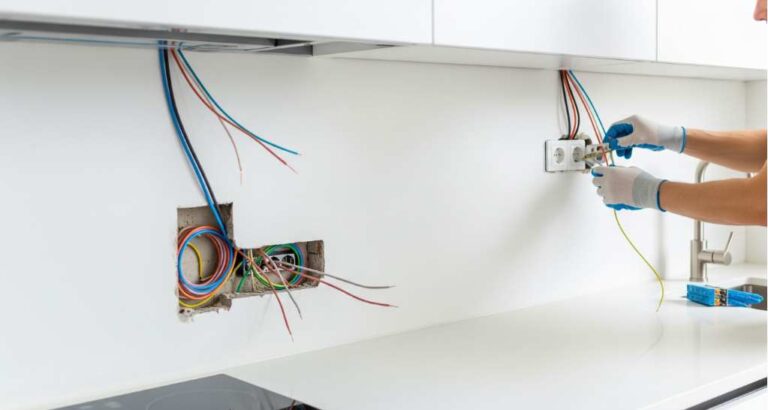
- Replace a worn switch or a dual fan-light switch.
- Replace the motor assembly where the housing is sound and the part is available, or replace the whole fan where it is not.
- Repair or remake the connections in the ceiling box and the switch box, with connectors rated for the location.
- Correct a GFCI problem by finding the actual leakage path instead of swapping devices.
- Add a dedicated circuit if the bathroom is genuinely overloaded.
- Replace a vent fan with a fan-light or a quieter unit while the ceiling is open, which is a common upgrade at the same time as ceiling fan and fixture work elsewhere in the house.
On timing: a straightforward diagnosis and fan or switch replacement is normally a single visit of one to three hours. Opening a ceiling to re-run a cable, or adding a dedicated circuit from the panel, runs longer and may involve a permit and an inspection, which adds days to the calendar even though the labor itself is short. Anyone quoting a repair sight unseen on a fan that may be anything from a 50 cent wire nut to a new unit and a new duct run is guessing.
Lehmann Electrical & Design is led by master electrician Jacob Lehmann and works across Milwaukee and Waukesha County. The company holds an A+ rating with the BBB and 4.9 stars on Google, and workmanship is backed by a 12-month warranty. If a dead bathroom fan turned up alongside other wiring you want handled on the same visit, an added exterior receptacle at the back of the house, a troublesome outlet, a ceiling fixture, say so when you book. A single trip covering several small items is almost always the better use of an electrician’s time on site.
To have a fan diagnosed and quoted properly, request an estimate or call 414-207-0109.
Why homeowners call Lehmann Electrical & Design
- Led by licensed master electrician Jacob Lehmann
- A+ rating with the BBB and 4.9 stars on Google
- 12-month workmanship warranty on the work we do
- Permits pulled and inspections scheduled as part of the job
- Milwaukee, Wauwatosa and Waukesha County, from 12012 W Fairview Ave, Wauwatosa
Want it fixed or replaced properly?
Tell us whether it makes any noise, and whether the light on the same switch still works.
Licensed master electrician. 12-month workmanship warranty.
Frequently asked questions
▾How long does it take to fix the electricity to a fan?
Most of these are a single visit. A switch, a failed fan motor or a loose connection in an
accessible box is usually diagnosed and repaired the same morning. The jobs that run longer are
the ones where the circuit itself is at fault, or where the fan needs a new duct run or a
dedicated circuit, because that is carpentry and wiring rather than a swap.
▾What electrical maintenance does a bathroom fan need?
Very little, and none of it needs an electrician. The grille comes off and washes in warm soapy
water, and the dust that collects on the blade and the housing can be vacuumed out. A fan choked
with years of lint runs hot and moves almost nothing, which is the single most preventable
reason one stops working properly. Anything beyond cleaning, meaning the wiring, the switch or
the motor, is work for an electrician.
▾Can a damaged electrical cord be repaired?
On a plug-in bathroom fan or heater, a damaged cord is replaced rather than taped or spliced. A
repair in the middle of a flexible cord is a weak point in a wet room, and in a bathroom that is
exactly where you do not want one. If the damage is at the appliance end, the unit usually needs
replacing or servicing by someone qualified to open it.
▾How much does it cost to repair a bathroom fan?
It depends entirely on what failed. A worn switch, a loose connection in the ceiling box, a seized motor and a disconnected duct are four different jobs with four different parts lists. We do not publish repair prices because a quote given before anyone has tested the circuit is not a quote. Describe the symptoms when you call and you will get a scoped estimate after diagnosis.
▾How long do electrical repairs like this take?
A diagnosis plus a fan or switch replacement is typically one to three hours on site, in a single visit. Work that involves opening a ceiling, re-running cable or adding a circuit back to the panel takes longer and may require a municipal permit and inspection, which stretches the calendar even when the hands-on labor is modest. Scheduling and parts availability affect the date more than the work itself does.
▾Can I just replace the bathroom fan myself?
The fan sits in a ceiling box in a wet location, usually spliced into a lighting or receptacle circuit, and often above a tub or tile floor. Replacing it means working overhead on live-capable wiring you cannot see from below, and in Milwaukee and Waukesha County the altered circuit is judged against Wisconsin SPS 316, which adopts the 2023 NEC. Cleaning the grille is homeowner work. Rewiring the box is not.
▾How much electrical service does my house have, and is it enough for a fan?
Your service size in amperes is printed on the main breaker in the panel, commonly 100, 150 or 200 amps in area homes. A bathroom fan draws so little current that service size is almost never the limiting factor. If a bathroom circuit trips repeatedly, the issue is the loading of that one branch circuit or a fault on it, not the size of the service.
▾My fan runs but the mirror still fogs. Is that electrical?
Usually not. A fan that spins at full speed but clears nothing is a ducting problem: a flex duct that has pulled off the housing, a crushed run in the attic, a backdraft damper gummed shut, or a fan sized too small for the room. An electrician checks the motor and the connections first, then traces the duct, because both ends of that path can look identical from the bathroom.
Next step
Get the fan sorted
Tell us whether it makes any noise at all.
Licensed master electrician12-month warranty4.9 on Google
Milwaukee, Wauwatosa and Waukesha County. Prefer to talk? Call 414-207-0109