Licensed master electrician · Call 414-207-0109
A GFCI outlet trips when it senses electricity leaking out of the circuit instead of returning the way it should. Modern personnel-protection GFCIs (UL 943 Class A) cut power when that leakage reaches only a few milliamps, far below anything a breaker would ever react to. The leak can be caused by moisture, a damaged cord, a failing appliance, a wiring fault, or a worn-out GFCI device itself. It is a safety response, not a nuisance.
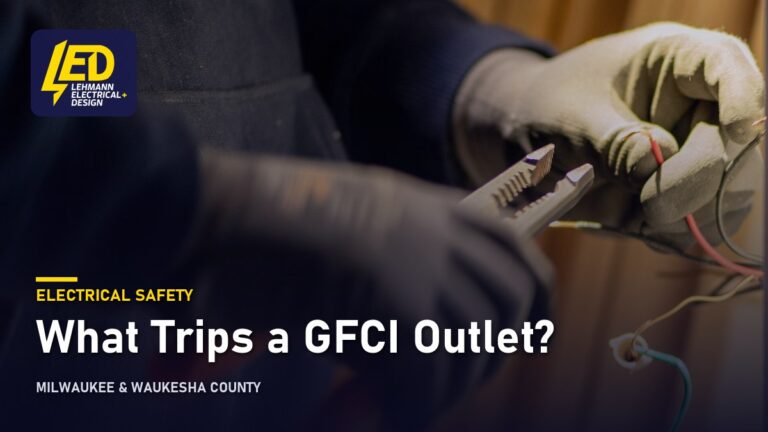
A GFCI (ground-fault circuit interrupter) outlet compares the current flowing out on the hot wire with the current returning on the neutral. Those two numbers should match. When they stop matching by more than a few milliamps, the device assumes the missing current has found another path to ground, and it shuts the circuit off in a fraction of a second.
That “other path” is the whole point. It could be water in a box, damp insulation, a cracked cord, a motor winding breaking down, or a person. A GFCI does not need metal-to-metal contact or a visible spark to act. It is designed to interrupt the exact kind of small leakage that can stop a heart, which is why they are required in bathrooms, kitchens, garages, basements, laundry areas, and outdoors.
So “what does tripping a GFCI outlet mean?” It means current went somewhere it was not supposed to go, and a device did its job. The follow-up question matters more: where is it going, and why?
What is usually causing it
Here is the practical list, roughly in order of how often a homeowner can solve it versus how often it needs a licensed electrician.
Moisture. Water is the classic cause. Rain blowing into an outdoor receptacle, a sprinkler hitting a garage outlet, condensation inside a weatherproof cover, a damp basement wall, steam from a shower. Water creates a low-resistance path to ground, and a GFCI will not tolerate it. Outdoor receptacles that trip after every storm usually have a failed cover gasket or a box that is collecting water.
A failing appliance or tool. Old space heaters, hair dryers, sump pumps, pressure washers, refrigerators, and shop vacs all develop internal leakage as insulation ages and motor windings break down. A cheap extension cord with a nicked jacket does the same thing. If the GFCI holds with nothing plugged in and trips the moment one specific device is connected, the device is the problem.
Cumulative leakage from several devices. Every appliance leaks a tiny amount of current to ground by design. Four or five of them on one GFCI-protected circuit can add up to the trip threshold without any single one being faulty. Long circuit runs with a lot of wire add to this.
A wiring fault. A neutral touching the box, a staple driven too tight through cable, a nail hit during a remodel, rodent damage, or a shared neutral between two circuits will all cause leakage that no amount of unplugging fixes.
A worn-out or miswired GFCI. These are electronic devices and they do not last forever. After years of heat, humidity, and surges, the internal sensing circuitry can fail, and some fail in the tripped position. Reversed line and load connections at installation will also cause odd behavior.
A voltage surge. Nearby lightning, utility switching, or a large motor starting can push a spike through the circuit that both damages GFCI electronics over time and causes immediate trips. If trips cluster around storms, that is worth mentioning when you call. A whole-home surge protection device installed at the panel takes the edge off transients before they reach your GFCIs, electronics, and appliances.
What a tripped GFCI looks like: the RESET button has popped out slightly and often a small indicator light is off, red, or amber depending on the brand. Downstream outlets and sometimes lights fed from that GFCI go dead too, which is why a dead bathroom outlet is so often solved at a GFCI in the garage.
What is safe to check yourself, and what is not
Safe for a homeowner, with the cover plate left on:
- Unplug everything on the circuit, including devices in other rooms that may be fed from the same GFCI.
- Press RESET firmly once. If it holds, plug devices back in one at a time and wait a minute between each. The one that trips it is your suspect.
- If it is an outdoor or garage receptacle, look for standing water in the box or a cover that no longer seals. Let it dry fully before resetting.
- Check whether a breaker in the panel has also tripped. Reset a breaker once at most, firmly to OFF then ON. If it trips again, leave it off and call an electrician.
A GFCI resets once too. If it will not hold, there is a real leakage fault or a failed device. Stop and have it inspected rather than pressing the button repeatedly.
Stop immediately and call if you notice a burning or hot-plastic smell, scorch marks, discoloration around the outlet or cord, buzzing, or crackling. Leave the breaker off and do not use the circuit or the device. Do not touch the outlet or the appliance to judge how hot it is. Use your nose, your eyes, and your ears instead.
Not safe for a homeowner: removing the device, opening junction boxes, working inside the panel, tracing a shared neutral, or replacing the GFCI yourself. Testing a receptacle that is actively faulting means working on live conductors. And never swap in a standard outlet to stop the tripping. That removes the protection and leaves the fault in place.
GFCI tripping again as soon as you reset it?
A licensed electrician separates a failing device from a wiring fault from an appliance fault, which look identical from the button.
Licensed master electrician. 12-month workmanship warranty.
When it points to a bigger problem
If the socket is dead rather than tripping, why an outlet stops working is the better starting point, and where there is arcing or a burning smell, why an outlet sparks should be read first. On a charging circuit the same symptom has its own causes, covered in why an EV charger keeps tripping.
> A GFCI that keeps tripping is not a device being oversensitive. It is a device reporting a real condition. When a GFCI holds fine with nothing plugged in, trips at random with no load, trips only in wet weather, or takes three attempts to reset, the fault is in the wiring or the device, not in your habits. Repeatedly resetting a GFCI that will not stay reset defeats the only thing standing between a fault and a person.
Patterns that point past a single bad appliance:
| What you see | What it usually points to | Who should handle it |
|---|---|---|
| Trips with nothing plugged in | Wiring fault or failed GFCI | Electrician |
| Trips only during or after rain | Water entry, failed cover or gasket | Electrician |
| Trips several times a day, any load | Degraded wiring insulation or shared neutral | Electrician |
| One appliance trips it every time | Faulty appliance or cord | Homeowner, replace the appliance |
| Will not reset at all, no load | Failed device or an ongoing fault | Electrician |
| Several GFCIs across the house trip together | Service-level or surge-related issue | Electrician |
Homes in Milwaukee and Waukesha County with original mid-century or older wiring are more likely to show these patterns, because rubber and cloth insulation becomes brittle and starts leaking to ground. Knob-and-tube and early ungrounded circuits are a related case: a GFCI can legally protect an ungrounded two-prong location, but it will also faithfully report every bit of leakage that aging wiring produces. That is useful information, and it usually means the circuit needs attention rather than a new button to press.
What an electrician does about it
Troubleshooting a GFCI is a measurement job, not a guessing job. On a service call, the work generally runs like this:

- Confirm what the GFCI actually protects. One device often feeds several rooms, and the fault may be forty feet away from the button.
- De-energize the circuit at the panel and verify it is dead with a meter before anything is opened.
- Test the device itself with a GFCI tester to see whether it trips at the correct threshold or has failed.
- Separate a wiring fault from an appliance fault by isolating the circuit section by section and reconnecting loads one at a time.
- Inspect boxes, splices, staple points, and weatherproof covers for water intrusion and mechanical damage.
- Check line and load wiring at the device, and look for a shared or crossed neutral between circuits.
- Repair or replace what is actually at fault: the device, a damaged section of cable, a box or cover, or the branch circuit.
Where a circuit is simply carrying more leakage than a single GFCI can tolerate, splitting the load across a properly protected new or replacement receptacle is often the clean fix. Permits for this kind of work are issued by your local municipality, which enforces Wisconsin SPS 316, the state’s electrical code. SPS 316 adopts the 2023 NEC and has been in effect since September 1, 2026. Work permitted before that date was done under the 2017 NEC, and existing installations do not have to be brought up to the newer edition unless they are altered.
If a GFCI in your home will not hold, or trips often enough that you have stopped trusting it, Lehmann Electrical & Design can diagnose the actual fault rather than replacing parts and hoping. The company is led by master electrician Jacob Lehmann, holds an A+ rating with the BBB, and is rated 4.9 stars on Google. Workmanship is backed by a 12-month warranty. Request an estimate for GFCI troubleshooting or call 414-207-0109.
Why homeowners call Lehmann Electrical & Design
- Led by licensed master electrician Jacob Lehmann
- A+ rating with the BBB and 4.9 stars on Google
- 12-month workmanship warranty on the work we do
- Permits pulled and inspections scheduled as part of the job
- Milwaukee, Wauwatosa and Waukesha County, from 12012 W Fairview Ave, Wauwatosa
Ready to have it traced?
Tell us which outlet, what is plugged in, and whether it trips with nothing on it.
Licensed master electrician. 12-month workmanship warranty.
Frequently asked questions
▾How many watts or amps will trip a GFCI outlet?
Neither, in the usual sense. A GFCI does not respond to how much power you are drawing. It responds to imbalance: a few milliamps of current leaking out of the circuit is enough. You can run a GFCI near its full 15 or 20 amp rating without tripping it, and you can trip it with a device drawing almost nothing if that device is leaking to ground. Overload is the breaker’s job, not the GFCI’s.
▾How does a GFCI outlet trip, and how do you trip one on purpose?
Internally, a current transformer compares the hot and neutral currents. Any mismatch beyond the threshold energizes a solenoid that mechanically snaps the contacts open. To trip one on purpose, press the TEST button, which deliberately diverts a small current through a resistor. Testing monthly is a good habit. If pressing TEST does not trip it, or RESET does not restore power, the device has failed and needs replacement.
▾How do you fix a tripped GFCI outlet?
Unplug everything on the circuit, press RESET once, then reintroduce devices one at a time to find the offender. If it resets and holds, you are done. If it will not reset, or trips again within minutes, stop. A GFCI that cannot hold is reporting a leakage fault in the wiring or has failed internally. Neither is fixed by pressing the button again, and both call for a licensed electrician.
▾How many times can a GFCI trip before it needs replacing?
There is no fixed count. A GFCI can trip hundreds of times and keep working correctly. What wears them out is time, heat, humidity, and voltage surges, not the trip count. Practically speaking, if a GFCI is more than ten to fifteen years old, fails its TEST button, resets only intermittently, or sits in a damp location, it is a replacement candidate regardless of how many times it has tripped.
▾What happens when a GFCI outlet trips?
Power stops at that receptacle and at everything wired downstream of it, which can include other outlets and occasionally lights in nearby rooms. The RESET button pops out, and most brands show a status light. Nothing is damaged by the trip itself. The circuit breaker in the panel usually stays on, which is why the breaker panel can look perfectly normal while a bathroom or garage sits dead.
Next step
Get the GFCI traced
Tell us which outlet and when it trips.
Licensed master electrician12-month warranty4.9 on Google
Milwaukee, Wauwatosa and Waukesha County. Prefer to talk? Call 414-207-0109