Licensed master electrician · Call 414-207-0109
Recessed lights that shut off on their own and come back a few minutes later are usually overheating. Listed recessed housings include a thermal protector that opens the circuit when the fixture gets too hot and closes again once it cools. The first things to check are the lamp wattage against the label, whether attic insulation is packed against a housing not rated for it, and whether the trim is trapping heat. Loose connections, dimmer mismatch, and failing LED drivers cause the same symptom in different patterns.
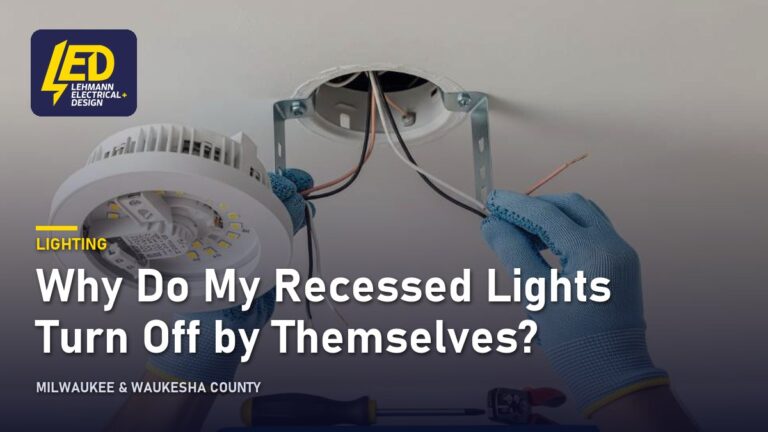
A recessed light that turns off by itself and returns after a cooling period is being shut down by a thermal protector. That device opens the circuit before heat damages the housing, the wire insulation inside it, or the ceiling material around it. It is a safety feature doing its job, and it is also a signal that something about the installation is wrong: a lamp above the fixture’s rated wattage, insulation touching a housing that was never listed for insulation contact, or a trim that chokes off airflow.
A light that turns off and stays off, or flickers before it quits, usually points somewhere else. Loose wire connections, worn socket contacts, an incompatible dimmer, a dimmer below its listed minimum load, and failing LED drivers all produce intermittent outages. So does a loose or open neutral upstream, which is the one cause that deserves prompt attention because it can affect far more than the lights.
If you notice a burning or hot-plastic smell, scorch marks or discoloration on the trim or ceiling, buzzing, or crackling, stop using that circuit, leave the breaker off, and call an electrician. Those are not symptoms of an ordinary thermal cutout.
What is usually causing it
The usual suspects are the lamp, the trim, the insulation, the dimmer, the driver, and the connections, and each one leaves a different fingerprint.
| Cause | Typical pattern | What it looks like |
|---|---|---|
| Thermal cutout from overheating | Off after a period of running, back on once cool | One or two cans, often the ones in insulated ceilings or carrying the highest-wattage lamps |
| Lamp above the housing’s rated maximum | Same as above, repeatable on demand | A screw-base can labeled for 60 W fitted with a 75 W halogen, or a retrofit module installed with no air gap |
| Insulation contact on a non-IC fixture | Worst in winter or right after attic work | Fixtures sitting under blown-in insulation that were never listed for it |
| Dimmer incompatibility or minimum load | Flicker, buzz, then dropout | LED lamps on an old incandescent-only dimmer, or a total LED wattage below the dimmer’s listed minimum load |
| Failing LED driver | One fixture only, no pattern | Integrated LED can that blinks, dims, or quits while its neighbors stay lit |
| Loose connection in a junction box or socket | Random, often triggered by vibration | Lights go out when someone walks upstairs or a door closes hard |
| Loose or open neutral upstream | Several fixtures and other devices affected | Brightness shifts elsewhere in the house, two circuits misbehaving together |
Three details matter more than homeowners expect.
IC rating is not a suggestion. “IC-rated” means the housing is listed for direct contact with thermal insulation. A non-IC can buried in insulation reaches its thermal limit on a long evening, every evening. This is a familiar local failure mode: 1950s through 1970s non-IC cans in Wauwatosa and Waukesha bungalows and Cape Cods that were later blanketed with blown-in attic insulation during an energy retrofit. The insulation was the right call. The cans underneath it were not rated for it.
Wattage limits are per lamp, not per room. The label inside a screw-base housing gives a maximum wattage for a single lamp. A retrofit LED module is a different animal: it carries its own listing and its own instructions, and it is only approved in housings its listing covers. Swapping a module into an incompatible can does not inherit the can’s original rating.
Dimmers have a published minimum load. Replace four 65 W incandescents with four 9 W LEDs and the total load may fall below the figure printed in the dimmer’s specifications. That is a listed spec, not a quirk, and operating below it produces flicker and dropout. If your lights also glow faintly after you switch them off, that is a related wiring and dimmer condition rather than an overheating one, and LED lights glowing when switched off is a separate diagnosis.
What is safe to check yourself, and what is not
Safe to check, with the wall switch off and the fixture cool:
- Read the label inside the can. It lists the maximum lamp wattage and whether the housing is IC-rated. Compare it to what is actually installed.
- Note which fixtures misbehave and when. Write down how long until it drops out and how long until it returns. That single observation often identifies the cause before anyone opens a box.
- Check whether the room’s dimmer is rated for LED loads and what its minimum load is. The model number is printed on the body or the back of the paddle.
- Swap in a known-good lamp of the correct type and wattage in a screw-base can, once the fixture has cooled.
- If a breaker has tripped, reset it once at most: push it firmly to OFF, then to ON. If it trips again, leave it off and have the circuit inspected before touching it again.
Work that belongs to a licensed electrician, and that your municipality requires to be permitted and inspected under Wisconsin SPS 316:
- Opening the junction box on the side of a can, or any ceiling box, to tighten or remake connections.
- Pulling insulation away from fixtures in an attic without knowing which housings are rated for what and where the wiring runs.
- Replacing a dimmer, a socket, or a driver.
- Any work behind the cover of the service panel. Turning the main breaker off does not de-energize the service conductors or the line-side lugs of the main breaker. Only the utility, usually by pulling the meter, or a separate service disconnect fitted ahead of the panel, can do that.
> A recessed light that shuts off and comes back is not broken. It is protecting itself from heat. The real question is why it is getting that hot, because the answer is usually a lamp, a trim, or a pile of attic insulation that does not belong where it is. Fixing the heat source fixes the light. Replacing the fixture without fixing the heat source just buys a new fixture that will do the same thing.
Lights cutting out and coming back on their own?
A licensed electrician works out whether the fixtures are overheating or the circuit is at fault, which are very different jobs.
Licensed master electrician. 12-month workmanship warranty.
When it points to a bigger problem
Three patterns move this from a nuisance to something that needs a licensed electrician promptly. If the switch feeding them also runs warm, that points at a connection rather than the fixtures.
Several fixtures on different circuits acting up together. Kitchen cans, a living room track light, a master bedroom fixture, and a dining room fixture all flickering or dropping out is unlikely to be four separate fixture failures. The shared element is the wiring. A loose splice, a failed backstab connection at a device, or an open neutral further upstream can make lights across multiple circuits dim, brighten, or cut out. In a 120/240 V house the two 120 V legs share a return neutral. If that neutral opens, the loads on the two legs end up in series across 240 V instead of each sitting at 120 V, so the lightly loaded side rises well above 120 V while the heavily loaded side sags. That is how an open neutral damages electronics, and it is why this symptom gets diagnosed rather than lived with.
Heat damage you can see or smell. Browned trim, a hot-plastic odor, discolored wire insulation visible at the socket, buzzing, or crackling means stop. Leave the breaker off for that circuit and call. Do not touch the fixture or the panel to judge how hot it is: use smell, discoloration, and sound instead.
A breaker that trips with the lights off. A breaker opening when nothing is drawing load usually means a wiring fault, a short or a ground fault, rather than a worn-out breaker. Most residential breakers are thermal-magnetic, with a heat-sensitive strip for sustained overload and a magnetic coil for short circuits, and the magnetic half does not care whether the lights are on. Never substitute a larger breaker to stop the tripping. The breaker is sized to protect the wire behind it, and the fix for a genuinely overloaded circuit is an additional circuit, not a bigger device.
Permits for this work are issued by your municipality, Milwaukee, Wauwatosa, Waukesha and the surrounding communities, which enforce Wisconsin SPS 316, the state’s electrical rules. SPS 316 adopts the 2023 NEC and has been in effect since September 1, 2026. Work permitted before that date was done under the 2017 NEC. Generally an existing installation does not have to be brought up to the newer edition unless it is altered, though some items are treated as retroactive and your local inspector has the final word.
What an electrician does about it
The visit starts with the pattern you recorded, then moves to measurement. A licensed electrician confirms voltage at the fixture under load, measures voltage drop on the run, uses a thermal camera or a temperature probe rather than a hand to find terminations running hot, verifies the housing’s IC rating against actual attic conditions, confirms the lamp or module matches the fixture’s listing, and tests dimmer compatibility and minimum load. Where connections are suspect, each splice on the affected run is opened, inspected, and remade with the correct connector.
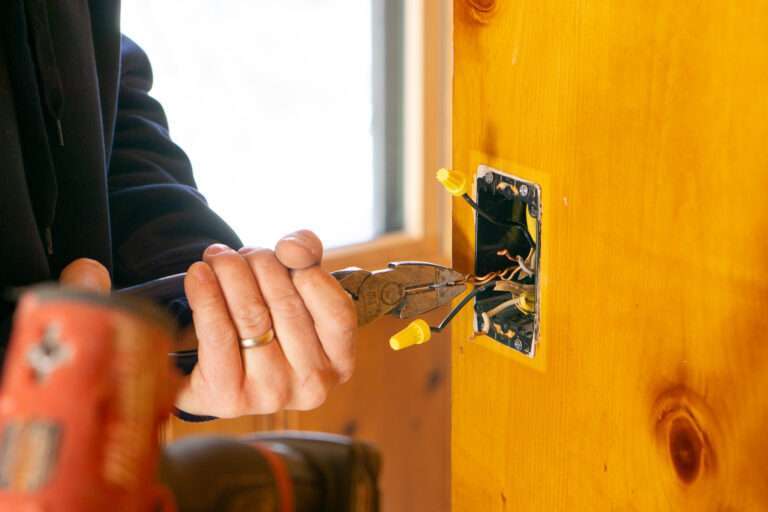
The repair depends on what the testing shows. Sometimes it is a lamp change and an air gap restored. Sometimes it is a dimmer matched to the LED load. Sometimes a non-IC housing in an insulated ceiling has to be replaced with an IC-rated, airtight fixture, which is also the right moment to reconsider spacing and beam angle if the room was never lit well. If a whole room needs rethinking, that is a recessed lighting layout and install rather than a repair, and it is estimated and permitted differently.
For readers wondering what a from-scratch install actually involves, at a high level it runs like this: a layout is set for the room’s dimensions, ceiling height, and furniture; joists and existing obstructions are located; openings are cut to the template; housings or remodel cans are set and secured; the switch leg and feed are run and the circuit load is checked; and trims go on last, after the ceiling is patched where needed. None of those steps are difficult to describe. The difficulty is in box fill, insulation clearance, fire-rated assemblies, dimmer and driver matching, and getting it through inspection, which is why it is permitted work and not an afternoon project.
Loose neutrals and faults found upstream are traced to their source and repaired, not patched at the fixture.
Lehmann Electrical & Design is led by master electrician Jacob W. Lehmann and holds an A+ rating with the BBB and 4.9 stars on Google. Workmanship is backed by a 12-month warranty.
If your recessed lights keep cutting out, or you want the kitchen cans, a living room track light, and the bedroom and dining room fixtures all looked at in one visit, tell us what the lights are doing and we will schedule an estimate. Call 414-207-0109 if you would rather talk it through first.
Why homeowners call Lehmann Electrical & Design
- Led by licensed master electrician Jacob Lehmann
- A+ rating with the BBB and 4.9 stars on Google
- 12-month workmanship warranty on the work we do
- Permits pulled and inspections scheduled as part of the job
- Milwaukee, Wauwatosa and Waukesha County, from 12012 W Fairview Ave, Wauwatosa
Want them looked at?
Tell us which room, how many fixtures, and whether the lamps were changed recently.
Licensed master electrician. 12-month workmanship warranty.
Frequently asked questions
▾Can recessed lights really turn themselves off?
Yes. Listed recessed housings are required to include thermal protection, a device that opens the circuit when internal temperature exceeds the fixture’s limit and closes again as it cools. Retrofit LED kits vary, so check the product’s listing. That cycling is a safety feature rather than a malfunction, but it means the fixture is running hotter than it was designed to, and the heat source should be found.
▾Can you install recessed lighting yourself, and is it easy?
Cutting a hole and clipping in a housing looks easy, and that part is. The parts that decide whether it is safe and whether it passes are not: box fill, IC and airtight ratings, insulation clearance, dimmer and driver compatibility, circuit loading, and the permit and inspection your municipality requires under Wisconsin SPS 316. The usual suspects behind cycling-off calls are the lamp, the trim, and the insulation, which is exactly where unpermitted work goes wrong.
▾How much does it cost to install recessed lighting in one room?
We do not publish prices, because the figure genuinely depends on the ceiling. The drivers are: fixture count, ceiling height, attic or crawl access above, drywall versus plaster, whether a usable switch leg and circuit already exist, whether a new circuit is needed, dimmer type, trim selection, and patching and paint. Those move the number substantially, so the honest answer is a walkthrough and a written estimate.
▾How long does it take to install recessed lighting?
A straightforward room with attic access above and an existing switch is typically a single-day job. Finished ceilings with no access, plaster instead of drywall, two-story construction, or a new circuit run back to the panel add time. Drywall patching and paint are usually handled separately. The estimate identifies which of those conditions applies before any holes get cut in your ceiling.
▾Can you add an outdoor outlet on the back of the house at the same visit?
Yes, and it is commonly bundled with interior lighting work since both involve circuit planning and the same permit. An exterior receptacle needs GFCI protection, a weather-resistant type receptacle, and a cover rated for use while something is plugged in. A GFCI trips when a few milliamps of current leaves the circuit by any path, including through a person or damp material, with no metal contact required. The visit can also cover exterior lighting work.
▾Why does it matter whether I turn the lights off?
Beyond energy cost, heat is the real reason with recessed fixtures. A can running for hours has more opportunity to reach its thermal limit, especially if it is buried in insulation or fitted with a lamp above its rated maximum. Repeated thermal cycling shortens the life of drivers, sockets, and wire insulation. Switching them off is not a fix, but it reduces the stress while the cause is diagnosed.
Next step
Get the lights checked
Tell us which room and how many fixtures.
Licensed master electrician12-month warranty4.9 on Google
Milwaukee, Wauwatosa and Waukesha County. Prefer to talk? Call 414-207-0109