Licensed master electrician · Call 414-207-0109
A red flash on a smoke detector is usually normal. Most hardwired and battery alarms blink a small red LED once every 30 to 60 seconds to show they have power and are watching the room. The flashes that matter are the ones paired with sound: a chirp every minute usually means a dying battery, and a continuous loud pattern means the alarm is sensing smoke or carbon monoxide. If an alarm is sounding, get everyone outside first and call 911.
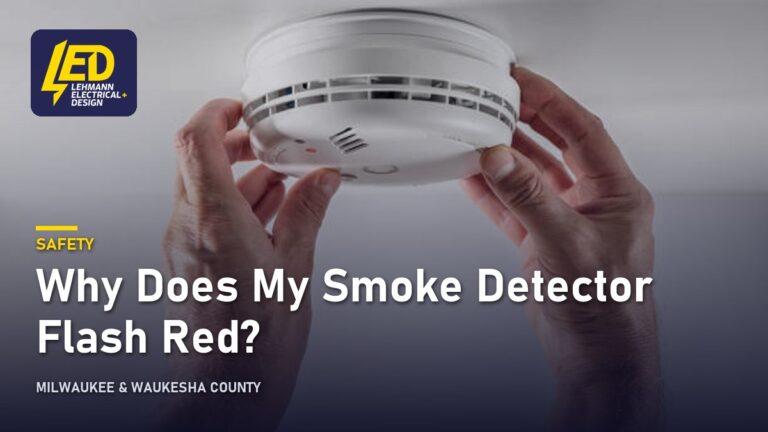
A single red blink on a steady cycle is a heartbeat indicator. It tells you the alarm is energized and the sensor chamber is active. Many models use red for that heartbeat, and some use green for AC power with red reserved for alarm and fault states, which is why two detectors in the same hallway can look like they disagree.
What changes the meaning is sound and rhythm:
| What you see and hear | Most likely meaning | What to do |
|---|---|---|
| Red blink about once a minute, silent | Normal heartbeat, unit has power | Nothing |
| Red blink plus a chirp about once a minute | Low or failing battery | Replace the battery, or the whole unit if it is sealed |
| Rapid red flashing with a loud repeating alarm | Smoke or CO detected | Evacuate, call 911 |
| Red flash with a chirp every 30 seconds or a distinct error pattern | End of life or sensor fault | Replace the detector |
| Steady red with no sound, continuous | Unit has latched an alarm memory or faulted | Read the model’s indicator chart, then replace or have it checked |
| No light at all on a hardwired unit | Lost AC power to the circuit, or dead unit | Have the circuit checked |
A chirping, blinking alarm at 3 a.m. is the classic version of this question, and it is almost always a battery whose voltage drops as the house cools overnight.
What is usually causing it
Four things account for nearly every red flash a homeowner notices.
Normal operation. The heartbeat LED is doing its job. Nothing is wrong.
Battery voltage. In a hardwired alarm, the battery is a backup, not the main power source, so a weak backup battery will chirp and flash even though the unit is still running on house current. In sealed 10-year alarms there is no battery to change, and the same signal means the unit is finished.
End of life. Smoke sensors drift. Manufacturers generally rate residential smoke alarms for about 10 years from the date of manufacture, which is printed on the back of the unit. Combination smoke and carbon monoxide alarms often have shorter CO sensor life. An alarm past that date can flash, chirp, false-alarm, or quietly stop detecting.
Contamination. Dust, cooking grease, construction debris, insects, and humidity from a nearby bathroom all confuse an optical sensor. A unit over a kitchen or at the top of a basement stairwell collects more of this than one in a bedroom.
> A red light that blinks on a slow, steady cycle and makes no noise is the alarm telling you it has power. A red light paired with a chirp is the alarm telling you it needs attention. A red light paired with a loud, repeating horn is the alarm telling you to get out of the house. Those three signals look similar from the hallway and mean completely different things, so listen before you reach for a ladder.
Interconnected alarms add one more twist. When hardwired detectors are linked, one unit sensing smoke sets off every alarm in the house. Many models then mark the originating unit with a different light pattern so you can tell which room triggered it. If every alarm in the house went off and you cannot find the cause, that marker is the first thing to look for.
What is safe to check yourself, and what is not
Safe for a homeowner: read the label on the back of the unit for the manufacture date and the indicator chart, press and hold the test button, vacuum the outside of the housing with a brush attachment, and replace a removable backup battery. Those are the whole list.
Not safe for a homeowner: anything behind the junction box or panel cover. Hardwired smoke detectors sit on a 120 volt branch circuit, often shared with hallway lighting. The interconnect wire between units is a low-voltage signal line that rests near zero volts and is only driven when one alarm sets off the others, so it is the branch circuit behind the detector, not the interconnect, that makes this work for an electrician. Turning off the breaker that feeds the alarms does not make the rest of the panel safe. With the main breaker off, the service conductors coming into the house and the line-side lugs on the main breaker stay energized. Only the utility, usually by pulling the meter, or a separate service disconnect ahead of the panel can take those dead.
Stop and call for help if you notice any of the following at a detector, its junction box, or the panel: a burning or hot-plastic smell, scorch marks, brown or melted discoloration, buzzing, or crackling. Leave the breaker for that circuit off and do not use the circuit until an electrician has looked at it. Do not touch the device to judge how hot it is. Smell, sight, and sound tell you what you need to know.
If you do switch off the alarm circuit’s breaker and it will not stay on, reset it once at most: push it firmly to OFF, then back to ON. If it trips again, leave it off and have the circuit inspected. A breaker that trips with the load disconnected points to a wiring fault, not a tired breaker.
Alarm still flashing after a new battery?
A licensed electrician works out whether it is the detector, the interconnect wire or the circuit feeding it.
Licensed master electrician. 12-month workmanship warranty.
When it points to a bigger problem
Sometimes the detector is the messenger, not the patient.
A detector that resets itself, blinks erratically, or goes dark and comes back is reporting unstable power on its branch circuit. Loose neutral connections, a backstabbed device failing in a daisy chain, or deteriorating insulation on older wiring all show up this way. Homes in the Milwaukee and Waukesha County area with original knob and tube or early cloth-insulated branch circuits are overrepresented in that category simply because the wiring is older.
Repeated nuisance alarms during storms, or several detectors failing within weeks of each other, often follow a voltage event. Surges from utility switching, a nearby lightning strike, or large motor loads inside the house degrade the electronics in low-voltage devices long before they kill anything with a motor in it. Smoke alarms, thermostats, garage door openers, and network gear tend to go first. That is one of the practical arguments for whole-home surge protection at the panel, which clamps the spike before it reaches every device downstream.
Also treat the following as a wiring question rather than a detector question: alarms on a circuit that also trips a GFCI or AFCI device. An AFCI, or arc-fault circuit interrupter, watches for the electrical signature of arcing in a 120 volt branch circuit serving living areas. A GFCI, or ground-fault circuit interrupter, trips when a small amount of current leaks away by any path, including through a person or damp material. Reset either device once. If it will not hold, there is a real fault or a failed device, and the explanation often overlaps with the reasons a GFCI keeps tripping.
Coverage is the other bigger problem. Wisconsin SPS 316, which adopts the 2023 NEC and has been in effect since September 1, 2026, governs electrical work including one- and two-family dwellings. Existing installations do not have to be brought up to the new edition unless they are altered, so an older house can legally have fewer alarms than a new one would get. If your home has a single detector in the hallway and nothing in the bedrooms, a flashing light is the least of it.
What an electrician does about it
For a flashing or chirping detector, the work is diagnostic first. An electrician reads the manufacture date and the unit’s own indicator codes, tests the branch circuit for correct voltage and a solid neutral, checks the interconnect wiring between units, inspects the junction boxes for heat damage or loose terminations, and confirms the detectors are the right type and in the right locations for the home’s layout.
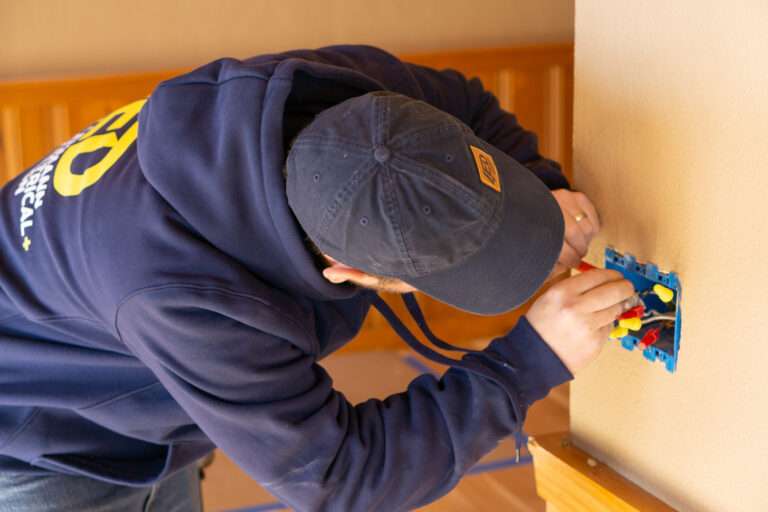
The fix follows from what the test shows. A contaminated or expired unit gets replaced. A whole set of detectors past 10 years gets replaced together, because replacing one at a time in an interconnected system invites compatibility problems between brands and generations. A circuit with a loose neutral or damaged conductor gets repaired and permitted through the local municipality, which is the body that issues permits and enforces SPS 316 in Milwaukee, Wauwatosa, Waukesha and the surrounding communities. Where a house never had adequate coverage, the job becomes hardwired and interconnected alarm installation in the sleeping rooms, outside each sleeping area, and on every level.
Lehmann Electrical & Design is led by master electrician Jacob Lehmann and holds an A+ rating with the BBB and 4.9 stars on Google. Workmanship is covered by a 12-month warranty.
If your detector is doing something you cannot explain, or you have a flashing light plus any smell, scorch mark, or buzzing, ask us to take a look or call 414-207-0109.
Why homeowners call Lehmann Electrical & Design
- Led by licensed master electrician Jacob Lehmann
- A+ rating with the BBB and 4.9 stars on Google
- 12-month workmanship warranty on the work we do
- Permits pulled and inspections scheduled as part of the job
- Milwaukee, Wauwatosa and Waukesha County, from 12012 W Fairview Ave, Wauwatosa
Want the alarms checked properly?
Tell us how many are flashing, whether they are hardwired, and how old they are.
Licensed master electrician. 12-month workmanship warranty.
Frequently asked questions
▾Why is my smoke detector blinking green?
Green usually means the alarm is receiving AC power from the house wiring. On many hardwired models, green is the normal power indicator and red is reserved for alarm, fault, or low-battery signals. A green light that goes out or starts flashing can mean the unit has lost house power and is running on its backup battery, which is worth having the circuit checked.
▾How does a whole house surge protector work?
It is a device wired into the electrical panel that sits in parallel with the circuits. Under normal voltage it does nothing. When voltage spikes above a set threshold, internal components divert the excess energy to the ground path and clamp the remaining voltage to a level your electronics can survive. It protects everything downstream, including hardwired smoke alarms, at once.
▾How are whole house surge protectors installed, and how long does it take?
An electrician mounts the unit at or next to the service panel and connects it on a dedicated two-pole breaker, keeping the leads as short and straight as possible because lead length reduces performance. The work happens inside the panel enclosure, requires a permit through your municipality, and is not homeowner work. Most straightforward installations are a short appointment rather than a full day.
▾How many kA do I need, and how much protection is enough?
Residential panel-mounted devices are commonly rated between 50 kA and 100 kA or more per phase. A higher kA rating generally points to a longer service life and to how well a device survives one large surge, rather than to better protection moment to moment; the clamping voltage rating is what decides how much gets through to equipment. Point-of-use protection at sensitive electronics complements the panel device. We size and recommend a specific unit after looking at your panel, so ask during the estimate.
▾How long do whole house surge protectors last?
They wear out, because the components inside absorb energy each time they divert a spike. Service life depends on how many events the device has taken, not just age. Most have a status light or audible indicator that tells you when protection has been exhausted, and that light is worth checking a couple of times a year. A protector with a dark status light is no longer protecting anything.
▾Why does my smoke detector flash red and chirp at night?
Battery voltage sags slightly as the house cools overnight, which is often enough to push a weakening backup battery below the alarm’s low-battery threshold. That is why the chirp so often starts in the early morning hours. Replace the battery if the unit takes one. If the alarm is a sealed 10-year model, the same signal means the unit has reached end of life.
Next step
Get the alarms checked
Tell us how many are flashing and whether they are hardwired.
Licensed master electrician12-month warranty4.9 on Google
Milwaukee, Wauwatosa and Waukesha County. Prefer to talk? Call 414-207-0109