Licensed master electrician · Call 414-207-0109
A buzzing outlet almost always means electricity is moving across a connection it was never meant to cross. A loose wire, a worn-out receptacle, or a damaged plug lets current arc through a tiny air gap, and that arcing hums, buzzes, or crackles. It is not a harmless quirk. Stop using that outlet, unplug what is in it, switch the circuit off at the breaker, and have a licensed electrician look at it.
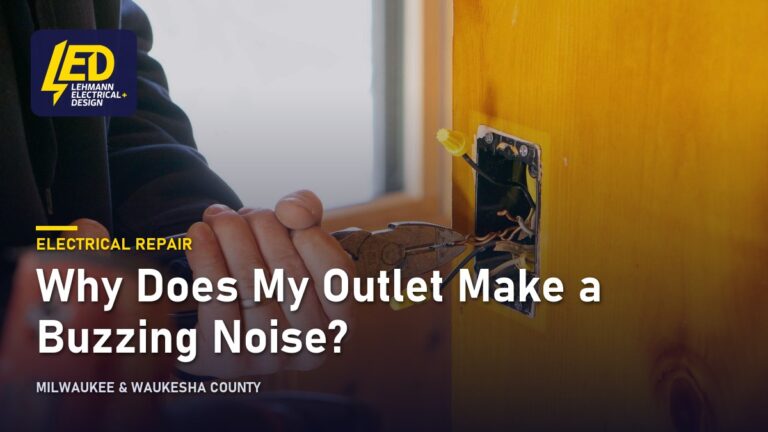
Outlets are supposed to be silent. There is no normal buzz, hum, or ring coming from a properly wired receptacle. When you hear one, the sound is usually vibration caused by arcing, which is current jumping a small gap instead of flowing cleanly through metal. That gap is hot. Arcing temperatures can scorch plastic and char wood framing long before anything trips.
So, to answer the question people ask most directly: is a buzzing outlet dangerous? Yes, treat it as dangerous until an electrician proves otherwise. The buzz itself will not shock you, but it is the audible symptom of a connection that is overheating.
What to do right now, in order: unplug whatever is in the outlet if you can do so without touching a hot or discolored device body. Go to the panel and switch that circuit off. Leave it off. If you smell burning plastic, see brown or black marks around the slots, or hear crackling or popping, do not use the circuit again at all until it has been repaired. Call an electrician rather than waiting to see whether it quiets down on its own.
What is usually causing it
The noise narrows the problem down a long way. Here is how the common causes sort out.
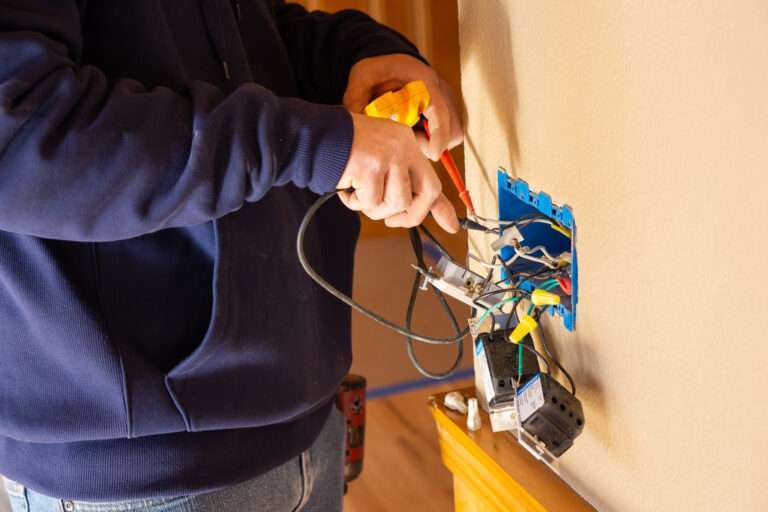
Loose terminal screws inside the box. Wires are clamped under screws on the side of the receptacle. Decades of heating and cooling, or a screw that was never torqued properly at installation, lets that clamp relax. Current then has to jump the gap, and it buzzes. This is also the cause behind the complaint “why does my outlet keep popping,” because the arc is intermittent rather than steady.
Back-stabbed connections. Many receptacles accept a wire pushed into a spring clip at the back instead of under the screw. The spring loses tension over time. Loads like space heaters, window air conditioners, and hair dryers accelerate it.
A worn receptacle. The brass contacts that grip a plug’s blades flatten out after enough insertions. A plug that feels loose or falls out of its own weight is already making poor contact, and poor contact buzzes under load. This answers “why does my plug make a buzzing noise” and “why does my socket make a buzzing noise” at the same time: the sound is coming from the junction between plug and outlet, not from the appliance.
A damaged plug or cord. Cracked plug bodies, bent blades, and cords that were crushed by furniture create the same arcing on the appliance side. Try the device in a different outlet. If the buzz travels with the device, the cord or plug is the problem.
An overloaded circuit. Pulling close to the breaker’s rating through a weak connection makes the buzz louder and heats the whole assembly. Note that loading a circuit near its limit does not itself cause a buzz in good wiring. It only amplifies a fault that already exists.
A device that hums legitimately. Some dimmers, transformers, and LED drivers hum quietly. That sound comes from the device or the wall plate, not from the outlet contacts. A faint electrical hum from a dimmer switch under load is usually just magnetic vibration. A buzz from a receptacle with a plug in it is not.
| What you hear | Most likely source | Safe to keep using? |
|---|---|---|
| Steady buzz or hum from the receptacle | Loose terminal, worn contacts, back-stab failure | No. Kill the breaker. |
| Crackling or popping | Active arcing, often intermittent | No. Kill the breaker and call. |
| Sharp snap once when plugging in | Normal inrush on some appliances | Usually yes, if it does not repeat |
| Faint ring or whine | Dimmer, LED driver, or transformer vibration | Often yes, but worth checking |
| Buzz that follows the appliance | Damaged plug or cord | No. Retire the cord. |
| GFCI buzzing or clicking | Device failing or detecting leakage | No. Have it replaced. |
What is safe to check yourself, and what is not
Safe: look and listen, and nothing more. You can look at the outlet for discoloration, melted plastic, or scorch marks around the slots. You can smell for hot plastic. You can note whether the noise starts only when a particular appliance is plugged in. You can move that appliance to a different outlet in a different room to see whether the sound follows it. You can switch the circuit breaker off. You can test a GFCI with its own TEST and RESET buttons.
Also safe: resetting a tripped breaker once. Push it firmly to OFF, then back to ON. If it trips again, leave it off and have the circuit inspected. The same rule applies to a GFCI, which also gets one reset. If it will not hold, there is a genuine leakage fault or the device itself has failed.
Not safe, and not your job: removing the cover plate and pulling the receptacle out of the box, tightening terminal screws, replacing a receptacle, splicing wire, or opening anything behind the panel cover. Two reasons. First, the outlet may be fed from a circuit you have not identified, so switching off the breaker you think serves it does not guarantee the box is dead. Second, with the main breaker off, the service conductors and the line-side lugs of the main breaker stay energized. Only the utility, typically by pulling the meter, or a separate service disconnect fitted ahead of the panel can take those dead. That is not homeowner territory.
And never respond to repeated tripping by fitting a larger breaker. The breaker protects the wire, not the appliance. Oversizing it removes the protection and leaves the wire to overheat quietly inside the wall.
Buzzing still there with everything unplugged?
A licensed electrician tests the circuit under load and checks every termination for the loose connection a buzz usually points to.
Licensed master electrician. 12-month workmanship warranty.
When it points to a bigger problem
Sometimes the buzzing outlet is just a tired receptacle, and swapping it out ends the story. Other times it is the first symptom to surface in wiring that has a broader issue. Signs that the problem is larger than one device:
- More than one outlet on the same circuit buzzes, feels warm, or has gone dead.
- Lights on that circuit dim or flicker when a motor-driven appliance starts.
- The breaker trips with nothing plugged in. On a standard thermal-magnetic breaker, which uses a heat-sensitive strip for sustained overload and a magnetic coil for short circuits, that pattern points to a short or ground fault in the wiring more often than to a worn breaker.
- A GFCI keeps tripping. A personnel-protection GFCI (UL 943 Class A) opens on 4 to 6 milliamps of current leaking away by any path, including through damp drywall or a person. Nothing has to touch metal for it to act. A GFCI that will not stay reset is reporting a real fault, not doing an unnecessary favor.
- Cloth-insulated or knob and tube wiring anywhere in the house. Old insulation crumbles at the terminals, which is exactly where arcing starts.
- Aluminum branch wiring from the mid-century era, which expands and contracts enough to loosen connections repeatedly.
In older Milwaukee and Waukesha County homes, buzzing outlets often turn up on circuits that have simply been asked to do more than the original wiring was planned for. That is a diagnostic job rather than a parts swap, and it belongs in the hands of someone doing proper electrical troubleshooting and repair rather than guesswork.
What an electrician does about it
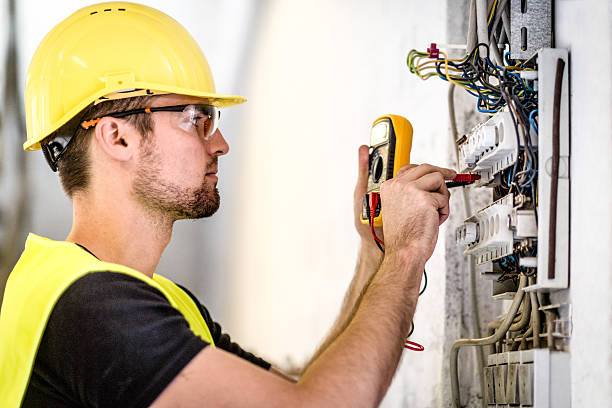
The work starts with isolating the circuit and verifying it is actually dead with a meter rather than trusting the breaker label. From there, an electrician opens the box, inspects every termination for heat damage, checks conductor condition and box fill, confirms the polarity and ground, and measures voltage drop under load to find weak connections that look fine but perform badly.
The fix depends on what turns up. A failed receptacle gets replaced with a new spec-grade device wired under the screw terminals rather than back-stabbed. Heat-damaged conductors get cut back to clean copper, and if there is not enough slack, the box gets re-fed. A circuit that is genuinely overloaded gets a new dedicated circuit, because the correct remedy for too much load is more capacity, not a bigger breaker. If the box itself is charred, the box is replaced.
It is also the natural moment to deal with outlets you have been meaning to add. Homeowners frequently ask about a receptacle on the back of the house while an electrician is already on site, and a weatherproof exterior outlet added on the back of the house is a straightforward add-on when the crew is in the attic or basement anyway.
Permits for this work are issued by your local municipality, which enforces Wisconsin SPS 316. SPS 316 adopts the 2023 NEC and has been in effect since September 1, 2026. Work permitted before that date fell under the 2017 NEC, and existing installations do not have to be brought up to the newer edition unless they are being altered.
Lehmann Electrical & Design is led by master electrician Jacob Lehmann, holds an A+ rating with the BBB, carries a 12-month workmanship warranty, and rates 4.9 stars on Google. If you want a buzzing outlet diagnosed, request an estimate or call 414-207-0109. Homeowners looking for an electrician in the western suburbs can start there too.
Why homeowners call Lehmann Electrical & Design
- Led by licensed master electrician Jacob Lehmann
- A+ rating with the BBB and 4.9 stars on Google
- 12-month workmanship warranty on the work we do
- Permits pulled and inspections scheduled as part of the job
- Milwaukee, Wauwatosa and Waukesha County, from 12012 W Fairview Ave, Wauwatosa
Ready to have the outlet looked at?
Tell us which room it is, what was plugged in and when the noise started.
Licensed master electrician. 12-month workmanship warranty.
Frequently asked questions
▾Why is my outlet clicking?
A rhythmic click usually comes from a device cycling on and off, such as a thermostat, a refrigerator relay, or a failing GFCI trying to reset itself. A single sharp click when you insert a plug is often normal inrush. Repeated clicking from inside the wall, especially with any warmth or smell, is arcing and needs the circuit switched off and inspected.
▾Why does my outlet make a ringing noise?
A faint ring, whine, or high-pitched tone is more often magnetic vibration in a transformer, LED driver, or dimmer than arcing. Low-voltage doorbell transformers and phone chargers are common culprits. It is usually harmless, but if the tone rises and falls with load, or comes with any heat or odor, have it checked rather than assuming it is cosmetic.
▾Why is my GFCI outlet making a buzzing noise?
A GFCI that buzzes is typically failing internally, or its line connections have loosened. These devices contain electronics and a trip solenoid, and they wear out, usually within 10 to 15 years. Press TEST, then RESET once. If it buzzes, will not hold, or will not trip on test, stop using it and have it replaced. Do not open it up.
▾My outlet hums only when one appliance is plugged in. Is the outlet or the appliance at fault?
Move the appliance to a different outlet on a different circuit. If the hum travels with it, the plug, cord, or appliance is at fault, and the cord should be retired. If the hum stays with the original outlet regardless of what is plugged in, the receptacle or its wiring is the problem. Either way, leave that circuit off until it is repaired.
▾Can I just replace the outlet myself to stop the buzz?
No. Replacing a receptacle looks simple but requires confirming the box is actually de-energized, identifying which conductor is which, and verifying the grounding and box condition. A buzz also frequently means heat damage further back in the wiring that a new receptacle will hide rather than fix. Licensed work also keeps your installation inside Wisconsin SPS 316, which adopts the 2023 NEC.
Next step
Get the outlet checked
Tell us which room it is and when the noise started.
Licensed master electrician12-month warranty4.9 on Google
Milwaukee, Wauwatosa and Waukesha County. Prefer to talk? Call 414-207-0109