Licensed master electrician · Call 414-207-0109
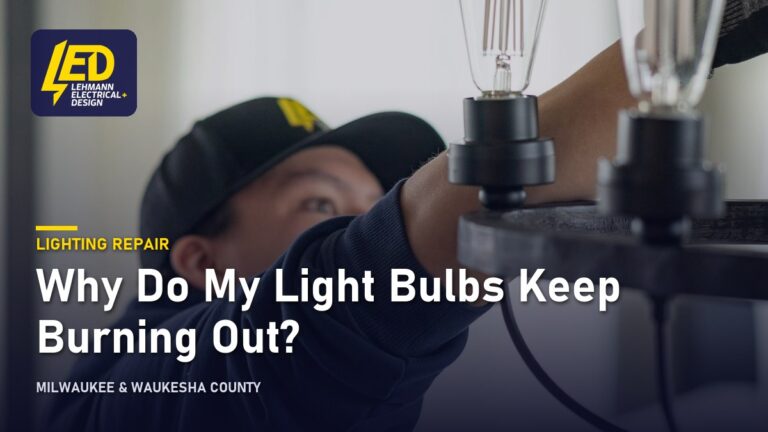
Light bulbs that keep burning out are usually running too hot, being shaken, sitting loose in a worn socket, or paired with a dimmer they were not made for. Those causes stay with one fixture. When bulbs fail in several rooms, or lights look brighter than they should, the cause is more likely the electrical supply itself, such as high voltage or a loose neutral connection, and that needs an electrician promptly.
A bulb should not need replacing every few weeks. The pattern of failures tells you a lot: one fixture that eats bulbs points to that fixture, its socket or the bulb you are using, while failures all over the house point back toward the panel or the utility connection. The sections below help you work out which you have, what you can safely check, and when to stop and call for help.
What is usually causing it
The usual causes are heat, vibration, a poor connection at the socket, a dimmer mismatch, frequent switching, poor-quality bulbs, and voltage problems. Match what you are seeing to the likely cause:
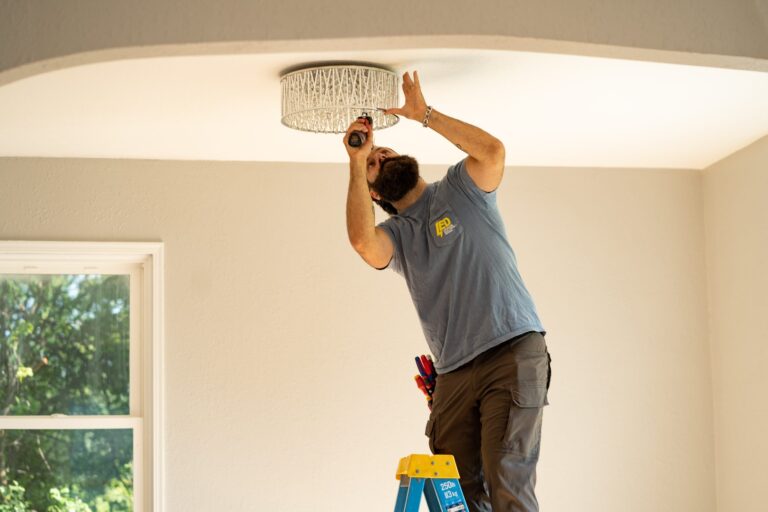
| What you notice | Likely cause | What to do |
|---|---|---|
| Bulbs fail early in one enclosed fixture, glass dome or recessed light | Heat trapped around the bulb | Use a bulb rated for enclosed fixtures and check the fixture’s wattage label |
| Bulbs fail in a ceiling fan or a garage door opener | Vibration | Use bulbs rated for fans or openers; have a wobbling fan checked |
| One socket keeps killing new bulbs, sometimes with flicker | Worn or loose socket contact | Have an electrician check or replace the socket or fixture |
| LED bulbs on a dimmer flicker, buzz or die young | Bulb and dimmer do not suit each other | Use dimmable LEDs and a dimmer listed as compatible with them |
| Bulbs fail in many rooms, or lights seem too bright | Voltage problem, possibly a loose neutral | Call an electrician; contact your utility if lights surge and dim |
| Bulbs flicker, then fail, with a burning smell or scorch marks | Loose or damaged wiring | Stop using the light and call an electrician |
Heat. Every bulb gives off heat, and an LED bulb’s electronics are sensitive to it. The small circuit in the base of an LED, called the driver, converts household power for the light-emitting chips, and it wears out faster when it runs hot. A bulb sealed inside a glass globe, a closed outdoor jelly-jar light or a recessed can has little air around it. LED bulbs that are suitable for enclosed fixtures say so on the packaging and often on the bulb itself. If a bulb does not say it, treat it as an open-fixture bulb. With older incandescent or halogen bulbs, the risk is fitting a bulb above the maximum wattage printed on the fixture’s label, which overheats the bulb, the socket and the wiring behind it.
Recessed lights. Recessed lights combine heat with a tight space. A recessed housing may have a thermal protector that cuts power when the can gets too hot, which can look like a bulb failing when it is really recessed lights that turn off by themselves. Insulation packed around a housing that is not rated for contact with it makes the heat worse.
Vibration. The thin filament in an incandescent bulb is easily damaged by shaking, and constant vibration also stresses the electronics in an LED bulb. A ceiling fan, especially one that wobbles, shakes its light kit constantly, as does a garage door opener every time it runs. Bulbs sold for fans and openers are built for this. A fan that wobbles badly may also be loose on its mounting, which is worth fixing for its own sake, and our ceiling fan installation service covers mounting and wiring. Some fan light kits also have a built-in wattage limiter that switches the light off if the bulbs draw more than the kit allows, which looks like a dead bulb but is not.
A worn or loose socket. A bulb has to press firmly against the small metal contact at the bottom of the socket. If that contact has lost its spring, has been flattened by bulbs screwed in too hard, or is corroded, the connection can arc slightly, heat the bulb’s base and shorten its life. Old sockets also become brittle and discolored with heat. That is a job for an electrician, not something to pry at.
Dimmers. A dimmer designed for incandescent bulbs does not always work well with LEDs. A non-dimmable LED on a dimmer, or a dimmable LED on a dimmer that does not support it, can flicker, buzz and fail early. Heat at the dimmer itself is a related warning sign, covered in our article on a light switch that gets warm.
Frequent switching. Each time an incandescent bulb switches on, its cold filament takes a brief surge of current, which is why a bulb at the end of its life tends to fail at the moment you flip the switch. Compact fluorescent bulbs (CFLs) lose life when they are switched on and off often, which makes them a poor choice for a closet, a bathroom or a motion-controlled light. LED bulbs cope with frequent switching better.
Bulb quality. Cheap bulbs save money on the shelf with smaller drivers and less heat sinking. An LED bulb should not be judged against the lifetime printed on its box if it is running hot or on an unsuitable dimmer, but if good bulbs in an open fixture keep failing, look beyond the bulb. Our guide to how long LED bulbs last explains what a normal LED lifespan looks like.
Voltage problems. Household lighting circuits are designed for about 120 volts. When the supply runs consistently high, or swings up and down, bulbs fail early all over the house rather than in one place, often alongside lights that keep dimming or brightening. A loose or failing neutral connection is the serious version of this, explained below.
What is safe to check yourself, and what is not
You can safely check the bulb, the labels and the pattern of failures, because none of that involves opening a fixture, a switch or the panel. Turn the light off and let the bulb cool before you touch it, and use a stable step ladder for ceiling fixtures.
Safe to check:
- The bulb is seated properly. With the light off and the bulb cool, make sure it is screwed in snugly, not forced. A loose bulb flickers and runs hot at the base.
- The fixture’s label. Most fixtures carry a label, often inside the globe or on the canopy, giving the maximum wattage and sometimes the bulb type. Compare it with the bulb you are using.
- The bulb’s packaging. Check whether the bulb is dimmable, whether it is rated for enclosed fixtures, and whether it suits damp locations if it is in a bathroom or outdoors.
- The pattern. Note whether failures happen in one fixture, on one switch, or all over the house, and whether lights brighten or dim when a large appliance such as a washer, dryer or air conditioner starts.
- A better bulb. Try a bulb from an established maker, rated for the fixture it is going into.
Not safe, and not homeowner work:
- Prying at or bending the contact inside a socket.
- Taking down a fixture, or opening a switch or dimmer box, to check the wiring.
- Removing the panel cover or tightening connections inside the panel.
- Replacing a dimmer or switch.
If there is a burning or hot-plastic smell, scorch marks or discoloration on the socket or fixture, buzzing or crackling, stop using that light, switch the circuit off at the breaker if you can identify it, leave it off, and call an electrician. If a breaker has tripped, reset it once at most, by pushing it firmly to OFF and then ON; if it trips again, leave it off until an electrician has inspected the circuit. A bulb that simply burns out usually goes dark with no lasting smell, so a smell that lingers, or comes from the fixture or switch rather than the bulb, is a warning sign.
Bulbs burning out faster than they should?
Tell us which fixtures fail and how often, and we will find out whether it is the fixture, the wiring or the supply.
Licensed master electrician. 12-month workmanship warranty.
When it points to a bigger problem
Bulbs burning out in several rooms point to a problem in the electrical supply rather than in any one fixture. The signs to take seriously are:
- Bulbs failing in many rooms, or across the house, within a short time.
- Lights that are noticeably brighter than usual, or some rooms bright while others go dim.
- Lights that dim or surge when a large appliance starts. Brief dimming when an air conditioner kicks on can be normal, as we explain in lights that flicker when the AC starts, but strong or worsening swings are not.
- Electronics or appliances failing around the same time as the bulbs.
- Flickering in several rooms at once.
> A house wired for 120 and 240 volts relies on its neutral connection to keep the voltage balanced between the two halves of the panel. If that neutral loosens or fails at the service, the meter or the panel, one half of the house can rise above its normal voltage while the other half drops. Bulbs then burn out, lights surge and dim, and electronics can be damaged. It is a hazard, not a nuisance, it gets worse rather than better, and it is not something a homeowner can check: the connections involved are inside the panel and the utility’s equipment.
If you see bulbs failing across the house together with lights that surge and dim, unplug sensitive electronics, contact your electric utility, and call an electrician. The utility looks after its own lines and the meter; an electrician handles the service equipment, the panel and the wiring inside the house.
What an electrician does about it
An electrician tests the supply and the fixture to find out whether the fault is the voltage, the wiring or the fixture, then fixes that part.
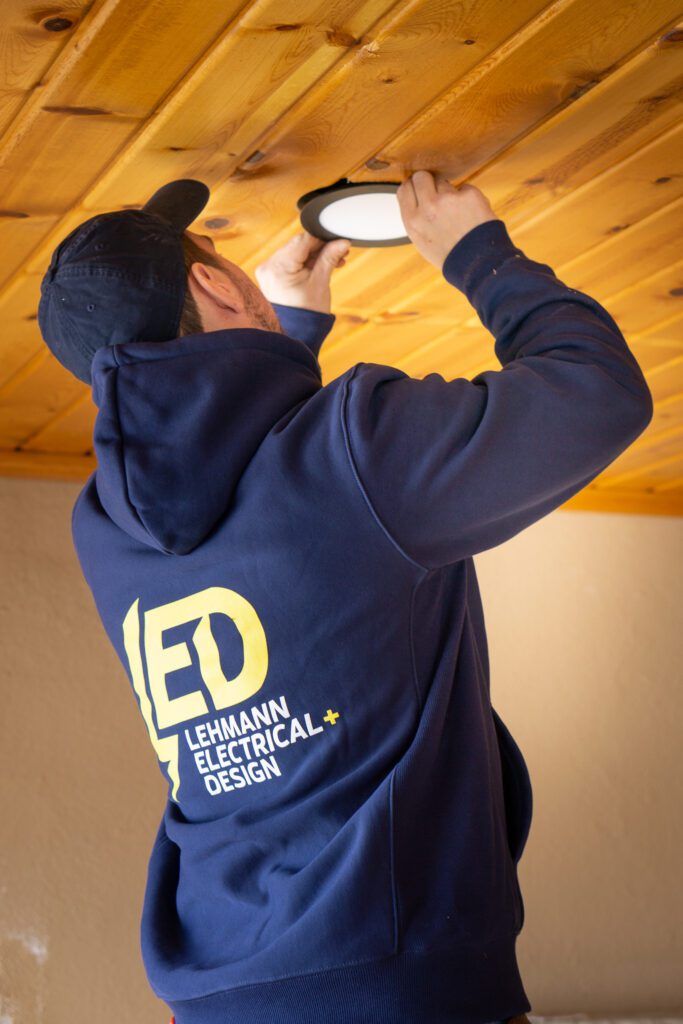
For failures all over the house, the visit starts at the panel: measuring the voltage on both halves with lights and appliances running, and checking the main neutral and its connections for looseness, heat or corrosion. If the problem is on the utility’s side, the electrician tells you so and what to ask the utility for. Under Wisconsin SPS 316, which adopts the 2023 NEC (in effect since September 1, 2026), new work in your panel follows the current edition, and your electrician will tell you whether it needs a permit from your municipality.
For a single fixture or circuit, the electrician checks the socket, the fixture’s wiring and the connections at the switch, and looks for heat damage. Depending on what turns up, the fix may be:
- Replacing a worn socket or a fixture whose socket and wiring have been damaged by heat.
- Replacing a dimmer with one listed as compatible with the LED bulbs you use.
- Replacing a fixture over a tub or shower with one listed for that damp or wet location.
- Replacing an old recessed housing with one rated for contact with insulation, or an LED retrofit designed for it.
- Remaking loose connections at switches and splices.
Our electrical repair service covers the full range of fixture, switch and wiring faults behind problems like this one.
Lehmann Electrical & Design is led by Jacob W. Lehmann, a Wisconsin master electrician, license 1283316, working under Wisconsin electrical contractor license 1492849. The company holds an A+ rating with the BBB, 4.9 stars on Google, and backs its work with a 12-month workmanship warranty.
Bulbs still burning out? Note which fixtures fail, how often, and whether other lights flicker or surge, then arrange a visit or call 414-207-0109. We find the cause and quote the repair before any work starts. We work across Milwaukee and Waukesha County.
Why homeowners call Lehmann Electrical & Design
- Led by licensed master electrician Jacob Lehmann
- A+ rating with the BBB and 4.9 stars on Google
- 12-month workmanship warranty on the work we do
- Permits pulled and inspections scheduled as part of the job
- Milwaukee, Wauwatosa and Waukesha County, from 12012 W Fairview Ave, Wauwatosa
Need a socket or fixture replaced?
We replace worn sockets and heat-damaged fixtures, fit LED-compatible dimmers, and check the panel when failures are house-wide.
Licensed master electrician. 12-month workmanship warranty.
Frequently asked questions
▾Why do light bulbs keep burning out in the same fixture?
When one fixture keeps killing bulbs, the cause is usually in that fixture: heat trapped in an enclosed globe or recessed can, vibration from a fan or opener, a worn socket contact, or a dimmer that does not suit the bulb. Check that the bulb is rated for the fixture and seated snugly. If correct bulbs still fail, or the socket looks discolored, have an electrician check the socket and wiring.
▾Why are all my light bulbs burning out?
Bulbs failing all over the house point to the electrical supply, not the bulbs. High voltage from the utility, or a loose or failing neutral connection at the service or panel, can push some circuits above their normal voltage. Watch for lights that seem too bright or that surge and dim when appliances start. Unplug sensitive electronics, contact your utility and call an electrician, because a failing neutral is a hazard.
▾Why do my LED light bulbs keep burning out?
LED bulbs usually fail early because their electronics run too hot, often in enclosed or recessed fixtures they are not rated for, or because they sit on a dimmer they do not suit. Cheap bulbs with small drivers are more vulnerable. Use LEDs rated for enclosed fixtures where needed, dimmable LEDs on compatible dimmers, and bulbs from established makers. If good LEDs still fail, have the circuit checked.
▾Why do my recessed light bulbs keep burning out?
Heat is the usual reason. A recessed can holds the bulb in a tight space with little air, and insulation around the housing traps more heat, which shortens the life of an LED bulb’s electronics. Use bulbs the packaging says are suitable for enclosed or recessed fixtures. If the light goes off and comes back on by itself, the housing’s thermal protector may be cutting power, and an electrician can check the housing and the insulation around it.
▾Does a light bulb smell when it burns out?
A bulb that simply burns out usually goes dark without any lasting smell. A burning or hot-plastic smell that lingers, or that comes from the fixture, the socket or the switch rather than the bulb, is a warning sign of overheating. Turn the light off, switch off its breaker if you can identify it, leave it off and call an electrician. Do not keep replacing bulbs in a fixture that smells.
▾Why do my bathroom light bulbs keep burning out?
Bathroom lights face heat, moisture and frequent switching together. Vanity globes and shower lights are often enclosed, so the bulb needs to be rated for enclosed fixtures, and moisture can corrode a socket over time. CFLs in particular lose life when switched on and off often. Under Wisconsin SPS 316, which adopts the 2023 NEC (in effect since September 1, 2026), a light fixture directly above a tub or shower, within 8 feet of the rim or threshold, must be listed for damp locations, or for wet locations where shower spray reaches it. If yours is not, an electrician can replace it.
▾Why do my light bulbs keep burning out in my ceiling fan?
Vibration is the usual reason. A fan shakes its light kit every time it runs, and more so if it wobbles, which shortens the life of incandescent filaments and cheaper LEDs. Use bulbs rated for ceiling fans and check that the fan is balanced and tight on its mount. Some fan light kits also have a wattage limiter that switches the light off when bulbs draw too much, which can look like a burnt-out bulb.
▾Why do my light bulbs keep blowing out with a pop?
When an incandescent filament breaks, it can arc for an instant inside the bulb, with a flash and a pop, and occasionally that trips the breaker. Once in a while, that is not alarming, and you can reset the breaker once; if it trips again, leave it off. If bulbs pop regularly, breakers trip, or a pop comes with a burning smell or scorch marks at the socket, stop using the fixture and have an electrician check the socket, wiring and supply voltage.
Next step
Get your lighting fault fixed
Tell us which lights fail and how often.
Licensed master electrician12‑month warranty4.9 on Google
Milwaukee, Wauwatosa and Waukesha County. Prefer to talk? Call 414-207-0109