Licensed master electrician · Call 414-207-0109
When your air conditioner kicks on, it draws a large surge of electricity for the first second or so. That surge can pull voltage down across your home, making lights dim or flicker briefly. A single quick flicker that stops within a second or two is usually normal. Flickering that repeats, lasts longer or is getting worse can signal a connection, wiring or capacity problem. If your lights dim and brighten with nothing starting up, or flicker when your neighbor’s AC runs, those cases are covered below too.
An air conditioner’s compressor draws several times its running current the moment it starts, and that surge briefly pulls the voltage down, so lights dim. One short dip per start is expected. Flickering that repeats, deepens or spreads through the house points at a connection, the circuit or the service itself.
- A dip shorter than a second, once per start, is normal behaviour.
- Flickering that has been getting worse over weeks is the one to act on.
- Lights that dim with nothing starting up point at the service or a loose neutral.
- A burning smell, buzzing or a warm switch plate means stop and call today.
If a switch plate, outlet or the panel is warm, smells hot or buzzes, or the flickering comes with a burning smell, stop using that circuit and call an electrician today.
What Usually Causes Lights to Flicker When the AC Starts
| Cause | What you notice | What to do |
|---|---|---|
| Normal compressor startup | One brief flicker, under a second | Nothing |
| LED bulbs or an older dimmer | Only LED fixtures flicker | Try LED-rated dimmers or bulbs |
| Loose connection at an outlet, switch or fixture | Flicker in one room or one fixture | Electrician inspection |
| Window AC sharing a circuit with lights | Lights on that circuit dim hard; breaker may trip | Dedicated circuit |
| Panel near its capacity | Several rooms dim; breakers trip | Electrician load evaluation |
| Loose or corroded service or main neutral connection | Lights brighten and dim across the house | Call an electrician promptly |
Normal startup. Inverter-driven (variable-speed) compressors ramp up gradually. Single-stage compressors start hard, so one brief flicker at startup followed by steady light is within normal range.
LED lights and older dimmers. LED bulbs react to voltage changes that incandescent bulbs averaged out. If flickering appeared after you switched to LED, the bulbs may be showing a small dip your old bulbs hid. Dimmers not rated for LED loads make it worse.
Loose connections. A loose connection at an outlet, switch or junction box can turn a minor dip into a visible flicker in one room. It is also a fire risk in its own right, whatever the flicker.
Shared or overloaded circuits. A central air conditioner is wired on its own dedicated 240-volt circuit, so it does not share with lights. A 120-volt window unit, though, often sits on a circuit with lights and outlets, and there its startup surge is much more visible; a dedicated circuit for the window unit is the fix. Some older Milwaukee-area homes also still have 60- or 100-amp service that was in place long before central air, which leaves the whole panel with little headroom.
Problems at the service entrance. Where the utility’s wires connect to your home, corroded or loose connections make voltage drop further than it should, affecting several rooms or the whole house.
Safe Checks When Lights Flicker With the AC
Safe to observe:
- Does the flicker happen only at AC startup, or randomly? Random flickering with nothing starting is a different problem.
- How many rooms are affected? One fixture points to a local issue; the whole house points to the panel or service.
- Is it getting worse over the summer or across seasons?
- Look at the panel from where you stand, without touching it. A burning or hot-plastic smell, buzzing, crackling or scorch marks mean call an electrician today.
- If a breaker has tripped, reset it once: push it firmly to OFF, then back to ON. If it trips again, leave it off and call an electrician.
Not safe to do yourself:
Do not remove the panel cover, touch the main breaker lugs or inspect wiring at the service entrance. Even with the main breaker off, the service conductors and the main breaker’s line-side connections stay energized, and a homeowner has no way to switch them off. Only the utility can, usually by pulling the meter.
Flickering getting worse, or spreading through the house?
A licensed electrician measures the voltage drop at startup, checks the connections at the panel and the service, and works out whether the circuit, the panel or the supply is behind it.
Licensed master electrician. 12-month workmanship warranty.
When Flickering Lights Point to a Bigger Problem
Lights brighten and dim across the house. Lights that cycle up and down, rather than flickering once, can mean a failing neutral connection at the service. With a compromised service neutral, the two 120-volt legs of your supply float: depending on the load on each side, one leg can rise above 120 volts while the other sags. That can damage electronics and appliances and create a fire risk, so it needs prompt attention.
Many rooms react to any large motor. If lights all over the house respond to the AC, the dryer or any big motor, the issue may be in the panel or at the utility connection rather than in one circuit.
It is getting worse. Deteriorating connections do not heal themselves; a minor problem one summer can be a hazard by the next.
Breakers trip when the lights flicker. A breaker tripping at AC startup means that circuit is pushed past its capacity. Never fit a larger breaker to stop the tripping: the breaker is sized to protect the wire, and a bigger one violates the conductor-protection rules (Section 240.4) of the 2023 NEC as adopted by Wisconsin SPS 316 (in effect since September 1, 2026). The fix is a correctly sized circuit, under a permit from your municipality.
Older wiring. Aluminum branch-circuit wiring (mainly 1965 to 1973) and knob-and-tube wiring (mostly before the 1950s) need specific connection methods. Mention either when you call, because it changes how an electrical inspection is done.
Any of these is worth an electrician’s visit rather than living with it.
What an Electrician Does About Flickering Lights
A licensed electrician diagnosing AC-related flicker typically works in this order:
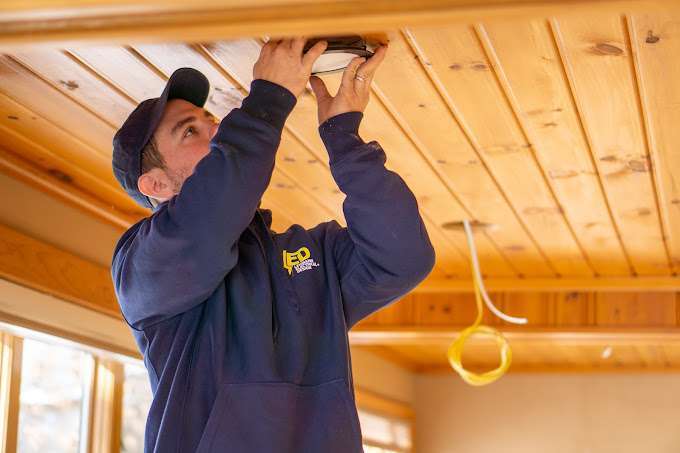
- Inspect the panel, service entrance connections and the wiring path to the AC for loose, corroded or undersized connections.
- Run a load calculation, a check of your home’s electrical demand against the panel’s rated capacity, to see whether there is enough headroom.
- Correct the circuit if a window unit shares a circuit with lighting or an AC circuit is undersized.
For LED lights that flicker because of voltage sensitivity, an electrician can fit an LED-compatible dimmer or confirm the fixture and bulb suit the circuit.
For the startup surge itself, a soft-start device on the compressor reduces the peak inrush. A hard-start kit works differently: it helps the compressor start faster, which can shorten the flicker, though how much it changes the peak depends on the kit. Both are usually HVAC technician work, and an electrician and HVAC tech working together can fix the flicker at its source.
If you are also planning other work, such as an outdoor outlet on the back of the house or new lights in the kitchen, living room, master bedroom or dining room, combining it into one visit is usually more efficient.
Why homeowners call Lehmann Electrical & Design
- Led by licensed master electrician Jacob Lehmann
- A+ rating with the BBB and 4.9 stars on Google
- 12-month workmanship warranty on the work we do
- Permits pulled and inspections scheduled as part of the job
- Milwaukee, Wauwatosa and Waukesha County, from 12012 W Fairview Ave, Wauwatosa
Ready to have it looked at?
Send which lights flicker, whether it happens only when the AC starts and how long the dip lasts. The electrician arrives knowing what to measure.
Licensed master electrician. 12-month workmanship warranty.
Frequently Asked Questions
▾Why do my lights flicker when I turn on my dryer?
A dryer, like an AC, is a high-current appliance, and its heating element or motor causes a brief surge that dips the voltage. One flicker at startup is normal. Repeated dimming, flickering in several rooms or a breaker tripping at the same time points to a loose connection, an undersized circuit or a panel near capacity.
▾Why do my LED lights flicker when the AC turns on, but my old bulbs did not?
The small electronics inside an LED react to voltage changes that an incandescent filament averaged out, so the same dip your old bulbs hid now shows as a flicker. An LED-rated dimmer, or a soft-start device on the AC compressor, often solves it without replacing fixtures.
▾Why do my lights flicker when my neighbor’s AC turns on?
Neighboring homes often share one utility transformer, so a large load starting next door can dip your voltage too. If it happens consistently and noticeably, report it to your utility (We Energies in most of the Milwaukee area). It can point to an overloaded transformer, a failing utility neutral or a loose service connection.
▾Why do my lights dim and brighten randomly, even when nothing starts up?
Random dimming and brightening is a different problem from startup flicker. It can mean a failing main (service) neutral connection or a deteriorating utility connection, or, if only one room is affected, a loose connection on that circuit. It deserves a prompt electrician visit, because a loose main neutral can damage appliances and create a fire hazard.
▾Why do my house lights flicker sometimes but not every time the AC runs?
Flicker that comes and goes often points to a loose connection that makes or breaks contact with temperature, vibration or load. A connection that holds on a cool morning can loosen slightly on a hot afternoon. Intermittent faults are harder to find, but they do not fix themselves, and an electrician with the right test equipment can track them down.
Next step
Tell us what the lights are doing
Send which lights flicker, whether it happens only when the AC starts and how long the dip lasts. The electrician arrives knowing what to measure.
Licensed master electrician12-month warranty4.9 on Google
Milwaukee, Wauwatosa and Waukesha County. Prefer to talk? Call 414-207-0109