Licensed master electrician · Call 414-207-0109
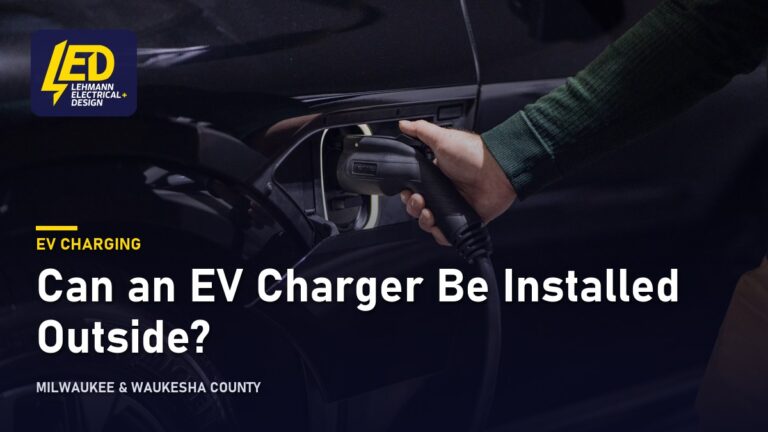
Yes. A Level 2 home EV charger can be installed outside, on an exterior wall or a post, as long as the charger is listed for outdoor use and the circuit, connection and mounting suit a wet location. Outdoor-rated chargers carry an enclosure rating such as NEMA 3R or NEMA 4. A plug-in charger needs a GFCI-protected outlet with a cover that stays weatherproof while plugged in. The installation needs a permit from your municipality.
When the garage is full, too small, detached or missing, the car lives on the driveway, and an outdoor charger is the normal answer. A Level 2 charger runs at 240 volts, several times faster than a standard 120-volt outlet, and it is built to sit outside through rain, snow and a Wisconsin January, provided the right unit goes in the right place.
What makes a charger suitable for outdoors
A charger is suitable for outdoors when it is listed for outdoor installation and its enclosure is rated to keep out rain, snow and ice. Check three things before you buy:
The listing. The charger should be listed by a nationally recognized testing laboratory, such as UL or Intertek (ETL), as electric vehicle charging equipment. The installation manual will say plainly whether outdoor installation is permitted.
The enclosure rating. NEMA ratings describe what an enclosure keeps out. These are the two you will usually see on outdoor chargers:
| Rating | What it protects against | Where it fits |
|---|---|---|
| NEMA 3R | Falling rain, sleet and snow, and damage from ice forming on the outside | An exterior wall, especially a sheltered one under an overhang |
| NEMA 4 | All of the above, plus wind-blown rain, splashing, and water directed from a hose in testing | Exposed walls, posts, and spots where snow is blown or washed |
Some chargers also list an IP rating, a separate international scale, such as IP65 or IP66. Either way, the higher protection is worth having on a wall that takes the weather head-on.
The operating temperature range. Every charger’s spec sheet lists the temperatures it is designed to run in. Milwaukee winters can drop below zero Fahrenheit. Outdoor-rated home chargers are designed for cold climates, but ratings vary by model, so confirm the low end of the range covers it.
The cable matters too. An outdoor charger needs a cable that stays flexible in cold weather and a holster or hook to keep the connector off the ground, out of puddles and away from snow.
Hardwired or plug-in outdoors
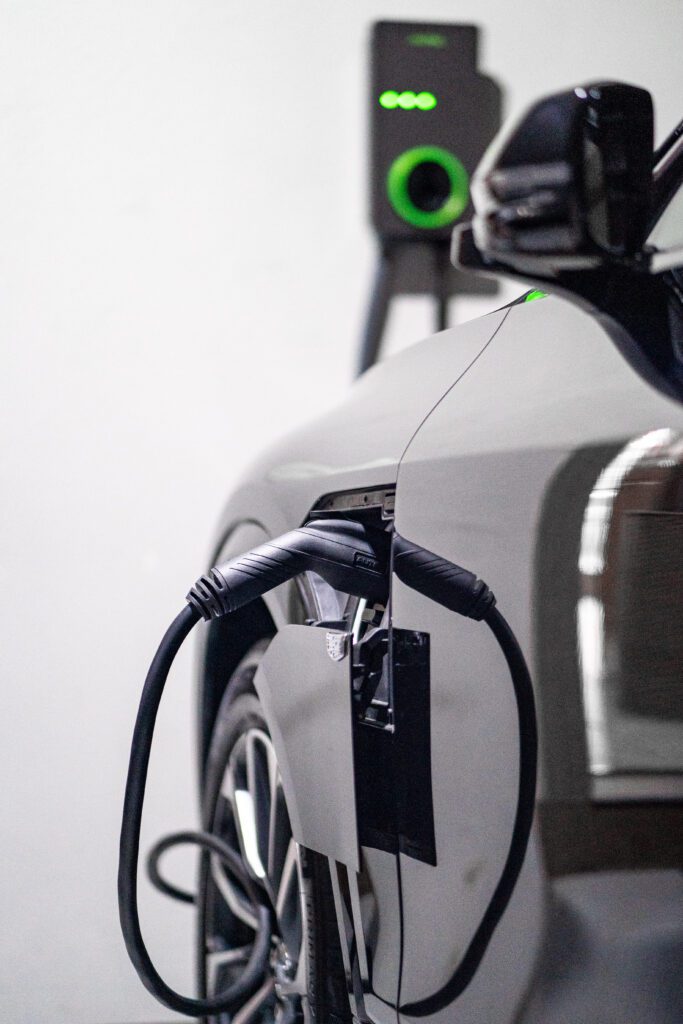
Outdoors, a hardwired charger is usually the cleaner choice, though a plug-in charger can work if the outlet and the charger are both suited to it. The difference is what connects the charger to the circuit.
| Hardwired | Plug-in (240-volt outlet) | |
|---|---|---|
| How it connects | Wired directly to the circuit | Plugs into a 240-volt outlet, often a NEMA 14-50 |
| Weather exposure | No plug or outlet to keep dry | The outlet needs a cover that stays weatherproof with the plug in |
| Circuit protection | Set by the electrician to the 2023 NEC adopted by Wisconsin SPS 316 and the charger’s manual | The outlet needs GFCI protection (NEC 625.54) |
| Manufacturer approval | Normally permitted outdoors if the unit is outdoor-rated | Some makers do not permit their plug-in version outdoors |
| Moving the charger later | Needs an electrician | Can be unplugged and taken with you |
Plug-in chargers outdoors. Under Wisconsin SPS 316, which adopts the 2023 NEC (in effect since September 1, 2026), a 240-volt outlet installed for EV charging, such as a NEMA 14-50, needs GFCI protection (NEC 625.54). GFCI stands for ground fault circuit interrupter, a device that cuts power when it detects current leaking by any path, including through water or a person. The outlet also needs a weatherproof cover that stays closed over the plug, often called an in-use or bubble cover. Check the charger’s manual too: some manufacturers allow their plug-in model outdoors and some require the hardwired version for an exterior wall.
Hardwired chargers outdoors. With no plug and outlet, there are fewer places for water to get in and nothing to work loose. Your electrician protects the circuit as the 2023 NEC adopted by Wisconsin SPS 316 and the charger’s installation manual require. A listed Level 2 charger also has its own built-in ground-fault protection. A charger, breaker or GFCI that keeps tripping points to a real fault or a failed device, not a normal mismatch, and our guide to an EV charger that keeps tripping explains the causes.
Either way, a Level 2 charger needs a dedicated EV charger circuit of its own, with the breaker sized for a continuous load, which under the 2023 NEC adopted by Wisconsin SPS 316 (NEC 210.20(A)) means the charger’s continuous current is no more than 80 percent of the breaker’s rating: a charger set to 32 amps belongs on a 40-amp circuit, and one set to 48 amps on a 60-amp circuit. Amps, or amperage, measure how much current flows.
Choosing the spot
The right spot is where the cable reaches the car’s charging port comfortably, the charger stays out of the snow and away from bumpers, and the run back to your panel is reasonable. Walk through these before anything is mounted:
- Cable reach. The cable has to reach the charging port wherever you actually park, without stretching across a walkway or being pulled tight. Check where the port is on your car, and on any car you might own next.
- Snow and ice. Keep the charger above the height that drifting or shoveled snow reaches, out of the path of a snowblower’s discharge and a plow’s windrow at the end of the drive, and away from a roof edge that drips and freezes.
- Bumpers. A charger at the head of a parking spot can be hit by a car pulling in. A wheel stop or a protective post solves that.
- The run to the panel. The farther the charger is from your electrical panel, the longer the wiring run, and the more wall, siding or ground it has to cross.
- Wi-Fi. A smart charger that schedules charging or reports usage needs a usable signal at the mounting spot. An exterior wall can be a weak spot for home Wi-Fi.
- Mounting height. The manufacturer’s manual sets a mounting height range, and your electrician checks it against the 2023 NEC adopted by Wisconsin SPS 316 as well.
- Access. An outdoor charger is visible from the street. Check whether the charger can be locked through an app or with a key, which stops anyone else from using it.
Inside or outside the garage? If the car is parked in the garage, a charger inside is sheltered and the cable stays warmer and more flexible. If the car lives on the driveway, a charger outside is the practical answer.
| Inside the garage | Outside, on a wall or post | |
|---|---|---|
| Weather | Sheltered | Needs an outdoor-rated unit |
| Cable in winter | Stays warmer and more flexible | Stiffer in deep cold |
| Where it reaches | Cars parked inside | Cars on the driveway or in front of the garage |
| Access by others | Behind a door | Visible; worth locking |
Detached garages and posts. A charger can also go on a post at the edge of the driveway or on a detached garage. Either one means a trench from the house, or a feeder to the garage’s own panel, so it is worth planning with everything else the garage will need. We cover that in power to a detached garage.
Charging outside through a Wisconsin winter
An outdoor-rated charger works through a Wisconsin winter, and the slowdown people notice in cold weather comes from the car’s battery, not the charger.
A cold battery cannot accept charge as quickly as a warm one, so the car uses some of the incoming power to warm the battery before charging at full speed. That makes cold-weather charging look slower on the dashboard, wherever the charger is mounted. If your car can warm the cabin and the battery while it is still plugged in, use that feature: the heat can then come from the grid rather than the battery.
> An outdoor EV charger is designed to be rained and snowed on. The charger and the car exchange a control signal, called the pilot, before the charger switches power to the connector, so the connector is not energized while it hangs in its holster. A damaged connector or cable should still be treated as live. What winter actually asks of you is housekeeping. Keep the connector in its holster with its cap on, knock snow off the charging port before plugging in, and route the cable so it is not left lying where a snowblower, a plow or a tire can catch it.
If the connector freezes into the car’s port, let it thaw rather than forcing it. Pulling hard on a frozen connector can damage the latch or the port.
Can you charge in the rain? Yes. Chargers and vehicle ports are built for it, and the safety checks before power flows apply in wet weather just as in dry. Do not use a charger whose cable or connector is cracked or damaged, in any weather. If you smell burning or hot plastic, see scorch marks or discoloration on the charger, outlet or plug, or hear buzzing or crackling, stop charging, switch the charger’s breaker off and call an electrician.
Permits and inspection
An outdoor EV charger needs an electrical permit from your municipality, whether that is Milwaukee, Wauwatosa, Waukesha or another town in the area.
Those municipalities enforce Wisconsin SPS 316, which adopts the 2023 NEC and has been in effect since September 1, 2026. The inspector checks the circuit and breaker sizing, the dedicated circuit, the outdoor rating of the charger, the outlet and its cover where there is one, GFCI protection on any outlet, the mounting, and the burial depth of any wiring run underground to a post or a detached garage. We go through the process in permits for an EV charger.
Planning to charge on the driveway?
Send us a photo of your panel and where you park, and we will plan the outdoor install.
Licensed master electrician. 12-month workmanship warranty.
What decides the cost
The cost of an outdoor EV charger installation is driven mostly by the distance from your panel and by what the wiring has to cross to get there. We do not publish a figure, because the same charger can be a short run through one wall or a trench across the yard.
| Factor | What it changes |
|---|---|
| Distance from the panel to the charger | Longer runs need more wire, and sometimes heavier wire to limit voltage drop |
| The route | Through a garage wall, along the siding in conduit, or underground to a post |
| Hardwired or plug-in | A plug-in setup adds an outlet rated for the location and a weatherproof in-use cover |
| Space and capacity in your panel | A free space keeps it simple; a full or undersized panel may need a load management device or an upgrade |
| Post or detached garage | Trenching, a post or a feeder add work |
| The charger itself | Outdoor-rated units with higher enclosure ratings can cost more |
| Permit and inspection | Required, and scheduled with your municipality |
If your panel is the open question, our home EV charger installation service starts with a load calculation to confirm it has the capacity for the charger.
> An outdoor charger is priced by its route, not by its location on the house. Two installations a few feet apart can differ a great deal because one sits on the far side of the garage wall from the panel and the other needs a run across the house or a trench. When you ask for a quote, the useful details are where your panel is, where you park, which charger you have in mind, and any other large loads you plan to add.
Lehmann Electrical & Design is led by Jacob W. Lehmann, a Wisconsin master electrician, license 1283316, working under Wisconsin electrical contractor license 1492849. The company holds an A+ rating with the BBB, 4.9 stars on Google, and backs its work with a 12-month workmanship warranty.
Our EV charger installation work covers outdoor walls, posts and garages, including the panel work behind them.
Planning an outdoor charger? Take a photo of your panel and the spot where you park, and request a quote or call 414-207-0109. We work across Milwaukee and Waukesha County.
Why homeowners call Lehmann Electrical & Design
- Led by licensed master electrician Jacob Lehmann
- A+ rating with the BBB and 4.9 stars on Google
- 12-month workmanship warranty on the work we do
- Permits pulled and inspections scheduled as part of the job
- Milwaukee, Wauwatosa and Waukesha County, from 12012 W Fairview Ave, Wauwatosa
Want it done right the first time?
We check your panel capacity, pick the mounting spot with you, and handle the permit and inspection.
Licensed master electrician. 12-month workmanship warranty.
Frequently asked questions
▾Does an outdoor EV charger need a cover?
A charger that is rated for outdoor use does not need a separate cover; its enclosure is the weather protection. A plug-in charger’s outlet is different: it needs a weatherproof cover that stays closed with the plug inserted, often called an in-use or bubble cover. Keeping the connector in its holster with its cap on protects it from snow and ice.
▾Can you charge an EV outside in the rain?
Yes. Outdoor chargers and vehicle charging ports are designed for rain and snow, and the connector carries no power until the charger and the car confirm they are connected. Keep the connector in its holster when it is not in use, and never use a charger whose cable or connector is cracked or damaged, whatever the weather.
▾Do EV chargers work in cold weather?
An outdoor-rated charger is built to run in cold weather within the temperature range on its spec sheet, so check that range against a Wisconsin winter. Charging can look slower in the cold because the car spends some power warming its battery first. Warming the car while it is still plugged in draws that energy from the grid rather than the battery.
▾Does an outdoor EV charger need GFCI protection?
A plug-in charger does. Under Wisconsin SPS 316, which adopts the 2023 NEC, a 240-volt outlet installed for EV charging, such as a NEMA 14-50, needs GFCI protection (NEC 625.54). A hardwired charger connects without a receptacle, and your electrician protects its circuit as the 2023 NEC adopted by Wisconsin SPS 316 and the charger’s installation manual require. A listed Level 2 charger also has its own built-in ground-fault protection.
▾Should an EV charger be inside or outside the garage?
Put the charger where the car is actually parked. If the car is in the garage, inside keeps the charger and cable sheltered and warmer in winter. If the car is on the driveway, an outdoor-rated charger on the outside wall or a post is the practical choice. The distance back to your electrical panel also affects which spot makes more sense.
▾Can an EV charger be mounted on a post?
Yes. A post-mounted or pedestal charger is a good fit where the driveway is far from the house or the garage is detached. It needs an outdoor-rated charger, a wiring run underground in a trench, and a permit. Plan the trench with any other power the driveway or garage might need, so it is only dug once.
Next step
Get your outdoor charger quoted
Tell us where you park and your panel size.
Licensed master electrician12‑month warranty4.9 on Google
Milwaukee, Wauwatosa and Waukesha County. Prefer to talk? Call 414-207-0109