Licensed master electrician · Call 414-207-0109
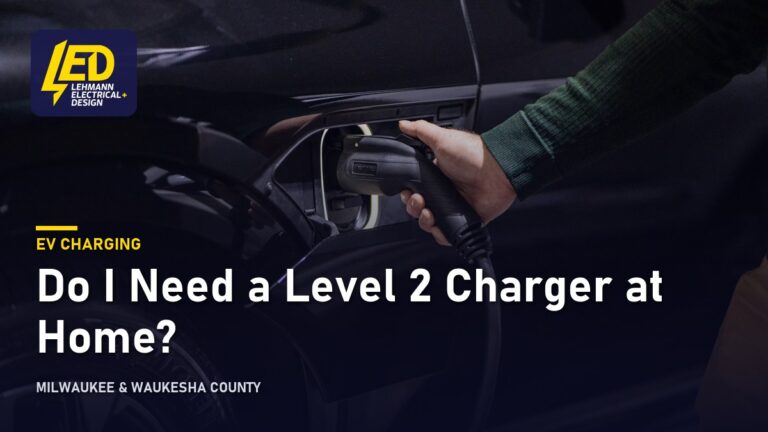
If you drive a full battery-electric vehicle more than about 40 miles a day, a Level 2 charger at home is usually the right call. Level 1 charging from an ordinary 120-volt outlet adds only a few miles of range per hour, which falls behind a normal commute by midweek. Level 2 runs on a dedicated 240-volt circuit and refills most batteries overnight. Plug-in hybrid owners, by contrast, are often fine on Level 1.
What the job actually involves
Installing a Level 2 charger means running a new dedicated 240-volt circuit from your electrical panel to the parking spot, with nothing else sharing that circuit. A licensed electrician does the work: it involves opening the panel cover, landing conductors on a new two-pole breaker, and in many houses working near the service entrance, the point where the utility’s wires enter the building. Those service conductors and the main breaker’s line-side lugs stay energized even with the main breaker switched off, which is one of several reasons this is not homeowner work.
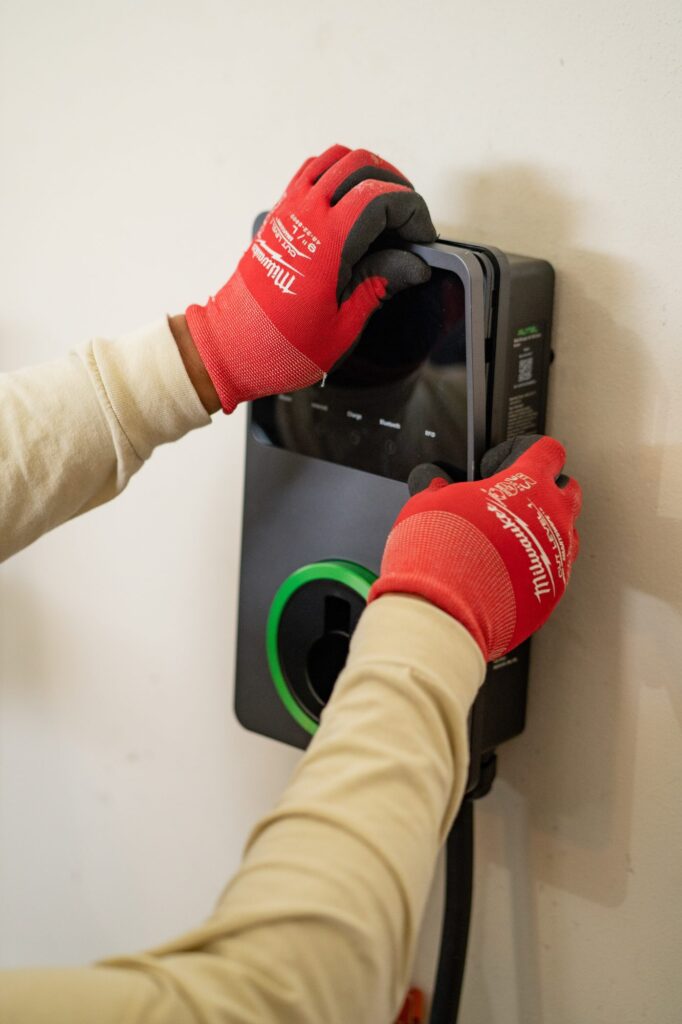
A typical installation looks like this:
- A load calculation. This is an arithmetic check of what the existing panel already supplies (range, dryer, air conditioning, water heater) against the service size, to find out how much spare capacity is left for a charger.
- Selecting the circuit size. Charger amperage, the current the circuit carries, is chosen from the spare capacity available. Common residential choices are 20, 30, 40, 50, or 60 amps.
- Running cable or conduit from the panel to the mounting location, which may mean a basement ceiling, an attached garage wall, a crawl space, or an outdoor run to a detached garage.
- Mounting and terminating the charger, or installing a NEMA 14-50 receptacle if you are using a cord-and-plug unit.
- Permit, inspection, and commissioning.
Wisconsin SPS 316, which adopts the 2023 NEC (in effect since September 1, 2026), requires EV supply equipment to be supplied by its own individual branch circuit with no other outlets on it (NEC 625.40). That is a common reason the “just add it to the dryer circuit” idea does not survive contact with an electrician. Our overview of EV charger installation covers the full range of what the work can include.
Who supplies the charger? Either way works. Many homeowners buy the unit themselves, often because the automaker bundles or discounts one, and the electrician installs it. Others ask the electrician to supply and install. Decide before the quote, because it changes the material line and because a hardwired unit and a plug-in unit need different terminations. If you are buying it yourself, confirm the model and its maximum amperage before the site visit so the circuit is sized for the equipment you actually own.
How to tell if you need it
Work out your real daily miles, then compare them against what Level 1 can replace overnight. That single comparison answers the question for almost everyone.
Level 1 is a cord that plugs into an ordinary 120-volt household outlet. It draws about 12 amps, roughly 1.4 kW, which is the practical ceiling on a 15-amp circuit. A 2016 US Department of Energy fact sheet put that at 2 to 5 miles of range per hour, and the physics has not changed since: at 1.4 kW, a 12-hour overnight stretch returns roughly 15 to 17 kWh before losses, which is about 40 to 55 miles in an efficient car and noticeably less in a truck or SUV, or in a Wisconsin February.
Level 2 uses a 240-volt dedicated circuit, the same voltage class as an electric dryer or range. The same 2016 DOE sheet put Level 2 at 10 to 20 miles per hour, but that figure reflects the 16 to 32 amp equipment common at the time. Today’s 40 and 48 amp circuits deliver roughly 9.6 to 11.5 kW, which lands nearer 25 to 40 miles of range per hour. Your actual rate is capped by whichever is lower, the circuit your panel can support or the car’s onboard charger.
| Level 1 | Level 2 | |
|---|---|---|
| Voltage | 120 V | 240 V |
| Typical current | 12 A (about 1.4 kW) | 24 A to 48 A (5.8 to 11.5 kW) |
| Circuit | Existing 15 A or 20 A outlet | New dedicated circuit |
| Range added per hour | about 2 to 5 miles | about 15 to 40 miles, depending on amperage |
| Overnight (12 hours) | about 40 to 55 miles in an efficient car, less in a truck | typically a full battery |
| Permit in Wisconsin | Not needed if you use an existing, adequate outlet; a new 120 V receptacle run for charging does need one | Yes, from your municipality |
| Best for | Plug-in hybrids, short commutes | Most full EVs |
Here is the plain test. If your daily driving is under about 40 miles, you park at home for 10 or more hours, and your battery is small, Level 1 is genuinely enough and you can skip the install. If you drive more than that, if two drivers share one charger, if you take weekend trips and come home near empty, or if your car has a 70 to 100 kWh battery, Level 1 will fall behind and never catch up during the week.
A few more signals that point to Level 2:
- You rely on a garage outlet that also feeds a freezer, a workbench, or the garage door opener. A 12-amp continuous draw uses the entire continuous allowance of a 15-amp circuit, so there is nothing left for anything else on it.
- You own a Tesla, Rivian, F-150 Lightning, or similar long-range vehicle. Manufacturers assume Level 2 at home.
- Cold weather matters here. A Wisconsin February costs real range to battery preconditioning and cabin heat, and Level 1 has no headroom to absorb that.
- You want to charge on off-peak hours. Level 2 finishes inside a narrow overnight window; Level 1 cannot.
Plug-in hybrids are the honest exception. A PHEV typically carries a battery in the 8 to 18 kWh range, and most accept something in the neighborhood of 3.3 to 7.2 kW rather than the 11 kW a full EV will take. Check your owner’s manual for the actual figure. A standard outlet refills that battery overnight, and a Level 2 charger will not make the gas engine any less necessary on a long trip. Many PHEV owners do not need Level 2. The reasons to install one anyway are if you drive the electric range down twice a day, if you share the garage with a full EV, or if you expect your next car to be fully electric.
What decides the price
Four things move the number more than the charger itself: distance, path, panel capacity, and amperage.
Distance from the panel to the parking spot. A charger mounted on the far side of a basement wall from the panel is a short run. A detached garage 60 feet across a yard means trenching, conduit, and considerably more labor and material.
The route. A finished basement ceiling, plaster walls, a slab floor, or a masonry exterior all add time. An unfinished basement or an open attached-garage stud bay is the easy case.
Spare capacity in the existing panel. The load calculation decides whether a 60-amp circuit is available or whether 30 amps is the realistic answer. This is also why no electrician can quote a charge rate over the phone.
Amperage and wire size. Bigger circuits need bigger conductors and bigger breakers. Typical residential pairings:
| Charger output | Breaker | Copper conductor (typical) | Approx. power |
|---|---|---|---|
| 16 A | 20 A | 12 AWG (at its 20 A limit; voltage drop is unforgiving on long runs) | 3.8 kW |
| 24 A | 30 A | 10 AWG | 5.8 kW |
| 32 A | 40 A | 8 AWG | 7.7 kW |
| 40 A | 50 A | 6 AWG | 9.6 kW |
| 48 A | 60 A | 6 AWG, with 75 degree C rated terminations | 11.5 kW |
Those pairings are not conservative padding. EV charging is a continuous load, meaning three hours or more at full current, and a branch circuit’s breaker must be rated at no less than 125 percent of the continuous load (NEC 210.20(A)). Put another way, a continuous load may occupy no more than 80 percent of the breaker’s rating. A 48-amp charger on a 60-amp breaker is the correct pairing and will not trip from the charging load itself, though a wiring fault or a failed breaker can still trip any circuit. Oversizing the breaker to stop nuisance tripping is never the answer, because the breaker protects the wire.
Exact wire size also depends on run length (voltage drop), conductor material, insulation rating, and whether the cable is in conduit, underground, or in a hot attic. Treat the table as the starting point an electrician then verifies, not the final spec.
We do not publish installation prices, because an honest figure depends on the four variables above. A site visit or clear photos of your panel and parking spot produce a real number.
How long it takes and what is disrupted
Most straightforward installations are a single day, often half a day. A short run from a basement panel to an attached garage wall can be finished in three to five hours including cleanup.
What that day looks like:
- Power may be off briefly while the new breaker goes in, depending on the installer’s safe-work practice and the panel. It is not an all-day outage. If you work from home, mention it when scheduling and the crew will tell you when to expect it.
- There is drilling and some noise. Dust is contained, but a finished-ceiling route may mean small access holes that get patched.
- Vehicles come out of the garage for the day.
- Inspection happens after the work, usually on a separate visit scheduled by the municipality.
Longer jobs: a detached garage with trenching can run two days, sometimes split across a week if the ground is frozen or a utility locate request is pending. Late fall and winter trenching in southeastern Wisconsin is slower and occasionally has to wait. If a charger matters before the snow, earlier scheduling is simply more practical. Our home EV charger installation work covers both the simple garage runs and the awkward detached ones.
One note on cable length while you are choosing a mounting spot. Level 2 chargers typically ship with an 18 to 25 foot cable. Measure from the proposed mounting point to your vehicle’s charge port with the car parked the way you actually park it, nose-in or backed in. Getting the mounting location right costs nothing before the install and is expensive to change after.
Weighing up whether Level 2 is worth it?
A licensed electrician tells you what your panel can support before you buy a charger, which is the constraint most people meet last.
Licensed master electrician. 12-month workmanship warranty.
Permits and inspection
Yes, a Level 2 charger installation needs a permit. A new 240-volt branch circuit is permitted electrical work, and permits are issued by your local municipality (Milwaukee, Wauwatosa, Brookfield, Waukesha, and the rest), which enforces Wisconsin SPS 316. SPS 316 adopts the 2023 NEC and has been in force since September 1, 2026. Work permitted before that date was done under the 2017 NEC, and existing installations do not have to be brought up to the new edition unless they are altered.
The inspection is a good thing, not a hurdle. An inspector checks conductor sizing, breaker rating, grounding and bonding, the dedicated-circuit requirement, and the equipment listing. If a seller, insurer, or future buyer ever asks about the charger, a closed permit is the document that answers them. Unpermitted 240-volt work has a way of becoming a problem at closing.
Your electrician normally pulls the permit, schedules the inspection, and meets the inspector. You should not have to touch that process.
Before you buy, check the utility side too. We Energies and the other utilities serving southeastern Wisconsin have at times offered EV charging rate options and equipment programs for residential customers, and the terms change. Those programs are worth a look before you commit to a charger model, because some are tied to specific metering arrangements or require a networked unit. Check your utility’s current EV page directly, since we cannot vouch for what is on offer on any given day. Rate plans and rebates do not change the wiring, but they can change which charger makes sense.
Choosing an electrician
Ask for three things: a current Wisconsin license, written confirmation that they pull the permit, and a load calculation before they quote an amperage. Anyone who names a charge rate without having seen your panel is guessing.
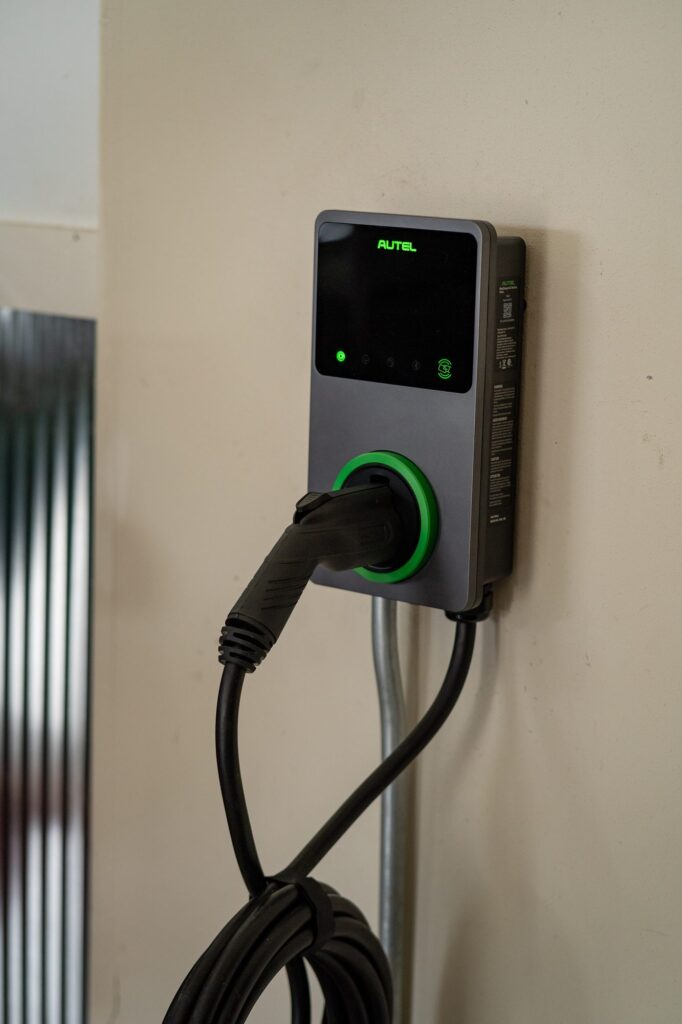
Worth asking about as well:
- Will they do the work on a dedicated circuit, per NEC 625.40, rather than sharing an existing one?
- Do they handle inspection scheduling?
- Is the charger hardwired or plug-in, and do they explain the tradeoff?
- Do they supply the unit, or do you?
- What does the workmanship warranty cover, and for how long?
Lehmann Electrical & Design is led by master electrician Jacob Lehmann, holds an A+ rating with the BBB, and is rated 4.9 stars on Google. Our work carries a 12-month workmanship warranty. For Tesla owners, Tesla charger installation has its own considerations around the Wall Connector and wiring for future load sharing.
One last word on doing it yourself. Plenty of online guides make this look like a weekend task. The reason to hand it over is not difficulty, it is that the service conductors and the main breaker’s line-side lugs stay energized with the main breaker switched off. A homeowner has no way to de-energize them. Only the utility can, usually by pulling the meter, or a separate service disconnect if one is fitted ahead of the panel.
Why homeowners call Lehmann Electrical & Design
- Led by licensed master electrician Jacob Lehmann
- A+ rating with the BBB and 4.9 stars on Google
- 12-month workmanship warranty on the work we do
- Permits pulled and inspections scheduled as part of the job
- Milwaukee, Wauwatosa and Waukesha County, from 12012 W Fairview Ave, Wauwatosa
Want to know what your panel will take?
Tell us your car, your daily mileage, and the amp rating on your panel.
Licensed master electrician. 12-month workmanship warranty.
Frequently asked questions
▾Is Level 1 or Level 2 charging more efficient?
Level 2 is somewhat more efficient. Every charging session loses some energy to the onboard charger, battery conditioning, and cooling, and those overheads run for the whole session. Because Level 2 finishes in a fraction of the time, less energy is spent on overhead and more goes into the battery. The gap is modest rather than dramatic, and we have not seen a figure we would quote as fact. It is not a reason on its own to install Level 2.
▾Is Level 1 or Level 2 charging faster?
Level 2, by a wide margin. Level 1 at about 12 amps on 120 volts delivers roughly 1.4 kW. A 40-amp Level 2 circuit delivers about 9.6 kW, close to seven times as much, and a 48-amp circuit about 11.5 kW. In practice that is the difference between adding a few miles an hour and refilling most of a battery overnight. Your car’s onboard charger sets the upper limit regardless of circuit size.
▾What do I need to install a Level 2 charger at home?
You need spare capacity in your electrical panel, confirmed by a load calculation, a dedicated 240-volt circuit sized for the charger, a mounting location within cable reach of your charge port, a permit from your municipality, and a licensed electrician. The charger itself is often the least complicated part. Panel capacity is what determines the amperage you can actually run.
▾How long does it take a Level 2 charger to charge an EV?
That depends on battery size and circuit amperage, which is why no honest answer comes without seeing your panel. As a rough guide, a 40-amp circuit delivering about 9.6 kW refills a 75 kWh battery from 20 percent to 80 percent in roughly four to five hours. A 30-amp circuit delivers about 5.8 kW, so the same charge takes roughly 65 percent longer. Most overnight parking windows are long enough either way.
▾Do I need a permit to install a Level 2 EV charger?
Yes. Installing a new 240-volt branch circuit is permitted work, and the permit comes from your local municipality, which enforces Wisconsin SPS 316 (adopting the 2023 NEC, in force since September 1, 2026). Your electrician should pull the permit and meet the inspector. A closed permit is also what documents the installation for insurers and future buyers.
▾Can I just use the dryer outlet?
No. Wisconsin SPS 316, adopting the 2023 NEC, requires EV supply equipment to be on its own individual branch circuit with no other outlets (NEC 625.40). Splitters and interlock devices sold online do not satisfy that. A dryer circuit is also typically 30 amps, which would limit you to a 24-amp charger even if sharing were permitted.
▾What if the breaker trips after installation?
A correctly sized charger circuit should not trip from normal charging. Push the breaker firmly to OFF then back to ON once. If it trips again, leave it off and call an electrician. If you notice a burning or hot-plastic smell, scorch marks, discoloration, buzzing, or crackling at the charger, outlet, or panel, stop using the circuit, leave the breaker off, and call right away. Do not touch anything to judge temperature.
Get a real answer for your house. A short site visit tells you exactly what amperage your panel supports, where the charger should mount, and what the install will cost, with the permit handled. Request an estimate or call 414-207-0109.
Next step
Get the panel checked
Tell us your car and the amp rating on your panel.
Licensed master electrician12‑month warranty4.9 on Google
Milwaukee, Wauwatosa and Waukesha County. Prefer to talk? Call 414-207-0109