Licensed master electrician · Call 414-207-0109
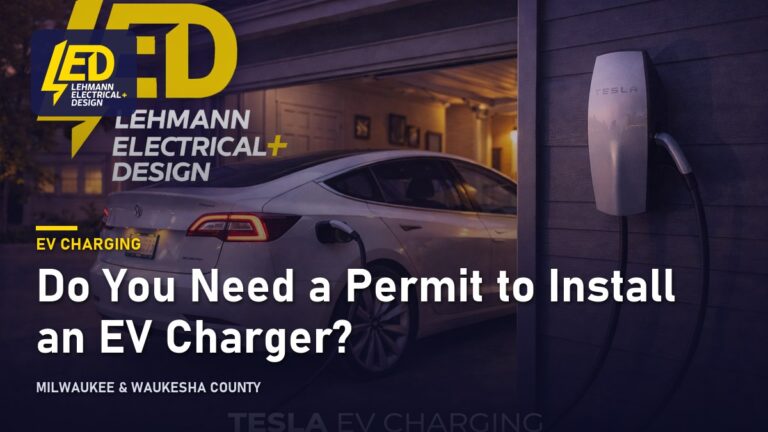
Yes. In Milwaukee and Waukesha County, installing a Level 2 EV charger means adding a new 240-volt circuit, and that is permitted electrical work in the municipality where the house sits. Your city or village issues the electrical permit and inspects the finished circuit. The permit is normally pulled by the licensed electrician doing the work, not by the homeowner, and it is usually a straightforward part of the job rather than an obstacle.
What the job actually involves
An EV charger installation is really a circuit installation with a charger on the end of it. Most homeowners buy a Level 2 charger, which runs on 240 volts and charges several times faster than a standard wall outlet. That charger needs its own dedicated circuit, meaning nothing else shares it, as set out in NEC 625.40 and carried into Wisconsin by SPS 316, which adopts the 2023 NEC (in effect since September 1, 2026).
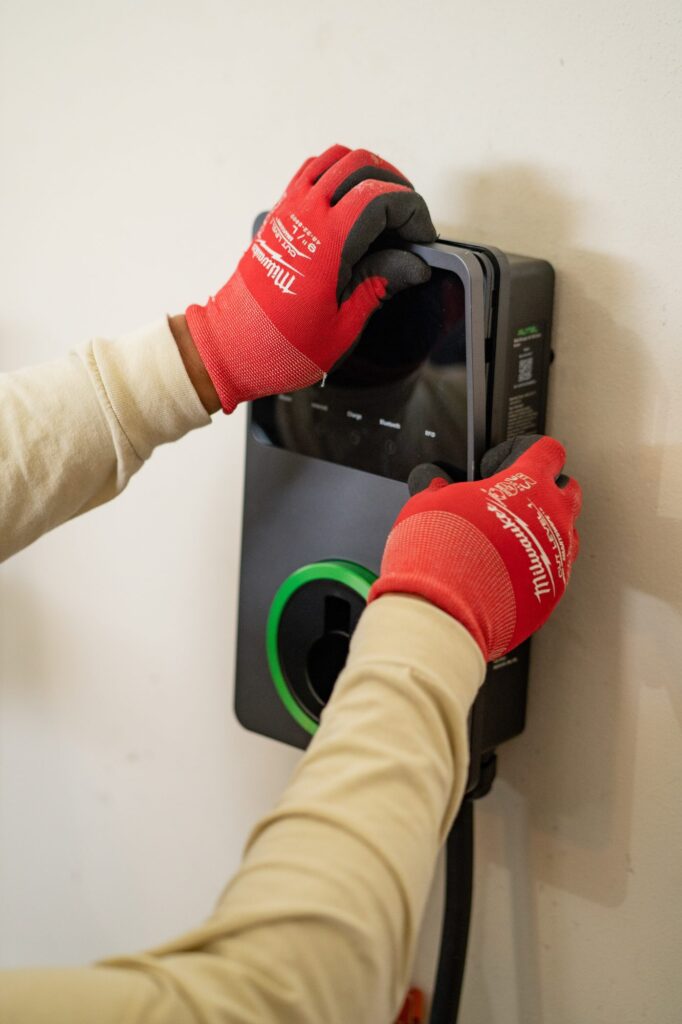
The work breaks down into a few clear stages:
- A load calculation. This is an arithmetic check of what the home’s electrical service can support once the charger is added, based on the size of the service, the square footage, and the fixed appliances already connected. The service is the incoming supply from the utility, and the load calculation decides the largest charger circuit the house can safely take.
- Finding a spare position in the panel. A 240-volt charger circuit occupies two adjacent breaker spaces. If the panel is full, options include a tandem breaker where the panel is listed for one, or reworking existing circuits.
- Running the cable. From the panel to the charger location, through a basement joist bay, up a wall, along a garage ceiling, or in conduit on a masonry wall.
- Mounting and terminating the charger, either hardwired or on a 240-volt receptacle, depending on the unit and the location.
- Permit, inspection, and sign-off with the municipality.
All of the panel work happens inside an enclosure where the incoming service conductors stay energized even with the main breaker switched off. A homeowner cannot de-energize those conductors. The utility can, usually by pulling the meter, and a separate service disconnect ahead of the panel can do it if one is fitted. That is the plain reason a licensed electrician does this part, and it is not a safety formality. The rest of the trade knowledge, conductor sizing, breaker selection, and the permit itself, follows from the same place. For a full picture of how a residential job runs from the first call to the final inspection, our home EV charger installation work follows the same sequence on every house.
How to tell if you need a permit, and what else you might need permission for
Assume a permit is required, then confirm the details with the municipality. Three separate questions get mixed together in homeowner enquiries, and they have different answers.
Do you need an electrical permit? Yes, for a new 240-volt branch circuit. Permits are issued by the local municipality, Milwaukee, Wauwatosa and Waukesha each issuing their own, all enforcing Wisconsin SPS 316. The permit is applied for on the basis of the circuit and its rating rather than the brand of charger, though the inspector will still expect the charger itself to be a listed product installed the way its listing allows.
Do you need a building permit? Generally not for a typical garage installation. A building permit covers structural and envelope work. If the install requires cutting a new opening through an exterior wall, building a pedestal outside, or trenching to a detached garage, additional permits or approvals may come into play. Your electrician will tell you after seeing the site.
Do you need permission from anyone else? This one catches people out. If you rent, you need the owner’s written permission. In a condominium or a homeowners association, the exterior wall, the garage slab, and sometimes the electrical service are common property, and the association’s rules govern what you may attach and where. If you share a parking structure, the electrical supply to your stall may not be yours to use. None of this is code, it is property law and contract, and it is worth settling before anyone quotes the work.
> A permit is not a tax on your project. It is the mechanism that puts a municipal inspector in your garage to confirm the conductor size matches the breaker, the circuit is dedicated, the connections are tight, and the equipment is installed the way it was listed to be installed. If the circuit is ever involved in a fire or an insurance claim, the permit record is the evidence the work was inspected. Unpermitted electrical work also tends to surface at the worst possible moment, during a home sale, when a buyer’s inspector finds a 240-volt circuit with no record behind it.
Can you install your own EV charger?
Plugging a portable Level 1 cord into an existing, properly grounded 120-volt outlet is just using an appliance. Nobody needs a permit for that. Installing a Level 2 charger is different: it means a new circuit, work inside the panel, and an inspection.
Whether a homeowner may do this work on their own home is a question for your municipality’s building department, not something to take from a blog post, and the permit and the inspection apply either way. Some associations and insurers take their own view on top of that.
The practical caution is separate from all of that. We do not publish instructions for panel work and we will not describe it as something to attempt, because the hazard is concentrated in the part of the job that looks simplest, landing two conductors on a breaker. The line side of the main breaker cannot be switched off from inside the house, no matter who is holding the screwdriver. An undersized conductor or a loose termination on a 240-volt circuit that runs for hours at a time is exactly the fault that shows up later as heat.
What decides the price
The charger itself is often the smallest line in the quote. What moves the number is the circuit.
| Factor | Why it changes the cost |
|---|---|
| Distance from panel to charger | Every foot of 240-volt cable, conduit, and fastening adds material and labor. A charger on the garage wall next to the panel is the cheapest case there is. |
| Finished vs. unfinished route | Open basement joists and exposed garage framing are quick. Fishing cable through finished walls and ceilings, or drilling through masonry, is slow. |
| Detached garage | A separate structure may need a buried feeder, a trench, and its own small subpanel. On a job of this type, that is usually the largest single cost on the estimate. |
| Spare capacity in the panel | If the load calculation shows room and the panel has two open spaces, the work is simple. If not, the circuit may have to be sized smaller, or other work is needed first. |
| Circuit size | A 60-amp circuit uses heavier conductors than a 40-amp circuit. Bigger is not automatically better if your car cannot use the extra. |
| Hardwired vs. receptacle | A 240-volt receptacle adds a device and a box. Some chargers and some locations require hardwiring. |
| Permit and inspection fees | Set by your municipality, not by the electrician. |
On circuit size, the sizing rule matters and it surprises people. A branch circuit’s breaker must be rated at no less than 125 percent of a continuous load, which is the same as saying a continuous load may occupy no more than 80 percent of the breaker’s rating (NEC 210.20(A), unchanged in the 2023 NEC that Wisconsin adopts through SPS 316). A continuous load is one defined as running three hours or more at its maximum current, and EV charging is treated that way. So a 32-amp charger belongs on a 40-amp circuit and a 48-amp charger on a 60-amp circuit.
| Charger setting | Correct circuit | Notes |
|---|---|---|
| 24 A | 30 A | Common on smaller panels and plug-in units |
| 32 A | 40 A | A frequent middle setting on home units |
| 40 A | 50 A | |
| 48 A | 60 A | Usually hardwired, and needs real spare capacity |
Those pairings are correct and they do not trip. Breakers trip above their rating, following their trip curve, not at 80 percent of it.
What this means practically: the amperage your charger can be set to depends on what your panel’s spare capacity allows after the load calculation, so nobody can promise you a specific charge rate before looking at your service. A good electrician will tell you the largest circuit your home supports and let you decide whether a smaller one gets your daily miles back overnight anyway. For most commuters it does.
We quote per house rather than publishing a price here, because the circuit is the variable and we would rather look at yours. Our EV charger installation estimates are itemized so you can see which part of the cost is the circuit and which is the equipment.
How long it takes and what is disrupted
A straightforward attached-garage installation is typically a single visit of a few hours, with a separate inspection afternoon or morning scheduled afterward by the municipality. More involved jobs, a detached garage with a trench, a long run through finished space, or a panel that needs circuits rearranged, can run to a full day or two.
What actually gets disrupted:
- Power. Your electrician may need to kill power to the panel to land the new circuit. Ask in advance how long that will be, so you can plan around a home office, a freezer, or a medical device.
- Access. The electrician needs clear access to the panel and the charger location. Moving boxes away from the panel wall and clearing a car out of the garage before the crew arrives saves real time.
- Walls and ceilings. A fished cable sometimes needs small access holes. Ask at the estimate who patches them and whether patching is in the quote.
- Noise and dust. Drilling through masonry or a rim joist is loud for short bursts. Concrete coring or trenching for a detached garage is a bigger event.
- Your schedule after the install. Whether the charger can be used before the inspector has signed off is a question for your municipality and your electrician. Some jurisdictions are comfortable with the circuit energized and the inspection following; others are not. Ask before you plan a trip around it.
If you own a Tesla and expect a Wall Connector, the sequence above is identical, with the unit’s own commissioning and amperage settings configured at the end. We work on them regularly as a Tesla charger installer, which is a description of the work rather than a Tesla certification.
Want the permit handled as part of the job?
We pull it in your municipality and book the inspection, so the circuit ends up on the record rather than in a future buyer’s report.
Licensed master electrician. 12-month workmanship warranty.
Permits and inspection, step by step
Here is how the paperwork actually flows on a residential EV charger job in our service area.
- The electrician applies. A licensed electrical contractor pulls the permit in the municipality where the house is located, listing the new circuit and its rating. Lehmann Electrical & Design works under Wisconsin electrical contractor licence 1492849.
- The municipality issues it. Turnaround varies by municipality, and some run the whole thing through an online portal. This is one reason an electrician who already works in your city matters: they know the local process and the local inspector.
- The work is done to the standard in force. That standard is Wisconsin SPS 316, which adopts the 2023 NEC, in effect since September 1, 2026. Work permitted before that date was done under the 2017 NEC, and an existing installation does not have to be brought up to the newer edition unless it is being altered.
- The inspection happens. A municipal inspector checks the breaker and conductor sizing, the dedicated circuit, the grounding, the terminations, and the charger’s mounting and listing. Some inspectors want to see the run before it is closed up, which is why routing matters to scheduling.
- The record closes. The permit is signed off and the installation exists in the municipal record, which is what a future buyer’s inspector or an insurer will look for.
One caution worth stating plainly: if you ever notice a burning or hot-plastic smell, scorch marks, discoloration, buzzing, or crackling at the panel, the charger, or the receptacle, stop using the circuit, leave the breaker off, and call an electrician. Do not touch the equipment to judge how hot it is. Use smell, sound, and visible discoloration instead. And if the charger’s breaker trips, reset it once at most, firmly to OFF then ON. If it trips again, leave it off until it has been inspected. Never fit a larger breaker to stop tripping. The breaker is sized to protect the wire behind it, and a bigger breaker protects nothing.
Choosing an electrician for the job
Ask these five questions and the field narrows fast.
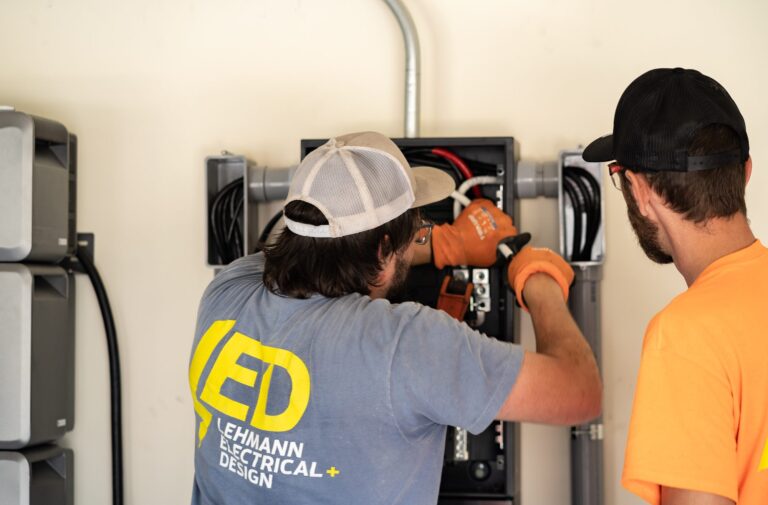
- Will you pull the permit? A contractor who suggests skipping it is telling you something about the rest of their work. The permit should appear on the estimate.
- Will you do a load calculation before quoting an amperage? A quote that names a charger circuit size without looking at the service and the existing fixed loads is a guess.
- Who is licensed, and on what? Wisconsin licenses the master electrician and the contracting business separately, so ask about both. Jacob W. Lehmann holds Wisconsin master electrician licence 1283316, and Lehmann Electrical & Design works under Wisconsin electrical contractor licence 1492849.
- Is the quote itemized? You should see the circuit, the equipment, the permit, and any patching as separate lines.
- What is warranted, and for how long? Our work carries a 12-month workmanship warranty. Equipment coverage comes from the charger manufacturer, which is a different thing, and any electrician who blurs the two is worth a follow-up question.
Lehmann Electrical & Design holds an A+ rating with the BBB and 4.9 stars on Google, and works from Wauwatosa across Milwaukee and Waukesha County.
Get a quote for your EV charger. Send us the make of your car, where you want the charger, and a photo of your electrical panel with the cover on. Do not remove the cover for any reason, including a photograph. With that we can tell you what your home is likely to support before anyone comes out. Request an estimate or call 414-207-0109.
Why homeowners call Lehmann Electrical & Design
- Led by licensed master electrician Jacob Lehmann
- A+ rating with the BBB and 4.9 stars on Google
- 12-month workmanship warranty on the work we do
- Permits pulled and inspections scheduled as part of the job
- Milwaukee, Wauwatosa and Waukesha County, from 12012 W Fairview Ave, Wauwatosa
Pricing up a charger installation?
Send your car, where you want the charger, and a photo of the panel with the cover on.
Licensed master electrician. 12-month workmanship warranty.
Frequently asked questions
▾Do you need a permit to install an EV charger at home?
Yes, in practice. A Level 2 home charger requires a new 240-volt dedicated circuit, and that is permitted electrical work in Milwaukee and Waukesha County municipalities. Your city or village issues the electrical permit and inspects the circuit afterward. Your electrician normally applies for it. Using a portable Level 1 cord in an existing outlet is not an installation and needs no permit.
▾Do I need a building permit to install an EV charger?
Usually not for a typical attached-garage installation, which needs an electrical permit rather than a building permit. A building permit may come into play if the job involves cutting a new opening in an exterior wall, constructing a pedestal, or trenching to a detached garage. Requirements are set by each municipality, so your electrician will confirm what your address needs before work starts.
▾Do you need permission from anyone besides the city?
Often, yes. Renters need the property owner’s written consent. Condominium and homeowners association residents usually need board approval, because exterior walls, garage slabs, and shared parking structures are frequently common property governed by association rules. It is a contractual question rather than a code question, and it is worth settling early, before you schedule an electrician or buy equipment.
▾How many amps should my EV charger circuit be?
That depends on your panel’s spare capacity, which a load calculation determines, so no one can promise a specific charge rate before seeing your service. A 32-amp charger needs a 40-amp circuit and a 48-amp charger needs a 60-amp circuit, because a continuous load may use no more than 80 percent of a breaker’s rating. A smaller circuit often replaces a full day’s driving overnight anyway.
Next step
Get your install quoted
Tell us your car and where the charger goes.
Licensed master electrician12‑month warranty4.9 on Google
Milwaukee, Wauwatosa and Waukesha County. Prefer to talk? Call 414-207-0109