Licensed master electrician · Call 414-207-0109
A detached garage needs one of two supplies: a single circuit from the house for lights and a few outlets, or a feeder to its own small panel, called a subpanel, when it will run an EV charger, a heater, a compressor or shop tools. Either way it needs GFCI-protected receptacles, a switched light and a way to shut its power off at the garage itself. A garage with a subpanel also needs its own ground rods. The work needs a permit from your municipality.
The right choice depends less on the garage and more on what you will ask of it over the next ten years. A garage that only stores a mower today may hold an electric vehicle or a workshop later, and the cheapest time to plan for that is before the trench is dug.
What the job actually involves
Wiring a detached garage means running a protected supply from the house panel to the garage, then giving the garage its own disconnect, grounding and circuits. The job breaks into five parts.
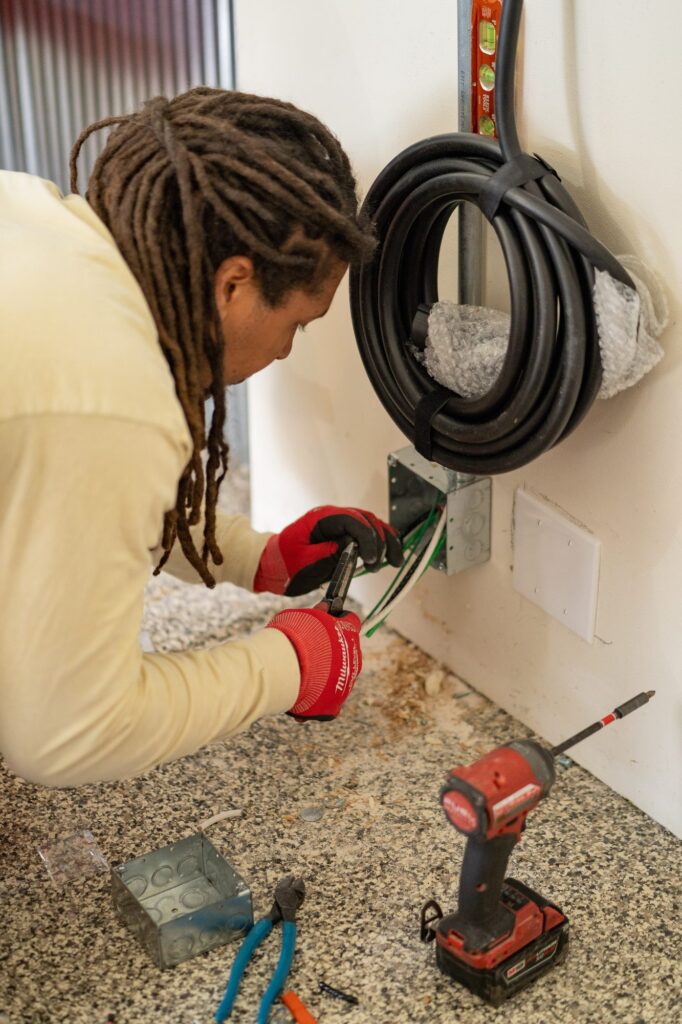
The supply from the house. A breaker in your main panel feeds either one branch circuit or a feeder. A branch circuit is a single run from one breaker to outlets and lights. A feeder is a larger run that supplies a second panel, the subpanel, which then splits power into several circuits in the garage.
The route. Most runs go underground, in conduit or in cable listed for direct burial, and how deep the run goes depends on the wiring method and on whether it passes under a driveway. Overhead runs are possible but need enough height over walkways and drives. Before any trench is dug, the utility lines are marked through Diggers Hotline (811), Wisconsin’s one-call service.
The disconnect at the garage. Anyone standing at the garage has to be able to shut off its power without walking back to the house. For a garage on a single circuit that can be a suitable switch; for a garage with a subpanel it is usually a main breaker in that panel.
Grounding. A feeder to a detached garage carries four wires: two hot conductors, a neutral and an equipment grounding conductor. In the garage panel the neutral and the ground are kept separate, and the garage gets its own grounding electrode, usually driven ground rods, connected to the panel. That arrangement keeps everyday neutral current off metal parts and grounding wires, and gives a fault a path back to the breaker so it trips.
Inside the garage. Under Wisconsin SPS 316, which adopts the 2023 NEC (in effect since September 1, 2026), receptacles in a garage need GFCI protection. GFCI stands for ground fault circuit interrupter, a device that cuts power when it detects current leaking by any path, including through a person. In the current edition that protection reaches many 240-volt receptacles as well as ordinary ones. A garage with power also needs at least one receptacle for each car space and a switched light.
The garage’s circuits start where the feeder ends, and new circuit installation inside the garage is planned at the same time as the supply, so the panel is sized for what will hang off it.
How to tell what your garage needs
What your garage needs is decided by what you plan to run in it, now and later. Match your plans to the supply:
| What you plan to run | Supply that usually fits |
|---|---|
| Lights, a garage door opener, a few outlets for a freezer and tool chargers | One 20-amp, 120-volt circuit from the house |
| A workshop: table saw, air compressor, dust collector | A feeder and subpanel sized for the largest tools running together |
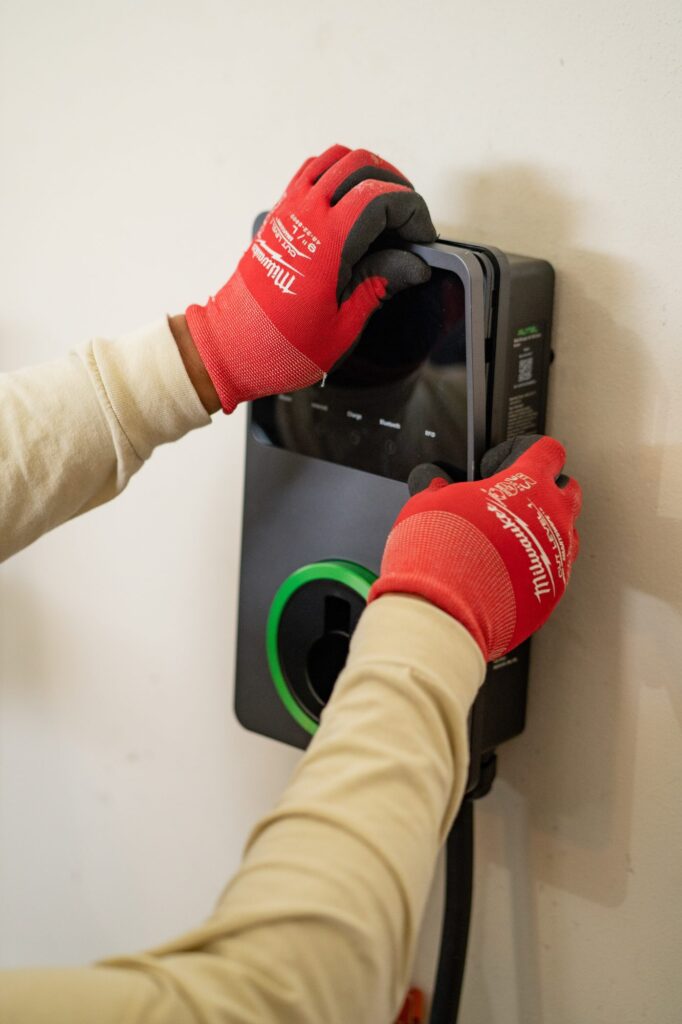
| A Level 2 EV charger | A feeder and subpanel sized for the charger plus the garage’s other loads |
| Electric heat | Dedicated 240-volt circuits sized from the heater’s nameplate, fed from a subpanel |
| A welder or kiln | Its own 240-volt circuit from a subpanel, sized from the equipment |
How many amps for a detached garage? A garage with lights and a few outlets can live on one 20-amp circuit. A garage with an EV charger and a workbench needs a feeder, and the size follows from arithmetic: a charger on a 40-amp circuit, plus lighting and receptacles, already needs most of a 60-amp feeder. A heavier shop needs more. The number comes from a load calculation for the garage and from what the house service can spare.
Does a detached garage need a subpanel? Not always. The NEC edition Wisconsin enforces generally allows a separate building one supply, so a garage that needs more than one circuit gets a feeder and a subpanel rather than several separate runs from the house. If one circuit covers everything you will ever plug in, a subpanel is not needed. We explain the trade-offs in how a subpanel works, including why a subpanel adds breaker spaces but not capacity.
The house service has to have room. A garage feeder borrows its capacity from your main service. If a load calculation shows the house panel cannot spare it, a panel upgrade comes first, and that is better known before the trench is open.
Plan for an EV even if you do not own one. Running conduit large enough for a future feeder costs little extra while the trench is open and saves digging up the yard later. A Level 2 charger needs a dedicated EV charger circuit of its own, so the garage panel should have spaces and capacity set aside for one.
If the garage already has power and something trips, reset the breaker or GFCI once at most: push the breaker firmly to OFF, then back to ON. If it trips again, leave it off until it is inspected. A GFCI that will not hold is reporting a real leakage fault or a failed device. If you smell burning or hot plastic, see scorch marks or discoloration, or hear buzzing or crackling at a panel or outlet, stop using the circuit, leave the breaker off and call an electrician.
Planning power for a garage or workshop?
Tell us the distance from your panel and what you want to run, and we will size the supply.
Licensed master electrician. 12-month workmanship warranty.
What decides the cost
The cost of wiring a detached garage is driven mostly by distance, the route and the size of the supply. We do not publish a figure, because the same garage can be a short trench across a lawn or a run under a concrete driveway.
| Factor | What it changes |
|---|---|
| Distance from the house panel to the garage | Longer runs need more conductor and trench, and larger conductors on long runs to limit voltage drop |
| Route and surface | Open lawn is the easy case; driveways, patios, landscaping and tree roots add work |
| Underground or overhead | Trenching and backfill versus a mast, attachment points and clearance |
| Single circuit or feeder | A feeder means larger conductors, a subpanel and ground rods |
| Feeder size | Sized to the garage’s load; larger feeders cost more per foot |
| Space and capacity at the house panel | A free space keeps it simple; a full or undersized panel adds work |
| Circuits inside the garage | Receptacles, lighting, EV charger and heater circuits are each their own work |
| Permit and inspection | Required, and scheduled with your municipality |
> A detached garage is priced by the run, not by the garage. Two identical garages can cost very different amounts to wire purely because one sits twenty feet from the house across a lawn and the other sits behind a poured driveway. When you ask for a quote, the useful details are the distance from your panel to the garage, what lies between them, and everything you plan to run in the garage over the next few years.
How long it takes and what is disrupted
A straightforward detached garage supply is often a one- or two-day job, with the inspection setting the pace in between.
A short underground run across a lawn, with room in the house panel, can be trenched, laid and terminated in a day. A long run, a driveway crossing or a subpanel with several circuits inside adds time. The order of work usually looks like this:
- Site visit: load calculation, route chosen, supply size decided.
- Permit applied for with your municipality and utility lines marked through Diggers Hotline.
- Trench dug and conduit or cable laid.
- Underground inspection, with the trench still open where the inspector asks for it.
- Trench backfilled, garage panel or circuit and ground rods installed, feeder terminated at both ends.
- Final inspection.
Disruption at the house is short. Power is usually off only while the new breaker is landed in the main panel. Shutting off the main does not make the panel safe to open, though: the service conductors and the main breaker’s line-side connections stay energized, and only the utility can shut those off, which is one reason this work stays with a licensed electrician. Outside, expect a narrow trench across the yard that is backfilled after inspection, with the lawn taking a few weeks to recover.
Permits and inspection
Wiring a detached garage needs an electrical permit from your municipality, whether that is Milwaukee, Wauwatosa, Waukesha or another town in the area.
Those municipalities enforce Wisconsin SPS 316, which adopts the 2023 NEC and has been in effect since September 1, 2026. Garage wiring permitted before that date was installed under an earlier edition, and an existing garage supply is not automatically required to be brought up to the newer edition. Once it is altered, the new work follows the current rules.
The inspector is there to confirm the parts that are buried or hidden once the job is finished: the burial depth and wiring method, the grounding electrode at the garage, the separation of neutral and ground in the garage panel, the disconnect, and GFCI protection on the receptacles. Underground work is usually inspected before the trench is backfilled, which is why the schedule has a gap in the middle.
An unpermitted feeder to a garage is the kind of thing that surfaces in a home inspection when the house is sold, and it is hard to prove what is buried without digging it up.
Choosing an electrician
Ask three questions: who pulls the permit, who arranges the utility locate, and what the quote includes once the trench is filled.
A contractor who says a garage feeder does not need a permit is telling you how the rest of the job will go. Ask whether the quote covers trenching, backfill and lawn or hardscape restoration, the garage panel and ground rods, and the circuits inside the garage, because those are the line items that make a cheap quote expensive halfway through. Ask how they sized the feeder, and whether the conduit leaves room for a future EV charger.
Lehmann Electrical & Design is led by Jacob W. Lehmann, a Wisconsin master electrician, license 1283316, working under Wisconsin electrical contractor license 1492849. The company holds an A+ rating with the BBB, 4.9 stars on Google, and backs its work with a 12-month workmanship warranty.
Planning power for a detached garage? Have the distance from your panel to the garage and a list of what you want to run, and request a quote or call 414-207-0109. We work across Milwaukee and Waukesha County.
Why homeowners call Lehmann Electrical & Design
- Led by licensed master electrician Jacob Lehmann
- A+ rating with the BBB and 4.9 stars on Google
- 12-month workmanship warranty on the work we do
- Permits pulled and inspections scheduled as part of the job
- Milwaukee, Wauwatosa and Waukesha County, from 12012 W Fairview Ave, Wauwatosa
Want the trench dug only once?
We will plan the feeder, the garage panel and room for a future EV charger together.
Licensed master electrician. 12-month workmanship warranty.
Frequently asked questions
▾How many amps do I need for a detached garage?
It depends on what the garage will run. Lights, a door opener and a few outlets can share one 20-amp circuit. A Level 2 EV charger, a heater or shop tools need a feeder and subpanel, and the feeder is sized by adding up those loads, with continuous loads such as EV charging counted at 125 percent. The house service also has to be able to spare that capacity.
▾Does a detached garage need a sub panel?
Only if it needs more than one circuit. A garage that runs lights and a few receptacles can be fed by a single circuit. Because a separate building generally gets one supply, a garage that needs several circuits, or any large 240-volt load, is fed by a feeder to a subpanel in the garage, which then splits power into individual circuits.
▾Does a detached garage subpanel need a main breaker?
The garage needs a way to shut off all of its power at the garage itself. A main breaker in the garage subpanel is the usual way to provide it, because it doubles as the disconnect and protects the panel. Your electrician confirms the exact arrangement your inspector will accept before the panel is ordered.
▾Do I need a ground rod for a detached garage?
Yes, if the garage is fed by a feeder to a subpanel. A detached building with its own panel needs its own grounding electrode, which normally means driven ground rods connected to the garage panel. A garage supplied by a single branch circuit that includes an equipment grounding conductor does not need a ground rod.
▾How many ground rods does a detached garage need?
Usually two. A single ground rod only counts on its own if testing shows its resistance to earth is low enough, so the common practice is to drive two rods spaced at least six feet apart rather than test one. Your inspector checks the grounding electrode at the garage as part of the inspection.
Next step
Get your garage supply quoted
Tell us the distance and what you will run.
Licensed master electrician12‑month warranty4.9 on Google
Milwaukee, Wauwatosa and Waukesha County. Prefer to talk? Call 414-207-0109