Licensed master electrician · Call 414-207-0109

A dedicated circuit serves one appliance and nothing else: its own breaker, its own wire, no shared outlets. In a typical home, the electric range, wall oven, cooktop, dishwasher, garbage disposal, microwave, refrigerator, clothes washer, electric dryer, electric water heater, furnace or air handler, central air conditioner, sump pump, and any built-in appliance with a motor or heating element belong on one. The pattern is simple: anything that draws heavy current, runs for long stretches, or must not lose power when something else trips.
What the job actually involves
Adding a dedicated circuit means running a new cable from the electrical panel to a new outlet or hardwired connection point, landing it on a breaker sized to the appliance, and getting the whole thing inspected.
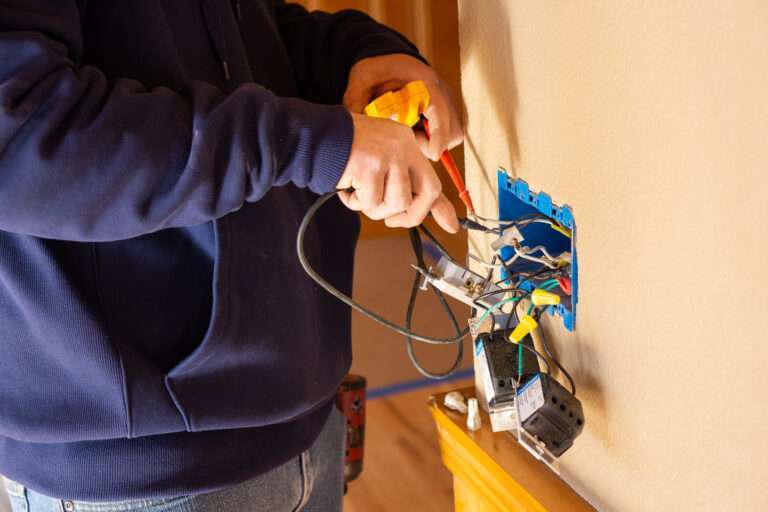
In practice, an electrician works through this sequence:
- Load calculation. A load calculation is an arithmetic check of how much current the house can actually support once the new appliance is added, based on the service size (usually 100 or 200 amps) and the existing loads. Amperage, or amps, is simply the rate of current flow, and every appliance has a nameplate telling you what it draws.
- Breaker space check. The panel needs a free slot of the right type. Where the panel is listed for them, a tandem (twin) breaker can free up a position.
- The cable route. This is usually the hardest part and the biggest cost driver. A basement panel beneath an unfinished joist bay is easy. A second-floor bathroom above a finished ceiling is not.
- Terminating in the panel. Landing a conductor on a breaker and the neutral and ground bars is work done behind the panel cover by a licensed electrician. With the main breaker off, the service conductors feeding the panel and the line-side lugs of the main breaker stay energized. A homeowner cannot shut those off. Only the utility can, usually by pulling the meter, or a separate service disconnect if one is fitted ahead of the panel.
- Receptacle or hardwired connection. Ranges and dryers get a specific receptacle configuration. Dishwashers, disposals, water heaters, and furnaces are often hardwired.
- Permit, inspection, labeling. The new circuit gets identified on the panel directory so the next person knows what it feeds.
Breaker sizing follows the appliance, not the other way around. Common residential pairings look like this:
| Appliance | Typical circuit | Voltage | Notes |
|---|---|---|---|
| Electric range (freestanding) | 40 or 50 A | 240 V | Sized from the nameplate rating |
| Wall oven or cooktop (separate) | 20 to 40 A | 240 V | Each usually gets its own |
| Electric clothes dryer | 30 A | 240 V | Gas dryers still need a 120 V circuit |
| Electric water heater | 30 A | 240 V | Continuous load, so sized accordingly |
| Central air conditioner | 20 to 40 A | 240 V | Follow the nameplate minimum circuit ampacity |
| Dishwasher | 15 or 20 A | 120 V | Often shared with nothing else |
| Garbage disposal | 15 or 20 A | 120 V | Switched, dedicated |
| Microwave (built-in or over-range) | 20 A | 120 V | Countertop units can sit on a small-appliance circuit |
| Refrigerator | 15 or 20 A | 120 V | Permitted on its own circuit rather than required to be; worth it so a tripped kitchen circuit does not defrost the food |
| Furnace or air handler | 15 or 20 A | 120 V | Must not share with anything |
| Sump pump | 15 or 20 A | 120 V | Keeps running during a storm |
| Kitchen countertop outlets | two 20 A minimum | 120 V | Small-appliance branch circuits, not dedicated to one device |
Two numbers in that table deserve a word of explanation. First, a breaker is sized so a continuous load, meaning one drawing maximum current for three hours or more, uses no more than 80 percent of the breaker’s rating. That is the same as saying the circuit is sized at 125 percent of the continuous load. Water heaters and fixed heating fall into this category. Second, a correctly matched load does not trip. A 24-amp appliance on a 30-amp circuit is right by design, not marginal.
How to tell if you need it
The clearest sign is a breaker that trips when two things run at once, or a new appliance whose installation manual specifies a dedicated circuit and a particular breaker size.
Work through these:
- The manual says so. Most manufacturers state it outright. A dishwasher manual asking for a dedicated 20-amp circuit is not a suggestion you can negotiate with.
- Lights dim when the appliance starts. Motors draw a surge on startup. If a fridge compressor kicking in makes the kitchen lights blink, the circuit is carrying more than it should.
- A breaker trips with a repeatable pattern. Microwave plus toaster equals darkness. That is a shared circuit at its limit.
- An appliance stops working and nobody notices until later. A chest freezer on a shared basement circuit that trips over the weekend is an expensive lesson.
- A new appliance is going in where none was before. Converting a gas range to electric, adding a second oven, or putting a wine fridge in the pantry all change the arithmetic.
- Extension cords or adapters are doing structural work. A plug strip feeding an appliance is a workaround, not a circuit.
Reset a tripped breaker once at most: push it firmly to OFF, then ON. If it trips again, leave it off and have it inspected. Never swap in a larger breaker to stop the tripping. The breaker is there to protect the wire behind the wall, and a bigger one simply lets the wire get hotter before anything intervenes. The fix for an overloaded circuit is another circuit.
Stop immediately and call for help if you notice a burning or hot-plastic smell, scorch marks or discoloration at an outlet or panel, buzzing, or crackling. Stop using that circuit or device, leave the breaker off, and get it looked at. Do not touch the outlet, the appliance, or the panel to judge how hot it is. Use smell, sight, and sound instead. A breaker that is mildly warm under sustained load is normal; a breaker that trips with nothing plugged in usually points to a short circuit or ground fault in the wiring rather than a worn-out breaker. If the pattern is intermittent and you cannot pin it to one appliance, that is squarely a troubleshooting and repair job rather than a guessing exercise.
Two protective devices come up constantly in this conversation. A GFCI, or ground-fault circuit interrupter, cuts power when a small amount of current leaks out of the circuit by any path, including through a person or damp material. The threshold is deliberately far below the level that would hold somebody onto a live part. No metal contact is needed. An AFCI, or arc-fault circuit interrupter, detects the signature of arcing in a wire or connection and applies to 120-volt branch circuits in living areas. A GFCI that will not hold after one reset means a real leakage fault or a failed device, not a device doing its job well.
What decides the price
Three things move the number: the distance and difficulty of the cable route, whether the panel has usable space, and whether walls and ceilings have to be opened and patched.
- Route length and access. A panel in an unfinished basement with open joists above, feeding an appliance on the same floor, is the cheap scenario. Fishing a cable up two floors through insulated exterior walls is not.
- Finished surfaces. Drywall that has to be cut and repaired adds labor, and patching and painting may be a separate trade.
- Panel space. If there is no open slot, that conversation changes shape. The answer is not always a bigger panel, but it is always a conversation before the quote is final.
- Circuit size and conductor. A 50-amp, 240-volt run uses heavier copper than a 20-amp, 120-volt run, and the material cost scales with it.
- Receptacle type. A standard 20-amp receptacle costs little. A 50-amp range receptacle and box cost more.
- Hardwired versus plug-in. Hardwiring a disposal or water heater adds a disconnect and sometimes a junction box.
- Permit fees. Set by the municipality, not the contractor.
- What is found along the way. Older Milwaukee and Waukesha County homes sometimes reveal knob-and-tube wiring, undersized neutrals, or junction boxes buried behind plaster. Those discoveries change the scope.
Every one of these is site-specific, which is why a dedicated circuit is quoted after someone has seen the panel and the route, not over the phone from an appliance model number.
How long it takes and what is disrupted
Most single dedicated circuits are a half-day to full-day job, with power to the house off for a short period while the breaker is landed.
Here is what a typical day looks like. The electrician confirms the panel, the route, and the termination point. Cable gets run, which is the noisy part if it involves drilling through joists or fishing through walls. The panel is opened and the circuit landed, and the house loses power for that portion of the work, often well under an hour. The receptacle or hardwired connection is made up, the circuit is tested, and the panel directory is updated. On a straightforward basement or garage run, the whole thing can be done between breakfast and mid-afternoon.
Longer jobs are usually longer because of access, not because of the electrical work. Opening and closing finished ceilings, coordinating with a drywall repair, or working around a kitchen that is mid-renovation stretches a one-day job across two visits. If multiple circuits are going in at once, a kitchen remodel being the common case, the electrical rough-in happens in one block and the devices get installed after the cabinets and counters are in.
Disruption for you is modest. You will need clear access to the panel, to the appliance location, and to whatever is in between, and you will want to plan around the power being off for a while. If a bedroom or living room ceiling has to be opened on the way, that room is out of use for the day. Work that touches the ceiling often gets combined with other overhead jobs for the same reason; it is common for a homeowner to add a new fixture or fan circuit while the ceiling is already open, because the access is the expensive part and it is already paid for.
Adding an appliance and not sure the circuit will take it?
A load calculation answers it properly, and it is the step that decides whether you need one new circuit or three.
Licensed master electrician. 12-month workmanship warranty.
Permits and inspection
A new branch circuit is permitted work, pulled with the local municipality, and inspected before it is considered finished.
Permits are issued by the city, town, or village where the house sits. Milwaukee, Wauwatosa, Waukesha, and the surrounding municipalities each run their own process, and each enforces the state’s electrical code. That code is Wisconsin SPS 316, which adopts the 2023 NEC and has been in effect since September 1, 2026. Before that date, Wisconsin work was done under the 2017 NEC; the state skipped the 2020 cycle entirely. Existing installations do not have to be brought up to the new edition unless they are being altered.
Several of the rules homeowners ask about by name live in the National Electrical Code as adopted here. Kitchens need at least two 20-amp small-appliance branch circuits serving the countertop outlets, which is why a kitchen is wired differently from a bedroom. Those circuits are not dedicated, because they feed multiple receptacles, but they are reserved: no lighting and no appliances from other rooms. Separately, fixed appliances with their own nameplate requirements get their own circuits so a single fault does not take out the furnace and the refrigerator together.
The practical reason to care about the permit is not paperwork. It is that an inspector who has never met you looks at the work, and that a future buyer’s home inspector finds a labeled, permitted circuit rather than an unexplained cable. Unpermitted electrical work has a way of surfacing at closing.
Choosing an electrician
Ask for the license, ask who is actually doing the work, and ask whether the quote includes the permit and the inspection.

Specific things worth asking before you sign anything:
- Will a load calculation be done before the circuit is added, and will you be shown the result?
- Is the permit included in the quoted figure, or billed separately?
- What happens if the cable route turns out to be harder than it looked, and how is that handled?
- Who patches the drywall?
- Will the panel directory be updated and the breaker labeled?
- What does the workmanship warranty cover?
Lehmann Electrical & Design is led by Jacob W. Lehmann, a licensed Wisconsin master electrician (license 1283316), and the company works under Wisconsin electrical contractor license 1492849. We hold an A+ rating with the BBB and 4.9 stars on Google, and we back our work with a 12-month workmanship warranty. We work across Milwaukee and Waukesha County, and when a tripping breaker turns out to be a wiring problem rather than an overload, the same crew handles that too, including for homeowners in West Allis and the suburbs around it.
Ready to get it quoted? Tell us the appliance, the room, and where your panel is, and we will come look at the route. Request an estimate or call 414-207-0109.
Why homeowners call Lehmann Electrical & Design
- Led by licensed master electrician Jacob Lehmann
- A+ rating with the BBB and 4.9 stars on Google
- 12-month workmanship warranty on the work we do
- Permits pulled and inspections scheduled as part of the job
- Milwaukee, Wauwatosa and Waukesha County, from 12012 W Fairview Ave, Wauwatosa
Planning a kitchen or laundry?
Tell us the appliances and where your panel is, and we will work out the circuits.
Licensed master electrician. 12-month workmanship warranty.
Frequently asked questions
▾What kitchen appliances need a dedicated circuit?
The dishwasher, garbage disposal, built-in or over-range microwave, electric range, separate wall oven and separate cooktop each typically get their own circuit. A refrigerator is allowed its own circuit rather than obliged to have one, and most kitchens are better for giving it one. Separately, the countertop receptacles are fed by at least two 20-amp small-appliance branch circuits that serve nothing else. Countertop appliances like toasters and kettles plug into those, which is why a kitchen needs more circuits than any other room in the house.
▾When does an appliance need a dedicated circuit?
Three triggers: the manufacturer’s installation manual specifies one, the appliance is a fixed or built-in unit with a motor or heating element, or the appliance must keep running when something else on the circuit faults. A sump pump and a furnace qualify under the third test even though their current draw is modest. If any of the three applies, plan on a separate circuit.
▾Does a gas dryer need its own circuit?
A gas dryer still needs a 120-volt circuit for the motor, controls, and igniter, and it is good practice to keep it off the shared laundry-room receptacles. An electric dryer is a different animal: it needs a 240-volt, 30-amp dedicated circuit and a specific four-prong receptacle. Swapping gas for electric is a new circuit, not an adapter.
▾Can I add a dedicated circuit myself if the panel has a free slot?
A free slot is the easy part. Sizing the conductor, routing it legally, terminating it behind the panel cover, and passing inspection are not. With the main breaker off, the conductors feeding the panel stay energized and cannot be shut off from inside the house. This is permitted work in Milwaukee and Waukesha County municipalities, and it needs a licensed electrician and an inspection.
▾Why does my breaker trip even with nothing plugged in?
That pattern usually points to a fault in the wiring, a short circuit or a ground fault, rather than an overload or a worn breaker. Standard residential breakers use a heat strip for sustained overload and a magnetic coil for short circuits, so a trip with no load points at the second mechanism. Leave the breaker off and have the circuit tested.
Next step
Get the circuits planned
Tell us the appliance and where your panel is.
Licensed master electrician12‑month warranty4.9 on Google
Milwaukee, Wauwatosa and Waukesha County. Prefer to talk? Call 414-207-0109