Licensed master electrician · Call 414-207-0109
A brief dip when a large motor starts is normal and harmless. Lights that dim and brighten on their own, dim across the whole house, or dim in some rooms while brightening in others are a different matter, and that second pattern is the one worth acting on quickly.
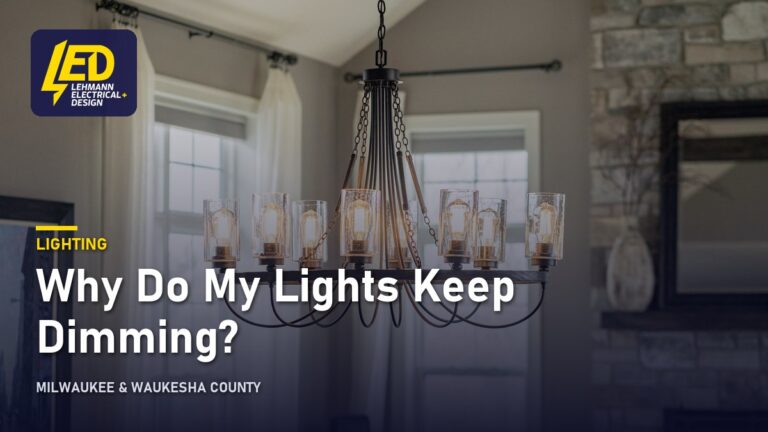
Dimming is a voltage problem. Something is either drawing a large amount of current for a moment, or a connection somewhere between the utility transformer and the light is no longer solid.
The harmless version has an obvious trigger. The air conditioner, the well pump, the garage door or the fridge compressor starts, the lights dip for well under a second, and they recover. Motors draw a surge of current at startup, far more than they use once running, and that surge pulls voltage down briefly across the circuit.
The version that matters has no trigger at all. Lights fade and swell on their own, or brighten noticeably in one part of the house while dimming in another. That pattern points at the neutral connection, and a failing neutral lets voltage swing above normal on some circuits. High voltage destroys electronics, and the damage is usually spread across the house rather than confined to one device.
If lights are dimming in one room while they brighten in another, treat it as urgent and have it looked at the same day.
What is usually causing it
| What you see | Usual cause | How urgent |
|---|---|---|
| Brief dip when a motor starts | Normal inrush current | Not urgent |
| One room dims under load | Overloaded or undersized circuit | Worth checking |
| Dimming with a buzz or warmth at a switch | Loose connection at a device | Prompt |
| Slow fade and swell, no trigger | Loose or failing neutral | Urgent |
| Dim in some rooms, bright in others | Open neutral at the service | Urgent |
| Whole street affected | Utility side | Report to the utility |
Motor startup
This is the least alarming of the causes. The dip is short, it lines up with something switching on, and nothing else changes. A heat pump or air conditioner is the usual culprit, and that specific case has its own explanation in why lights flicker when the AC turns on.

A dip that has become noticeably deeper or longer than it used to be is worth mentioning, because that change usually means a connection has degraded rather than the motor having changed.
Loose connections
Every joint between the panel and a fixture is a potential source. Back-stabbed receptacles, where a conductor is pushed into a spring clip rather than landed under a screw, loosen over years of thermal cycling. So do wire nuts that were never tightened properly, and terminals in a panel that have relaxed.
A loose joint behaves exactly like a dimmer nobody installed. It adds resistance, resistance drops voltage under load, and the drop shows up as dimming when something on that circuit draws current. The same resistance generates heat, which is why loose connections and a hot breaker often turn up together.
The neutral
The neutral is the return path. When it is solid, the two halves of a split-phase service stay balanced and every circuit sees roughly the same voltage. When it degrades, that balance depends on whatever happens to be switched on, and voltage shifts between the two halves as loads change. One side sags, the other rises.
That is why the signature is contradictory: some lights dim while others brighten, and both change as appliances cycle. It can occur at the panel, at the meter, at the service entrance, or on the utility’s side of the connection. All of those are for an electrician or the utility, not a homeowner.
Bulbs and dimmers
Not every cause is a fault. LED lamps on a dimmer designed for incandescent loads often behave oddly at the low end, dropping out or stepping rather than fading smoothly. Mixed brands of LED on one dimmer can do the same. That is a compatibility issue rather than a wiring one, and it stays confined to the circuit with the dimmer on it.
What is safe to check yourself, and what is not
Safe, and genuinely useful to note before anyone visits: whether the dimming affects one room or the whole house, whether it coincides with an appliance starting, whether neighbours see it too, whether anything buzzes or feels warm, and whether the lamps involved are LED on a dimmer. Writing down when it happens is more useful than it sounds, because an intermittent fault is hard to catch on a single visit. If a breaker trips while you are working out what is going on, reset it once at most: firmly to OFF, then to ON. If it trips again, leave it off and have the circuit inspected. A breaker that trips with nothing drawing current is reporting a fault, not wearing out.
Not a homeowner job, and not safe: the panel, the meter, the service entrance and any connection inside them. Those are the places a neutral fault usually lives. Even with the main breaker switched off, the service conductors and the main breaker’s line-side lugs stay live, and only the utility can take those dead. Work there is for a licensed electrician under a permit from the municipality. In Milwaukee, Wauwatosa and across Waukesha County that falls under Wisconsin SPS 316, which adopts the 2023 NEC and took effect on September 1, 2026.
If the panel is buzzing, discoloured, scorched, or smells of hot plastic, stop there and call. Do not judge a panel by touching it. Those are not symptoms to investigate at home.
Lights dimming with nothing switching on?
A licensed electrician measures voltage under load and finds the connection causing it, which is the part that gets warm.
Licensed master electrician. 12-month workmanship warranty.
When it points to a bigger problem
Three patterns move this from an annoyance to something that needs an electrician promptly.
Dimming paired with brightening elsewhere in the house, as described above, which points at the neutral and can take out electronics while you wait.
Dimming that has arrived recently in a house where nothing changed. Lights that were steady for years and are no longer steady mean something has degraded. Connections do not improve on their own, and the usual direction of travel is from intermittent dimming to heat.
Dimming alongside breakers that trip, outlets that run warm, or a burning smell. Any of those on their own warrants a look. Together with dimming they suggest a circuit or a service that is no longer coping, and an older service that was sized for a smaller electrical load is a common finding underneath.
Whole-house dimming that neighbours also notice is usually the utility’s, and reporting it to them is the right first call rather than paying for a diagnosis of someone else’s equipment.
What an electrician does about it
The work is measurement, not guesswork. An electrician records voltage at the panel and at affected circuits, then repeats it under load, because a connection that looks fine at rest reveals itself when current flows. A meaningful drop between no load and load points at where the resistance sits.
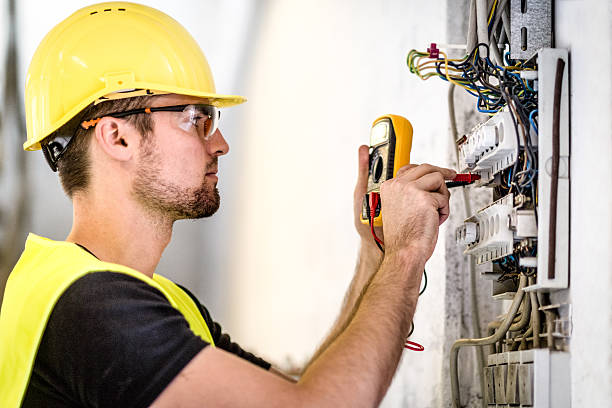
From there the search narrows. Terminals in the panel get checked for tightness and for heat, the neutral and ground connections get inspected, and devices along the affected circuits get opened and examined, with back-stabbed connections landed properly under screws. A thermal check finds joints running warm before they fail outright.
Where the fault sits upstream of the panel, at the meter or the service drop, that is coordinated with the utility rather than worked on directly. Where the house simply has more load than the service was built for, the conversation turns to capacity rather than repair.
If the cause turns out to be dimmer and lamp compatibility, the fix is matching the dimmer to the load, which a lighting contractor handles as a small job.
The same applies outdoors, where long cable runs and older fixtures bring their own voltage drop, and where dimming at the far end of a run is often the first sign of it. That work is covered by outdoor lighting.
Lehmann Electrical & Design is led by master electrician Jacob Lehmann and works across Milwaukee, Wauwatosa and Waukesha County from 12012 W Fairview Ave, Wauwatosa. Work carries a 12-month workmanship warranty, and the company holds 4.9 stars on Google.
If your lights are dimming and you cannot tie it to an appliance starting, you can request an estimate or call 414-207-0109 and describe the pattern you are seeing.
Why homeowners call Lehmann Electrical & Design
- Led by licensed master electrician Jacob Lehmann
- A+ rating with the BBB and 4.9 stars on Google
- 12-month workmanship warranty on the work we do
- Permits pulled and inspections scheduled as part of the job
- Milwaukee, Wauwatosa and Waukesha County, from 12012 W Fairview Ave, Wauwatosa
Want the cause traced?
Tell us whether it affects one room or the whole house, and whether anything brightens at the same time.
Licensed master electrician. 12-month workmanship warranty.
Frequently asked questions
▾Why do my lights dim when the AC kicks on?
Because the compressor draws a surge of current at startup, which pulls voltage down briefly across the house. A short dip that recovers immediately is normal. A dip that is deeper than it used to be, lasts longer, or is accompanied by a buzz at the panel is worth having checked, since that change usually reflects a connection that has degraded rather than the air conditioner behaving differently.
▾Why do my lights dim and brighten on their own?
That combination is the classic sign of a failing neutral connection. With the neutral compromised, voltage shifts between the two halves of the service as appliances switch on and off, so some circuits sag while others rise above normal. It is the one dimming pattern that can damage electronics throughout the house, and it should be looked at the same day rather than monitored.
▾Why do all the lights in my house keep dimming?
Whole-house dimming points upstream of any single circuit: the main panel, the service entrance, the meter, or the utility connection. If neighbours see it at the same time, it is the utility’s side and they should be told. If it is confined to your house, it is the service or the panel, and both are for an electrician.
▾Why do my lights keep dimming and flickering?
Flickering and dimming together usually mean a loose connection rather than a load problem. A joint that is no longer tight makes and breaks contact as it heats and cools, which reads as flicker, and adds resistance that shows as dimming when load increases. The same resistance produces heat, so this combination tends to get worse rather than settle.
▾Does dimming lights save money?
With LED lamps, dimming reduces power draw, though not in direct proportion to the apparent brightness, since the eye does not respond to light levels linearly. The saving on a handful of fixtures is modest. Dimming is better treated as a comfort and lamp-life decision than an energy-saving measure.
▾Do lights get dimmer over time?
LEDs do, gradually. Output falls slowly across their service life rather than failing abruptly, and manufacturers rate lamps for how much output remains after a stated number of hours. That decline is even and takes years, so it looks nothing like the dimming described here. A sudden change, or dimming that varies minute to minute, is a wiring question rather than a lamp one.
Next step
Get the dimming traced
Tell us whether it is one room or the whole house.
Licensed master electrician12-month warranty4.9 on Google
Milwaukee, Wauwatosa and Waukesha County. Prefer to talk? Call 414-207-0109