Licensed master electrician · Call 414-207-0109
Knob and tube wiring is not guaranteed to fail tomorrow, but it carries real risk that modern wiring does not. The wiring itself has no ground, its rubber and cloth insulation is now 70 to 100 years old, and it was never designed for the loads a modern household puts on it. In a Milwaukee or Waukesha County home, the honest answer is that knob and tube is a condition to get assessed by a licensed electrician, not a condition to ignore.
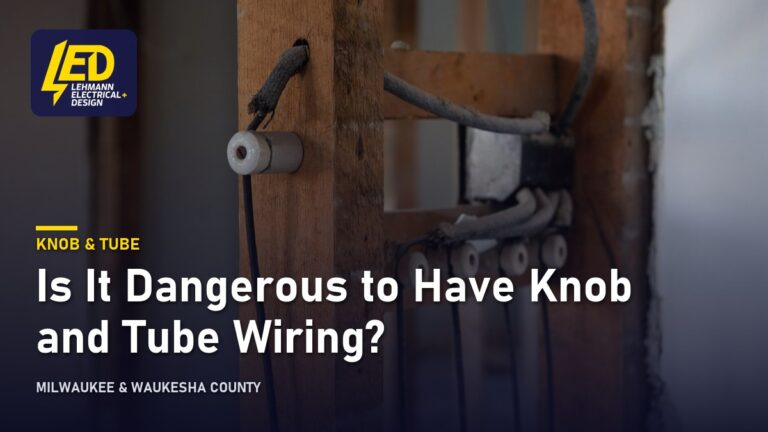
Yes, it is a legitimate hazard, and the degree of danger depends almost entirely on what has been done to it since it was installed.
Knob and tube (often shortened to K&T) was the standard residential wiring method from roughly the 1880s into the 1940s. Two separate conductors, a hot and a neutral, run through a house held away from framing by porcelain knobs and passed through joists inside porcelain tubes. The air gap around each wire was the cooling system. That design worked when a house drew a few hundred watts for lighting and nothing else.
Three things make it dangerous today:
- No equipment grounding conductor. There is no third wire to carry fault current safely back to the panel, so a metal appliance can become energized with nothing to clear the fault.
- Aged insulation. The original rubber compound hardens, cracks, and sheds, especially near heat sources like light fixtures. Bare copper inside a ceiling box is not unusual in a house this old.
- Decades of amateur modifications. This is the big one, and it is covered in the next section.
> Knob and tube wiring in untouched, original condition, in a dry space, carrying only a light load, is not an emergency. Knob and tube that has been spliced into with wire nuts and electrical tape, buried under blown-in attic insulation, or fed through a 20 amp breaker to run a window air conditioner is a genuine fire risk. Most homes that still have it are closer to the second description than the first, because a house does not sit still for 90 years.
If you ever smell burning plastic or a hot electrical odor, see scorch marks or browning around an outlet, switch, or fixture, or hear buzzing or crackling, stop using that circuit, leave the breaker off, and call an electrician. Do not wait for a scheduled appointment.
What is usually causing it
The hazard is rarely the original work. It is what was added to it.

Knob and tube was installed competently by the standards of its day. The failures that show up now trace back to a predictable list:
Insulation contact. When attics and walls were insulated in the 1970s and later, blown-in cellulose or fiberglass went in over live K&T conductors. The air gap that kept those wires cool disappeared. Covered conductors run hotter, the insulation degrades faster, and the degradation is invisible from the living space below.
Improper splices. Original K&T splices were soldered and taped. Later additions were often twisted together in an open attic with no junction box, or spliced to modern nonmetallic cable with the ground left disconnected because there was nothing to ground it to.
Overloading. A circuit designed for two ceiling lights now feeds a kitchen countertop, a space heater, or a bedroom full of electronics. Someone then “solved” the nuisance tripping by installing an oversized fuse or breaker. Never do this. The overcurrent device protects the wire, not the appliance, and a bigger breaker on old conductors removes the only thing standing between an overloaded circuit and a fire. The correct fix for an overloaded circuit is another circuit.
Moisture and rodents. Basements, crawl spaces, and attics are where brittle insulation meets water and chewing. Exposed conductor in a damp basement is a shock hazard with no ground path to clear it.
Two-prong outlets rewired to three-prong. Someone swaps a two-slot receptacle for a grounding-type one so a modern plug fits. The outlet now looks grounded and is not. Anything plugged in that relies on the ground for safety, a power strip surge protector for example, is protecting nothing. You can read more about the specific risks in older county housing stock and how they tend to show up during a remodel.
What is safe to check yourself, and what is not
You can observe, document, and describe. You should not open, test, or modify.
Safe for a homeowner:
| Task | Safe to do yourself? | Why |
|---|---|---|
| Look at exposed wiring in an unfinished basement or attic from a walkway | Yes | Visual only, no contact |
| Count outlet slots (two-slot vs three-slot) | Yes | Visual only |
| Note which rooms share a circuit by what goes dark when a breaker trips | Yes | No contact with wiring |
| Photograph porcelain knobs, tubes, or cloth-covered wire | Yes | Keep your hands off the conductors |
| Check for insulation piled over attic wiring | Yes, from a safe standing point | Do not move or dig in it |
| Reset a tripped breaker | Once | Push firmly to OFF, then ON. If it trips again, leave it off and have it inspected |
| Remove a cover plate, outlet, or switch | No | The wiring behind it may be ungrounded, brittle, or energized from an unexpected circuit |
| Remove the panel cover | No | Service conductors and the main breaker’s line-side lugs stay energized even with the main breaker off |
| Test for a ground with a plug-in tester and act on the result | No | These testers misread ungrounded and reverse-bootleg circuits in old homes |
| Splice, extend, or abandon any K&T conductor | No | Permit work, and the circuit routing is often unknown |
The panel point deserves emphasis. Turning the main breaker off de-energizes the branch circuits, but the conductors coming in from the utility and the lugs they land on remain live. A homeowner cannot make those safe. Only the utility can, typically by pulling the meter, or a separate service disconnect ahead of the panel if the house has one.
With knob and tube specifically, there is a second reason to keep cover plates on: identifying K&T correctly requires seeing the conductor routing, the splice method, and whether modern cable has been grafted on mid-run. That is work for someone with a meter, a license, and the ability to shut down the right circuit.
Knob and tube found in your house?
A licensed electrician establishes what is still live, what is already dead, and whether anything about it needs acting on now.
Licensed master electrician. 12-month workmanship warranty.
When it points to a bigger problem
Knob and tube is often the symptom an inspection finds first, and the underlying condition is a house wired for a different century.
Watch for these patterns:
- Breakers or fuses tripping on ordinary loads. A microwave and a toaster on the same 15 amp circuit is a sign the circuit count is too low for how the house is used now, not a sign the breaker is bad.
- Three-prong outlets with no ground. This usually means someone has been upgrading cosmetically for years without touching the wiring.
- A mix of wiring types in one run. K&T spliced to armored cable spliced to nonmetallic cable, with no junction boxes, is common in homes that have been remodeled piecemeal.
- Insulation added without the wiring being addressed. If the attic was insulated and K&T is still live underneath, the project was done without an electrical assessment.
- Insurance or lender questions at closing. Carriers and lenders treat K&T differently, and the requirements vary by company, so ask yours directly rather than relying on what a neighbor was told.
Any of those means the right next step is a full assessment of what is live, what is abandoned, how the circuits are divided, and what the service can support. That assessment is also the only way to price the work honestly. Replacing knob and tube in an older home depends on how much is still energized, how much wall and ceiling access exists, and whether plaster or drywall has to be opened.
What an electrician does about it
A licensed electrician starts by mapping the system, then replaces live knob and tube circuit by circuit with modern grounded cable, under permit.
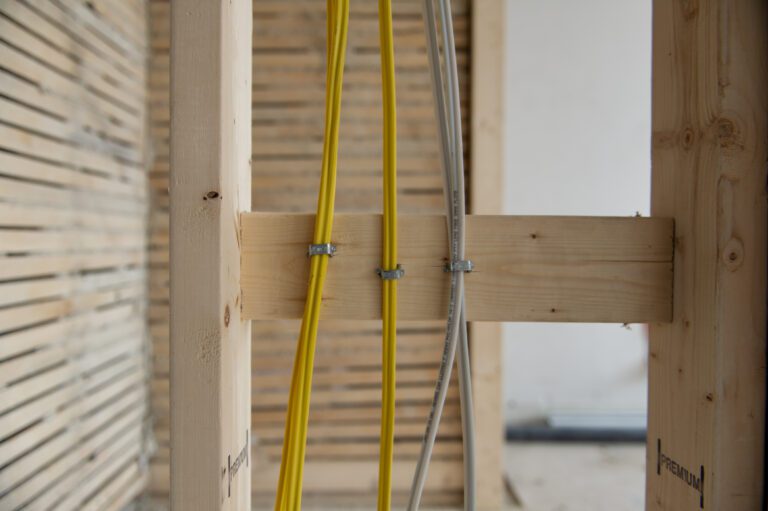
The sequence on a typical job:
- Identify and trace. Determine which K&T runs are still energized and which were abandoned in place years ago. Abandoned runs are harmless. Live runs are the scope.
- Load calculation. This is a formal calculation of the total demand a home places on its electrical service, based on square footage, appliances, heating and cooling, and fixed equipment. It determines whether the existing service is adequate for the rewired circuits.
- Plan the routing. Where cable can be fished through walls and ceilings with minimal demolition, and where access has to be opened.
- Replace and ground. New circuits run in grounded cable, properly divided, with junction boxes where splices are required. Protective devices are installed where the code in force calls for them: GFCI (ground fault circuit interrupter, which cuts power when a small amount of current leaks from a circuit by any path, including through a person) and AFCI (arc fault circuit interrupter, which detects the signature of arcing in a damaged conductor or loose connection).
- Permit and inspection. Permits are issued by the local municipality, which enforces Wisconsin SPS 316, the state’s electrical code. SPS 316 adopts the 2023 NEC and has been in effect since September 1, 2026. Existing installations are not required to be brought up to the newest edition simply because the edition changed, but work that alters a circuit is done to the code in force.
Work can often be staged. Knob and tube feeding bedrooms and the kitchen usually comes out first, and basement or garage lighting on original circuits in sound condition can sometimes wait, depending on what the assessment finds. A staged plan is worth asking about if the full scope is more than you want to take on at once.
Lehmann Electrical & Design is led by master electrician Jacob Lehmann, holds an A+ rating with the BBB, and is rated 4.9 stars on Google. Our work carries a 12-month workmanship warranty.
If you know or suspect your home has knob and tube, the useful first step is an assessment of what is actually live. You can request an estimate for knob and tube evaluation or call 414-207-0109, and you can read what the full replacement service involves before you do.
Why homeowners call Lehmann Electrical & Design
- Led by licensed master electrician Jacob Lehmann
- A+ rating with the BBB and 4.9 stars on Google
- 12-month workmanship warranty on the work we do
- Permits pulled and inspections scheduled as part of the job
- Milwaukee, Wauwatosa and Waukesha County, from 12012 W Fairview Ave, Wauwatosa
Want to know what you are dealing with?
Tell us the age of the house, where the wiring was found, and whether you are buying, selling or staying.
Licensed master electrician. 12-month workmanship warranty.
Frequently asked questions
▾Is it illegal to have knob and tube wiring in Wisconsin?
Existing knob and tube is not outlawed by the fact of its existence. Wisconsin SPS 316, which adopts the 2023 NEC and has been in effect since September 1, 2026, does not require a homeowner to tear out an installation simply because the code edition changed. What it does mean is that any new work, extension, or alteration of those circuits has to meet the current code, which in practice means replacing the run rather than extending it.
▾Is it okay to leave knob and tube wiring in place?
Abandoned, de-energized knob and tube can usually stay where it is. Live knob and tube is a judgment call that depends on its condition, whether insulation has been added over it, what loads it carries, and whether it has been spliced into. Leaving it energized without an inspection means you are accepting an unmeasured risk. Have it assessed, then decide with real information.
▾Is it safe to insulate over knob and tube wiring?
No. Knob and tube relies on open air around each conductor to shed heat, and burying it in attic or wall insulation removes that cooling. The conductors run hotter, the aged insulation breaks down faster, and the damage is hidden. If you are planning an insulation project in an older home, the wiring assessment comes first, and the K&T in that space is replaced before insulation goes in.
▾How much does it cost to replace knob and tube wiring?
We do not publish a figure for this because the honest number depends on the house. The scope is driven by how many circuits are still live, how accessible the walls and ceilings are, whether plaster has to be opened and repaired, and what the load calculation shows about the existing service. A walkthrough and an assessment produce a real quote. Anything quoted sight unseen is a guess.
▾What is actually wrong with knob and tube wiring?
Three things: there is no equipment grounding conductor, so fault current has no safe path back to the panel. The rubber and cloth insulation is decades past its service life and becomes brittle. And the circuits were sized for lighting, not for a modern household, so they are routinely overloaded. Add 90 years of undocumented splices and the result is a system nobody can fully verify without opening it up.
Next step
Get the wiring assessed
Tell us the age of the house and where the wiring was found.
Licensed master electrician12-month warranty4.9 on Google
Milwaukee, Wauwatosa and Waukesha County. Prefer to talk? Call 414-207-0109