Licensed master electrician · Call 414-207-0109
A breaker that feels slightly warm after hours of heavy use is usually normal, because breakers work by converting a small amount of the current passing through them into heat. A breaker that is genuinely hot, smells like burning plastic, looks discolored, or buzzes is not normal. That points to a loose connection, an overloaded circuit, a failing breaker, or a panel problem. If you notice any of those warning signs, leave that breaker off and call a licensed electrician.
Every breaker has internal resistance, and resistance under load produces heat. A 20 amp circuit running a space heater for three hours will leave the breaker noticeably warm, and so will the wire feeding it. That is physics, not a fault.
The line between warm and dangerous is not something you should test with your hand. Do not touch a breaker, a panel cover, or a suspect outlet to judge how hot it is. Judge it by the things you can sense from a safe distance instead.
Warning signs that mean stop using the circuit, leave the breaker in the off position, and call an electrician:
- A burning smell, or the smell of hot plastic near the panel
- Brown, yellow, or blackened discoloration on the breaker face or the panel cover
- Scorch marks around a breaker, outlet, or switch
- Buzzing, humming, sizzling, or crackling from the panel
- A breaker that trips again immediately after one reset
- Lights that dim or flicker when a large appliance starts
Those are not “watch it for a week” symptoms. Heat at an electrical connection tends to make the connection worse, which makes more heat. That loop is how a warm breaker becomes a burned bus bar.
What is usually causing it
Here are the causes worth understanding, roughly in the order an electrician rules them out.
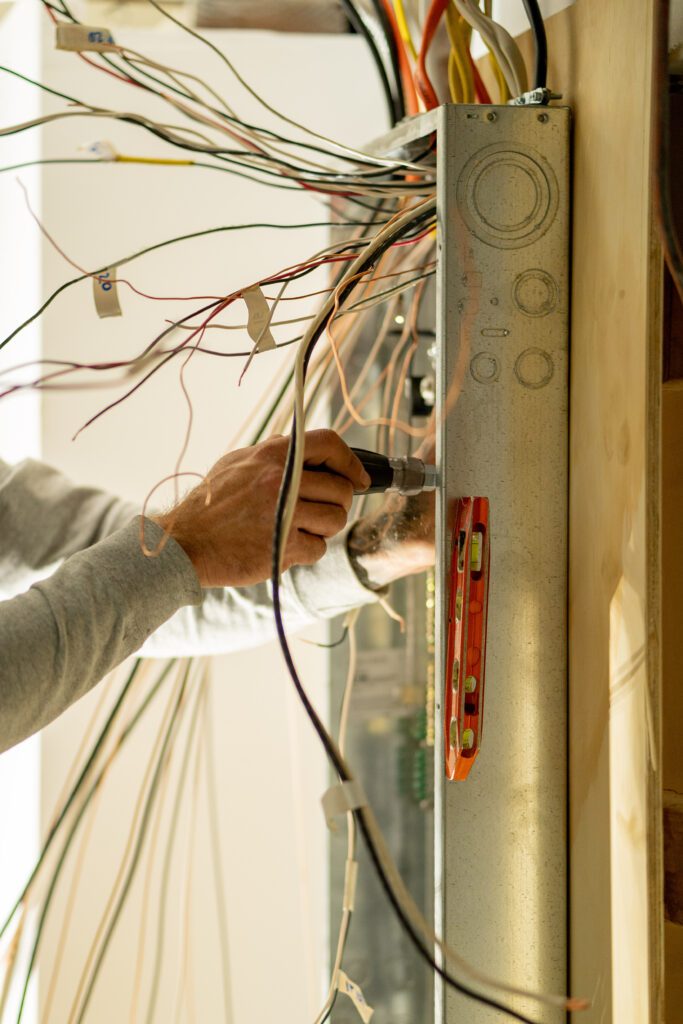
A loose connection. This is the one that produces real heat rather than mild warmth. Where the branch circuit wire lands on the breaker screw, or where the breaker clips onto the panel’s bus bar, a connection that is not tight has resistance. Resistance at a single point concentrates heat exactly there. Aluminum branch wiring, back-stabbed outlets down the circuit, and a breaker that has been reset many times over the years all make this more likely. A loose connection can run hot without ever tripping the breaker, because the heat is in the joint, not in the breaker’s sensing element.
A circuit carrying more than it should for long stretches. Breakers and wire are sized so that a continuous load sits at no more than 80% of the breaker rating, which is the same as sizing the circuit at 125% of the continuous load. A 16 amp continuous draw belongs on a 20 amp circuit. If a 20 amp kitchen circuit is running a countertop oven, a microwave, and a coffee maker at once, you are near or past the design limit. The breaker may hold and simply run hot, or it may finally trip. Either way, the wire behind the wall is working hard.
A failing breaker. Most standard residential breakers are thermal-magnetic: a heat-sensitive metal strip handles sustained overload, and a magnetic coil handles short circuits. The strip and the internal contacts wear. A breaker that has tripped repeatedly over decades, or that has been in a damp basement panel, can develop pitted contacts that heat up under ordinary load. The breaker does not get “weaker” in a helpful way; it gets unreliable in both directions.
A panel problem rather than a breaker problem. If the panel itself feels hot, if several breakers are warm, or if the main breaker area is warm, the issue may be at the bus bar, the main lugs, or the service entrance. The service entrance is where the utility’s conductors come into the house and land in the meter and panel. That is not a breaker-swap situation.
Certain panel brands with known defects. Some older residential panels, notably Federal Pacific Stab-Lok and Zinsco, have documented histories of breakers that fail to trip and connections that overheat. If you have one of those, heat is a reason to get it looked at rather than monitored.
Warm versus hot
| What you notice | Typical meaning | What to do |
|---|---|---|
| Slight warmth after hours of heavy load | Normal resistive heating | Nothing, but note which circuit |
| Warmth with nothing heavy running | Possible loose connection or failing breaker | Have it inspected |
| Hot plastic or burning smell | Connection is degrading now | Breaker off, call an electrician |
| Discoloration or scorch marks | Heat damage has already happened | Breaker off, call an electrician |
| Buzzing or crackling | Arcing | Breaker off, call an electrician |
| Whole panel or main area warm | Bus, lugs, or service issue | Call an electrician, do not open the panel |
What is safe to check yourself, and what is not
Safe, with the panel cover closed and in place:
- Look at the breakers and the cover for discoloration, soot, or a melted-looking face.
- Smell near, not against, the panel. Burning plastic has a distinct sharp odor.
- Listen for buzzing, humming, or crackling.
- Note which breaker and which rooms. Write down the number and the amperage printed on the handle.
- Reduce the load on a suspect circuit. Unplug a couple of the heaviest things on it and see whether the warmth goes away over the next few hours.
- Reset a tripped breaker once at most. Push the handle firmly all the way to OFF, then back to ON. If it trips again, leave it off and have it inspected. Repeated resetting into a fault is how connections get destroyed.
Not safe, and not a homeowner job:
- Removing the panel cover. Behind the cover, the bus bars and the line-side lugs of the main breaker are exposed.
- Turning the main breaker off and assuming the panel is dead. With the main off, the service conductors coming in and the main breaker’s line-side lugs stay energized. A homeowner cannot de-energize them. The utility can, usually by pulling the meter, and so can a separate service disconnect if one is fitted ahead of the panel.
- Tightening a breaker screw, reseating a breaker, or swapping a breaker. All of that is work behind the cover.
- Fitting a larger breaker to stop nuisance tripping. The breaker protects the wire. A 20 amp breaker on 12 gauge wire is not being generous; it is the ceiling that wire can safely carry. Putting a 30 amp breaker there removes the protection and leaves the wire unprotected. When a circuit is genuinely overloaded, the answer is a properly sized dedicated circuit for that load, not a bigger breaker.
Work inside a panel needs a licensed electrician and, in most cases, a permit from your local municipality, whether that is Milwaukee, Wauwatosa, Waukesha, or another community in the county. Those municipalities enforce Wisconsin SPS 316, which adopts the 2023 NEC and has been in effect since September 1, 2026. Work permitted before that date was done under the 2017 NEC, and an existing installation does not have to be brought up to the current edition unless it is altered.
Breaker still hot after the load came off?
A licensed electrician measures the load on that circuit and checks the breaker and the bus bar for a loose or worn connection.
Licensed master electrician. 12-month workmanship warranty.
When it points to a bigger problem
A hot breaker is a symptom. Sometimes it is a five-dollar part and a screwdriver turn. Sometimes it is telling you that the panel or the service is undersized for how the house is actually used now.
Signs that the problem is bigger than one breaker:
- Several breakers run warm, not just one
- The panel enclosure or the main breaker area is warm
- Lights across the house dim when the air conditioner or a well pump starts
- The panel is full, with tandem breakers filling slots that were never intended for them (a tandem, or twin, breaker is perfectly acceptable where the panel is listed for it, and a problem where it is not)
- The service is 60 or 100 amps and the house has since gained central air, a heat pump, a second electric range, or a shop
- The panel is a Federal Pacific Stab-Lok or Zinsco
- Aluminum branch circuit wiring, common in homes wired in the mid to late 1960s and 1970s
None of that proves you need a service upgrade. Amperage is the measure of electrical current, and whether your service amperage is adequate is decided by a load calculation, which is a documented arithmetic exercise that adds up the house’s square footage, appliances, heating and cooling equipment, and other fixed loads under the method in the adopted code. It is not something to infer from symptoms alone. A house with a 100 amp service and a hot breaker may just have a loose lug. Another with the same symptoms may genuinely be at its limit.
If you want a rough sense of where your house sits before anyone visits, a panel capacity estimator will give you a ballpark. Treat it as a conversation starter, not a verdict.
What an electrician does about it
The diagnostic sequence is fairly consistent, and it is worth knowing so you can tell whether you are getting a real answer or a guess.
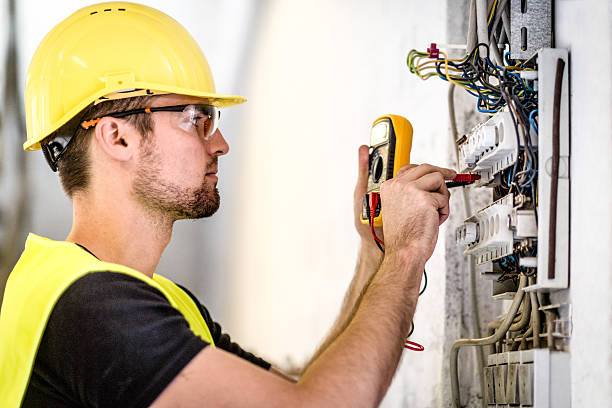
An electrician will ask what is on the circuit and for how long, then de-energize what can be de-energized and open the panel to inspect. They check the torque on the breaker terminal and the panel’s neutral and ground connections against the manufacturer’s spec, since both over-tight and under-tight connections cause heating. They look at the bus bar stab where the breaker seats for pitting, discoloration, or a spring that has lost tension. They measure actual current on the circuit under load with a clamp meter to see whether the load matches the breaker rating. Often they use a thermal camera to find which connection is the hot spot rather than guessing.
From there the fix follows the finding. A pitted stab or a scorched bus is not repairable in place, which is one of the situations where replacing the panel is the honest recommendation. A circuit that is simply carrying too much gets split, or the heavy appliance gets its own circuit. A panel that is out of slots, out of capacity per a load calculation, or damaged at the bus is a candidate for a full panel replacement, which is permitted work coordinated with the municipality and the utility.
What a competent electrician will not do is put a bigger breaker in and call it fixed.
Why homeowners call Lehmann Electrical & Design
- Led by licensed master electrician Jacob Lehmann
- A+ rating with the BBB and 4.9 stars on Google
- 12-month workmanship warranty on the work we do
- Permits pulled and inspections scheduled as part of the job
- Milwaukee, Wauwatosa and Waukesha County, from 12012 W Fairview Ave, Wauwatosa
Ready to have the panel checked?
Send the breaker’s amp rating, what it feeds and how warm it gets. The electrician arrives knowing what to test.
Licensed master electrician. 12-month workmanship warranty.
Frequently asked questions
▾Why is my breaker hot to the touch?
Some warmth is normal, because current passing through a breaker’s internal contacts and bimetal strip generates heat. What is not normal is heat with little load running, or heat paired with a burning smell, discoloration, or buzzing. Do not use touch as your test, since a faulting breaker can be hot enough to burn. Judge it by smell, appearance, and sound, and have it inspected if any of those are off.
▾Why is my breaker hot and tripping?
That combination usually means either a sustained overload or a degrading connection. A breaker heating up and tripping is doing its job: the thermal element responds to current above the rating over time. Reset it once. If it trips again, leave it off. The circuit needs to be measured under load to find out whether it is carrying too much, or whether a loose terminal is generating heat that trips the breaker at normal current.
▾Why is my breaker box hot?
Heat across the whole panel, rather than at one breaker, is more concerning than a single warm breaker. It points toward the bus bars, the main breaker lugs, or the service entrance conductors, all of which carry the full house load. Do not open the cover: with the main breaker off, the incoming service conductors and the main’s line-side lugs remain energized and only the utility can de-energize them. Call an electrician.
▾Is a warm breaker always a problem?
No. A breaker under a sustained heavy load, such as a dryer or a baseboard heater running for an hour, will feel warm, and so will the ones next to it. The concerning version is warmth that appears with light load, warmth that keeps increasing, or warmth alongside smell, discoloration, or noise. Noting which circuit and what was running is the most useful thing you can do before calling.
▾Can a hot breaker start a fire?
It can, which is why the warning signs matter. The mechanism is usually a loose connection: resistance creates heat, heat degrades the connection, the connection gets looser, and the cycle accelerates. Insulation, panel components, and nearby framing can ignite before the breaker trips, because the breaker senses current, not heat at a joint outside itself. That is the reason to leave a suspect breaker off rather than resetting it repeatedly.
If a breaker in your home is running hot, smells wrong, or trips more than once, it is worth having someone open the panel and measure it properly. Lehmann Electrical & Design, led by master electrician Jacob Lehmann, handles diagnostics and panel work across Milwaukee and Waukesha County, holds an A+ rating with the BBB, and is rated 4.9 stars on Google. Call 414-207-0109 or book an estimate and tell us which breaker and what was running.
Next step
Get the panel checked
Send the breaker rating, what it feeds and how warm it gets.
Licensed master electrician12-month warranty4.9 on Google
Milwaukee, Wauwatosa and Waukesha County. Prefer to talk? Call 414-207-0109