Licensed master electrician · Call 414-207-0109
Usually yes, but with conditions. Many carriers will insure a home with knob and tube wiring, often at a higher premium, with a lower coverage limit, or on the condition that the wiring is replaced within a set period after closing. Some carriers decline it outright. Policies vary by insurer, by state, and by what an inspector finds, so the only reliable answer comes from your own agent in writing.

Knob and tube wiring is not illegal, and it is not automatically uninsurable. It is a rating factor. Insurance companies price risk, and an ungrounded wiring system installed between roughly 1880 and the 1940s, with rubber-and-cloth insulation that is now 80 to 140 years old, sits in a higher risk bracket than modern cable.
What that means in practice falls into a few patterns:
| Carrier response | What it looks like | Typical condition |
|---|---|---|
| Insure as normal | Standard homeowners policy | Sometimes none, sometimes an inspection |
| Insure with conditions | Policy issued, replacement required | Often 30 to 180 days after binding |
| Insure with limits | Higher premium, or actual cash value instead of replacement cost | Varies widely |
| Decline or non-renew | Application refused, or existing policy not renewed | Often triggered by a four-point inspection |
| Surplus lines | Specialty or non-admitted carrier picks it up | Higher cost, narrower coverage |
Ask your agent two specific questions: does the carrier write policies on homes with active knob and tube circuits, and if yes, is replacement a condition of the policy or of renewal. Get the answer in writing before you waive an inspection contingency.
> Insurance carriers are not making a judgment about whether your wiring will fail tomorrow. They are making a judgment about a category. A knob and tube system that has been partly rewired, buried under blown-in insulation, and extended with modern cable by four decades of handymen is a genuinely harder risk to price than a house wired in 1998. That is why carriers so often ask for an electrician’s report rather than a yes or no.
A partial answer sometimes works. If an electrician can document that the knob and tube serving habitable rooms has been replaced and only a few dead or abandoned runs remain in the attic, many carriers will treat the house as modern wiring. That documentation is usually what unlocks the better policy.
What is usually causing it
The cause is simply the age of the house. Knob and tube was the standard residential wiring method in the United States from about the 1880s until it was gradually displaced in the 1930s and 1940s, with installations continuing in some areas into the early 1950s. If your home predates World War II and has not been fully rewired, some of it is likely still there.

The system works by running two separate conductors, a hot and a neutral, through the framing. Porcelain knobs hold the wires away from wood, and porcelain tubes protect them where they pass through joists and studs. The original insulation was rubber, wrapped in a cloth braid.
Three things turn that from “old but functional” into an insurance and safety problem:
- The insulation dries out. Rubber hardens and cracks with decades of heat cycling. The worst spots are near light fixtures and inside junction points, where the wiring runs hottest.
- There is no ground wire. Knob and tube is a two-wire system. Grounding, which gives fault current a safe path back to the panel, was not part of it. That is why these homes have two-prong outlets, and why plugging in anything with a three-prong plug invites an improvised adapter.
- Later work made it worse. Modern cable spliced onto brittle old conductors, splices made outside a box, circuits extended to feed a kitchen remodel, and blown-in or batt insulation packed over conductors that were designed to shed heat into open air. The original system relied on air circulation, so burying it in insulation changes how it behaves.
Fuse boxes, overloaded 15 amp circuits serving a modern kitchen, and decades of extension cords are symptoms of the same root cause, which is a wiring system built for a few lamps and a radio being asked to run a household in 2026. The specific hazards of aging circuits in older homes are worth understanding before you start calling agents.
What is safe to check yourself, and what is not
You can safely look, smell and listen. You cannot safely open, test, probe or repair.
Safe for a homeowner:
- Look in an unfinished basement or crawlspace. From the floor, with a flashlight, knob and tube is recognizable: single black-sheathed conductors running individually through white porcelain knobs and tubes, not bundled inside a jacket.
- Count the outlet prongs. Two-prong receptacles throughout a room are a strong hint the circuit is ungrounded, though not proof it is knob and tube.
- Check your paperwork. A past permit, an inspection report from when you bought, or a seller’s disclosure often names it directly.
- Look at the attic from the hatch, without walking on anything, for insulation covering loose single conductors.
- Use your nose and ears. A burning or hot-plastic smell, scorch marks or discoloration around a device, buzzing or crackling means stop using that circuit or device immediately, leave the breaker off, and call an electrician. Do not touch the outlet, the fixture or the panel to judge temperature. Smell, sound and visible discoloration tell you what you need to know.
Not safe without a licensed electrician, and work that needs a permit and an inspection:
- Removing a panel cover. With the main breaker off, the service conductors feeding the panel and the line-side lugs of the main breaker stay energized. A homeowner cannot de-energize them. Only the utility can, usually by pulling the meter, or a separate service disconnect ahead of the panel if one is fitted.
- Opening junction boxes, ceiling fixtures or receptacles to inspect splices.
- Pulling insulation away from conductors in an attic.
- Replacing two-prong outlets with three-prong outlets. Putting a grounded receptacle on an ungrounded circuit without the corrections allowed in the code is a false promise of protection to everything plugged into it.
- Any splicing, extending or removal of knob and tube.
If a breaker on an older circuit trips, reset it once at most: push it firmly to OFF, then to ON. If it trips again, leave it off and have the circuit inspected. Never fit a larger breaker or fuse to stop the tripping. The breaker protects the wire, and on old conductors that protection is the only thing standing between an overload and a fire. The fix for a circuit that cannot carry its load is a new circuit, not a bigger device.
Carrier asking about your wiring?
A licensed electrician documents what is actually there, what is still live and what has already been replaced, which is usually what the insurer is asking for.
Licensed master electrician. 12-month workmanship warranty.
When it points to a bigger problem
Knob and tube by itself is one issue. A house of that age usually raises two others at the same time: whether the panel has room for the new circuits, and whether arc fault protection is required on the work being added. These findings mean the house has a compound problem, and an insurance conversation will not be the hardest part of it.
- Modern cable spliced into old conductors. It means someone worked on the system without a permit, which raises the question of what else was done and where.
- Splices outside a box. Taped or twisted connections hanging in a joist bay are a fire ignition point with no enclosure to contain it.
- Insulation packed over live knob and tube. This turns up in older homes that were insulated years after they were wired. The wiring and the insulation were each fine in isolation.
- A fuse box with oversized fuses, or pennies behind a fuse, which disables overcurrent protection entirely.
- A kitchen, bathroom or laundry fed by a 15 amp ungrounded circuit. These are wet or heavy-load locations where ground-fault protection matters most. A GFCI, a device that cuts power when 4 to 6 milliamps of current leaks by any path, including through a person, is the backstop. Many of these rooms have none.
- Knitting-needle repairs, meaning extension cords stapled to baseboards, power strips chained together, and three-prong adapters on every two-prong outlet. That is a load problem telling you the circuits ran out of capacity decades ago.
- A circuit that trips with nothing plugged in. Most residential breakers are thermal-magnetic, with a heat strip for sustained overload and a magnetic coil for short circuits. One that trips on an empty circuit usually indicates a wiring fault, not a tired breaker.
Any one of these shortens the timescale. The wiring stops being a project for a future renovation and becomes something an electrician should assess promptly.” If you are weighing options, a guide to the real risks in older county homes covers how these conditions interact.
What an electrician does about it
A licensed electrician starts by establishing how much knob and tube is actually live, which is rarely the same as how much is visible. That means tracing circuits from the panel, opening devices and boxes, checking attics and crawlspaces, and separating energized runs from abandoned ones. The output is a written assessment: which circuits are knob and tube, which have been partly replaced, where the unsafe splices are, and what the house needs.
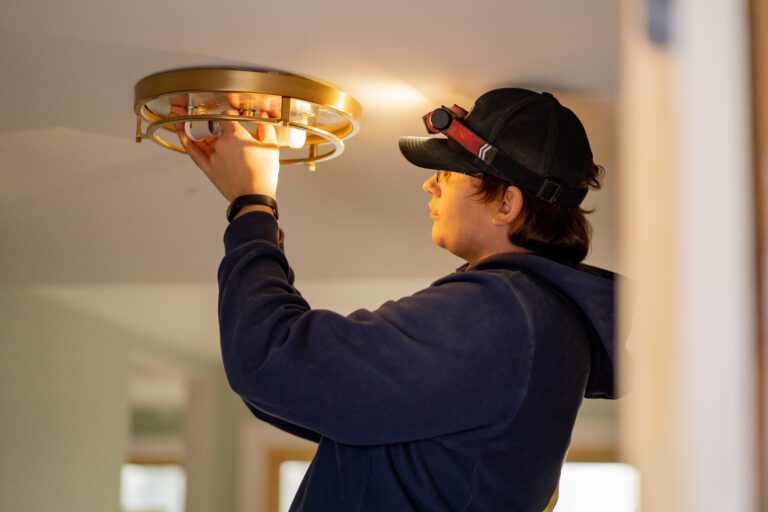
From there the work is rewiring. In an occupied home that usually means fishing new three-conductor cable through existing wall cavities, cutting and patching access points where there is no path, installing new boxes and grounded receptacles, feeding the new circuits from the panel, and abandoning or removing the old conductors. Kitchens, bathrooms and laundry areas get the ground-fault and arc-fault protection the 2023 NEC calls for, which Wisconsin adopted through SPS 316 in September 2026. AFCI, which stands for arc-fault circuit interrupter, detects the signature of an arcing fault in a 120 volt branch circuit and opens the breaker before it ignites surrounding material.
All of this is permitted work. Permits come from your municipality, Milwaukee, Wauwatosa, Waukesha or whichever town you are in, and the inspector enforces Wisconsin SPS 316, which adopts the 2023 NEC and has been in effect since September 1, 2026. Existing installations are not required to be brought up to the new edition simply because the edition changed, but work you do now is inspected against it. Rewiring also typically involves a load calculation, which is the arithmetic that establishes how much electrical capacity the house actually needs based on its square footage and appliances.
Scope drives cost, and scope varies enormously: a 1,200 square foot bungalow with an open basement and a walk-up attic is a different job from a 2,800 square foot four-square with plaster walls and finished third floor. We do not publish price ranges here because an honest number requires seeing the house. A full knob and tube replacement assessment is where that conversation starts.
Lehmann Electrical & Design is led by master electrician Jacob Lehmann and serves Milwaukee and Waukesha County. We hold an A+ rating with the BBB and 4.9 stars on Google, and our workmanship is covered by a 12-month warranty. If your carrier is asking questions about your wiring, request an assessment and written report or call 414-207-0109.
Why homeowners call Lehmann Electrical & Design
- Led by licensed master electrician Jacob Lehmann
- A+ rating with the BBB and 4.9 stars on Google
- 12-month workmanship warranty on the work we do
- Permits pulled and inspections scheduled as part of the job
- Milwaukee, Wauwatosa and Waukesha County, from 12012 W Fairview Ave, Wauwatosa
Need it assessed before your renewal?
Tell us the age of the house, what your insurer has asked for and your deadline.
Licensed master electrician. 12-month workmanship warranty.
Frequently asked questions
▾Can you get house insurance with knob and tube wiring?
In most cases yes, though your choices narrow. Some admitted carriers write these homes with a higher premium or an inspection requirement, some require replacement within a defined window, and some decline. Surplus lines and specialty carriers are a fallback at higher cost. Ask your agent directly whether the carrier writes active knob and tube, and get the answer in writing before closing.
▾What insurance companies will insure homes with knob and tube wiring?
That changes by state, by year and by the individual carrier’s underwriting appetite, so naming companies here would be misleading. The reliable path is an independent insurance agent who can shop multiple carriers in Wisconsin and knows which ones currently accept it. An electrician’s written report on how much knob and tube is live, and how much has already been replaced, materially improves your options.
▾How much does knob and tube wiring cost to replace?
It depends on square footage, how many circuits are involved, wall construction, attic and basement access, and how much finish work the house will need afterward. A plaster-walled home with finished upper floors costs substantially more than one with open access. We do not publish a figure because any number given without walking the house would be wrong. An on-site assessment produces a real scope and a real quote.
▾How long does knob and tube wiring last?
There is no expiration date, which is part of the problem. Some installations are intact after a century, while others have brittle, crumbling insulation at 70 years. What determines it is heat exposure, how many times the system was modified, and whether insulation was later packed over it. Condition is only established by inspection, not by the age of the house.
▾How long was knob and tube wiring used?
It was the dominant residential wiring method in the United States from roughly the 1880s through the 1930s, as armored cable and later nonmetallic sheathed cable took over. Installations continued in some regions into the 1940s and occasionally the early 1950s. If your home was built before 1950 and has never been fully rewired, assume some of the original system is still in the walls until an electrician confirms otherwise.
▾Do I have to remove old knob and tube, or just disconnect it?
Either can be acceptable depending on the situation and your inspector. De-energized conductors that are left in place but disconnected at both ends are not an electrical hazard, and removing wiring from closed walls can mean extensive demolition. What matters for insurance is usually documentation that nothing is live. Your electrician should confirm the approach with the municipality issuing the permit.
Next step
Get it assessed
Tell us what your insurer has asked for and your deadline.
Licensed master electrician12-month warranty4.9 on Google
Milwaukee, Wauwatosa and Waukesha County. Prefer to talk? Call 414-207-0109