Licensed master electrician · Call 414-207-0109
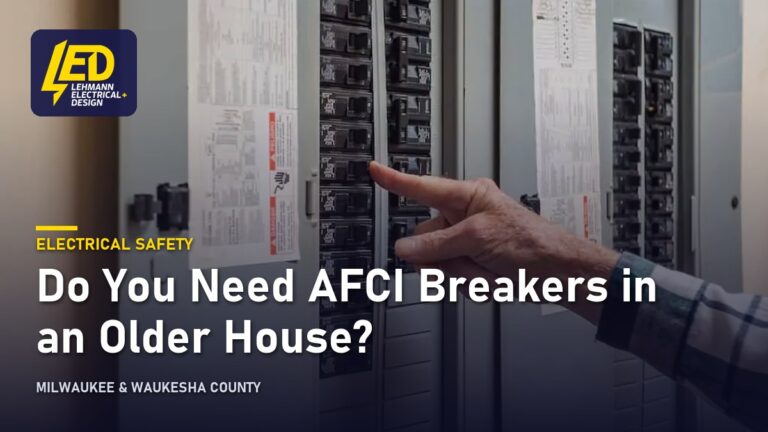
Quick answer. In most cases, no, not simply because your house is old. An arc fault circuit interrupter, or AFCI, is a breaker that watches for the electrical signature of arcing and shuts the circuit off. It is required in new work and when circuits are altered or extended, not retroactively on wiring that was legal when it was installed. Wisconsin now works to the 2023 National Electrical Code, adopted through SPS 316 effective September 1, 2026, and like every code before it, it applies to the work being done rather than to the house as a whole.
Where it starts to matter is the moment something changes. Replace a panel, add a circuit, finish a basement, or extend wiring into a new room, and that work has to meet the code in force today. Permits for that work are issued by your municipality, Milwaukee, Wauwatosa, Brookfield, Waukesha and the rest, each enforcing Wisconsin SPS 316. That is when AFCI protection stops being optional in the areas the code covers, and it is the usual reason an older house ends up with AFCI breakers in a panel that never had them.
For reference, NEC 210.12 in the 2023 edition covers 120-volt, 15- and 20-amp branch circuits supplying outlets and devices in dwelling-unit kitchens, family rooms, dining rooms, living rooms, parlors, libraries, dens, bedrooms, sunrooms, recreation rooms, closets, hallways, laundry areas and similar rooms or areas. It does not cover a 240-volt circuit such as a dryer, a range or an EV charger.
What is usually causing it
An arc fault is not the same thing as an overload or a short circuit. Most standard residential breakers are thermal-magnetic: a heat-sensitive strip handles sustained overload and a magnetic coil handles short circuits. Neither one objects to a small, intermittent arc at a loose terminal, because that arc may draw no more current than a table lamp.
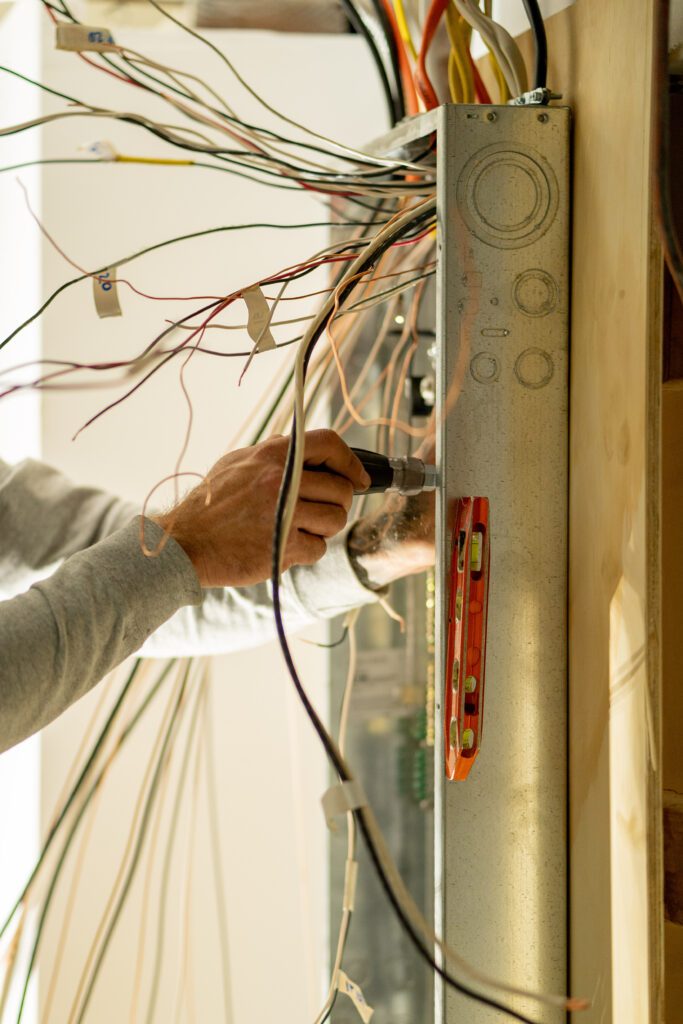
That is the gap AFCI protection was built to close. The device analyzes the current waveform for the signature of arcing and opens the circuit when it finds it. In an older house the conditions that produce arcing are more common than in new work, which is why the question comes up at all:
- Connections that have worked loose over decades. Heat cycling, vibration and a terminal screw that was never quite tight enough.
- Backstabbed devices. Switches and receptacles where the conductor was pushed into a spring clip at the back rather than wrapped around the screw. The clip relaxes over time.
- Cable damaged long ago. A staple driven slightly too hard, a nail through a stud bay, a cord pinched behind a baseboard.
- Repairs made quickly and never revisited. Splices without a box, wire nuts that were never tightened, two conductors under one screw.
A 1920s Milwaukee bungalow with knob and tube in the attic and a 1950s Wauwatosa ranch with early nonmetallic cable have different versions of the same story: decades of lamps, window air conditioners, holiday lights and a few weekend repairs, all landing on terminations that were tightened once.
If you smell hot plastic or burning, see discoloration or scorch marks around a receptacle, switch or panel, or hear buzzing or crackling, stop using that circuit or device, leave the breaker off, and call a licensed electrician. Do not touch the device to judge how hot it is.
What is safe to check yourself, and what is not
Plenty here needs no tools and no risk.
Worth noting before an electrician visits:
- Whether the panel already has any breakers with a test button on the face, which is what an AFCI or a combination AFCI/GFCI device looks like.
- The rating on the main breaker, and whether the panel directory is readable.
- Which rooms the circuit in question actually feeds, noticed by what loses power rather than by opening anything.
- Whether a breaker has tripped. A breaker gets one reset: push the handle firmly all the way to OFF, then to ON, once. If it trips again, leave it off and have it inspected. A breaker that trips on a circuit with nothing plugged in is pointing at the wiring, not at an appliance.
- A GFCI gets one reset too. If it will not hold, there is a real leakage fault or a failed device.
Not safe without a licensed electrician:
- Removing the panel cover. With the main breaker switched OFF, the service conductors feeding the panel and the main breaker’s line-side lugs stay energized. A homeowner cannot de-energize them. Only the utility can, usually by pulling the meter, or a separate service disconnect ahead of the panel if one is fitted.
- Swapping a standard breaker for an AFCI. The panel label states which breakers are listed for that panel, and most breakers are specific to a manufacturer’s panel, though some are classified for use in another maker’s enclosure. On many AFCI designs the circuit neutral has to land on the breaker rather than the neutral bar, while newer panels use a plug-on neutral base instead. Either way it is the electrician’s call, made against the panel label.
- Opening devices or junction boxes to look for the loose connection causing the trouble.
Not sure what your panel will take?
A licensed electrician checks what the panel is listed for and tests the circuits first, because arc fault protection on a faulty circuit just trips.
Licensed master electrician. 12-month workmanship warranty.
When it points to a bigger problem
An AFCI that will not hold on an older circuit more often reports a real fault than a defective breaker. When one is fitted and keeps tripping, the useful question is what changed, and the answer is frequently that a fault which was always there is now being detected for the first time.
Three findings move the job beyond fitting a breaker:
Shared (multiwire) neutrals. In some older installations two circuits on opposite legs of the panel share one neutral conductor. That arrangement is still permitted, and NEC 210.4(B) has required the two circuits to disconnect simultaneously since the 2008 edition, so a two-pole breaker or a handle tie is not new. The AFCI problem is mechanical rather than mysterious: a shared neutral cannot be split between two separate single-pole AFCI breakers, because each device needs to see the return current for its own circuit and only its own. The options are a two-pole AFCI breaker that covers both legs, or separating the circuits so each has its own neutral.
Cloth-insulated or knob and tube wiring. Insulation that has gone brittle does not get better. Where it has cracked or fallen away, conductors can arc against each other, against a box or across a splice, and an AFCI that is doing its job will keep reporting that arcing. The fix is the wiring, not the breaker.
A panel that is not listed for the breakers you need. Some older panels have no compliant AFCI available at all, and some are discontinued types that nobody makes a current-code breaker for. In that case the honest answer is that the panel has reached the end of what can be done with it, and replacing the panel becomes the real conversation rather than a breaker swap.
> An AFCI that trips the first week it is installed has usually found something. Fitting arc fault protection to a circuit with a loose terminal, a damaged cable or a splice outside a box produces a breaker that will not stay on, and the fault is cheaper to locate before the breaker goes in than after. Testing the circuit first is not an extra step, it is the order the job should run in.
Where whole house surge protection fits alongside this
An AFCI watches for arcing inside your own wiring. A surge protective device, or SPD, deals with voltage arriving from outside it, which is a different problem that neither one solves for the other. Homeowners in southeastern Wisconsin raise the two in the same conversation often enough that it is worth answering the surge questions properly here.
How it works. An SPD sits in parallel with your service. Under normal voltage it does nothing. When voltage spikes, from a nearby lightning strike, a utility switching event on the We Energies distribution network, or a large motor in your own house shutting off, internal components switch from a high-resistance state to a low-resistance one within nanoseconds and divert the excess energy to ground, clamping the voltage the rest of the house sees. It does not stop a direct strike on the house. It handles the far more common transients that shorten the life of furnace control boards, garage door openers, TVs and anything with a circuit board in it.
What it looks like and how it is installed. A whole house SPD is a small gray or beige box, roughly the size of a paperback, mounted on or directly beside the service panel, with a short lead set entering the panel. Type 1 devices can be installed on the line side of the service disconnect; Type 2 devices, the usual residential choice, are hardwired on the load side, typically fed by a two-pole breaker in the panel. The leads are kept as short and straight as the install allows, because long leads reduce how well the device clamps. The work means the panel cover comes off and the panel is de-energized, so it is licensed-electrician work with a municipal permit, not a weekend project.
How long installation takes. On a straightforward residential panel with a spare two-pole space, the install itself is usually under two hours once the electrician is on site. Older panels take longer: a service panel with no free spaces, a split-bus design, or a discontinued type with no available two-pole breaker all change the plan, and sometimes change it into a panel conversation instead.
| Spec | What it means | Typical residential figure |
|---|---|---|
| kA (surge current rating) | The peak current per phase the device can divert in a single event | 50 kA to 100 kA per phase for a service-entrance SPD; higher ratings generally correlate with longer service life, not better clamping |
| Joules | Total energy the device can absorb over its life | Commonly quoted in the tens of thousands for whole house units; useful only when comparing similar device types |
| Amps (breaker size) | The breaker feeding a Type 2 SPD, which carries no load current in normal operation | Usually a 2-pole breaker sized per the manufacturer’s instructions, often 20 A or 30 A |
| VPR (voltage protection rating) | How much voltage still gets through during a surge. The number most worth comparing | Lower is better; 600 V or below on 120/240 V service is a reasonable target |
| Service life | How long the device keeps protecting | Several years to around ten, depending on how many surges it absorbs. The status light tells you, not the calendar |
On cost, we do not publish a figure here, because the honest answer depends on the device, whether a two-pole space exists in your panel, and whether the panel is one that current SPDs can be fitted to at all. Ask for it as part of an estimate and you get a real number instead of a range that does not apply to your house. On protection level: one properly rated service-entrance device covers the whole panel, and plug-in strips at sensitive electronics are a reasonable second layer, not a substitute. If you want this fitted, whole house surge protection is a discrete job that is often done on the same visit as other panel work.
Knowing when it has expired. Nearly every residential SPD has a status LED or an indicator window. Green, or lit, means it is still protecting. Dark, red, or an audible alarm on some models means the device has done its job and needs replacement, and the house has no surge protection until it is replaced. Worth a glance whenever you are at the panel, and worth asking an electrician to check during any other visit.
What an electrician does about it
On a visit about AFCI protection in an older house, the work usually runs like this.
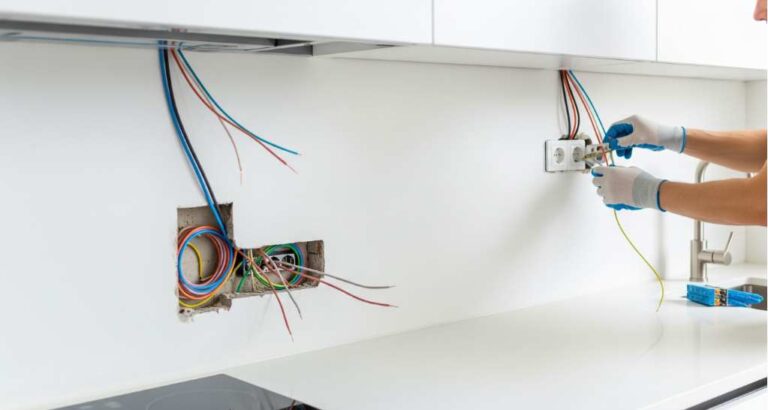
The electrician establishes what the panel is, who made it, and which AFCI devices are actually listed for it, because that single fact decides whether the rest of the conversation is possible. Then the circuits are identified and traced so it is clear what each one feeds, which is rarely what the directory claims in a house that has been extended twice.
If a breaker is being fitted to an existing circuit, the circuit is tested first. Terminations are checked, backstabbed devices are moved to screw terminals, and any splice found outside a box is dealt with. Shared neutrals are identified before anything is ordered, because they change which breaker is needed.
Where the work is part of a larger job, a panel replacement or a finished basement, the required protection is designed in from the start and the municipal permit and inspection cover it. Where it is a retrofit the homeowner has asked for, the sensible order is the circuits in the rooms NEC 210.12 names first: bedrooms, living and family rooms, hallways and the laundry area. While the panel is open, it is also the natural moment to look at surge protection and at whether the smoke alarms are interconnected and within their replacement date, since fire protection in an older house is a package rather than one device.
Why homeowners call Lehmann Electrical & Design
- Led by licensed master electrician Jacob Lehmann
- A+ rating with the BBB and 4.9 stars on Google
- 12-month workmanship warranty on the work we do
- Permits pulled and inspections scheduled as part of the job
- Milwaukee and Waukesha County, from 12012 W Fairview Ave, Wauwatosa
Why homeowners call Lehmann Electrical & Design
- Led by licensed master electrician Jacob Lehmann
- A+ rating with the BBB and 4.9 stars on Google
- 12-month workmanship warranty on the work we do
- Permits pulled and inspections scheduled as part of the job
- Milwaukee, Wauwatosa and Waukesha County, from 12012 W Fairview Ave, Wauwatosa
Want to know where your house stands?
Send the main breaker rating and a photo of the panel with the door shut.
Licensed master electrician. 12-month workmanship warranty.
Frequently asked questions
▾Do I have to add AFCI breakers to my existing house?
Not because the code changed. Existing wiring that was compliant when it was installed is generally allowed to remain. The requirement attaches to new work and to circuits you alter or extend, which is why panel replacements, basement finishes and remodels are where it usually appears. Wisconsin SPS 316 adopts the 2023 NEC, in effect since September 1, 2026.
▾Will an AFCI breaker fit my old panel?
Sometimes. It depends on the panel’s make and the breakers listed for it, which is printed on the panel label. Some older and discontinued panels have no listed AFCI option at all, and that is a strong argument for replacing the panel rather than hunting for a breaker that does not exist.
▾My AFCI keeps tripping. Is it faulty?
More often it is reporting something real. A breaker that trips with nothing plugged in is pointing at the wiring. Replacing the breaker without finding the cause usually produces a second breaker that trips. Reset it once, and if it trips again leave it off until an electrician has tested the circuit.
▾What is the difference between AFCI and GFCI?
A GFCI watches for current leaking out of the circuit by any path, including through a person, and trips at 4 to 6 milliamps. That is shock protection. An AFCI watches the waveform for arcing, which is fire protection. Combination devices do both, and some locations call for both kinds of protection.
▾How many joules and how many kA should a whole house surge protector have?
For a service-entrance device on a 120/240-volt house, 50 kA to 100 kA per phase is the usual range, with joule ratings commonly in the tens of thousands. Compare the voltage protection rating too, since that is what the house actually sees during a surge. Lower VPR is better protection.
▾How long do whole house surge protectors last?
Several years to around ten, but the number of surges absorbed matters more than the calendar. Each device has a status light or indicator window. If it is dark, red, or alarming, the device has spent itself and the house is unprotected until it is replaced. Check it when you are at the panel.
▾Does adding AFCI protection mean rewiring the house?
Usually not. It means fitting the right device and correcting whatever faults that device finds, which is often a handful of terminations. Rewiring only enters the conversation when the insulation itself has failed, which is a separate problem that the breaker has merely made visible.
▾Is this worth doing if I am not renovating?
That is a judgment call rather than a requirement. An older house with original wiring, aluminum branch circuits, or a history of flickering and warm devices is a better candidate than one rewired recently. An electrician can tell you which circuits would benefit and which would simply trip until something is fixed first.
If you want to know where your own house stands, tell us what you have or call 414-207-0109. Lehmann Electrical & Design is led by master electrician Jacob Lehmann and works across Milwaukee and Waukesha County.
Next step
Get your panel checked
Send your main breaker rating and panel make.
Licensed master electrician12-month warranty4.9 on Google
Milwaukee, Wauwatosa and Waukesha County. Prefer to talk? Call 414-207-0109