Licensed master electrician · Call 414-207-0109
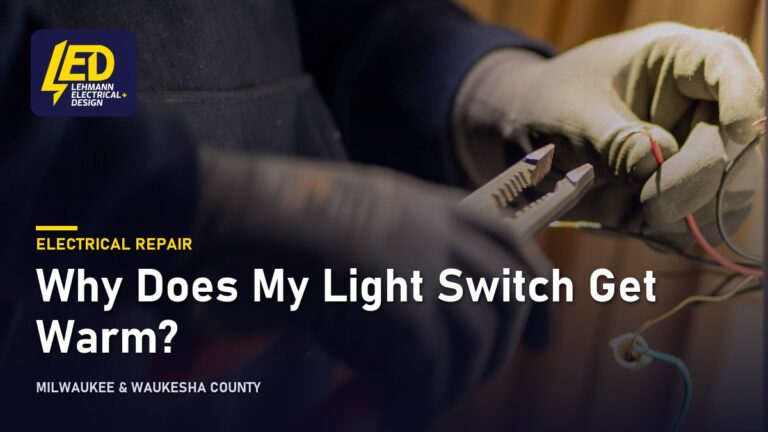
A dimmer that feels slightly warm is normal. A plain on-off switch that feels warm is not. A standard switch only makes and breaks a connection, so it should sit at close to room temperature; noticeable heat almost always traces back to a connection that is no longer tight, a device that has worn out, or a load the switch was never rated for. A loose connection in a wall box heats, arcs and gets worse over time, so it is worth having looked at.
What the device is doing decides whether heat is expected.
A dimmer is a working electronic device. A modern phase-control dimmer does not burn off the dimmed energy as heat, but its switching element still has real losses, and the metal strap behind the faceplate is what sheds them. Mild warmth at a dimmer is the device doing its job.
A plain switch is different. Its contacts have only a tiny resistance, so there is very little to turn into heat. A standard on-off switch that is warm enough for you to notice is abnormal, full stop. That is not an invitation to go and test it by hand. If you already noticed the warmth incidentally, that is your data point; do not go back and press a palm against a device you now suspect is faulting.
Judge it by smell, sight and sound instead. A burning or hot-plastic smell, browning or deformation on the plate, scorch marks, buzzing or crackling are the signs that matter. If any of those are present, stop using that switch, turn the circuit off at the panel if you can identify the right breaker with confidence, and call a licensed electrician. Turning a circuit off means operating the breaker handle on the front of the panel and nothing else: never remove the panel cover or the dead front, which is the inner metal plate behind the door. Panel labels are often wrong in an older house, so if you cannot tell which breaker it is, leave the panel alone and say so when you call.
One quick clarification, because it comes up: if you are asking why a headlight switch gets hot, that is an automotive switch on a 12 volt DC system and belongs with an auto electrical shop. Nothing here applies to it. Everything below is about 120 volt household branch circuits, meaning the wiring that runs from your panel to the switches and outlets in your walls.
Do light switches get warm?
A dimmer: yes, mildly, by design. A plain on-off switch: no.
That is the whole yes-or-no answer. If the device on your wall is a slider, a rotary knob, a small paddle with a separate brightness control or a smart dimmer, some warmth is part of normal operation. If it is a plain toggle or paddle that only goes on and off, warmth means something in the box is converting electricity into heat when it should be passing it straight through.
What is usually causing it
These are the faults an electrician checks, in roughly the order they get ruled out.
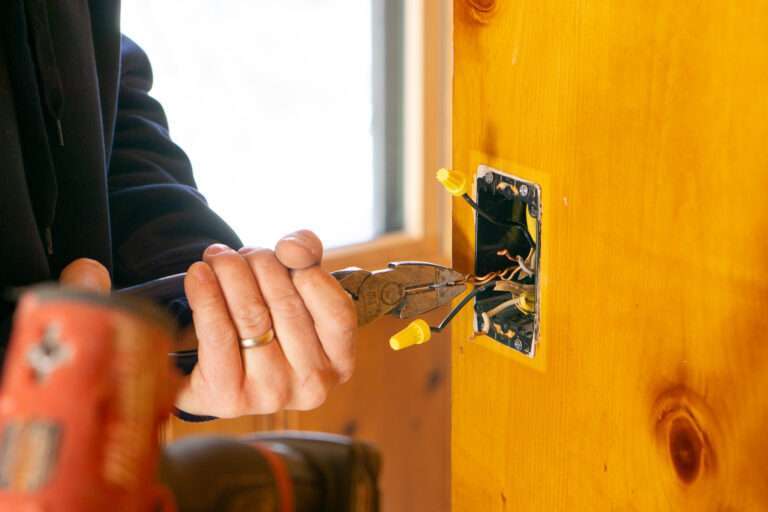
A loose or failing termination. This is what an electrician looks at first. A screw that was tight twenty years ago can relax through decades of heating and cooling, especially on devices in unheated back porches, garages and sunrooms that swing through a wide temperature range each year. The connection develops resistance, resistance produces heat, and heat loosens the connection further. It is a loop that gets worse rather than better.
A back-wired connection on a spring clip. Many switches allow the wire to be pushed into a spring clip at the back of the device instead of being wrapped under the screw terminal. Those push-in spring clips are a known weak point: the contact area is small and the clip can lose tension over time. Note that this is not the same as a screw-clamped back-wire terminal, found on many spec-grade devices, where a plate is tightened down onto the conductor by the screw. That style is a solid connection. The spring-clip style behind a receptacle is one of the reasons an outlet gets hot or smells before anything else goes wrong.
A dimmer carrying more than it should. Dimmers are rated for a maximum load, and that rating drops when they sit side by side in a shared box because they cannot shed heat as easily. A dimmer at its limit runs hot.
A dimmer not matched to the lamps. A dimmer built for incandescent lamps often behaves badly with LEDs. The LED driver draws a brief surge of current each time the dimmer switches, and a dimmer not designed for that waveform works harder than it should. Buzzing, flickering and heat all point the same way. The fix is a dimmer listed as compatible with the lamps you actually have.
Aluminum branch wiring. Houses wired roughly between 1965 and 1973 may have aluminum branch circuits. The joint between an aluminum conductor and a device not rated for it is a known heat source. The devices to ask for are marked CO/ALR, or the conductors are pigtailed to copper with connectors listed for aluminum-to-copper (AL/CU) use. This is not a general-handyman repair.
A worn-out switch. Switches carry a listed mechanical and electrical endurance rating, which is the number of operating cycles the manufacturer tested the device to. The contacts inside degrade with use, and a hallway switch flipped several times a day for thirty years has earned its retirement.
What a hot switch actually means
Plainly: a hot light switch means something in that wall box is turning electricity into heat instead of passing it along, and almost always that is a bad connection or a failing device.
The three common readings are these. A warm dimmer means the device is working normally, or is near its load limit. A warm plain switch means a loose terminal, a failed push-in clip, or a worn device. A hot switch with browning, a smell or a crackle means arcing, which is a fire risk rather than an inconvenience, and that circuit should be shut off rather than monitored.
Why does my light switch plate get hot?
Heat at the cover plate rather than at the switch itself usually means the source is behind the device, in the box, not in the switch mechanism.
A switch’s own losses stay in the switch body and its mounting strap. When the plastic or metal plate is warm across its face, heat is radiating from the wire connections, the wire nuts or the box itself. Common sources are a loose terminal on the device, a failing splice in the back of the box, conductors crowded into a box too small for them, or several dimmers ganged behind one multi-gang plate. A metal plate also spreads heat further than a plastic one, so warmth can feel more widespread than its source.
If the plate is browning, deforming, or has a hot-plastic smell around it, that is arcing damage. Stop using the circuit, leave the breaker off, and have it inspected.
Why is my light fixture getting hot, not the switch?
A hot fixture is a different problem with its own short list of causes, and it is worth separating from a hot switch.
| What you find | Likely cause | What it needs |
|---|---|---|
| Fixture body hot, lamp wattage above the label | Lamps exceed the fixture’s maximum rating | Lamps within the rating on the fixture label |
| Enclosed glass fixture, LED lamps failing early and running hot | LED lamp not rated for enclosed fixtures | Lamps marked “enclosed fixture rated” |
| Recessed can in a ceiling with insulation touching it | Older non-IC-rated housing buried in insulation | Insulation pulled back to the clearance stated on the housing’s listing label, or an IC-rated housing fitted |
| Heat and discoloration at the fixture’s wire connections | Loose or heat-damaged terminations in the fixture box | Device isolated, inspected and re-terminated |
| Fixture hot and the switch hot | Circuit loaded beyond what the wiring or devices were sized for, or a fault shared by both points. Look for a warm breaker, or lights dimming when another load is switched on | Load compared against the circuit and device ratings, fault traced |
Lamp wattage and the enclosed-fixture question are things a homeowner can check from the ground. Anything involving the wiring inside the fixture box or a recessed housing in the ceiling is electrician work.
What is safe to check yourself, and what is not
Everything in the first list stays outside the wall and needs no tools.
Worth noting before an electrician visits:
- Whether it is a dimmer or a plain switch, which decides whether mild warmth is expected at all.
- Whether the plate is discolored, browned or slightly deformed around the switch.
- Whether there is any burning or hot-plastic smell, now or recently.
- Whether there is buzzing or crackling, which often travels with heat. The same sound from a receptacle has its own set of causes.
- What the switch controls, and how much. A single LED fixture and a bank of ten downlights are very different loads.
- Whether anything else on that circuit misbehaves, such as an outlet that has stopped working or lights that flicker when the switch is operated.
- Whether the switch was recently replaced, and whether the lamps were recently changed to LED.
- How you noticed the warmth, if you noticed it incidentally. Do not go back and press a hand on a device you suspect is faulting.
Not safe without a licensed electrician:
- Removing the switch plate and the device to look at the terminations. The conductors in that box are live until the circuit is proven dead, and the breaker label is not proof.
- Tightening a terminal screw. It sounds trivial and it is the exact work that needs the circuit isolated and tested first.
- Replacing the switch yourself because the old one looks burnt. If it is burnt, the question is what caused it, and fitting a new device onto a damaged conductor repeats the fault.
- Anything behind the panel cover. Operating a breaker handle is fine. Removing the cover or the dead front is not, because the service conductors and the main breaker’s line-side lugs stay energized even with the main breaker off. A homeowner cannot de-energize those; only the utility can, usually by pulling the meter, or a separate service disconnect if one is fitted ahead of the panel.
If there is a smell of hot plastic, visible scorching, buzzing or crackling, turn the circuit off at the panel using the breaker handle, if you can identify the right breaker with confidence, and leave it off. If a breaker has tripped, reset it once at most: push it firmly to OFF, then ON. If it trips again, leave it off until it has been inspected. Never fit a larger breaker to stop tripping; the breaker is there to protect the wire.
Switch warm, or warmer than it used to be?
A licensed electrician isolates the circuit, opens the device safely and finds the connection that is heating, which is not something to tighten blind.
Licensed master electrician. 12-month workmanship warranty.
When it points to a bigger problem
A warm switch is sometimes a tired device and nothing more. These findings say it is not.
The warmth is at the plate rather than the switch body. Heat spreading to the cover plate points at the box behind the device rather than the switch mechanism.
More than one device on the circuit runs warm. One warm switch is a connection. Several warm points on the same circuit suggest the circuit is loaded closer to its limit than it should be, or that the problem is further upstream.
It changed after the lamps changed. A switch that started running warm after an LED retrofit usually points to a dimmer and lamp mismatch: the lamps draw less total power, but the dimmer is not designed for how LED drivers behave. The load went down and the heat went up, which tells you the problem is compatibility, not demand.
There is browning, a smell, or a crackle. Those describe arcing, which is a fire risk, and a circuit showing them should be switched off rather than watched.
The house has aluminum branch wiring. This changes the job. The connection method matters more than the device, and the work needs CO/ALR devices or listed AL/CU connectors fitted by somebody who knows the difference.
Older housing stock in our area makes several of these more likely at once. A pre-war bungalow that has been partially rewired over the decades can easily have original devices in some rooms, 1965 to 1973 aluminum-era work in others, and push-in-clip modern switches wherever a previous owner swapped something out. A warm switch in a house like that is worth having traced rather than guessed at.
Adding an outlet while the electrician is there
A common companion request: an extra receptacle on the back of the house, for a grill, string lights, a pressure washer or holiday decorations. It is a reasonable job to combine with a service call, and it is worth knowing what it involves.
An exterior receptacle is not a swap. It is either an extension of an existing circuit or a new circuit run from the panel, depending on what is already loaded on the nearest branch. Under Wisconsin SPS 316, which adopts the 2023 NEC and has been in effect since September 1, 2026, an outdoor receptacle must be weather-resistant rated, GFCI protected, and fitted with an in-use cover, the bubble-style lid that keeps the receptacle protected while a cord is plugged in. A GFCI, or ground-fault circuit interrupter, is a device that shuts the circuit off when it detects current leaking away by any path, including through a person or damp material. The personnel-protection type used in homes (UL 943 Class A) trips at 4 to 6 milliamps of leakage, which is well below the level that would injure someone. Outdoor work is permitted by your municipality, Milwaukee, Wauwatosa, Waukesha and the rest, which is the body that enforces SPS 316.
If you want one added, say so when you book the warm-switch visit, so it can be handled in one trip rather than two.
What an electrician does about it
The circuit is isolated and proven dead before anything is opened, because the breaker label in an older house is often wrong about what it controls.
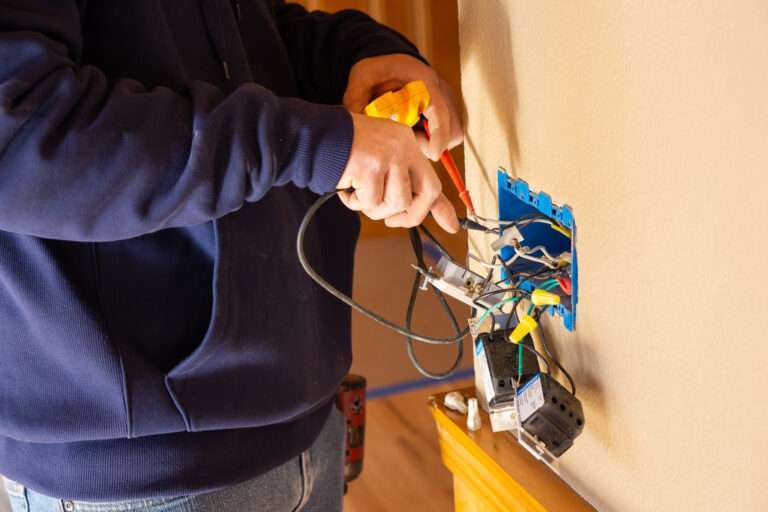
The device comes out and the terminations are inspected: whether the conductors were pushed into spring clips or landed under the screw terminals, whether there is heat damage on the insulation, whether two conductors share a single screw, and whether the box has room for the device without crowding the conductors. Discolored copper shows where the heat has been even after the device is removed.
The load is then compared with the device. For a dimmer, that means the type and count of lamps now on the circuit and whether the dimmer is derated because it shares a box with others. For a plain switch it means checking that the switch is rated for what it controls and that nothing has been added to the circuit since it was installed.
What is replaced depends on what is found. A tired device is replaced and re-terminated on screw terminals. A damaged conductor is cut back to sound copper if there is enough length, and extended properly in an accessible box if there is not. A mismatched dimmer is replaced with one listed for the lamps. Aluminum conductors are terminated with CO/ALR devices or listed AL/CU connectors. Then the circuit is tested under load rather than pronounced fixed because the switch looks new.
Why homeowners call Lehmann Electrical & Design
- Led by licensed master electrician Jacob Lehmann
- 4.9 stars on Google, and an A+ rating with the BBB
- 12-month workmanship warranty on the work we do
- Permits pulled with your municipality, which enforces Wisconsin SPS 316 (2023 NEC, in effect since September 1, 2026)
- Milwaukee and Waukesha County, from 12012 W Fairview Ave, Wauwatosa
Why homeowners call Lehmann Electrical & Design
- Led by licensed master electrician Jacob Lehmann
- A+ rating with the BBB and 4.9 stars on Google
- 12-month workmanship warranty on the work we do
- Permits pulled and inspections scheduled as part of the job
- Milwaukee, Wauwatosa and Waukesha County, from 12012 W Fairview Ave, Wauwatosa
Want it looked at before it gets worse?
Tell us which switch, what it controls and how warm it feels.
Licensed master electrician. 12-month workmanship warranty.
Frequently asked questions
▾Is it normal for a light switch to feel warm?
For a dimmer, mild warmth is normal and expected, because the switching electronics behind the faceplate have real losses. For a standard on-off switch, no. Its contacts have only a tiny resistance, so there is almost nothing there to produce heat. Warmth you can notice on a plain switch points to a connection problem in the box and should be inspected.
▾How do I tell if it is too warm without touching it?
Use smell, sight and sound. A burning or hot-plastic odor, browning or deformation of the plate, scorch marks, buzzing or crackling all mean stop using the circuit and call an electrician. Touching a device you already suspect is faulting is not a useful test and is not safe, so skip it. Judge by the other three senses instead.
▾Why does my dimmer switch get hot?
Dimmers give off heat as part of how they work, so some warmth is expected. Excess heat usually comes from one of three things: the dimmer is near its maximum load rating, it has been derated because it shares a box with other dimmers, or it is not listed as compatible with the LED lamps now fitted. A matched dimmer runs cooler.
▾Can I just tighten the screw myself?
The repair is small and the conditions are not. The conductors stay live until the correct circuit is isolated and tested, and the breaker label is not proof the right one is off. A terminal that has been running warm often has heat-damaged insulation or a heat-damaged conductor that needs cutting back, not retightening.
▾Does a warm switch mean the whole house needs rewiring?
Usually not. Most are a single connection or a single device, replaced in one visit. Rewiring only enters the conversation when the conductor insulation itself has failed through age or heat, or when the house has aluminum branch circuits from the 1965 to 1973 era that need a different connection method throughout.
▾The switch is warm but everything works. Can it wait?
Working is not the same as safe. A loose connection generates heat whether or not the lights behave, and resistance heating degrades the connection further over time. It is not usually a same-day emergency in the absence of a smell, scorching or a crackle, but it should not be left for months either.
If a switch in your house is running warm, tell us which one and what it controls or call 414-207-0109. Lehmann Electrical & Design is led by master electrician Jacob Lehmann and covers Milwaukee and Waukesha County.
Next step
Get the switch checked
Tell us which switch and what it controls.
Licensed master electrician12-month warranty4.9 on Google
Milwaukee, Wauwatosa and Waukesha County. Prefer to talk? Call 414-207-0109