Licensed master electrician · Call 414-207-0109
A Generac standby generator that starts and then quits is almost always telling you one of four things: it is not getting enough fuel, it is overheating or low on oil, it is seeing a load or voltage problem it cannot support, or a control board fault is stopping it on purpose. The unit’s own control panel usually logs a code that names the reason. Read the code first, then decide what is homeowner-safe and what needs a licensed electrician.
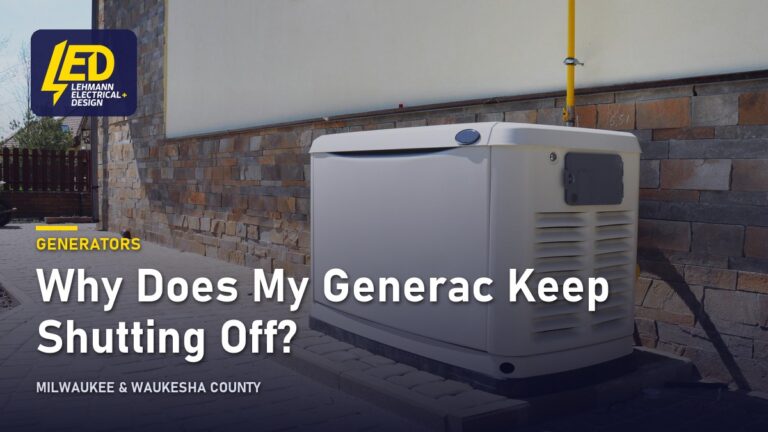
Your generator is shutting itself down because a protective sensor told it to. Standby generators are built to stop rather than destroy themselves, so a shutdown is a symptom, not the disease.
The pattern matters. A unit that runs for a few seconds and dies usually has a fuel delivery problem. One that runs for 10 to 30 minutes and then quits is more often thermal: low oil, low coolant on liquid-cooled units, or blocked airflow. One that shuts off the moment the house load transfers is an electrical or transfer switch issue. One that drops out at random, with no clear timing, often has a sensor, wiring, or control board fault.
Write down what the display says before you do anything else. Generac units show status and fault messages at the unit, and many models report through Mobile Link. “Low oil pressure,” “overcrank,” “overspeed,” “underspeed,” “RPM sensor loss,” and “low coolant” all point in very different directions, and guessing wastes your time.
What is usually causing it
Here are the causes worth checking, grouped by how the shutdown behaves.
Fuel supply. This is the single biggest source of confusion with natural gas and propane units. The generator may be plumbed correctly and still starve under load if the gas line is undersized for the distance, if a regulator is failing, or if a propane tank is low or too cold to vaporize at the rate the engine needs. A unit that fires, runs rough, and quits within a minute is behaving exactly like a fuel-starved engine. With propane, a tank that reads 20 percent in January can be functionally empty from the generator’s point of view.
Oil and cooling. Low oil pressure and high engine temperature both trigger a hard shutdown. Air-cooled Generac units also shut down if the enclosure cannot breathe. Snow drifted against the louvers, mulch or shrubs grown in tight, a mouse nest in the housing, or a clogged air filter all push engine temperature up until the sensor pulls the plug.
Battery and charging. A weak battery can start the engine and still cause a shutdown, because the control board needs stable voltage to stay awake. Generac batteries are a wear item, and a battery that tests fine in September can fail on the first cold night. If your unit shows a battery warning during weekly exercise, treat it as the cause, not background noise.
Load and transfer. If the generator runs fine unloaded and shuts down the second the transfer switch closes, the problem is on the electrical side: too much load for the unit, a failing transfer switch, a bad connection at the switch, or a motor load with a high inrush current that drags voltage below the limit the controller accepts. Well pumps, air conditioners, and heat pumps are the usual suspects.
Controller and sensors. Overspeed and underspeed faults, RPM sensor loss, and stepper motor faults are control-side problems. So is a shutdown with no fault code at all, which sometimes points to a loose harness connection or a corroded ground.
| Shutdown pattern | Most likely area | Who should handle it |
|---|---|---|
| Runs 5 to 60 seconds, then dies | Fuel supply or pressure | Check tank level yourself, then call |
| Runs 10 to 30 minutes, then dies | Oil level, coolant, blocked airflow | Oil and clearances yourself |
| Quits the instant load transfers | Load size or transfer switch | Electrician |
| Will not crank, or cranks and never catches | Battery, charger, fuel valve | Check the valve, then call |
| Random with no pattern, no code | Wiring, sensor, control board | Electrician |
What is safe to check yourself, and what is not
A homeowner can safely do four things: read the fault code on the display, confirm the fuel shutoff valve is open, look at the oil level with the engine off and cool, and clear snow, leaves, and plant growth away from the enclosure so air can move through it. You can also check that a propane tank actually has fuel in it. Nothing on that list requires opening an electrical enclosure.
Everything else belongs to a licensed electrician or a qualified generator technician. Do not open the transfer switch, the generator’s control panel, or your home’s load center. Do not manipulate the gas regulator. Do not bypass a sensor to “get it running.” Do not repeatedly crank a unit that keeps shutting down on low oil pressure, because you can turn a sensor fault into a bearing failure.
> If you smell burning or hot plastic near the generator, the transfer switch, or your electrical panel, or you see scorch marks, discoloration, or hear buzzing or crackling, stop there. Shut the generator off at its own switch, leave the affected breaker in the off position, and call an electrician. Those are signs of an active fault, not of a machine working hard, and they do not improve with time.
One more thing about breakers. If a breaker tripped during the outage, you may reset it once: push it firmly to OFF, then to ON. If it trips again, leave it off and have it inspected. Never replace a breaker with a larger one to stop nuisance tripping, because the breaker is sized to protect the wire behind it, not the appliance in front of it. The fix for a genuinely overloaded circuit is another circuit.
It is also worth knowing what “off” does not mean. Turning your main breaker off de-energizes the branch circuits in the house, but the service conductors feeding the panel and the line-side lugs on the main breaker stay live. A homeowner cannot make those safe. Only the utility can, usually by pulling the meter, or a separate service disconnect ahead of the panel if one is fitted. That is a large part of why transfer switch work is not homeowner work.
Generator still shutting down mid-run?
A licensed electrician reads the fault log, checks the transfer switch and tests the circuits it is being asked to carry.
Licensed master electrician. 12-month workmanship warranty.
When it points to a bigger problem
Repeated shutdowns sometimes mean the generator is fine and the installation is not.
The clearest example is undersizing. If the unit was specified from square footage rather than from an actual load calculation, which is the engineer’s tally of the real electrical demand on the circuits being backed up, it can be too small for what the transfer switch is handing it. That generator will run beautifully in weekly exercise and then trip or shut down every time the air conditioner and the well pump start within a few seconds of each other. No amount of servicing fixes a sizing error. If you want to sanity-check what your house actually demands, our whole-home generator sizing tool walks through it by circuit rather than by house size.
The second is gas supply. A generator can be the right kW and still starve because the gas piping was sized for the furnace and water heater, not for an engine that wants a large volume all at once. That is a plumbing and load-calculation problem that shows up as mysterious shutdowns under load.
The third is the transfer switch itself. Contacts pit and burn over time. A transfer switch that has been through a decade of Wisconsin outages can develop enough resistance at one pole to create heat, voltage drop, and unstable operation. This is an inspection item, not a guess.
The fourth is age. Well-maintained residential standby units commonly give 15 to 25 years of standby service, and they are rated in running hours rather than calendar years, so a unit that has covered a lot of long outages ages faster than one that has mostly exercised weekly. Once a unit needs a control board, a stator, and a transfer switch in the same season, replacement usually makes more sense than continued repair.
What an electrician does about it
An electrician starts with the fault history in the controller, because that turns a vague complaint into a short list. From there the work is measurement, not guesswork: gas pressure at the unit under load, not just at rest; battery and charging voltage; output voltage and frequency at the generator and again at the transfer switch; and continuity and torque at every connection in the transfer switch.

If the cause is electrical, the repair is a defined job with a permit. Permits are issued by your local municipality, Milwaukee, Wauwatosa, Waukesha and the surrounding communities each issuing their own, and they enforce Wisconsin SPS 316, which adopts the 2023 NEC (in effect since September 1, 2026). Work permitted before that date was done under the 2017 NEC, and an existing installation does not have to be brought up to the newer edition unless it is being altered.
If the cause is undersizing, the honest answer is a correctly sized replacement plus a load calculation, and our generator installation work always starts with that calculation rather than with a model number. Sizing depends entirely on which circuits you want backed up, so two identical houses can need very different units. You can start that conversation with the sizing worksheet before anyone visits.
Why homeowners call Lehmann Electrical & Design
- Led by licensed master electrician Jacob Lehmann
- A+ rating with the BBB and 4.9 stars on Google
- 12-month workmanship warranty on the work we do
- Permits pulled and inspections scheduled as part of the job
- Milwaukee, Wauwatosa and Waukesha County, from 12012 W Fairview Ave, Wauwatosa
Ready to have it looked at?
Send the model, the fault code on the display and how long it runs before it stops.
Licensed master electrician. 12-month workmanship warranty.
Frequently asked questions
▾Why does my generator shut off after a few minutes?
A shutdown at the five to thirty minute mark is usually thermal or oil-related: low oil level, high engine temperature, low coolant on a liquid-cooled unit, or airflow blocked by snow, leaves, or shrubs against the enclosure. Check the oil with the engine off and cool, clear the louvers, and read the fault code on the display. If the code says low oil pressure, stop cranking it and have it looked at.
▾Why does my Generac generator keep tripping instead of just stopping?
If a breaker trips rather than the engine stopping, the generator is being asked for more current than the circuit or the unit can deliver. Common triggers are large motor loads starting together, a fault on one of the backed-up circuits, or a generator sized from house square footage instead of a real load calculation. Reset the breaker once. If it trips again, leave it off and have the load and the transfer switch checked.
▾How much does a whole-house generator cost?
We do not publish prices, because a standby generator quote depends on the unit size, the transfer switch, the gas or propane supply run, the distance from the panel, the pad, and your municipality’s permit. Anyone quoting a figure before seeing the site is guessing. We will size it from the circuits you want backed up and give you a written number for your house.
▾How long can a whole-house generator run continuously?
On natural gas, a properly plumbed standby unit can run for days, limited mainly by oil change intervals and the manufacturer’s service schedule rather than by fuel. On propane, runtime is capped by tank size and draw rate, and cold weather reduces the rate at which propane vaporizes. For extended outages, plan for an oil and filter check at the interval in your owner’s manual.
▾How do I know what size generator I need?
From a load calculation, not from square footage. The number that matters is the real demand on the circuits you choose to back up, including the starting surge of motors like well pumps, air conditioners, and furnace blowers. A 2,000 square foot house backing up two circuits and a 2,000 square foot house backing up everything need very different units.
If your Generac keeps shutting down and you would rather know the cause than keep guessing, Lehmann Electrical & Design, led by master electrician Jacob Lehmann, troubleshoots standby generators and transfer switches across Milwaukee and Waukesha County. We hold a 4.9-star rating on Google and back our own work with a 12-month workmanship warranty. Call 414-207-0109 or request an estimate and tell us what the display says.
Next step
Get the generator checked
Send the model, the fault code on the display and how long it runs.
Licensed master electrician12-month warranty4.9 on Google
Milwaukee, Wauwatosa and Waukesha County. Prefer to talk? Call 414-207-0109