
Homeowners considering underground electrical service who want to understand pricing, budget for the project, and make informed decisions about overhead vs. underground options. Homeowners lack transparent, understandable pricing information and don’t know what factors drive costs.
By the end of this article, you’ll know typical cost ranges, what affects pricing, and how to get an accurate quote for your situation.

What Is Underground Electrical Service and Why Choose It?
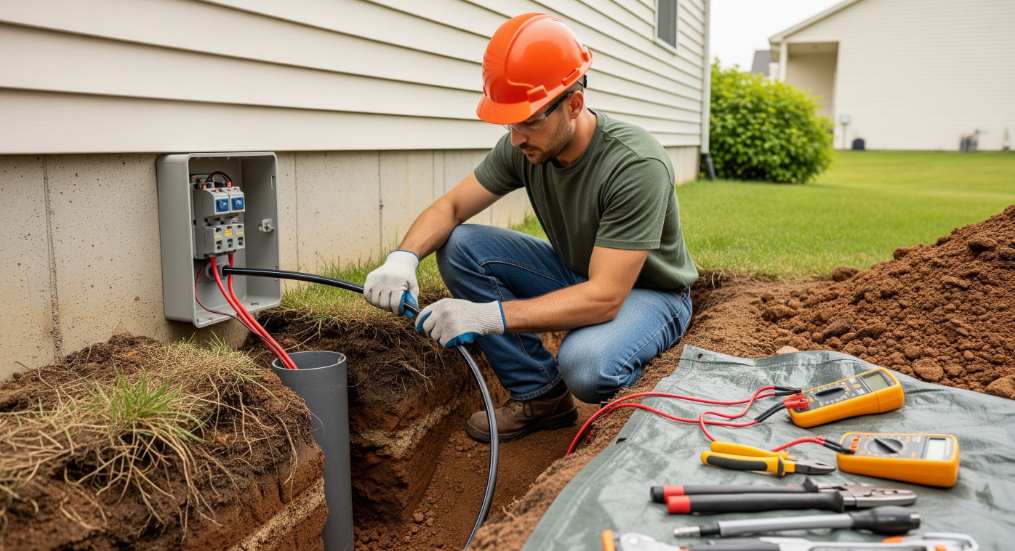
Underground electrical service means running power lines below the ground from the utility pole to your home’s meter. Instead of wires on poles, they’re buried in tubes called conduits. This setup brings power safely to your house without the mess above.
We at Lehmann Electrical & Design have switched many homes to underground service over our 20 years in business. One time, we helped a family in Milwaukee who were tired of winter storms cutting their power. After the install, they had fewer outages and a prettier yard. It even made room for their new solar panels without ugly wires.
Average Costs for Residential Underground Electrical Service
The total cost for residential underground electrical service typically ranges from $1,500 to $10,000 for straightforward installations, though larger or more complex projects can exceed $20,000.
Cost Per Foot Breakdown
The most common pricing model charges per linear foot of underground line. The average cost to run power underground is $10 to $25 per foot, or $5,000 to $12,500 for 500 feet of new electrical lines. In urban areas like Milwaukee, pricing can be 10 to 14 times higher compared to rural areas, translating to $20 to $40 per foot of conduit.
This per-foot charge includes trenching, conduit installation, wire, labor, and basic materials. However, it doesn’t always include utility locating, permits, or specialized site work.
Total Installation Costs by Project Type
Short runs (under 100 feet): $1,500 to $3,000. This might include running power to a detached garage or workshop.
Medium runs (100-300 feet): $3,500 to $8,000. Common for new construction or significant property expansions.
Longer runs (300+ feet): $10,000 to $20,000 or more. These projects often require professional soil analysis and careful permitting.
Breakdown by Distance and Components
Here’s a simple table to show costs:
| Distance | Average Cost (Underground) | Key Components Included |
| 100 ft | $1,000 – $3,000 | Trenching, conduit, wire |
| 300 ft | $3,000 – $9,000 | Plus permits, labor |
| 500 ft | $5,000 – $15,000 | Full service upgrade |
Materials like PVC conduit cost $1 to $3 per foot, while copper wire runs $1.50 to $5 per foot. Labor is $50 to $130 per hour. In one project, we saved a client money by using aluminum wire instead of copper—it worked great and cut costs by 20%.
Factors That Influence the Cost
Costs aren’t one-size-fits-all. Distance is key: More feet mean more digging and materials. Terrain matters too—rocky soil can add 50% to the bill because it needs special tools.
Materials play a role. Copper wire is strong but pricey; aluminum is cheaper for long runs. A conduit protects wires and is often required by codes. Permits cost $200 to $1,000, depending on your area. Labor varies—expect higher rates in busy cities.
Other factors: If you’re tying this to solar, you might need a panel upgrade, adding $1,000 to $5,000. Weather or underground obstacles like roots can bump up prices. We’ve seen jobs double in cost due to surprise rocks, but planning helps avoid that.
Step-by-Step Guide to Installation
Ready to install? Here’s how it goes, based on our process at Lehmann Electrical & Design.
- Plan and get permits: Call your utility and local office. We always check NEC codes for safety.
- Dig the trench: Usually 18 to 24 inches deep, depending on conduit use. Use a trencher for straight lines.
- Lay conduit and wire: Place PVC tubes, then pull wires through. We use fish tape for smooth pulls.
- Connect to the meter: Hook up at your home’s panel. Test everything.
- Inspect and backfill: Get approval, then fill the trench.
In a recent Milwaukee job, we finished a 150-foot install in two days. The client loved how quick and clean it was. For full details on our approach, check our Electrical Services Milwaukee.
Underground vs. Overhead: Pros, Cons, and When to Switch
Underground beats overhead in reliability—no storm damage—and looks better. It’s safer, with less risk of contact. But it costs more upfront, $10-25 per foot vs. $5-15 for overhead. Repairs are harder since you dig.
Overhead is cheaper and easier to fix, but prone to outages and is ugly. Switch if you value green, reliable power. For eco folks adding solar, underground handles the load better without visual clutter.
Making the Right Choice for Your Home
Think about your needs. If storms hit often, go underground. We’ve helped many switch and see quick ROI in fewer repairs.
Common Mistakes That Increase Underground Electrical Costs
Skipping utility locating – Hitting a gas or water line can cost tens of thousands to repair and might injure someone. Always have utilities marked.
Choosing cheap contractors – Unlicensed electricians might quote low initially, but code violations, rework, and fines end up costing more.
Underestimating distance – Carefully measure the actual path the wire must follow. A direct line on paper might require 20% more wire in reality due to terrain.
Neglecting soil testing – Rocky or contaminated soil discovered mid-project forces costly changes. Pre-project soil inspection pays for itself.
Postponing permit work – Unpermitted electrical work can’t be insured, affects home resale value, and may be unsafe.
Conclusion
Underground electrical service costs $5,000 to $15,000 on average but pays off in reliability and looks. From our experience, it’s great for green homeowners eyeing solar—boosts ROI by cutting outages. Next step: Contact a trusted electrician for a free quote. At Lehmann Electrical & Design, we’ve tested these installs in real homes, resulting in happier clients.
Ready to upgrade? Visit our Electrician Services page for more eco tips.
FAQ: How Much Does It Cost for Underground Electrical Service
How deep does underground electrical service need to be buried?
It must be at least 18 inches with conduit or 24 inches for direct burial, per NEC codes, to protect from damage.
Is underground electrical service worth the cost?
Yes, for reliability and aesthetics, especially if you face frequent storms—it cuts long-term repair costs by up to 40%.
What wire should I use for underground service?
Copper for short runs due to better conductivity, or aluminum for longer ones to save money, always in conduit for safety.
How does underground service tie into solar panels?
It supports upgrades for solar inverters and arrays, providing clean, reliable power without overhead clutter.
How long does underground electrical service installation take?
A typical installation takes 2 to 6 weeks from permit approval to completion. Timeline depends on weather, soil conditions, inspection scheduling, and project complexity.