Licensed master electrician · Call 414-207-0109
When your lights trip out, the breaker protecting that lighting circuit has shut itself off: too much current from an overload or a short circuit, or, on GFCI- and AFCI-protected circuits, current leaking out of the circuit or an electrical arc. On a lighting circuit, the culprit can be anything from too many fixtures on one breaker to a loose wire in a switch or a failing dimmer. A few checks are safe to do yourself. Anything involving live wiring needs a licensed electrician.
A lighting circuit trips when more current flows than the breaker allows, when a hot wire touches something it should not, or when a GFCI or AFCI catches leaking current or an arc. On lighting circuits the usual culprits are too many fixtures on one breaker, a loose wire in a switch box or a failing dimmer.
- Reset the breaker once only. If it trips again, leave it off.
- Trips that began after new dimmers or smart switches usually involve the neutral.
- A circuit that takes minutes to trip is being overloaded, not shorted.
- Scorch marks, a burning smell or a warm switch plate mean stop and call today.
If a switch, fixture or outlet on the circuit is warm, smells hot, buzzes or shows scorch marks, leave that breaker off and call an electrician today.
What Usually Causes Lighting Circuits to Trip
| Cause | What it means |
|---|---|
| Overloaded circuit | Too many fixtures or devices drawing current at once |
| Short circuit | A hot wire touching a neutral or ground wire, often in a switch, fixture or junction box |
| Ground fault | Current leaking out through a wet or damaged path |
| Failing breaker | A worn breaker tripping below its rating; less often the cause than a wiring fault |
Overloads. A circuit wired decades ago for two or three fixtures may now power recessed lights, a ceiling fan, a smart dimmer and a few plug-in lamps. The total adds up and the breaker trips, often after the lights have been on for a while.
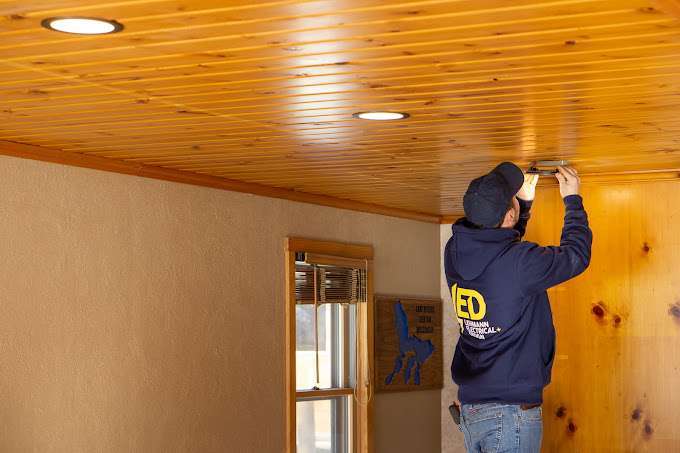
Short circuits. A hot wire (the one carrying current) touches a neutral or ground wire inside a switch, a fixture or the junction box where wires are spliced. Current surges and the breaker trips almost instantly.
Ground faults. Current finds an unintended path out of the circuit. That is why the 2023 NEC, as adopted by Wisconsin SPS 316 (in effect since September 1, 2026), requires GFCI protection for receptacles in many areas of a home, including kitchens, bathrooms, garages, basements, laundry areas and outdoors.
A GFCI trips when as little as 4 to 6 milliamps leaks out by any path, including through a person or damp material, far less than an ordinary breaker notices. Most light fixtures are not GFCI-protected themselves, but a light wired downstream of a GFCI outlet goes out when it trips.
Loose connections. A wire worked loose inside a switch, outlet or fixture can arc, with electricity jumping a tiny gap, generating heat that can ignite nearby material. AFCI breakers (arc fault circuit interrupters) detect this arcing and trip the circuit. If an AFCI keeps tripping on a lighting circuit, take it seriously.
Lighting Checks You Can Safely Do Yourself
You can safely:
- Reset the breaker once, correctly. Push it firmly to OFF, then back to ON; many breakers trip to a middle position and will not reset unless pushed through OFF. If it trips again, leave it off and call an electrician.
- Check for overloading. Add up the watts of the fixtures and plug-in devices on that circuit. At 120 volts, a 15-amp circuit carries 1,800 watts at most, and anything on for hours should stay under 1,440 watts (80 percent). A load within that should not trip a healthy breaker.
- Check your GFCI outlets. If outdoor lights or kitchen outlets are dead, find the nearest GFCI outlet, often in a bathroom, kitchen or garage, and press Reset once. If it will not hold, there is a real leakage fault or a failed GFCI, so stop and have it inspected.
- Swap a bulb that keeps blowing for one rated for the fixture, within the maximum wattage on the fixture label.
- Unplug any lamp with a pinched cord or a scorched plug.
Stop and call a licensed electrician if:
- The breaker trips again after its one reset, or will not stay ON at all.
- You smell burning plastic or see scorch marks near a switch, outlet or fixture.
- The breaker or panel smells hot, looks discolored, buzzes or crackles.
- The problem involves wiring inside walls, junction boxes or the panel.
Work inside the panel or at the service connection is never a do-it-yourself job. Even with the main breaker off, the service conductors and main lugs stay energized; only the utility can switch them off, usually by pulling the meter.
Still tripping with the fixtures switched off?
A licensed electrician measures the load on the circuit, opens the switch and fixture boxes to check for loose or damaged conductors, and tests whether the breaker itself is still sound.
Licensed master electrician. 12-month workmanship warranty.
When Tripping Lights Point to a Bigger Problem
Several circuits trip at once. If lights all over the house go out together, the problem may be upstream: a failing main breaker or the utility feed. If neighbors have lost power too, report it to We Energies or your utility. A tripped main breaker gets one reset at most, and none if there is a burning smell, buzzing or scorching.

A breaker trips with nothing on. If every light is switched off, everything is unplugged, and the breaker still trips on reset, there is almost certainly a short or ground fault in the wiring itself.
Fuses keep blowing. In an older home with a fuse panel, repeated blown fuses mean the same things a tripping breaker does. Replace a fuse only with one of the same rating, never a larger one, and never bridge a fuse socket with a penny or other bypass.
Outdoor and holiday lights trip. One damaged light string, wet connection or bad plug can trip the GFCI for a whole outdoor circuit, and Wisconsin freeze-thaw cycles can let water into outdoor boxes. If the GFCI will not hold, the wiring needs inspection; Lehmann’s outdoor lighting work covers exactly this.
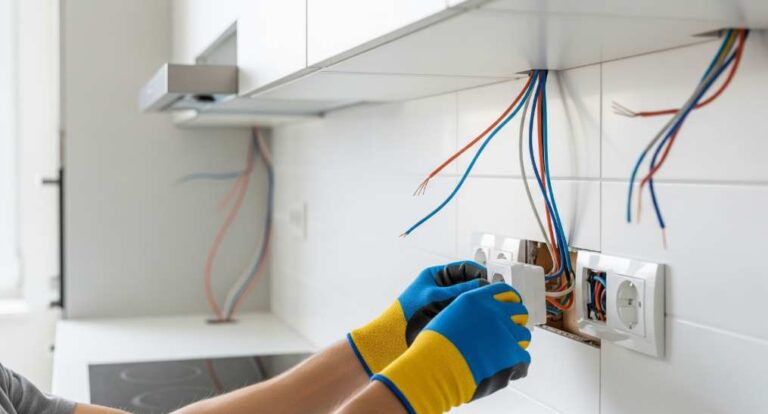
Trips started after new switches or dimmers. Many smart dimmers need a neutral wire at the switch box, which older wiring does not always have. Borrowing a neutral from another circuit is not allowed under the 2023 NEC as adopted by Wisconsin SPS 316, and it can cause flickering, humming or nuisance trips, especially on AFCI-protected circuits.
Any of these is worth an electrician’s visit rather than another reset.
What an Electrician Does About Tripping Lights
A licensed electrician starts with measurement. A clamp meter and load testing show whether the breaker sees a real overcurrent or is tripping below its rating. Every switch, outlet and fixture on the circuit is checked for loose terminations, because one loose wire can arc where neither you nor the breaker can see it. On some brands, the AFCI breaker’s trip-cause indicator can also narrow the search.
If the circuit is overloaded, the fix is to move some lighting or outlets onto a new circuit. A larger breaker is never the answer: the breaker is sized to protect the wire, and a bigger one violates the conductor-protection rules of the 2023 NEC as adopted by Wisconsin SPS 316, as well as creating a fire risk.
If you are adding lighting in several rooms, such as kitchen recessed lights, living room track lighting, a dining room fixture or a master bedroom light, an electrician first checks which circuits have spare capacity. Light fixtures can join a circuit with room to spare; heavier loads, or a new switch location for track lighting, may need a new circuit or switch leg. Scoping every room in one visit is more efficient than one fixture at a time.
An outdoor outlet, such as one on the back of the house, can be fed from an existing circuit with spare capacity or from a new one. Either way it needs GFCI protection and a weather-resistant receptacle in a weatherproof box with an in-use cover, plus a permit from your municipality, such as Milwaukee, Wauwatosa or Waukesha. It can be added during the same visit as lighting work.
Why homeowners call Lehmann Electrical & Design
- Led by licensed master electrician Jacob Lehmann
- A+ rating with the BBB and 4.9 stars on Google
- 12-month workmanship warranty on the work we do
- Permits pulled and inspections scheduled as part of the job
- Milwaukee, Wauwatosa and Waukesha County, from 12012 W Fairview Ave, Wauwatosa
Ready to have it looked at?
Send which lights go out, what was switched on at the time and whether anything changed recently. The electrician arrives knowing what to test.
Licensed master electrician. 12-month workmanship warranty.
Frequently Asked Questions
▾Is it dangerous if a circuit breaker keeps tripping?
One trip is a protection event, not an emergency. Repeated tripping signals an underlying fault: an overload, a short, loose wiring or a failing breaker. Left alone, a short or an arcing connection can heat insulation or framing enough to start a fire. If a breaker trips again after one reset, leave it off and have the circuit inspected.
▾Why do my lights keep tripping when I turn them on?
A trip the moment you flip a switch points to a short inside the switch, the fixture or the wiring between them. Switching on sends a brief inrush of current, and a short at that moment trips the breaker instantly. Do not keep resetting and switching; have the fixture and switch inspected before using that circuit again.
▾Why do my upstairs lights keep tripping?
Upstairs lights are often on one circuit that runs through several rooms, sometimes with bedroom outlets or a bathroom fan on the same breaker, so a heavy load or a fault anywhere on that floor trips them all. In older Milwaukee-area homes, deteriorated insulation on old knob-and-tube wiring, or later splices added to it, can also be the cause. Reset once; if it trips again, have the circuit traced.
▾Why do my outdoor lights keep tripping?
Outdoor receptacles must be GFCI-protected because moisture is present, and outdoor lights on the same circuit share that protection; older hardwired fixtures on their own circuit may have none. A damaged bulb, a cracked housing or a wet extension cord can trip the GFCI. Press Reset once on the nearby outdoor or garage GFCI. If it will not hold, or the breaker trips instead, have the circuit inspected.
▾Why do my light bulbs keep blowing out?
Bulbs that fail quickly usually point to a fixture running too hot for the bulb, a loose socket connection or a loose neutral that makes the voltage swing. If lights across the house also brighten and dim, that can mean a loose service neutral, which needs an electrician right away. LED bulbs rated for the fixture help with heat but will not fix a loose connection.
▾Why do my Christmas lights keep blowing out?
Each string is rated for a maximum number of connected strands, and connecting more overloads the string’s own fuse; incandescent strings reach that limit far sooner than LED ones. A damaged socket or a loose or missing bulb can also darken part of a string. If the lights trip the outdoor GFCI instead, the cause is usually moisture or damage.
Next step
Tell us which lights go out
Send which lights trip, what was switched on at the time and whether anything changed recently. The electrician arrives knowing what to test.
Licensed master electrician12-month warranty4.9 on Google
Milwaukee, Wauwatosa and Waukesha County. Prefer to talk? Call 414-207-0109