Licensed master electrician · Call 414-207-0109
A clear-sky outage almost always has one of two causes: something failed inside your home’s electrical system, or something failed on the utility side of the meter. The fastest way to tell them apart is to look outside. If your neighbors are dark too, it is the utility’s line. If only your house is out, or only part of your house, the problem is on your side and needs an electrician.
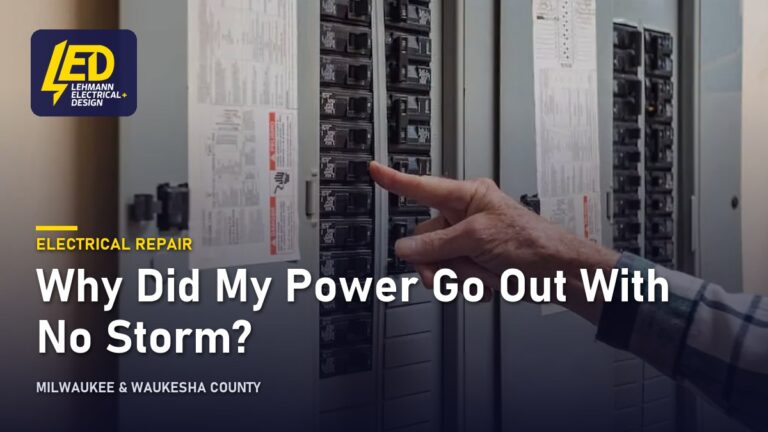
Power does not need weather to fail. Inside the house, a tripped breaker, a failing main breaker, a loose connection, or a burned-out neutral can drop power without a storm in sight. Outside the house, a car hitting a pole, a squirrel across a transformer, a dug-up underground feeder, or scheduled utility work will do the same thing.
Start with the cheapest diagnostic there is, which costs nothing: look up and down the street at night, or check whether the house next door still has lights. Then check your electrical panel for a breaker that is not sitting where the others are. If neither of those explains it, you are looking at a fault that needs testing by someone licensed.
What is usually causing it
Here are the causes worth knowing about, grouped by whose equipment is at fault.
On the utility’s side of the meter:
- A vehicle strike, fallen tree limb, or animal contact on a pole or transformer
- An underground service cable damaged by digging
- Planned maintenance or line work in the neighborhood
- A blown fuse on the utility transformer serving several homes
On your side of the meter:
- A tripped branch circuit breaker, which kills one room or one group of outlets rather than the whole house
- A tripped or failing main breaker, the big breaker at the top of the panel that feeds everything else
- A loose or corroded connection in the panel or at the meter socket, which can heat up and intermittently open
- A lost neutral, where lights across the house brighten and dim oddly before things go dark
- A GFCI or AFCI device that has tripped and taken a whole string of outlets with it
If only one room went quiet, the likely answer is a single breaker or a tripped GFCI, and there is a straightforward order for checking that in our guide to power out in a single room.
Half-house outages deserve a special mention. A residential service brings in two 120 volt legs that combine to 240 volts. If one leg is lost, roughly half your 120 volt circuits die while the other half work, and 240 volt appliances like a dryer or range behave strangely. That pattern points at the service connection, the main breaker, or the utility drop, not at anything you plugged in.
| What you observe | Most likely location | Who can work on it |
|---|---|---|
| Whole street dark | Utility line or transformer | Utility only |
| Whole house dark, neighbors fine | Main breaker, meter socket, or service lateral | Electrician, sometimes with the utility |
| About half the house dead, 240 V appliances odd | One lost 120 V leg | Electrician and/or utility |
| One room or one wall of outlets dead | Branch circuit breaker or GFCI | One reset attempt, then an electrician if it trips again |
| Lights dim and surge together | Possible lost neutral, which can push some circuits well above 120 V and damage appliances | Stop using the circuits and call an electrician urgently |
What is safe to check yourself, and what is not
Safe to check: whether neighbors have power, whether your utility shows an outage in your area, whether any breaker in the panel is sitting in a middle or off position, and whether a GFCI outlet in a bathroom, kitchen, garage, or exterior wall has popped its button.
You may reset a tripped breaker once. Push it firmly all the way to OFF, then back to ON. A GFCI gets one reset too, with the TEST then RESET buttons. If either one will not hold, stop. A breaker that trips again with nothing plugged in usually means a short circuit or a ground fault in the wiring, not a tired breaker. Leave it off and have it inspected.
Stop immediately and call an electrician if you notice a burning or hot-plastic smell, scorch marks, discoloration, buzzing, or crackling anywhere near the panel, an outlet, or a switch. Stop using that circuit or device, leave the breaker off, and do not reset it again. Do not touch the panel, an outlet, or a device to judge how warm it is. Smell, discoloration, and sound tell you everything you need to know without putting a hand near a fault.
What is never safe for a homeowner:
- Removing the panel cover. Behind it are energized busbars and terminals with no insulation.
- Anything at the meter or on the service entrance conductors, meaning the cables that bring utility power into the house. Even with the main breaker switched off, the service conductors and the line-side lugs of that main breaker stay energized. A homeowner cannot de-energize them. The utility can, usually by pulling the meter, and so can a separate service disconnect if one is fitted ahead of the panel.
- Replacing a breaker with a larger one to stop nuisance tripping. The breaker protects the wire. Oversizing it leaves the wire unprotected. The correct fix for a genuinely overloaded circuit is another circuit.
A note on sizing, since it explains why some trips are real and some are not. Breakers are sized so a continuous load, meaning three hours or more at maximum current, sits at no more than 80 percent of the breaker’s rating. That is NEC 210.20(A), which Wisconsin enforces through SPS 316, the state’s electrical code, which adopts the 2023 NEC and has been in effect since September 1, 2026. A load matched correctly to its breaker should not trip. If yours does, something has changed.
Power gone with nothing obvious to blame?
A licensed electrician separates a utility problem from a fault inside the house, which decides who you should be calling.
Licensed master electrician. 12-month workmanship warranty.
When it points to a bigger problem
A one-time outage after a known cause is a nuisance. A pattern is a warning. Where a breaker is the thing that keeps letting go, why a breaker keeps popping covers what that usually means. Treat these as signs of a developing fault rather than bad luck:
- Outages that repeat without an obvious trigger, especially at different times of day
- Lights that flicker or dim house-wide when a large appliance starts
- A main breaker that trips while total household load is nowhere near its rating
- Any heat damage, discoloration, or burning smell at the panel, meter socket, or an outlet
- Power that drops and returns on its own, which often means a loose connection arcing as it expands and contracts
Loose connections are the ones that worry electricians most, because they generate heat at the point of resistance. That heat damages insulation and terminals long before anything stops working. An intermittent whole-house outage with no storm, no utility event, and no tripped breaker is a reasonable description of a connection that is failing at the panel or the meter socket, and it should be looked at rather than waited out.
Homes that lose power often enough to matter, for reasons that turn out to sit on the utility side, sometimes end up looking at standby power options once the wiring has been cleared as the cause. That is a separate conversation from fixing a fault, and the fault comes first.
What an electrician does about it
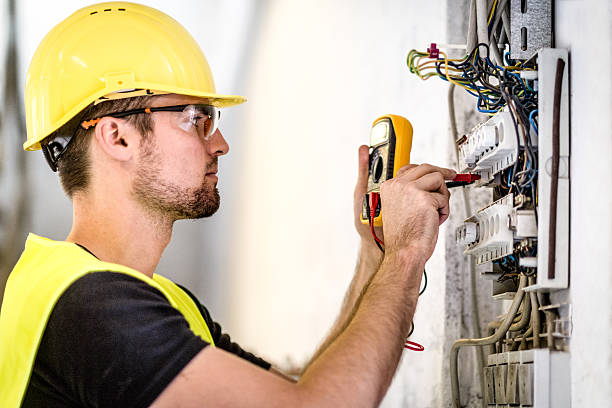
An electrician’s job on a no-storm outage is to find out where the voltage stops. That means measuring at the panel, at the main breaker’s load side, at the meter socket where accessible, and then working outward circuit by circuit. Testing is done with a meter, not by guesswork, and the goal is to isolate the fault to a specific device, connection, or run of cable.
Typical findings and typical repairs:
| Finding | Usual repair |
|---|---|
| Failed or weak main breaker | Breaker replacement |
| Loose lug or terminal in the panel | Re-terminate and torque to spec |
| Burned or corroded meter socket | Socket replacement, coordinated with the utility |
| Damaged underground service lateral | Utility repairs its portion, electrician handles the customer-owned portion |
| Short or ground fault on a branch circuit | Locate, isolate, repair or replace the damaged section |
| Failed GFCI or AFCI device | Device replacement and verification |
Permits for this work are issued by the local municipality, Milwaukee, Wauwatosa, or Waukesha for example, and the municipality enforces Wisconsin SPS 316. Existing installations do not have to be brought up to the newly adopted edition unless they are altered.
Lehmann Electrical & Design is led by master electrician Jacob Lehmann and serves Milwaukee and Waukesha County. We carry a 12-month workmanship warranty and hold 4.9 stars on Google. If your power dropped with clear skies overhead and you would like it diagnosed properly, request an estimate or call 414-207-0109.
Why homeowners call Lehmann Electrical & Design
- Led by licensed master electrician Jacob Lehmann
- A+ rating with the BBB and 4.9 stars on Google
- 12-month workmanship warranty on the work we do
- Permits pulled and inspections scheduled as part of the job
- Milwaukee, Wauwatosa and Waukesha County, from 12012 W Fairview Ave, Wauwatosa
Want it traced properly?
Tell us what is dead, what still works, and whether anything tripped.
Licensed master electrician. 12-month workmanship warranty.
Frequently asked questions
▾What is an electrical emergency?
An electrical emergency is any condition that can cause fire or shock right now: a burning or hot-plastic smell, smoke, visible arcing, scorch marks or discoloration at a panel or outlet, buzzing or crackling, a breaker that trips repeatedly, exposed conductors, or water contacting electrical equipment. A whole-house outage with no damage signs is urgent but not usually dangerous. Damage signs change that.
▾When should I call an emergency electrician?
Call right away for smoke, burning smells, arcing, scorch marks, buzzing, water in or on electrical equipment, or a breaker that will not stay set after one reset attempt. Also call if lights across the house dim and brighten together, which can indicate a lost neutral and can damage appliances. A single dead room with no other symptoms can usually wait for normal hours.
▾What do emergency electricians do?
They stabilize the hazard first, then diagnose. That means isolating the affected circuit, confirming with test equipment where power is being lost or where current is leaking, and making the installation safe before repair work begins. Depending on what they find, the repair happens the same visit or the circuit stays locked out until parts or a utility disconnect can be arranged.
▾How much does an emergency electrician cost?
Pricing depends on the time of day, the response window, and what the fault turns out to be, so an honest number comes after a look at the system rather than before. We do not publish a flat emergency figure. Call 414-207-0109 and describe the symptoms, and you will get a clear explanation of how the visit is priced before anyone is dispatched.
▾How long does an emergency electrician take?
Diagnosis on a no-storm outage is often quick, because the voltage either stops at the service, at the main breaker, or downstream of it, and a meter finds that fast. Repairs vary widely. A breaker swap is short. A burned meter socket or a damaged service lateral involves coordinating with the utility, which can extend the work beyond a single visit.
▾Could a generator have prevented this?
Only if the outage came from the utility. A standby unit does nothing for a fault inside your own wiring, because the fault is downstream of where the generator feeds in. If repeated utility outages are the real issue, our backup power information covers how automatic standby systems are sized and installed.
Next step
Get the outage traced
Tell us what is dead and what still works.
Licensed master electrician12-month warranty4.9 on Google
Milwaukee, Wauwatosa and Waukesha County. Prefer to talk? Call 414-207-0109