Licensed master electrician · Call 414-207-0109
Most commercial lighting needs a documented inspection and cleaning twice a year, with a driver or lamp service cycle set by the fixture type. Interior offices, retail and light industrial spaces generally do well on a six-month cycle. High-bay warehouses, kitchens, parking structures and exterior lighting usually need quarterly attention because dust, grease, vibration and weather wear them faster. Emergency and exit lighting is tested on its own, much shorter schedule.
Here is the practical schedule most buildings in Milwaukee and Waukesha County can run on.
| Lighting type | Inspection and cleaning | Lamp or driver service |
|---|---|---|
| Office and retail interior (LED troffers, downlights) | Every 6 months | Driver and fixture check every 2 to 3 years |
| Warehouse and high-bay | Every 3 to 4 months | Group check at 3 to 5 years, lift required |
| Kitchen, food prep, wash-down areas | Every 3 months | Gaskets and lenses annually |
| Parking lot, wall packs, canopy | Every 3 to 6 months | Photocell and surge check annually |
| Emergency and exit fixtures | Monthly function test, annual full-duration test | Battery replacement as it fails the test |
Emergency lighting is the one item a building owner should not let slide. A monthly push-button test and an annual full-duration test are what the local fire inspector commonly asks to see logged, under the life-safety requirements the municipality enforces as the authority having jurisdiction. Confirm the exact testing interval and log format with your own inspector, because the requirement follows the occupancy type and the building’s approval, not a general rule of thumb.
The other reason to keep a cycle is that LED failure is gradual rather than sudden. A fluorescent tube died and somebody noticed. An LED panel dims, shifts color, or drops a quadrant, and nobody notices because the change happens over years. Commercial LED fixtures are commonly rated to what the industry calls L70, meaning the hour count at which light output has fallen to 70 percent of what the fixture produced new. That 30 percent loss is the end of the rated life, not a normal operating condition, and scheduled maintenance is how you catch the drift before the floor gets there.
What is commercial lighting, and what makes a fixture commercial grade
Commercial lighting is the lighting system of a non-residential building: the troffers and downlights in offices, the high bays over a warehouse floor, the track and accent lighting in retail, the wall packs and pole lights in a parking lot, and the exit and emergency fixtures that carry the building through a power loss. It also includes the controls layer, meaning occupancy sensors, photocells, dimmers and timeclocks, and the lighting panels and contactors that feed it all.
Commercial grade lighting is a narrower term. It describes fixtures built for long daily run hours, for higher distribution voltages such as 277 volts, with drivers that can be replaced rather than fixtures that get thrown away, and with the listings a building inspector expects for the application. Putting residential-grade fixtures into a commercial ceiling is a false economy: they fail sooner, they are harder to match when half of them go, and they may not be listed for the environment they end up in.
What is usually causing it
Lighting degrades from a short list of causes. Some are physical, some are electrical, and a maintenance visit has to look at both.
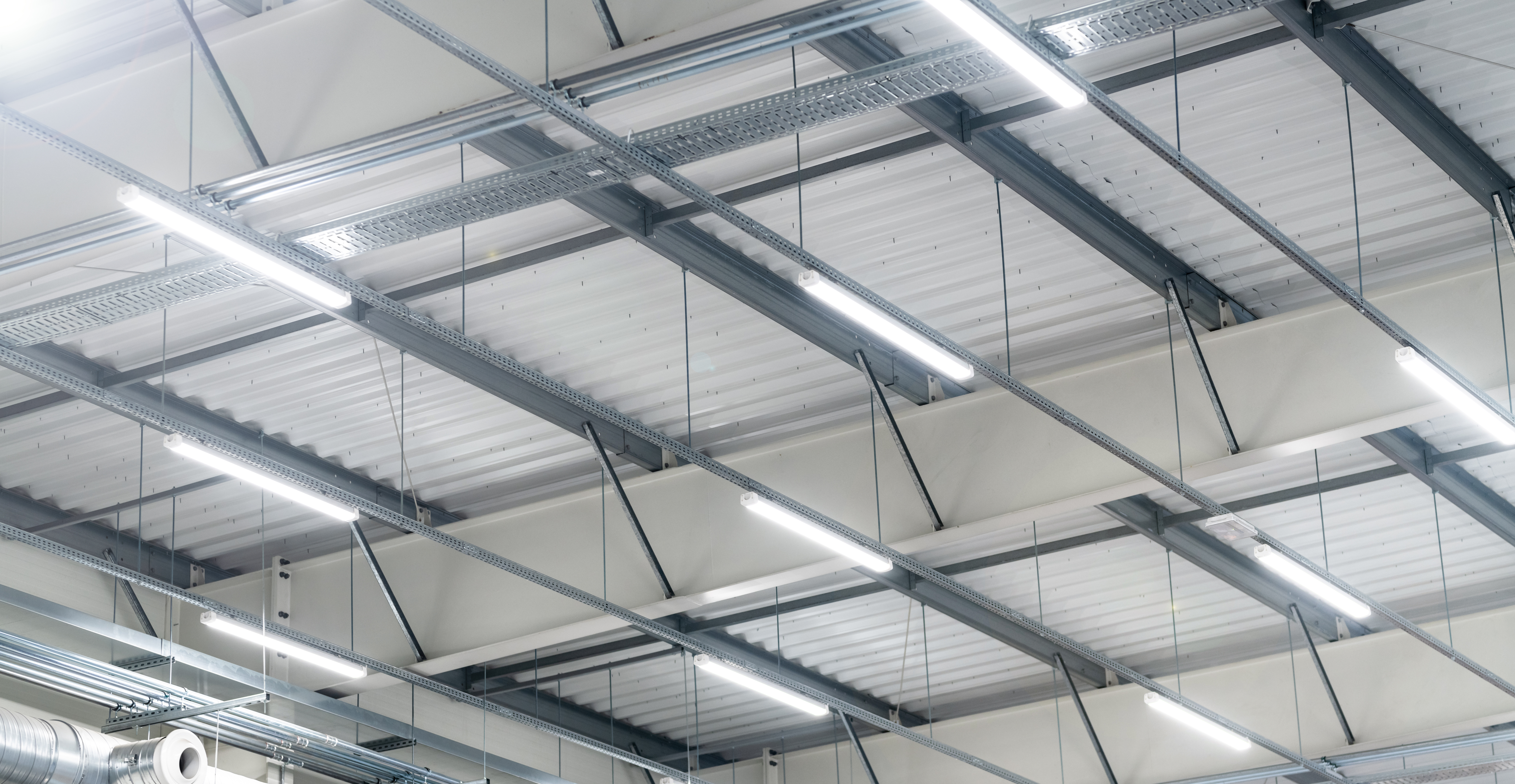
Dirt on the lens. A dusty diffuser in a warehouse or a greasy lens over a kitchen line cuts delivered light without a single component failing. Cleaning is the cheapest lighting improvement in any building.
Driver failure. An LED fixture is a light source plus a driver, which is the small power supply that converts building voltage into the steady current the diodes need. The diodes commonly outlast the driver. When a fixture flickers, buzzes, strobes at low dimming levels, or dies entirely while its neighbors stay lit, the driver is the first thing to check.
Heat. LEDs lose output and life when heat is trapped. A fixture crammed into an insulated ceiling pocket, or a high bay sitting under an unvented roof deck in August, will dim faster than the datasheet suggests.
Cold, in the other direction. Unheated warehouse and storage space in Waukesha County can sit near or below freezing for weeks in January. LEDs themselves are generally happy in the cold, but drivers and any remaining fluorescent tubes are not: low-temperature ballasts and cold-rated drivers exist for a reason, and a fixture that takes a long time to come up to full brightness on a winter morning is often the wrong fixture for an unheated bay rather than a failing one.
Voltage and surge events. Utility switching, lightning, and large motor loads starting and stopping in the same building all stress drivers. A parking lot pole that loses a driver every other year is worth investigating for surge protection and grounding at the base before another driver goes in.
Controls drift. Occupancy sensors get blocked by a new shelving run. Photocells get painted over or sun-bleached. Timeclocks lose their schedule after an outage and never get reset. Before assuming a fixture has failed, check whether the control that commands it is doing what it is supposed to.
Mixed-age fixtures. Once failed fixtures get replaced piecemeal, you end up with a ceiling running three color temperatures and two brightness levels. That reads worse to a customer than one burned-out lamp.
What is safe to check yourself, and what is not
A facilities person or owner can safely do the visual and housekeeping half of lighting maintenance. The electrical half needs a licensed electrician.
Reasonable for in-house staff:
- Walk the space after hours and write down every fixture that is out, flickering, or visibly dimmer than its neighbors.
- Wipe down accessible lenses and diffusers at a height a step stool reaches safely.
- Press the test button on emergency and exit fixtures monthly and log the date and result.
- Check that occupancy sensors are not blocked and that nothing has been stacked in front of a photocell.
- Note any fixture that hums, buzzes, or crackles, and any that has discolored or scorched plastic around the lens or the junction box.
Not reasonable for in-house staff:
- Anything behind a panel cover. With a main breaker off, the service conductors and the line-side lugs of that main breaker stay energized. A building occupant cannot de-energize them. The utility can, usually by pulling the meter, as can a separate service disconnect ahead of the panel if one is fitted.
- Work on ballasts, drivers, or fixture wiring, including the common “it just needs a new driver” swap. That is line-voltage work.
- Anything requiring a lift, a ladder over a stairwell, or a roof hatch.
- Parking lot poles, wall packs, and anything on a 277-volt or three-phase circuit. If you are not sure what feeds a lighting branch, understanding how a three-phase panel distributes load explains why a commercial lighting circuit is often 277 volts rather than 120.
> If a fixture, switch, or panel gives off a burning or hot-plastic smell, shows scorch marks or discoloration, or buzzes or crackles, stop using that circuit, leave the breaker off, and call an electrician. Do not touch the device to judge how hot it is. Smell, discoloration, and sound tell you what you need to know, and they tell you before a burn does.
If a lighting circuit trips a breaker, reset it once at most. Push the handle firmly to OFF, then to ON. If it trips again, leave it off and have the circuit inspected. Never fit a larger breaker to stop the tripping. The breaker protects the wire, and a bigger breaker on the same wire removes the protection instead of fixing the overload. The real fix for an overloaded lighting circuit is a new circuit.
How commercial LED fixtures get installed
Installing commercial LED lighting is licensed work that pulls a permit from the municipality, so this is a description of the job rather than instructions for doing it. The work typically runs like this: confirm the circuit voltage and available capacity at the lighting panel, verify the new fixtures are listed for the voltage and the environment, de-energize and lock out the circuit, remove the old fixtures and any ballasts, make up the fixture whips and connections, support the fixtures from structure rather than from the ceiling grid alone where the fixture weight calls for it, terminate and commission the controls, then test levels and dimming before the inspection.
Retrofit kits that replace the guts of an existing housing are not a shortcut around any of this. The kit has to be listed for the housing it goes into, and a kit installed into a housing it was not listed for can void the fixture listing. An electrician will also want to know whether existing dimmers and occupancy sensors are compatible with the new drivers, because incompatible pairings are a frequent source of flicker and low-end dropout on a brand-new installation.
Lights failing one by one across the building?
A licensed electrician separates end-of-life lamps from a driver, circuit or control fault, which decides whether you are replacing or repairing.
Licensed master electrician. 12-month workmanship warranty.
When it points to a bigger problem
Sometimes lighting symptoms are the building telling you about something upstream.
Lights dim when a motor starts. A rooftop unit, compressor, or elevator pulling in and visibly dimming the lights means voltage drop. That can be undersized feeders, a loose connection, or a service that is tight for the load.
Repeat driver failures in one location. One dead driver is a component. Four dead drivers on the same circuit in two years points to a surge, grounding, or voltage problem that will keep consuming whatever you install.
Breakers that trip with the lights switched off. Branch-circuit breakers in commercial panels are typically thermal-magnetic, meaning a heat-sensitive element handles sustained overload and a magnetic coil handles short circuits; larger frames are often electronic-trip instead. A breaker that trips with the load off points to a wiring fault rather than a tired breaker.
You are out of circuits before you are out of fixtures. If every lighting addition means hunting for a spare space in the panel, the question has stopped being about lighting and become a question about capacity. Lighting runs three hours or more at a stretch, so it counts as a continuous load. Under Wisconsin SPS 316, which adopts the 2023 NEC and has been in effect since September 1, 2026, the overcurrent device must be rated at no less than the noncontinuous load plus 125 percent of the continuous load. Put more simply, a continuous load may occupy no more than 80 percent of the breaker’s rating. A 20-amp lighting circuit therefore carries 16 amps of continuous lighting, not 20.
Mismatched light levels across a floor. If half the office reads at a healthy level and half reads dark, that is a design problem rather than a failure. A survey by a commercial lighting contractor will tell you whether the answer is cleaning, replacement, or a layout change.
Exterior pole work. Anything that involves the pole base, the feeder to it, or a shared service point may require coordination with We Energies before the work can proceed, particularly if the circuit has to be de-energized at the utility side. That is scheduling, not drama, but it is a reason to plan exterior lighting work rather than treat it as a same-day repair.
How commercial service size gets calculated
Service size is the result of a load calculation, which is a documented tally of everything the building connects, adjusted by the demand factors the code allows. Lighting is the part that touches this article directly.
For lighting, the calculation starts from a general lighting load expressed in volt-amperes per square foot by occupancy type, taken from the unit load table in the adopted code. Multiply the floor area by that figure, add the actual connected load for any lighting that exceeds it, add receptacle loads, then add the real equipment: HVAC, kitchen equipment, motors, elevators, and anything else with a nameplate. Apply demand factors, convert volt-amperes to amperes by dividing by the system voltage (and by the square root of three for a three-phase service), then size the service at or above that figure with the continuous-load rule applied.
A worked shape, not a quote for your building: a 10,000 square foot office at a general lighting unit load, plus receptacles, plus a rooftop unit and miscellaneous equipment, commonly lands in the range where a 400-amp, 208Y/120-volt three-phase service is the right answer rather than a 200-amp service. The point is that the number comes out of the arithmetic, not out of a rule of thumb, and the calculation has to be signed by someone who will stand behind it. Lighting is usually a small slice of it, but a lighting expansion is often what triggers the recalculation.
What an electrician does about it
A commercial lighting maintenance visit from a licensed electrician is more than changing lamps. It typically includes:
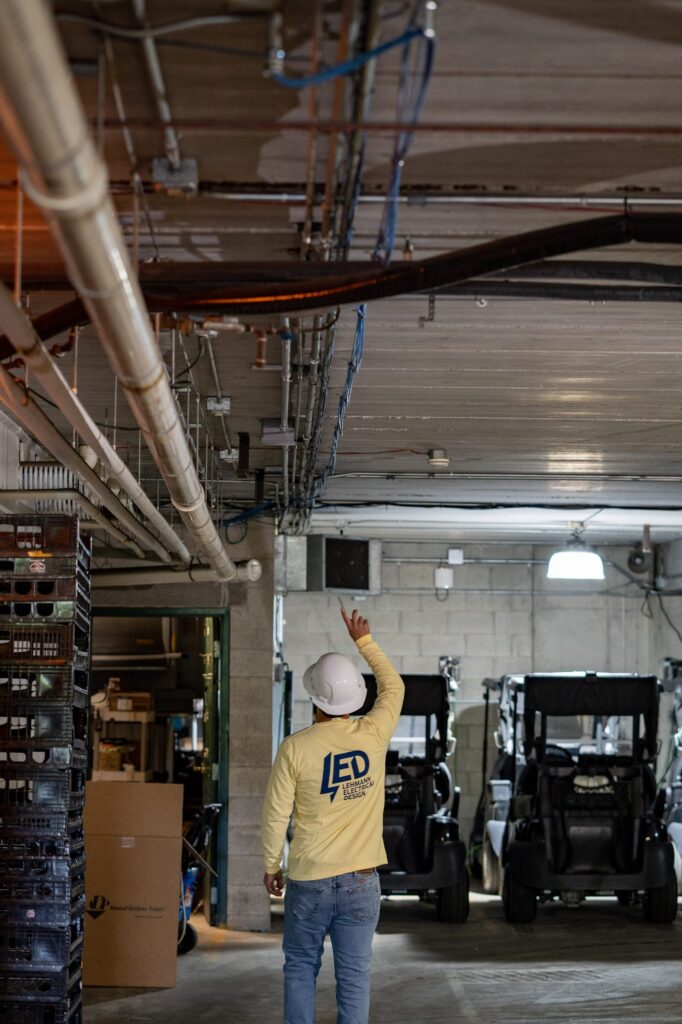
- A fixture-by-fixture inventory with failures, flicker, and color mismatch noted.
- Light-level readings taken with a footcandle or lux meter at desk height, roughly 30 inches above the floor for seated work and at floor level for circulation and storage, so that “it feels dark” becomes a number.
- Lens cleaning and lamp or driver replacement, matched to the existing color temperature so the ceiling stays consistent.
- Torque checks and visual inspection at lighting panels and disconnects, looking for heat discoloration and loose terminations.
- Testing and resetting of occupancy sensors, photocells, dimmers, and timeclocks.
- Function and duration testing of emergency and exit lighting, with a dated log.
- Exterior pole, wall pack, and canopy checks, including surge protection and grounding at the base.
- A written punch list separating what was fixed, what needs a part, and what needs a larger project.
Planned work also tends to be easier to budget than unplanned work, because a scheduled lift visit that covers a whole bay is a different kind of trip than an emergency call for one dead high bay over a production line. Jacob Lehmann is a master electrician, and the commercial electrical work his team performs includes scheduled maintenance agreements as well as one-off repairs. Lehmann Electrical & Design holds a 4.9-star rating on Google and an A+ rating from the BBB, and workmanship is covered by a 12-month warranty.
If you would like a baseline lighting survey and a maintenance interval matched to how your building actually gets used, tell us about your building and we will put a schedule together. You can also reach the office at 414-207-0109.
Why homeowners call Lehmann Electrical & Design
- Led by licensed master electrician Jacob Lehmann
- A+ rating with the BBB and 4.9 stars on Google
- 12-month workmanship warranty on the work we do
- Permits pulled and inspections scheduled as part of the job
- Milwaukee, Wauwatosa and Waukesha County, from 12012 W Fairview Ave, Wauwatosa
Want a maintenance schedule that fits the building?
Tell us the type of premises, roughly how many fixtures, and how old the installation is.
Licensed master electrician. 12-month workmanship warranty.
Frequently asked questions
▾What is electrical maintenance?
Electrical maintenance is the scheduled inspection, testing, cleaning, and repair of a building’s electrical systems before they fail. In a commercial setting it covers panels, distribution equipment, lighting, controls, motor connections, and emergency systems. Industrial electrical maintenance adds machine controls, variable frequency drives, and production equipment. In electrical engineering the term covers the same idea applied to any installed system: preventive work on a calendar, plus corrective work when something breaks.
▾How long do commercial LED lights last?
Quality commercial LED fixtures are typically rated between 50,000 and 100,000 hours to L70, the hour count at which output has fallen to 70 percent of new. Hours matter more than years: at 12 hours a day, seven days a week, 50,000 hours is about 11 years, while the same fixture on a 12-hour weekday-only schedule reaches 50,000 hours in about 16 years. Drivers commonly fail before the diodes do.
▾How long do office lights last?
LED troffers in an office are usually the 50,000 to 100,000 hour rating above, which on typical office hours is a long calendar life, with the driver as the likely first failure. Remaining fluorescent troffers are different: linear tubes are typically rated in the 20,000 to 36,000 hour range depending on type, and the ballast is a separate wear item. A lightly used space uses up rated hours more slowly, which stretches calendar life rather than exceeding the rating.
▾How many lumens or lux do I need for office lighting?
General office work is designed to a target light level at the desk rather than to a fixture count, and the figure differs between the published standards and their editions. Translating any target into fixture lumens depends on ceiling height, fixture spacing, and surface colors, so a reading at the work surface with a light meter is more reliable than a calculation from a catalog. Detailed drafting or inspection work needs more. Corridors and storage need considerably less.
▾How does office lighting affect productivity?
Honestly, the effect is real but easy to overstate. What is well established is comfort: glare on screens, visible flicker, and light levels too low for the task cause eye strain, headaches, and complaints, and people work worse when they are uncomfortable. Even, glare-free light at an appropriate level removes those problems. Treat lighting as removing an obstacle to good work rather than as a lever that increases output.
▾How do I make office lighting less harsh?
Harsh office lighting is usually three things: direct glare, too cool a color temperature, and no dimming. Diffused or indirect fixtures, a color temperature in the 3500K to 4000K range instead of 5000K, and dimming on the brighter zones resolve most complaints. Aiming or shielding fixtures away from screens helps more than reducing overall output, which tends to make the space feel gloomy instead of comfortable.
Next step
Get the lighting reviewed
Tell us the type of premises and roughly how many fixtures.
Licensed master electrician12-month warranty4.9 on Google
Milwaukee, Wauwatosa and Waukesha County. Prefer to talk? Call 414-207-0109