Licensed master electrician · Call 414-207-0109
A home standby generator needs professional service once a year, and most manufacturers, including Generac, also ask for a short oil-and-filter service at roughly 100 to 200 running hours if the unit sees heavy use. Between annual visits, you watch the weekly self-test, keep the enclosure clear, and check the indicator panel monthly. Skipping the yearly service is one of the reasons a generator sits silent during an outage.
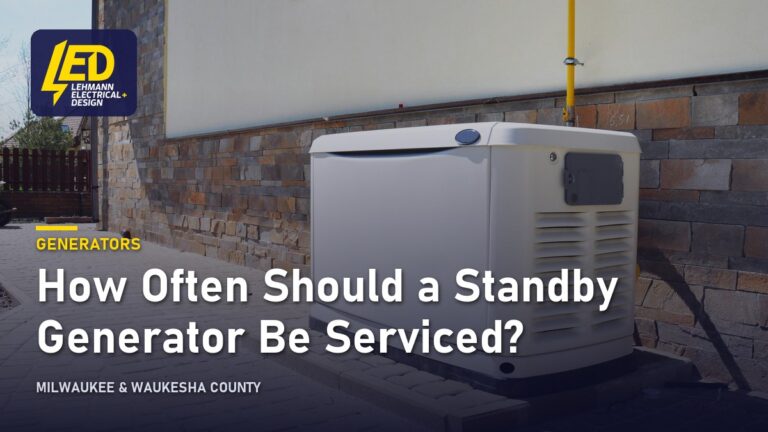
Once a year, by a qualified technician, plus a few minutes of homeowner attention each month.
That annual visit is not a cursory look. A proper service covers oil and filter, air filter, spark plugs on the schedule the manufacturer sets, battery condition and terminals, coolant on liquid-cooled units, fuel pressure, the transfer switch, control board fault history, and a load test that proves the machine will carry your house and not just idle in the driveway.
Here is the schedule most Milwaukee and Waukesha County homeowners should follow:
| Interval | Who does it | What happens |
|---|---|---|
| Weekly | The generator itself | Automatic self-test, usually 5 to 20 minutes. Confirm it ran. |
| Monthly | Homeowner | Look at the status light or app, clear snow, leaves and nests, confirm no warning codes |
| Every 6 months | Homeowner | Visual check for oil stains, rodent damage, loose vent screens |
| Annually | Licensed electrician or generator technician | Full service, fluids, filters, battery, transfer switch, load test |
| Every 100 to 200 run hours | Technician | Oil and filter change after extended outages, per the owner’s manual |
| Per the owner’s manual | Technician | Battery replacement, at the interval the manufacturer states |
Air-cooled units, which covers most 10 kW to 26 kW home systems, generally want an oil change at 100 to 200 hours or annually, whichever comes first. Liquid-cooled units run longer intervals but add coolant service. Your owner’s manual is the authority for your specific model, and a good technician follows it rather than a generic checklist.
A portable generator is different. It has no automatic self-test and no transfer switch, so service is based on use: oil change after the first 20 to 30 hours of break-in, then every 50 to 100 hours, fresh fuel or stabilizer every few months, and a test start before storm season. A portable left with old gas in the carburetor is the classic no-start.
What is usually causing it
When a standby generator fails to start during an outage, the cause is rarely the engine itself. It is almost always something that annual service would have caught.

The battery. A standby generator’s battery sits on a trickle charger for years, warm in summer and well below freezing in a Wisconsin January. Batteries lose capacity as they age, and a battery that reads fine at rest can still fail to turn the engine over on a hard winter morning. Manufacturers generally give standby batteries a service life of a few years whether they have ever been used or not, so check your own manual for the interval it states.
Stale fuel. Natural gas and propane do not go stale, which is one reason they dominate home standby installations here. But fuel pressure can drift, a propane tank can be low, and a regulator can fail. A generator that cranks but will not fire is often a fuel delivery problem.
Oil and filters. Oil degrades with time as well as hours. Run a generator through a 36-hour ice storm outage on year-old oil and you are asking a lot of the engine.
Rodents and insects. The enclosure is warm, dry, and quiet for most of the year. Mice nest in it, chew wiring insulation, and pack the air intake. Wasps build in the vents. This is a common finding on a six-month visual check.
Ignored fault codes. The controller logs faults. If the weekly exercise cycle failed four weeks running and nobody looked at the panel, the generator has been telling you for a month that it will not be there when you need it.
The transfer switch. This is the device that disconnects your house from the utility and connects it to the generator. Its contacts and controls wear. A perfectly healthy engine behind a sticking transfer switch still leaves you in the dark.
What is safe to check yourself, and what is not
You can do a useful amount without opening anything. Here is the honest division of labor.
Safe for a homeowner:
- Read the status light or the mobile app and note any warning or alarm
- Confirm the weekly self-test actually ran, by hearing it or by checking the log in the app
- Keep three feet clear around the enclosure: no stacked firewood, no snow drift, no shrubs growing in
- Clear leaves and debris from the air intake and exhaust vents from the outside
- Look for oil stains on the pad underneath
- Check the engine oil level if your manual shows a dipstick you can reach without removing an electrical cover, with the unit off and cool
- Keep the propane tank above a quarter full if you are on LP
Not for a homeowner, ever:
- Anything behind the generator’s electrical access covers or inside the transfer switch enclosure
- Anything inside your main electrical panel
- Spark plugs, valve adjustment, or the governor on a unit you are not trained on
- Bypassing or jumping the transfer switch so the generator can feed the house directly
- Running a generator cord into a dryer or range outlet to backfeed the house
That last point matters more than any other. Backfeeding sends generator voltage out onto the utility lines, which can injure a line worker, and it removes the interlock that keeps the generator and the utility from ever being connected at the same time. It also requires a permit it will never get. Every municipality in our area, Milwaukee, Wauwatosa, Waukesha and the rest, enforces Wisconsin SPS 316, which adopts the 2023 NEC, in effect since September 1, 2026, and a legally installed standby generator has a listed transfer switch for exactly this reason.
One more thing about your electrical panel: turning the main breaker off does not make the panel safe. The service conductors coming in and the main breaker’s line-side lugs stay energized. A homeowner cannot de-energize them. Only the utility can, usually by pulling the meter, or a separate service disconnect ahead of the panel if one is fitted. Leave the cover on.
If you ever smell burning or hot plastic near the generator, the transfer switch, or your panel, or you see scorch marks or discoloration, or you hear buzzing or crackling, stop using the equipment, leave the relevant breaker off, and call an electrician. Do not touch the device to judge how hot it is. Smell, sight, and sound tell you what you need to know.
Not sure when yours was last serviced?
A licensed electrician runs it under load, reads the fault log and checks the transfer switch, which is the part that decides whether the house sees power.
Licensed master electrician. 12-month workmanship warranty.
When it points to a bigger problem
A generator that needs more than routine service is usually telling you one of four things. Three of them have their own walkthroughs: one that shuts off mid-run, one showing a red light, and a transfer switch that never hands over.
It keeps tripping its own main breaker or a branch breaker when it runs. Reset a tripped breaker once at most: push it firmly to OFF, then to ON. If it trips again, leave it off and have it inspected. A breaker that trips with nothing running more often means a wiring fault than a tired breaker. Never fit a larger breaker to stop the tripping, because the breaker protects the wire, not the appliance.
It starts, carries the load for a while, then drops out. That pattern points at fuel supply, cooling, or an overload. If the generator was sized for the circuits you had in 2019 and you have since added a heat pump, a second refrigerator, or a well pump, the machine may simply be undersized for what is now being asked of it.
The weekly exercise cycle runs but the unit will not pick up the load. That is usually the transfer switch or its control wiring, not the engine.
It is 15 or more years old and the parts conversation has started. Air-cooled home standby units are generally a 10 to 20 year proposition depending on run hours and maintenance. At some point the right answer is replacement rather than a third expensive repair, and a fresh sizing exercise using a quick backup sizing tool is the place to start that conversation.
Sizing is worth saying plainly: the correct generator size comes from which circuits you want backed up and what those loads actually draw, not from your home’s square footage. A 2,400 square foot house with gas heat, gas water heat, and a gas range needs far less than a same-sized all-electric house. That is what a load calculation does, adding up the real demand of the circuits going on the generator. If you want a starting number before you call anyone, running your loads through the generator sizing calculator will get you in the right range.
What an electrician does about it
A licensed electrician does three separate jobs around a standby generator, and it helps to know which one you are asking for.

Annual service. Fluids, filters, battery test and replacement, spark plugs on schedule, inspection of the enclosure and wiring, a review of the controller’s fault log, and a load test that runs the generator under real load long enough to prove it holds. The technician should leave you a record of what was done and what the engine hours were.
Diagnosis and repair. When the unit fails a test or throws a code, the work is tracing it: fuel pressure, battery and charging circuit, starter, controller, transfer switch contacts, and the circuit feeding the switch. This is the part that sits behind covers and belongs to a licensed electrician.
Installation and replacement. Setting the pad, the gas or propane connection, the transfer switch, the conductors between generator, switch, and panel, and the permit and inspection with your municipality. Our generator installation and service work covers all three stages, from sizing through the annual visits afterward.
Lehmann Electrical & Design is led by master electrician Jacob W. Lehmann and holds an A+ rating with the BBB and 4.9 stars on Google. Work we perform carries a 12-month workmanship warranty.
If your generator has not been serviced in over a year, or you are weighing a Generac system for your home and want a straight answer on sizing, request an estimate for generator work or call 414-207-0109. We serve Milwaukee and Waukesha County.
Why homeowners call Lehmann Electrical & Design
- Led by licensed master electrician Jacob Lehmann
- A+ rating with the BBB and 4.9 stars on Google
- 12-month workmanship warranty on the work we do
- Permits pulled and inspections scheduled as part of the job
- Milwaukee, Wauwatosa and Waukesha County, from 12012 W Fairview Ave, Wauwatosa
Ready to book the annual service?
Send the model, the install year and when it was last looked at.
Licensed master electrician. 12-month workmanship warranty.
Frequently asked questions
▾How often should a Generac standby generator be serviced?
Generac’s home standby schedule calls for a maintenance service once a year, with oil and filter changes based on run hours as well, typically every 100 to 200 hours on air-cooled models. Your specific manual sets the exact intervals for your model and engine. Annual service plus an oil change after any long outage is the practical rule for a Wisconsin home.
▾How often should a standby generator be tested?
Most home standby units run an automatic self-test weekly or every two weeks, for 5 to 20 minutes, which exercises the engine and keeps the battery charged. That self-test is not a load test. It confirms the engine runs, not that the generator will carry your house. A proper load test happens at the annual service.
▾How long can a whole house generator run continuously?
A natural gas standby unit connected to a utility line can run for days, limited mainly by oil life and the need to shut down for an oil change on extended outages. On propane, runtime depends on tank size and load. Check your manual for the maximum continuous run time and the oil change interval during prolonged use.
▾How much does a whole house generator cost?
We do not publish prices, because the cost depends on which circuits you are backing up, the generator size that follows from that, the gas or propane work, the transfer switch, and the panel and conduit run. An on-site assessment and a load calculation give you a real number instead of a guess. Ask for a written estimate.
▾What size whole house generator do I need?
Size comes from the loads, not the house. Add up what the circuits you want backed up actually draw, including motor starting current for things like well pumps, air conditioners, and furnaces. Whole-house coverage needs more than an essentials-only setup. Our backup power sizing tool gives a starting range, and we confirm it on site.
▾How often should a portable generator be serviced?
By hours, not by the calendar. Change the oil after the first 20 to 30 hours of break-in, then every 50 to 100 hours. Clean or replace the air filter and check the spark plug at the same interval. Add fuel stabilizer or drain the gas before storage, and start it every few months. Never backfeed a portable generator into your house wiring.
Next step
Book the annual service
Send the model and when it was last serviced.
Licensed master electrician12-month warranty4.9 on Google
Milwaukee, Wauwatosa and Waukesha County. Prefer to talk? Call 414-207-0109