Licensed master electrician · Call 414-207-0109
A red light on a Generac home standby generator means the unit has shut down or will not start, and it has stopped protecting your house. The generator’s controller logs a fault code that explains why. Common causes include low oil pressure, high engine temperature, low battery voltage, overcrank (it tried to start and failed), overspeed, or a wiring or fuel supply problem. The red light is a stop signal, not a maintenance reminder. The generator is out of service until the fault is cleared.
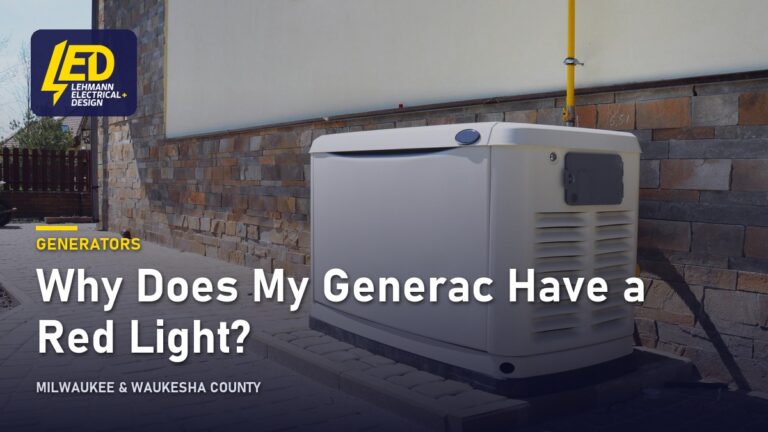
Generac’s controller uses a simple color code. Green means the unit is in automatic mode and ready. Yellow means a warning: the generator will probably still run, but something needs attention, often a scheduled maintenance interval or a battery that is getting weak. Red means the generator has faulted and will not start or has shut itself down mid-run.
If you have a red light and a yellow light together, you are usually looking at a fault plus a pending warning. The yellow is often a maintenance-due reminder that was already there, and the red is the thing that actually matters. Clear the red first.
The practical takeaway: a red light means that if the power goes out tonight, nothing will happen. The generator will sit there. That is the whole reason it matters.
> A red light on a Generac is the unit telling you it tried to do its job and could not, or that it shut down to protect its own engine. It is not a reminder light. Until the fault is read and corrected, the generator is not standby equipment, it is a box in the yard. Checking the display, confirming the unit is set to AUTO, and confirming the main gas valve is open are reasonable homeowner steps. Anything past that belongs to a licensed electrician or a qualified generator technician.
What is usually causing it
The controller display or the Mobile Link app will show a fault code or a short text message. That message is the real diagnosis. Below are the categories homeowners run into most often, in rough order from simplest to most serious.

| Fault category | What it usually means | Typical cause |
|---|---|---|
| Low battery / battery problem | The 12 V starting battery cannot turn the engine over reliably | Battery at end of life, loose or corroded terminal, failed battery charger in the unit |
| Overcrank | The engine cranked but never started and the controller gave up | No fuel, closed gas valve, low propane, fouled spark plugs, clogged fuel regulator, cold-weather fuel pressure drop |
| Low oil pressure | The engine shut down to avoid damaging itself | Low oil level, oil leak, failed sensor, internal engine wear |
| High engine temperature | Overheating shutdown | Blocked air intake or exhaust, debris or snow packed around the enclosure, cooling fan issue |
| Overspeed / underspeed / underfrequency | The engine is not holding its rated RPM, so output voltage and frequency are out of range | Governor or fuel delivery fault, load problem, failing engine component |
| RPM sense loss | The controller cannot read engine speed | Sensor or wiring fault |
| Wiring error / auxiliary fault | A control or sensing circuit is not reading correctly | Rodent damage to harness, corroded connector, water intrusion, control board fault |
| Switch not in auto | Not a mechanical fault at all | Unit left in OFF or MANUAL after service |
That last one is worth saying out loud, because it is the cheapest fix there is. A generator left in OFF or MANUAL after a service visit, a test run, or a cover-off inspection will not start on its own. Some controllers show that condition in red precisely because the consequence is the same as a fault.
Cold weather adds its own pattern. Propane vaporizes more slowly as temperatures drop, so a tank that runs a unit fine in October can fail to keep up in January and throw an overcrank fault. Snow drifted against the enclosure can cause an overheat shutdown. Neither is a defect in the generator.
If you are researching this because you are considering a unit rather than troubleshooting one you own, our whole home generator installation work covers the electrical side, the transfer switch, the permit, and the load planning.
What is safe to check yourself, and what is not
There is a short list of safe checks, and then the line.
Safe for a homeowner:
- Read the display. Write down the exact fault text or code. This is the single most useful thing you can do before calling anyone.
- Confirm the switch is in AUTO. On most Generac home standby units the control switch is reachable without opening anything that carries utility voltage.
- Confirm the fuel supply. The manual shutoff valve on the natural gas line should be open. On propane, check the tank level and that the service valve is open.
- Look around the enclosure. Clear snow, leaves, mulch, or anything blocking the air intake or exhaust. Generac specifies a clearance around the unit; keeping that space open is routine homeowner work.
- Check the oil level using the dipstick, if the engine is cool and your owner’s manual shows you how. This is engine maintenance, not electrical work.
- Use your nose and eyes. A burning or hot-plastic smell, scorch marks, discoloration, buzzing, or crackling anywhere at the generator, the transfer switch, or the electrical panel means stop. Leave the generator in OFF, leave the breaker off, do not use the circuit, and call an electrician.
Not safe, and not a homeowner job:
- Opening the transfer switch enclosure. This is where utility power and generator power meet. It stays energized from the utility side even when the generator is off.
- Working behind the cover of your electrical panel. Turning the main breaker off does not de-energize everything inside: the service conductors coming in and the line-side lugs on the main breaker stay live. A homeowner cannot shut those off. The utility can, usually by pulling the meter, and a separate service disconnect ahead of the panel can if one is fitted.
- Clearing a fault repeatedly to force the unit to run. If a low oil pressure or high temperature shutdown is real, overriding it damages the engine.
- Jumping, bypassing, or disconnecting a sensor to make a light go away.
- Gas line work of any kind.
One more rule that carries over from general electrical safety: do not touch the generator, the transfer switch, or the panel to judge whether something is too hot. Use smell, sound, and visible discoloration instead.
Red light still on after the checks?
A licensed electrician reads the fault log, tests the transfer switch and confirms the unit will carry the load it is meant to.
Licensed master electrician. 12-month workmanship warranty.
When it points to a bigger problem
Some red lights are a battery. Some are the first symptom of something that will not be fixed in an hour.
Treat these as serious:
- Repeat low oil pressure shutdowns with correct oil level. That pattern points at the engine or the oil pump, not the sensor.
- Overspeed, underfrequency, or voltage faults. The generator is producing power outside its rated range. Appliances and electronics on a backed-up circuit do not tolerate that well.
- A fault that returns immediately after being cleared. The controller is reading a condition that is still present.
- Wiring error or RPM sense faults on a unit that has been outdoors for years. Rodent damage to a control harness and water in a connector are both real and both need the harness traced, not a part swapped at random.
- The generator runs but nothing in the house transfers over. That is a transfer switch or control wiring issue, and it means the generator was never going to help you in an outage even when the light was green.
- Any burning smell, scorching, or discoloration at the transfer switch or panel. Stop there and call.
There is also the quiet failure mode worth naming: a generator that has been throwing a red light for months and nobody noticed. Weekly exercise cycles are how these units prove themselves. If the exercise cycle has not run, the fault has been sitting. Signing up for the unit’s monitoring, or simply walking out and looking at the light once a month, prevents the discovery happening during an ice storm.
What an electrician does about it
A proper diagnostic visit follows the fault, not a guess. The technician reads the stored fault history from the controller, which often shows a sequence rather than one event, then measures rather than assumes: battery voltage under cranking load, charger output, fuel pressure at the regulator under running load, engine oil condition, sensor resistance, and the control harness continuity.

On the electrical side, that extends to the transfer switch: confirming it senses utility loss, commands a start, transfers cleanly, and transfers back. A generator that starts and a transfer switch that works are two separate things, and a red light sometimes exposes a problem in the second one.
Where the fault is a worn battery, a fouled plug, a blocked intake, or a unit left in MANUAL, the fix is same-visit. Where it is a control board, a governor, an engine problem, or damaged wiring, you get a clear explanation of the part, the labor, and whether the unit’s age makes repair or replacement the better money. Electrical work that alters the installation is permitted through your local municipality, which enforces Wisconsin SPS 316, the state’s electrical code, which adopts the 2023 NEC and has been in effect since September 1, 2026. Existing installations do not have to be rebuilt to a newer edition unless they are altered.
If the conversation turns toward replacement, sizing is the part people get wrong. A kW number cannot be guessed from square footage. It comes from which circuits you want backed up: the furnace blower, well pump, sump pump, refrigeration, a few lighting and outlet circuits, and whether you want central air. Working through a generator sizing estimate before a site visit gets the conversation to the right range quickly.
Lehmann Electrical & Design is led by master electrician Jacob Lehmann and holds an A+ rating with the BBB and 4.9 stars on Google. If your Generac is showing a red light, or you want a straight answer on what a standby system would actually cover in your home, you can tell us what your generator is doing or call 414-207-0109. Our installation work carries a 12-month workmanship warranty. You can also look through how standby power backup options are usually configured for homes in Milwaukee and Waukesha County.
Why homeowners call Lehmann Electrical & Design
- Led by licensed master electrician Jacob Lehmann
- A+ rating with the BBB and 4.9 stars on Google
- 12-month workmanship warranty on the work we do
- Permits pulled and inspections scheduled as part of the job
- Milwaukee, Wauwatosa and Waukesha County, from 12012 W Fairview Ave, Wauwatosa
Ready to have it looked at?
Send the model and the fault showing on the display.
Licensed master electrician. 12-month workmanship warranty.
Frequently asked questions
▾What does the red light mean on my Generac generator?
It means the unit has faulted. It either shut itself down to protect the engine or it failed to start when called. The controller display shows a specific code or message, such as low oil pressure, overcrank, overspeed, low battery, or wiring error. Until that fault is read and corrected, the generator will not come on in an outage. Write the exact message down before calling for service.
▾Why does my Generac have a red and yellow light at the same time?
The red is the active fault that stopped the generator. The yellow is a separate warning, most often a maintenance interval that has come due or a battery reading that is marginal but not yet failed. Address the red first, because that is what is keeping the unit from running. Then schedule the maintenance the yellow is asking for so it does not become the next red light.
▾How much does a whole house generator cost?
We do not publish prices for standby generator installations, because the number moves with the size of the unit, the transfer switch, the distance from the gas meter and the electrical panel, the concrete or composite pad, and the permit your municipality requires. Any figure quoted without seeing the house is a guess. A site visit produces a real number, and the sizing conversation comes first.
▾How much whole house generator do I need?
Sizing comes from the load you want backed up, not from the size of the house. The calculation adds the running watts of each circuit plus the starting surge of motor loads: furnace blower, well pump, sump pump, refrigerator and freezer, and central air if you want it. Two houses of the same square footage can need very different units depending on whether they have a well and whether air conditioning is included.
▾How long can a whole house generator run?
A natural gas unit connected to a utility line can run continuously for days, limited mainly by oil and maintenance intervals rather than fuel. Generac publishes a recommended oil change interval for extended operation, so a long outage means checking oil. On propane, runtime is tank size divided by consumption at your actual load, which is why propane installations are often paired with a larger tank than the minimum.
▾Should I keep clearing the fault to get it running again?
No. Clearing a fault once to see whether it was a one-time event is reasonable. Repeatedly clearing a low oil pressure or high temperature shutdown overrides a protection the engine needs, and it can turn a sensor-level problem into an engine replacement. If the fault returns right away, the condition is still present. Leave the unit off and have it diagnosed.
Next step
Get the generator checked
Send the model and the fault on the display.
Licensed master electrician12-month warranty4.9 on Google
Milwaukee, Wauwatosa and Waukesha County. Prefer to talk? Call 414-207-0109