Licensed master electrician · Call 414-207-0109
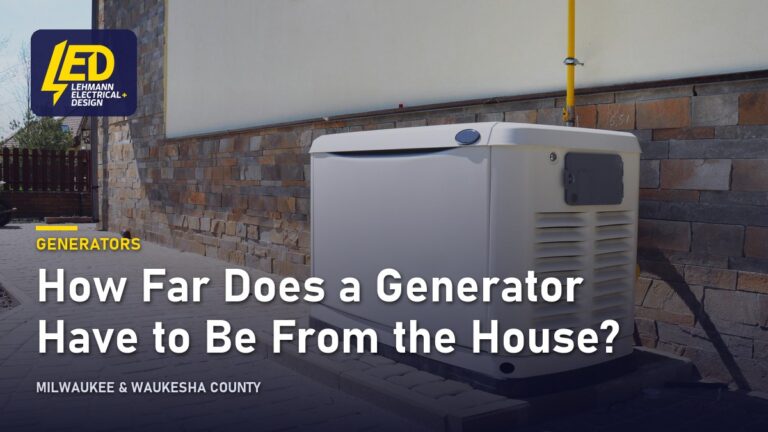
A permanently installed home standby generator sits close to the house, not out in the yard. The two governing dimensions are 5 feet to any opening in a wall and 18 inches to the wall itself. Generac’s installation guidance, which cites NFPA 37, calls for at least 5 feet from operable windows, doors, vents and window wells, 5 feet of clearance above, and 3 feet clear at the front and both ends. The 18-inch rear figure applies only to units carrying the SwRI label. Local rules can be stricter.
What the job actually involves
Siting the generator is the first decision on an install, and it drives most of the others. The unit sits on a pad or a composite base, usually along a side or rear wall, positioned so the exhaust and the air intake are clear of anything the house breathes in through.
Here are the clearances a typical air-cooled home standby unit is installed to, taken from Generac’s clearance guidance, which cites NFPA 37:
| Direction | Minimum clearance | Notes |
|---|---|---|
| From openings in walls | 5 feet | Counts operable windows, doors, vents and window wells |
| Above the unit | 5 feet | Nothing overhanging: no soffit, no deck, no eave encroachment |
| Front and both ends | 3 feet | Includes trees, shrubs and bushes, not just structures |
| Rear, to a stationary wall | 18 inches | Only for units carrying the SwRI logo |
| Rear, unit without SwRI logo | 5 feet from combustible materials, 3 feet from non-combustible materials | Confirm on the unit’s own spec sheet |
| Under a wooden deck or platform | Prohibited by Generac’s installation guidance | Also ruled out by the 5-foot overhead clearance |
Two things people misread about that table. The 5-foot rule is measured to openings, not to the wall itself, which is why a unit can sit 18 inches off the siding and still be wrongly placed if a basement window well or a dryer vent is 3 feet away. And meeting those distances does not by itself guarantee carbon monoxide stays out of the house. Generac says so plainly. On some houses the right answer is farther away than the minimum, because of where the prevailing wind pushes exhaust or how a wall reflects it back toward a bedroom window.
One Wisconsin detail that does not appear in any manufacturer table: pad height. A unit set flush with grade can end up in standing snow or sitting in meltwater every spring. Raising the pad so the enclosure’s air intakes stay clear of drifted snow is a judgment call made on site, and it is worth asking any contractor how they plan to handle it.
Beyond siting, the job is a gas connection and an electrical connection. Natural gas or propane is run and sized for the unit’s demand. On the electrical side, a transfer switch is installed so the generator and the utility can never feed the house at the same time, and the backed-up circuits are wired to it. That work happens inside and behind the panel cover, on conductors a homeowner cannot de-energize. Turning the main breaker off does not make the panel safe: the service conductors and the line-side lugs of the main breaker stay energized until the utility pulls the meter or a separate service disconnect ahead of the panel is opened. A licensed electrician does this work, under permit.
How to tell if you need it
You need a permanently installed generator, rather than a portable one you drag out, when you want the house to come back on by itself and keep running without anyone feeding it fuel. That is the real dividing line.
Signs the fixed unit is the right call:
- Outages at your address last more than a few hours. Older overhead feeds and heavy tree cover make a longer outage more likely at a given address, though how often it happens at yours is something only your own history will tell you.
- Something in the house cannot sit cold. A finished basement with a sump pump, a well pump, a freezer, medical equipment, a home office that has to stay online.
- Nobody is home to start a portable unit. A standby unit senses the outage, starts, transfers load and shuts down again when utility power returns.
- You already run extension cords in an outage. That is a sign the loads you care about are real and worth putting on a transfer switch properly.
- You cannot safely site a portable generator. Portable units have to run well away from the house with exhaust pointed away. A lot of city lots in this service area do not give you that, and running one in a garage or close to a window is how carbon monoxide gets into a house.
Sizing is a separate question from siting, and it is not something you read off square footage. The kilowatt rating follows the circuits you want backed up: the well pump, the furnace blower, the refrigerator, a sump pump, selected lighting and outlets, or the entire panel. Two identical houses can need very different units depending on whether the air conditioning and the electric range are in or out. Walking through the loads first is what our generator installation services are built around, and it avoids buying a unit that is either short on capacity or larger than you will ever use.
What decides the price
Price is driven less by the generator model than by what is around it. The main variables:
The site itself. A spot that already meets the clearance distances, sits on firm ground near the gas meter and near the panel is the cheapest install. A spot that needs the pad built up, a window well relocated, shrubs removed or the unit moved to the far side of the house costs more.
Distance from the gas supply and the panel. Every foot of gas line and every foot of conduit and conductor between the unit and the house is material and labor. A generator on the opposite corner from the meter is a longer, more expensive run.
The gas supply’s capacity. The existing gas service and piping has to deliver enough fuel for the generator plus the furnace and water heater while they all run. Sometimes the meter or a section of pipe has to be upsized. That is a real cost that shows up on some houses and not others.
How much of the house is backed up. A transfer switch covering eight essential circuits is a different job from one covering the whole panel. More circuits means a bigger switch, a bigger unit and more wiring.
Generator size and fuel type. Natural gas or propane, air-cooled or liquid-cooled, and the kW rating that came out of the load discussion.
We cannot publish a figure for your house here, because what an install costs genuinely depends on the five things above. To get a sense of the size you are dealing with before anyone comes out, our generator sizing calculator walks through which loads you would want covered.
How long it takes and what is disrupted
A typical residential standby install runs one to two days on site, after the permit is in hand and the equipment has arrived. The sequence is usually: set the pad, place the unit, run gas, run electrical and install the transfer switch, then commission and test.
The disruption is modest and predictable:
- Power off for part of one day. Tying in the transfer switch means the house is de-energized for a few hours. Note that only the utility, or a separate service disconnect ahead of the panel, can de-energize the service conductors themselves; the main breaker does not do it. You will be told the outage window in advance.
- Gas off briefly while the new line is connected and pressure-tested.
- Some digging or trenching between the meter, the unit and the house, depending on routing.
- Noise during the test run. The unit is started, loaded and run through a transfer simulation. It is loud for several minutes.
- An exercise cycle afterward. The generator self-tests on a set schedule, typically weekly or biweekly. The run length is set during commissioning and is a few minutes rather than an hour, with the exact figure depending on the model. Neighbors notice this, so timing the cycle for a weekday mid-morning rather than a Sunday morning is worth asking about.
Not sure a generator will fit where you want it?
Send us a photo of the wall and where your gas meter is. We will check the clearances against your municipality’s setbacks before anyone quotes a pad.
Licensed master electrician. 12-month workmanship warranty.
Permits and inspection
A standby generator install is permitted work. The permit is issued by your local municipality (Milwaukee, Wauwatosa, Waukesha and the surrounding villages each run their own department), and the electrical work is inspected against Wisconsin SPS 316, which adopts the 2023 NEC (in effect since September 1, 2026). Most jurisdictions also require a separate mechanical or gas permit for the fuel connection.
Three things sit outside the electrical code and get missed:
- Zoning setbacks. Your municipality sets how close any equipment may sit to a property line. That is a zoning question, not an electrical one, and it can override a clearance that is otherwise fine.
- Gas meter clearance. The gas utility has its own required clearance around the meter and around any vent or regulator on it. That distance comes from the utility, not from the generator manufacturer, and it has to be confirmed for your meter before the pad goes in.
- Local rules beating the manufacturer. Generac’s clearance guidance states that local codes take precedence over its recommendations. An inspector or an authority having jurisdiction can require more distance than the 5-foot and 18-inch figures above.
This is the part worth reading twice. The manufacturer’s clearance distances are installation guidance drawn from NFPA 37, not Wisconsin electrical code. Wisconsin SPS 316 governs the electrical work. The siting distances come from the manufacturer, and the local authority can be stricter than both. A contractor who quotes you a location without having checked your municipality’s setback and your gas utility’s meter clearance has not finished the siting question.
Inspection happens after the work and before the unit is signed off. Permit fees are set by the municipality, so ask any contractor whether their quote has them in it.
Choosing an electrician
Ask three questions and you will separate the real quotes from the thin ones.

Where exactly is the unit going, and why there? The answer should mention your window wells, your dryer and bath vents, your deck or eaves overhead, your property line and your gas meter, not just “along that wall.” If the quote has no location on it, the clearance work has not been done.
Who pulls the permit, and under which code? The contractor pulls it. The electrical inspection is against Wisconsin SPS 316, which adopts the 2023 NEC. A contractor who wants you to pull a homeowner permit for a transfer switch tie-in is shifting responsibility for work on service-side conductors onto you.
How did you arrive at the size? You want to hear a list of circuits, not a square footage. If the conversation starts with “a 22 kW will cover a house your size,” the load calculation (the arithmetic that adds up what your chosen circuits actually draw) has not happened. The same calculator runs that logic, so you can see the list of loads for yourself before a quote lands.
Lehmann Electrical & Design is led by Jacob W. Lehmann, a licensed Wisconsin master electrician (licence 1283316), and the company works under Wisconsin electrical contractor licence 1492849. We hold an A+ rating with the BBB, 4.9 stars on Google, and back our work with a 12-month workmanship warranty.
Ready for a firm number on your house? Request an estimate and we will walk the site, check the clearances against your municipality’s setbacks and your gas meter, and size the unit against the circuits you actually want running. Or call 414-207-0109.
Why homeowners call Lehmann Electrical & Design
- Led by licensed master electrician Jacob Lehmann
- A+ rating with the BBB and 4.9 stars on Google
- 12-month workmanship warranty on the work we do
- Permits pulled and inspections scheduled as part of the job
- Milwaukee, Wauwatosa and Waukesha County, from 12012 W Fairview Ave, Wauwatosa
Want the siting settled before you buy a unit?
Tell us which wall you had in mind and which circuits you want backed up.
Licensed master electrician. 12-month workmanship warranty.
Frequently asked questions
▾How far does a Generac generator have to be from the house?
Generac’s clearance guidance, which cites NFPA 37, calls for at least 5 feet from openings in walls (operable windows, doors, vents, window wells), 5 feet of clearance above, and 3 feet at the front and both ends. The rear can be as close as 18 inches to a stationary wall, but only on units carrying the SwRI logo. Units without it need 5 feet from combustible materials and 3 feet from non-combustible materials. Local codes take precedence.
▾How far does a gas generator have to be from the house?
A permanently installed natural gas or propane standby unit follows the manufacturer’s clearance distances above: 5 feet from wall openings, 18 inches at the rear for an SwRI-labeled unit. A portable gas generator is a different machine entirely and must run well away from the house with exhaust directed away, never in a garage, breezeway or under an open window, because of carbon monoxide.
▾Can a generator sit under a deck?
No. Generac’s installation guidance prohibits placing the unit under a wooden deck or platform, and the 5 feet of required clearance above the generator rules out most overhangs, soffits and eaves anyway. If the only level spot on your lot is under a deck, the unit needs a different location, which may mean a longer gas and electrical run.
▾How long can a whole house generator run continuously?
On natural gas from a utility line there is no fuel tank to empty, so the unit can run for as long as gas keeps flowing and oil-change intervals are observed. A very long outage eventually means a planned shutdown for oil service, and a regional event can affect gas supply as well as power. On propane, runtime is set by tank size and load, which your installer can estimate from the unit’s fuel-consumption chart.
▾How long does the weekly exercise cycle run?
The self-test runs on a schedule, commonly weekly or biweekly, and the duration is set during commissioning. It runs for a few minutes, with the exact length depending on the model and how it was configured at commissioning. Ask for the day and time to be set deliberately, because the engine is audible during the test, and a mid-morning weekday slot bothers neighbors far less than an early weekend one.
▾Does meeting the 5-foot rule mean carbon monoxide cannot get in?
No, and Generac states this directly. Meeting the NFPA 37 distances does not guarantee exhaust stays out of the house. Depending on wind direction, wall geometry and where bedroom windows sit, the unit may need to be placed farther away than the minimum. Working carbon monoxide alarms on every level of the home remain necessary regardless of where the generator sits.
Next step
Get your generator site checked
Tell us the wall you had in mind and where the gas meter sits.
Licensed master electrician12‑month warranty4.9 on Google
Milwaukee, Wauwatosa and Waukesha County. Prefer to talk? Call 414-207-0109