Licensed master electrician · Call 414-207-0109
Yes. A home battery charges perfectly well from the grid, and plenty of installations have no solar attached at all. What solar changes is not whether the battery works, but how long it can keep working once the power is out.
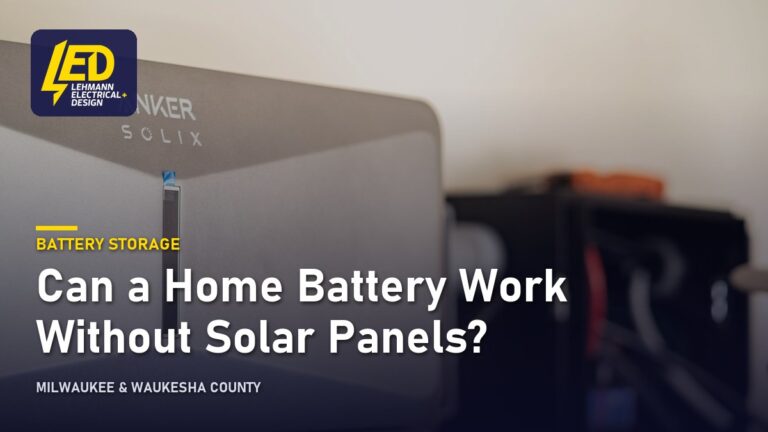
A battery stores electricity. It does not care where that electricity came from.
Without solar, the battery fills from the grid, usually overnight or whenever your utility rate is lowest, and holds that charge until you need it. When the power goes out, a transfer device disconnects the house from the grid and the battery takes over the circuits it was set up to carry. That is a complete, working system.
The difference solar makes is refilling. A battery on its own is a tank with one filling station, and that station is the grid. When the grid is down, the tank empties and stays empty. Add solar and the tank refills every sunny day, which turns a few hours of backup into something that can ride out a multi-day outage.
So the real question is not whether it works, but what you want it to do. For short outages, price-based rate shifting, or keeping a few critical circuits alive, a battery on its own does the job. For long outages, solar is what makes the difference.
What is usually causing it
The question usually comes from one of three places, and each has a different answer.
| What you are actually asking | Short answer |
|---|---|
| Will it physically function without panels? | Yes, it charges from the grid |
| Will it still help in a long outage? | Only until it empties, with no way to refill |
| Should I add solar at the same time? | Depends on outage length and your utility’s rates |
Where the confusion comes from
Batteries are marketed alongside solar, so the two get described as one product. They are separate pieces of equipment that happen to pair well. The battery and its inverter manage charging and discharging regardless of the source, and a system installed without panels is a normal configuration rather than a workaround.
AC-coupled, and why it matters later
A battery added to a house that has no solar is typically AC-coupled, meaning it connects on the alternating-current side of the system rather than sharing a DC link with panels. The practical consequence is good news: adding solar afterwards is straightforward, because the panels bring their own inverter and the battery does not need replacing or rewiring to accommodate them.
If you think solar is likely within a few years, say so at the design stage. It affects where equipment is placed and how much room is left in the panel, and those are cheap decisions to make early and awkward ones to revisit.
Whole house or critical loads
Most installations do not back up everything. A critical-loads subpanel carries the circuits you actually need during an outage, commonly the furnace controls, the refrigerator, well pump, some lighting and a few receptacles. Backing up the entire service is possible but asks much more of the battery, and an electric range, central air conditioning or an electric water heater will empty one quickly.
Deciding what goes on that subpanel is the single most useful conversation to have before anything is ordered.
What is safe to check yourself, and what is not
Useful to work out in advance, and none of it electrical: which circuits you would want alive during an outage, how long your outages typically last, whether anyone in the house depends on powered medical equipment, and where there is wall space that stays within a reasonable temperature range. Batteries have published operating temperature limits, and an unheated garage in a Wisconsin winter is worth flagging rather than assuming.
Not a homeowner job: anything inside the panel, the service equipment, or the battery and its gateway. A battery installation involves a transfer device that disconnects the house from the grid, which is life-safety wiring. Done wrong it can backfeed the utility line and endanger the people working on it. That work is carried out by a licensed electrician under a permit from the municipality. In Milwaukee, Wauwatosa and across Waukesha County it falls under Wisconsin SPS 316, which adopts the 2023 NEC and took effect on September 1, 2026.
If the battery is already installed and simply is not charging, that is a different question with its own set of causes, covered in why a home battery is not charging.
Thinking about backup without going solar first?
A licensed electrician works out what your service can carry and which circuits are worth backing up, which decides the equipment rather than the other way round.
Licensed master electrician. 12-month workmanship warranty.
When it points to a bigger problem
Three things turn a straightforward battery job into a larger one, and all three are worth knowing before you commit.
The panel is full. A battery and its gateway need space and capacity. An older service that is already at its limit may need upgrading first, which changes the scope and the order of work.
The service is undersized for the plan. Backing up more of the house, or adding solar and an EV charger later, stacks demand that the existing service was never designed for. Working out total load before buying equipment avoids finding out afterwards.
The circuits are not arranged for it. Critical-loads backup assumes the circuits you want can be separated cleanly. In a house where lighting and receptacles are mixed across circuits, or where an earlier addition was wired into whatever was nearest, some rearranging comes first.
How long any of this will actually keep your house running is its own calculation, and what a 20 kWh battery will run works through it with real figures.
What an electrician does about it
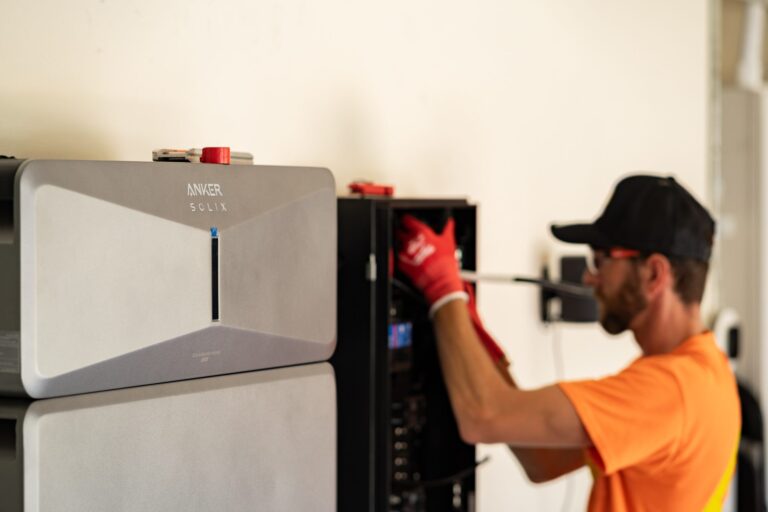
The visit starts with load, not product. An electrician looks at the existing service and panel, measures or calculates what the house actually draws, and works through which circuits matter to you during an outage. That produces a critical-loads list, and the list determines the equipment rather than the other way round.
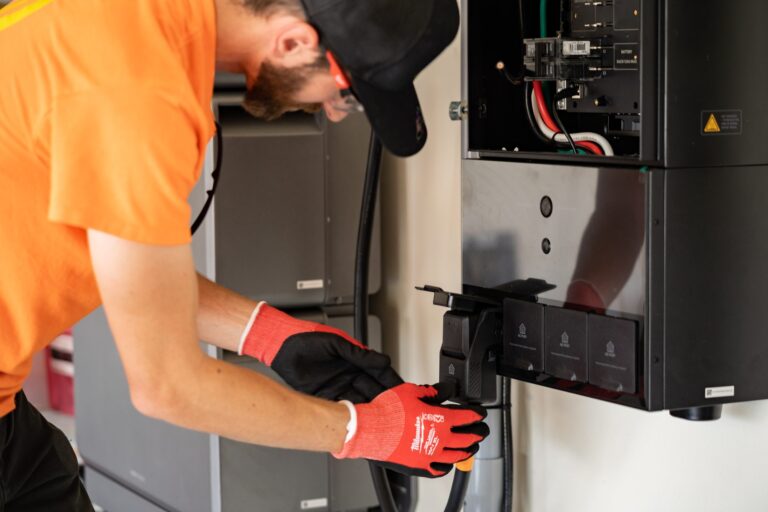
From there the design covers where the battery and gateway go, whether the panel has room or needs work first, how the transfer device isolates the house from the grid, and what the utility requires for interconnection. Permits are pulled, the work is inspected, and the system is commissioned and tested by simulating an outage rather than assuming it will behave.
Where solar is likely later, the design leaves room for it. Where it is not, the system is sized for grid charging alone.
Lehmann Electrical & Design is led by master electrician Jacob Lehmann and works across Milwaukee, Wauwatosa and Waukesha County from 12012 W Fairview Ave, Wauwatosa. Work carries a 12-month workmanship warranty, and the company holds 4.9 stars on Google.
You can see what home battery installation involves, or request an estimate and call 414-207-0109 to talk through what you want backed up.
Why homeowners call Lehmann Electrical & Design
- Led by licensed master electrician Jacob Lehmann
- A+ rating with the BBB and 4.9 stars on Google
- 12-month workmanship warranty on the work we do
- Permits pulled and inspections scheduled as part of the job
- Milwaukee, Wauwatosa and Waukesha County, from 12012 W Fairview Ave, Wauwatosa
Want to know what it would take here?
Tell us what you would want running in an outage, and roughly how long your outages last.
Licensed master electrician. 12-month workmanship warranty.
Frequently asked questions
▾Can I have a home battery without solar?
Yes, and it is a common configuration. The battery charges from the grid instead of from panels, and everything else about the installation is the same: a gateway that disconnects the house during an outage, a critical-loads subpanel, and a permit and inspection. The one real limitation is that an outage lasting longer than the battery’s capacity cannot be refilled until the grid returns.
▾Is it worth getting a home battery without solar panels?
It depends on what you want from it. If your outages are short and occasional, a battery alone covers them comfortably and keeps the furnace, the fridge and the lights running. If your utility prices electricity differently across the day, a battery can shift when you draw from the grid. If your concern is multi-day outages, solar is what changes the answer, because without it the battery cannot recharge while the grid is down.
▾How do home battery backup systems work?
The battery sits between the grid and the circuits it protects, with a gateway watching the incoming supply. When that supply fails, the gateway disconnects the house from the grid, which prevents backfeeding the utility line, and the battery begins supplying the backed-up circuits through its inverter. When grid power returns, the gateway reconnects and the battery recharges. The switchover is fast enough that most electronics do not notice it.
▾Do I need a battery for solar panels?
No. Solar without a battery works fine and is the more common installation, but the panels only produce while the sun is up, and in a grid outage a system without a battery normally shuts down for safety. A battery is what gives solar the ability to keep a house running after dark or during an outage.
▾Why do solar panels need batteries during a power cut?
Because a grid-tied solar system is required to shut down when the grid fails. That protects utility crews from a system feeding power back into lines they are working on. A battery with a proper gateway creates an isolated island covering your own circuits, which is what allows the solar to keep producing safely while the grid is down.
▾How does solar work without batteries?
The panels produce direct current, an inverter converts it to alternating current, and that power is used in the house as it is generated. Anything you do not use is exported to the grid, subject to whatever arrangement your utility offers. It reduces what you draw during daylight, but it stores nothing, which is why it does not help at night or in an outage.
▾Can I build a home battery backup system myself?
No, and this is not a cautious answer. A backup system includes a transfer device that disconnects your house from the grid, and getting that wrong can push power back onto utility lines that someone is working on. It also involves stored energy that cannot be switched off the way a circuit can: the battery is live at its terminals whatever the breakers are doing. The work is permitted, inspected and tied into the utility’s interconnection requirements, and none of those steps have a homeowner path. What you can usefully do yourself is the planning: deciding which circuits matter, where the equipment could go, and what you want it to achieve.
▾What kind of battery do I need for solar panels?
That is a design question rather than a shopping one. Capacity follows from the circuits you want backed up and how long you want them to run, and the inverter has to be matched to the loads it will carry, particularly motor loads like a well pump or a furnace blower that draw a surge at startup. An electrician sizes both after looking at your actual service and usage rather than from a model name.
Next step
Get the options assessed
Tell us what you would want running in an outage.
Licensed master electrician12‑month warranty4.9 on Google
Milwaukee, Wauwatosa and Waukesha County. Prefer to talk? Call 414-207-0109