Licensed master electrician · Call 414-207-0109
No single Wisconsin rule sets how often a commercial building has to be inspected once it is in service, so the interval is a judgement. Ours, from the buildings we look after, is that most commercial premises want a full electrical inspection every three to five years, with a shorter cycle for higher-demand sites. Industrial plants, kitchens, machine shops and anything with motors, heat or heavy duty cycles are usually inspected annually. Life-safety equipment such as exit and emergency lighting is checked monthly and tested annually. On top of that, any building being bought, leased, expanded or re-fitted should be inspected before money changes hands.
What a commercial electrical inspection actually involves
A commercial electrical inspection is a licensed electrician systematically working through the building’s distribution system, from the service entrance (the point where the utility’s wires and meter hand power over to your building) down to the last receptacle, looking for heat, wear, overload and anything that no longer matches how the space is being used.

On a typical visit that means:
- Reading the main service and subpanels: breaker and fuse ratings against the conductors they protect, torque and condition of terminations, corrosion, moisture staining, signs of arcing, and whether circuit directories still describe reality.
- Measuring actual load on the service and on heavily used feeders, often with a recording meter left in place for a few days, so the numbers reflect a real workweek rather than one quiet morning.
- Testing GFCI and AFCI protection where it is installed. A GFCI (ground fault circuit interrupter) cuts power when a small amount of current leaks out of the intended path, including through a person. An AFCI (arc fault circuit interrupter) opens the circuit when it detects the signature of an arcing fault in the wiring.
- Checking grounding and bonding, including the grounding electrode connection and bonding of metal water lines, conduit and equipment enclosures.
- Thermal imaging of panels, disconnects, motor starters and large junctions under load, which finds loose or failing connections before they fail loudly.
- Walking the occupied space: receptacles, cord-and-plug equipment, exposed or damaged conduit, junction boxes missing covers, and the inevitable collection of power strips feeding other power strips.
- Life-safety items: exit signs, emergency egress lighting, and emergency shutoffs.
Nothing in that list is a job for building maintenance staff with a screwdriver. Work behind a panel cover, on feeders, or on service conductors is licensed-electrician work, done with the right test equipment and the right protective gear, and often with a permit. The useful division of labor is that your staff report symptoms and an electrician opens equipment.
The deliverable matters as much as the visit. A real inspection ends in a written report: what was found, what the measured loads were, what is a code or safety defect versus a maintenance item, and a priority order with enough detail to budget from. If all you get is a verbal “looks fine,” you did not buy an inspection.
How to tell your building is due
You are due if you cannot answer when it was last done. Beyond that, the honest triggers fall into three groups: time, change, and symptoms.
Time. Use the interval table below as a starting point and adjust for how hard the building works.
| Building type | Full inspection interval | Why |
|---|---|---|
| Office, professional, light retail | Every 3 to 5 years | Stable loads, mostly receptacle and lighting circuits |
| Restaurant and commercial kitchen | Annually | Heat, grease, moisture, heavy motor and appliance duty |
| Warehouse and distribution | Every 2 to 3 years | Lift truck charging, dock equipment, high-bay lighting |
| Manufacturing, machine shop, industrial | Annually, with thermal scans | Motor loads, vibration, dust, continuous duty |
| Medical, dental, veterinary | Annually | Equipment sensitivity and life-safety circuits |
| Multi-tenant commercial | Every 2 to 3 years, plus at every tenant turnover | Each fit-out changes the load picture |
| Exit and emergency lighting (any building) | Monthly function check, annual duration test | The usual interval, set by the fire official for your jurisdiction; it has to work the one time it is needed |
Change. An inspection should be scheduled whenever the electrical demand changes rather than waiting for the calendar: a new tenant, a kitchen or production line addition, a space conversion, rooftop HVAC replacement, a lease renewal, a sale or refinance, or an insurance carrier asking questions. Some insurers ask for a recent thermal scan on an older commercial service, and it is cheaper to have one in a drawer than to be scrambling during underwriting.
Symptoms. Some of these are a scheduling conversation and some are a stop-work conversation.
Call and schedule when you see breakers that trip occasionally, warm cover plates, dimming when large equipment starts, discolored receptacles, panel directories nobody trusts, a panel so full that every slot is taken, or lighting that has started behaving oddly. If fixtures are flickering across a floor or a whole circuit, there is a specific set of causes worth understanding, because flickering lights in a commercial building often point at a loose connection rather than a bad lamp.
Stop using the circuit or device immediately, leave the breaker off, and call an electrician if you notice a burning or hot-plastic smell, scorch marks or discoloration around a panel, outlet or equipment, buzzing, or crackling. Do not reach toward the panel to judge how hot it is: use smell, sight and sound. A breaker may be reset once, pushed firmly to OFF and then to ON. If it trips a second time, leave it off until it has been inspected. Never fit a larger breaker or fuse to stop nuisance tripping, because the breaker is there to protect the wire, and the correct fix for a circuit that is genuinely overloaded is more circuit capacity, not more amperage on the same conductors.
What decides the price
Price is driven by scope and access, not by square footage alone. The main variables an electrician prices against are:
How many pieces of gear there are. A single 200 A service and two subpanels is a different job than a 1,200 A switchboard, a transformer, six distribution panels and thirty motor starters. Panel count and breaker count are the biggest single driver.
Whether the equipment can be opened. Dead-front covers come off in minutes on a clean, accessible panel. A panel blocked by shelving, buried in a tenant’s stockroom, mounted at height, or sitting in a damp mechanical room costs more in time before any testing begins.
Whether load has to be recorded. A snapshot reading is quick. Leaving a recording meter on the service for a week, returning to retrieve it, and analyzing the data is a second visit.
Whether thermal imaging is included. Infrared scanning has to happen with the building under real load, which sometimes means scheduling around production hours.
Age and documentation. A building with current as-builts and a legible panel schedule is faster to inspect than one where every circuit has to be traced. Older commercial buildings with decades of undocumented alterations take the longest.
How far the report goes. A defect list is one product. A load study with recommendations for future capacity is another.
Whether corrective work is bundled. Many owners ask for small repairs to be completed during the inspection visit, which is efficient but changes the quote.
Lehmann Electrical & Design quotes commercial inspections after a short conversation about the building, because guessing at panel count over the phone helps nobody. Call 414-207-0109 or send the details through the site and you will get a number tied to your actual gear.
How long it takes and what gets disrupted
Expect most commercial inspections to be measured in hours, not days, and expect brief outages at specific panels rather than a building-wide shutdown.
A small office or retail suite with one service and a couple of panels is commonly a half day. A mid-size restaurant, clinic or multi-tenant building is usually a full day. A manufacturing facility or a building with a large switchboard and multiple distribution panels can run two to three days, and load recording adds a return visit a week later.
Most of the work happens with the building energized. Thermal imaging has to be done under load, and load measurements are meaningless without it. The disruptive moments are short and planned:
- Opening and inspecting a panel interior is often done with that panel de-energized, which means the circuits it feeds go down for the time it takes, typically fifteen to forty-five minutes per panel.
- Testing GFCI devices trips the circuits they protect, so anything plugged into them restarts.
- Emergency lighting duration testing runs the batteries down and needs recharge time afterward.
A point worth stating plainly: turning the main breaker off does not make the equipment safe to touch. The service conductors feeding the main and the line-side lugs of the main breaker itself stay energized. Only the utility, usually by pulling the meter, or a separate service disconnect fitted ahead of the panel can de-energize those. That is a large part of why this work belongs to licensed electricians with the training and equipment for energized gear, and why building staff should never open a service enclosure.
The practical way to limit disruption is sequencing. Most owners choose to have panels serving back-of-house, storage and non-critical areas opened during business hours, and panels serving servers, refrigeration, point-of-sale or production taken down before opening or after closing. Tell the electrician which loads cannot go down and when, and the schedule gets built around that. Lighting work often pairs well with the same visit, and keeping to a sensible schedule for commercial lighting maintenance means fewer separate trips into tenant space.
Not sure when your building was last looked at?
A first inspection sets the baseline and the interval, and tells you which equipment needs a shorter cycle than the rest.
Licensed master electrician. 12-month workmanship warranty.
Permits, code, and how an inspection relates to each
An inspection is not itself a permitted activity, but anything it uncovers usually is. Testing, measuring, thermal imaging and reporting do not require a permit. Replacing a failed breaker, correcting grounding, adding circuits, or altering a panel generally does, and the permit is issued by your local municipality, which enforces the state electrical rules.
In Wisconsin, that framework is SPS 316, which adopts the 2023 edition of the National Electrical Code and has been in effect since September 1, 2026. Work permitted before that date was carried out under the 2017 NEC, which Wisconsin used previously. An important nuance for owners of older buildings: an existing installation is not required to be brought up to the current edition simply because a new edition took effect. The current code applies when you alter, extend or replace something. So a 1978 panel that was compliant when installed is not automatically a violation today, but the new circuit you add to it next year gets built to the 2023 NEC as Wisconsin adopts it, and defects that were never compliant in any edition are still defects.
One rule that comes up constantly in commercial reports is the continuous load rule. A branch circuit’s overcurrent device must be rated at no less than the noncontinuous load plus 125 percent of the continuous load (NEC 210.20(A)). That is the same as saying a continuous load, meaning one that runs at maximum current for three hours or more, should occupy no more than 80 percent of the breaker’s rating. Assemblies listed for 100 percent operation exist, but they are the exception, not the default. This is why a report may flag a circuit that has never tripped: it can be loaded beyond what the code allows for sustained duty and still look fine on a Tuesday.
Sizing a commercial service follows the same logic at a larger scale. A load calculation adds up the connected load by category, continuous loads at 125 percent, applies the demand factors the code allows for lighting, receptacles, kitchen equipment, motors and HVAC, takes the largest motor into account, converts volt-amperes to amperes using the service voltage and phase, and then compares the result against the existing service rating with headroom for growth. It is arithmetic, but the demand factors and exceptions are where it gets done wrong, which is why a load calculation belongs to a licensed electrician rather than a spreadsheet found online.
Choosing an electrician for the work
Choose a licensed electrical contractor who inspects commercial systems regularly, reports in writing, and will stand behind corrective work.
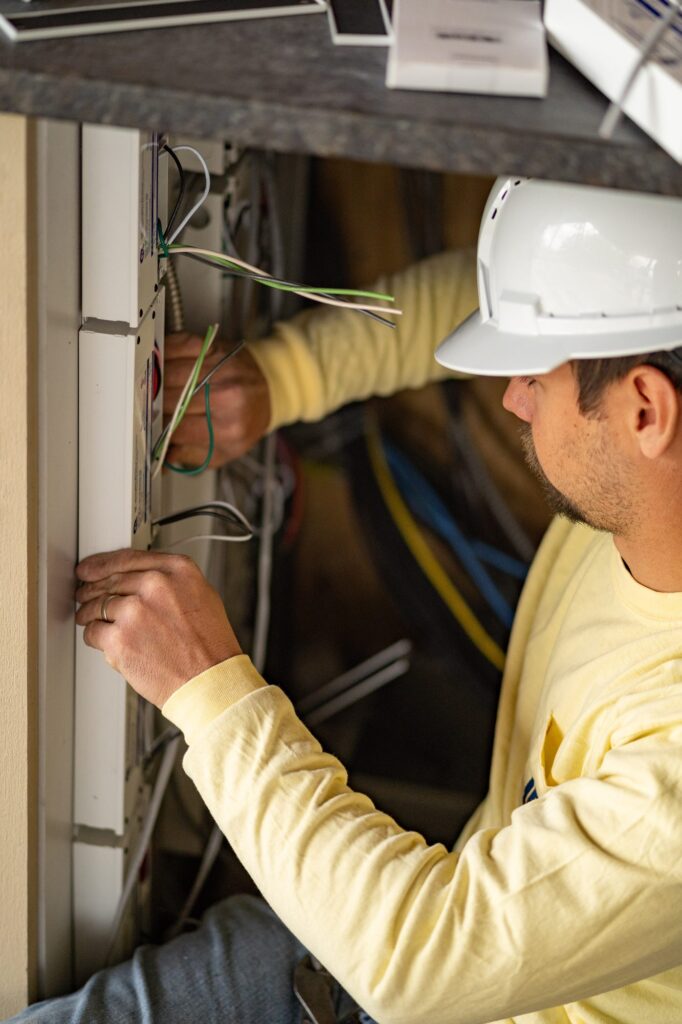
Ask for four things. First, the license: Lehmann Electrical & Design works under Wisconsin electrical contractor license 1492849, and Jacob Lehmann holds Wisconsin master electrician license 1283316. Second, a sample report, so you can see whether findings come with severity, location and a recommendation rather than a bare list. Third, what test equipment is included, specifically whether thermal imaging and recording load measurement are part of the price or an add-on. Fourth, who does the corrective work, and under what warranty. Lehmann backs its work with a 12-month workmanship warranty.
Be wary of an “inspection” that is really a sales walkthrough, one that produces no document, or one priced so low that nothing could have been opened. Also be wary of anyone who proposes replacing equipment before measuring the load on it. The measurement comes first.
Lehmann Electrical & Design is based in Wauwatosa and carries out commercial electrical work across Milwaukee and Waukesha County, with an A+ rating from the BBB and 4.9 stars on Google.
Why homeowners call Lehmann Electrical & Design
- Led by licensed master electrician Jacob Lehmann
- A+ rating with the BBB and 4.9 stars on Google
- 12-month workmanship warranty on the work we do
- Permits pulled and inspections scheduled as part of the job
- Milwaukee, Wauwatosa and Waukesha County, from 12012 W Fairview Ave, Wauwatosa
Want this on a schedule instead of a crisis?
Tell us the building type, the age of the service and how many panels you have.
Licensed master electrician. 12-month workmanship warranty.
Frequently asked questions
▾How often should commercial electrical installations be tested?
Every three to five years for ordinary offices and light retail, and annually for restaurants, clinics, warehouses with charging equipment, and anything industrial. Exit and emergency lighting is on its own cycle, usually a monthly function check and an annual duration test, confirmed with your fire official. Testing should also happen outside that schedule whenever a tenant changes, a space is converted, or significant equipment is added or removed.
▾How often should electrical equipment be inspected?
Individual equipment follows duty, not the building average. Panels, disconnects and motor starters in continuous service benefit from an annual thermal scan under load, because loose terminations announce themselves as heat long before they fail. Cord-and-plug equipment, extension cords and portable tools should be visually checked by staff regularly and pulled from service when damaged. The manufacturer’s maintenance interval governs anything with a published schedule.
▾How often should an industrial electrical installation be tested?
Annually is the working standard for industrial sites, with infrared scanning of switchgear, distribution panels and motor control under real production load. Vibration, dust, heat and continuous duty loosen connections and degrade insulation faster than office conditions do. Plants running multiple shifts, or with frequently reconfigured production lines, often move to a rolling program where a portion of the distribution system is inspected each quarter.
▾How often should a commercial property be electrically tested if nothing has changed?
Still on the three-to-five-year cycle at minimum. Nothing visibly changing does not mean nothing is degrading: terminations loosen through thermal cycling, insulation ages, moisture finds its way into outdoor and basement equipment, and occupant load creeps upward one space heater and one appliance at a time. An inspection on a quiet building is also the cheapest kind, because findings are small and can be scheduled rather than rushed.
▾How do you calculate commercial electrical service size?
An electrician performs a load calculation: connected loads are totaled by category, continuous loads are counted at 125 percent, the demand factors the code allows for lighting, receptacles, kitchen equipment and motors are applied, the largest motor is accounted for, and the result is converted from volt-amperes to amperes at the service voltage and phase. Actual recorded load from a metering period is then compared against that figure, and growth headroom is added.
Not sure when your building was last inspected? That is the usual answer, and it is a good enough reason to book. Request a commercial electrical inspection quote through the contact form or call 414-207-0109, and you will get a scope and a price tied to your actual panels, service and schedule.
Next step
Get your building scheduled
Tell us the building type and the age of the service.
Licensed master electrician12‑month warranty4.9 on Google
Milwaukee, Wauwatosa and Waukesha County. Prefer to talk? Call 414-207-0109