Licensed master electrician · Call 414-207-0109
Commercial lights flicker because something is interrupting or varying the voltage reaching the lamp. The usual suspects are a failing lamp or driver, an incompatible dimmer, a loose connection in a fixture or junction box, or a large motor load such as a rooftop HVAC unit pulling hard when it starts. Flicker across a whole area, or flicker that arrives with buzzing or a burning smell, points to a wiring or service problem and needs a licensed electrician.

A light flickers when its supply voltage dips, wavers, or breaks contact for a fraction of a second. In a commercial building there are three broad origins for that: the lamp itself, the circuit feeding it, or the electrical service feeding the building.
One point to settle before anything else: yes, every fluorescent lamp flickers. The lamp extinguishes and re-strikes with each half cycle of the alternating current supply, so there is always a baseline pulse. On a healthy fixture that pulse is too fast and too shallow for most people to see. The visible, irregular, strobing flicker that makes people complain is a fault on top of that baseline, not the baseline itself.
Harmless flicker is usually local and isolated. One fixture in one office, one tube in one troffer, one dimmed zone that shimmers at low settings. Annoying, but not a hazard.
Flicker you should act on is the kind that spreads. If lights across several rooms dim together when a compressor kicks on, if a whole branch of the building blinks, or if flicker arrives alongside buzzing, crackling, scorch marks, discoloration at a device, or a hot-plastic smell, stop using that circuit, leave its breaker off, and call an electrician. Those are signs of a loose or arcing connection, and arcing generates heat.
What is usually causing it
Here are the causes worth checking, roughly in the order a technician would work through them. Several are wear rather than faults, which is why a building on a planned commercial lighting schedule meets fewer of them.
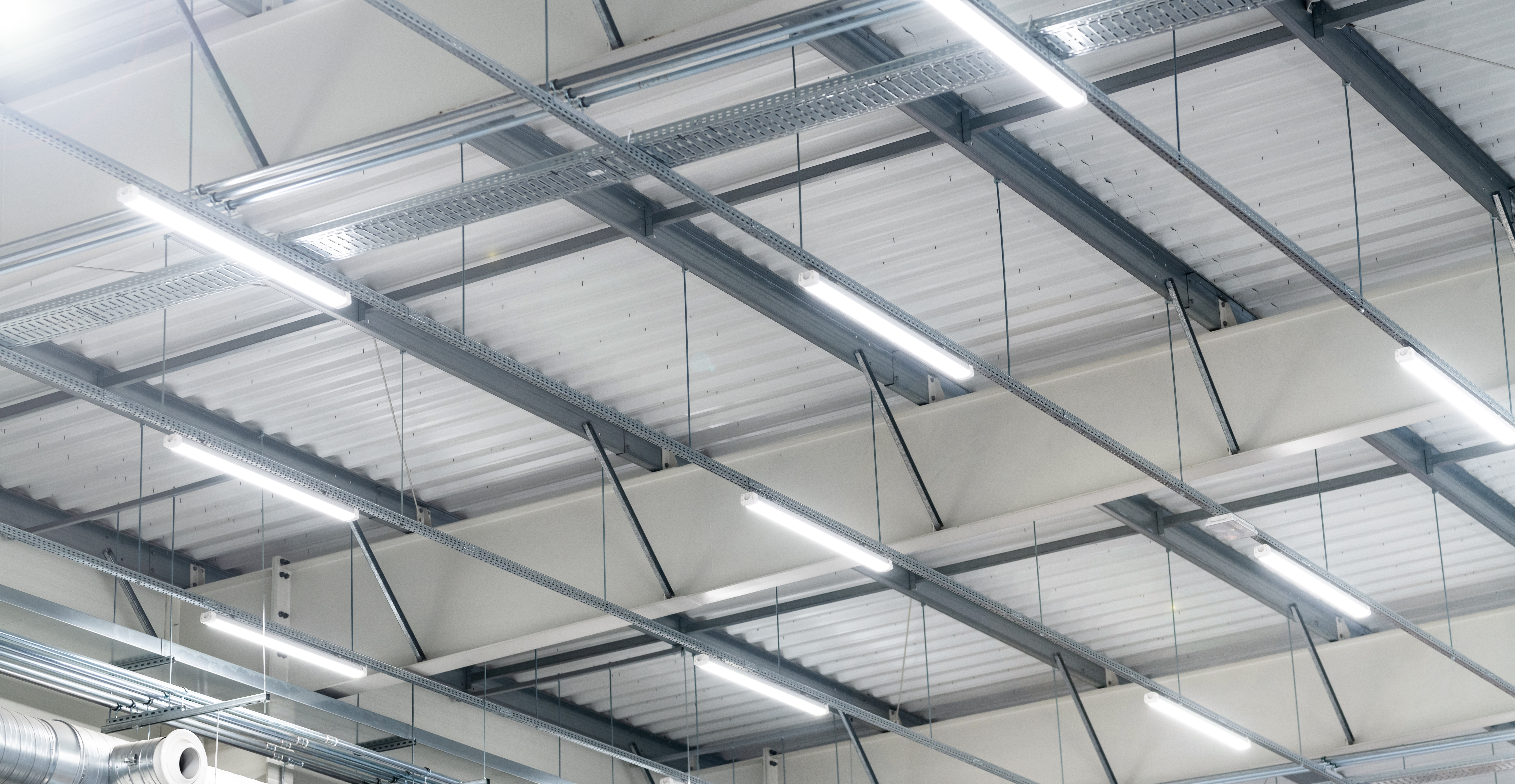
The lamp, tube, or LED driver is at end of life. Fluorescent tubes flicker as the cathodes at each end wear out and struggle to strike the arc, and the classic end-of-life sign is a blackened band at one or both ends of the glass. A persistent pink or orange glow concentrated at one end points more specifically at a failed cathode or a ballast filament circuit that is no longer heating it properly. LED fixtures flicker when the driver, the small power supply inside the fixture that converts building voltage to what the diodes need, starts to fail. A single fixture misbehaving while its neighbors are steady is almost always the fixture.
A failing ballast. On older fluorescent systems the ballast regulates current to the tube. A tired ballast produces flicker, hum, slow starts, or a tube that lights at one end only. Replacing the tube does nothing because the tube was not the problem.
Dimmer incompatibility. A common failure mode after an LED retrofit is dimmer incompatibility. An old dimmer designed for incandescent loads does not control modern LED drivers cleanly. The result is shimmer at low levels, pop-on behavior, or ghosting. The fix is a dimmer matched to the fixture and a load that falls inside the dimmer’s minimum and maximum range, not a different bulb.
Loose connections. A wire nut that was never fully seated, a backstabbed terminal on a switch, a loose lug in a junction box, a lamp holder with weakened contacts. Each one makes intermittent contact, and intermittent contact makes both flicker and heat. This is the cause that matters most, because it is the one that can start a fire. Scheduled inspection can find loose terminations and heat-damaged lugs early, before anyone in the building notices a symptom at all.
Large motor loads starting. Rooftop units, air compressors, elevators, walk-in cooler compressors, and commercial kitchen equipment draw several times their running current for the first moment of startup. That inrush pulls voltage down briefly, and lights on the same part of the system dip in sympathy. A brief dip when a known piece of equipment starts is normal behavior. A deep, obvious dip every time, or one that reaches lighting on unrelated circuits, suggests the service or a feeder is marginal for the load.
Voltage issues from outside the building. Utility switching, a fault on a nearby line, or a neighboring tenant’s heavy equipment can show up in your lights. Flicker that affects the entire building at the same moment, including equipment on different panels, is worth reporting to your utility, We Energies for most of this area, as well as having an electrician check the service entrance, the point where the utility’s conductors land and the building’s own distribution begins.
A local note worth adding: plenty of commercial stock around Milwaukee and Waukesha County was wired in the 1960s through the 1980s, often with aluminum feeder conductors and fluorescent troffers that have since been retrofitted once or twice. Aluminum terminations relax over decades of heating and cooling, and a retrofit done lamp-first without touching the fixture wiring leaves the original joints in place. Those two facts account for a lot of what we are called out to look at in older buildings.
| What you see | Likely origin | Who should handle it |
|---|---|---|
| One fixture, one lamp, steady neighbors | Lamp, driver, or ballast | Facility staff can replace a lamp; fixture internals, an electrician |
| One dimmed zone shimmers at low settings | Dimmer and LED driver mismatch | Electrician selects a compatible control |
| Lights dim briefly when HVAC starts | Motor inrush | Electrician, if the dip is severe or widespread |
| A whole room or branch blinks together | Loose connection on a circuit or feeder | Electrician, promptly |
| Buzzing, crackling, smell, scorch marks | Arcing fault | Stop using it, breaker off, call an electrician |
| Whole building flickers at once | Service or utility side | Electrician plus a call to the utility |
What is safe to check yourself, and what is not
Facility staff can safely do a short list of things, and the list ends at the fixture.
Safe to do:
- Note which fixtures flicker, which do not, and what time of day or what equipment is running when it happens. Patterns solve these faster than anything else.
- Note whether any breaker has tripped on the affected circuits, and whether flicker and tripping happen together. If a breaker has tripped, reset it once: push it firmly to OFF, then to ON. If it trips again, leave it off and have the circuit inspected. Flicker plus repeat tripping on the same circuit is a combination to report, not to keep resetting through.
- Swap a suspect fluorescent tube or LED lamp for a known-good one of the same type. Switch the circuit off at the breaker first, not just at the wall switch. Switched neutrals and multiple switch legs are common in commercial lighting, so the wall switch alone is not a reliable way to know the fixture is dead. Confirm the fixture is dark before reaching into it.
- Check that a lamp is seated fully in its holder.
- Read the dimmer and the fixture labels and confirm the control is rated for the load type and wattage.
Not safe, and not appropriate for anyone without a license:
- Removing a panel cover. With the main breaker off, the service conductors and the line-side lugs of the main breaker stay energized. Nobody inside the building can de-energize them. The utility can, usually by pulling the meter, and a separate service disconnect ahead of the panel can if one is fitted.
- Tightening lugs, terminations, or neutral connections.
- Replacing a ballast or driver, rewiring a fixture, or working inside a junction box.
- Anything on the line side of the meter, on service conductors, or anything a permit covers. Permits in this area are issued by the local municipality, Milwaukee, Wauwatosa, Waukesha and the surrounding communities, which enforce Wisconsin SPS 316, the state’s electrical rules, which adopt the 2023 NEC (in effect since September 1, 2026).
Do not touch a device to judge whether it is running hot. Use smell, sound, and appearance instead. A burning or hot-plastic odor, a buzz, a crackle, a brown or yellow stain on a cover plate, or a blackened lamp holder are the signals that matter.
Lights flickering across a tenancy or a floor?
A licensed electrician separates a driver or ballast problem from a circuit or supply fault, which decides whether you are replacing fittings or fixing wiring.
Licensed master electrician. 12-month workmanship warranty.
When it points to a bigger problem
Flicker becomes a structural question, rather than a lamp question, when it tracks with load rather than with a fixture.
The pattern to watch: lights across multiple rooms dim noticeably every time a specific piece of equipment starts, and the dimming has gotten worse as the building has added load. That is a voltage drop symptom, and it says the conductors, the feeder, or the service are being worked harder than they were sized for. Adding a new tenant, a kitchen, a production machine, or a bank of chargers changes the arithmetic. So does replacing one compressor with a larger one.
A second pattern worth taking seriously is flicker that moves around. Today it is the east hallway, next week the conference room. Wandering flicker usually means a shared connection upstream of both, a feeder termination or a neutral, rather than a coincidence of failing lamps.
Those two patterns are findings rather than emergencies. They justify an inspection on a normal schedule, before they turn into a repair.
A third combination is different. Flicker alongside a hum in the panel area, or alongside breakers that trip with no obvious overload, describes a connection or an equipment problem inside the distribution gear itself. Both of those deserve attention within days rather than at the next convenient maintenance window, because a loose or degraded termination in a panel makes heat where the heat is hardest to see. If that hum comes with a hot-plastic smell, discoloration, or crackling, treat it as a stop: leave the affected breaker off and call an electrician.
What an electrician does about it
The work is diagnostic first. A licensed electrician confirms the symptom, then measures rather than guesses.

A typical sequence looks like this. Voltage is measured at the fixture and at the panel, both at rest and while the suspect equipment runs, so the dip can be seen rather than described. Current is measured and compared with the protective device rating, because a continuous load, meaning one expected to run for three hours or more, should occupy no more than 80 percent of that rating. On a branch circuit that rule lives at NEC 210.20(A); for a feeder it is 215.3, and for the service overcurrent device 230.90. Terminations are inspected and torqued to specification with the circuit de-energized, which on branch circuits is straightforward and on a feeder or service usually means coordinating a planned shutdown window with the building, its tenants, and sometimes the utility, since a feeder termination cannot always be killed from inside the building.
Where the cause looks like it sits upstream, a load calculation is run for the building: a formal tally of connected load, demand factors, and growth that answers whether the existing service and feeders still fit the building’s actual use. For a commercial property that calculation drives everything else, and it is the honest answer to “how do I know what service size I need.”
Then the fix. Sometimes it is a compatible dimmer and an afternoon. Sometimes it is a run of new drivers. Sometimes it is retermination at a feeder. Occasionally it is a recommendation to re-engineer how a large motor load is fed so its inrush stops bothering the lighting. The diagnosis sets the scope, which is why no one can quote a flicker over the phone.
> Scheduled inspection catches loose terminations, heat-stained lugs, and aging ballasts while they are still a maintenance item. Flicker is often the first visible symptom of a connection that has been slowly degrading for months, so the goal of a maintenance program is to find it before the lights announce it.
That is a good argument for a planned maintenance schedule rather than reactive calls. Lehmann Electrical & Design handles troubleshooting, lighting, and commercial electrical work across Milwaukee and Waukesha County, and holds a 4.9-star rating on Google. If flicker started after a load was added, or you are planning something substantial like commercial charging equipment, that is the right moment to have the service evaluated rather than after the fact.
If the lights in your building are flickering and you would like someone to find out why, request an estimate or call 414-207-0109. Work we perform carries a 12-month workmanship warranty.
Why homeowners call Lehmann Electrical & Design
- Led by licensed master electrician Jacob Lehmann
- A+ rating with the BBB and 4.9 stars on Google
- 12-month workmanship warranty on the work we do
- Permits pulled and inspections scheduled as part of the job
- Milwaukee, Wauwatosa and Waukesha County, from 12012 W Fairview Ave, Wauwatosa
Want it diagnosed properly?
Tell us the type of premises, which areas flicker, and whether it tracks with equipment switching on.
Licensed master electrician. 12-month workmanship warranty.
Frequently asked questions
▾Do fluorescent lights flicker, or is mine faulty?
All of them flicker. A fluorescent lamp re-strikes its arc every half cycle of the supply, so there is always a baseline pulse you are not meant to notice. A fault looks different: a slow visible strobe, a lamp that cycles on and off, a swirl at one end, or a blackened band on the glass. If you can clearly see it from across the room, that is a worn lamp, a tired ballast, or a bad holder contact.
▾How do I fix flickering fluorescent lights?
Work in order. Replace the tube first, since lamps fail far sooner than anything else and a fresh tube of the same type settles most cases. If a known-good tube still flickers, suspect the ballast, which regulates current and is the next component to fail with age. If both the tube and the ballast are sound, look at the lamp holders and the fixture wiring. Tube swaps are facility work. Ballast replacement and fixture rewiring are electrician work.
▾Are flickering fluorescent lights dangerous?
A flickering tube by itself is not dangerous, it is a worn lamp or a tired ballast. What can be dangerous is the heat from a failing ballast or a loose lamp holder contact. If a fluorescent fixture buzzes loudly, smells of hot plastic, or shows brown discoloration or scorch marks, stop using it, switch the circuit off at the breaker, and have an electrician look at it before it is used again.
▾How fast do fluorescent lights flicker?
Magnetic-ballast fluorescent lamps pulse twice per cycle of the 60 Hz supply, so about 120 times a second. That is fast enough that most people do not consciously see it but slow enough to cause eye strain and headaches in some people. Electronic ballasts and LED drivers switch at much higher frequencies and greatly reduce the visible pulse, though budget LED drivers can still carry noticeable 120 Hz ripple. Irregular flicker you can plainly see is a fault, not the normal rate.
▾How do I fix flickering after an LED retrofit in a fluorescent fixture?
Most post-retrofit flicker comes from a mismatch. Either a ballast-compatible tube is running on a failing ballast, a ballast-bypass tube is sharing a fixture with the old ballast still wired in, or the existing dimmer cannot control the new driver. The cure is matching the lamp type to how the fixture is actually wired and using a control rated for LED loads. Fixture rewiring is electrician work, not a lamp swap.
▾How is commercial electrical service size calculated?
With a load calculation, not a rule of thumb. An electrician inventories connected load, lighting, receptacles, HVAC, motors, kitchen and process equipment, applies the demand factors that fit the occupancy type, adds 125 percent of the largest motor’s full-load current per NEC 430.24, and allows headroom for planned growth. The result in amperes, the measure of current flow, is compared to the existing service. Wisconsin SPS 316, which adopts the 2023 NEC, governs how that calculation is performed here.
▾Should I call the utility or an electrician?
Both can be right. If the whole building flickers at the same instant, including equipment fed from different panels, report it to your utility directly, since the cause may sit on their side of the meter. If flicker is confined to certain circuits, rooms, or fixtures, it is inside the building and an electrician is the right call. When you are unsure, reporting it to the utility costs nothing and an electrician can still check the service entrance.
▾Why would my office lights keep flickering when nothing has changed?
Things do change, slowly. Connections loosen with thermal cycling, drivers and ballasts age, and equipment draws more current as it wears. Flicker that develops gradually in one area usually means an aging component or a termination that has worked loose. Flicker that appears suddenly across several rooms more often means a connection has degraded upstream on a feeder, and that one should be inspected rather than waited out.
Next step
Get the flickering traced
Tell us which areas flicker and when it happens.
Licensed master electrician12-month warranty4.9 on Google
Milwaukee, Wauwatosa and Waukesha County. Prefer to talk? Call 414-207-0109