Licensed master electrician · Call 414-207-0109
A green blinking or steady green light on a smoke detector normally means the alarm has AC power from your home’s wiring. It is a status light, not a fault. On most hardwired models green means “powered,” and a slow green blink can also mean the unit is running on AC while the backup battery is charging or has just been replaced. If the green light is flashing in a fast or unusual pattern, or it goes dark entirely while the breaker is on, something has interrupted power and that is worth looking into.
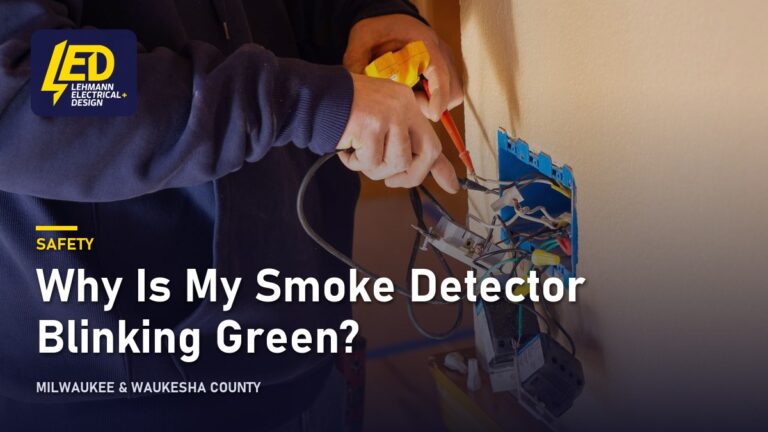
Green equals power. Red usually equals alarm, test, or a fault condition. Most hardwired smoke detectors sold in the United States use a green LED to confirm the unit is connected to a live 120 volt circuit, and many manufacturers specify a green blink every minute or so rather than a steady glow so the light is less distracting at night.
So if you looked up at the ceiling and saw green, the honest answer is that your detector is probably doing exactly what it was designed to do. Check the label on the side or back of the unit. Every manufacturer prints its own LED legend, and the same green blink can mean “AC present” on one brand and “AC present, battery charging” on another.
What matters more than the colour is whether the pattern changed. A detector that has blinked green once a minute for three years and still does is normal. A detector that was steady green and is now flashing green rapidly, or alternating green and red, or has gone completely dark, is telling you something new. Write down the pattern you see, note the brand and model from the label, and compare it against that unit’s instructions before assuming the worst.
What is usually causing it
The green light is driven by the AC side of the detector, so almost everything that changes it comes back to power, the battery, or the unit’s own age.

| What you see | Usual meaning | What it typically needs |
|---|---|---|
| Slow green blink or steady green | AC power present, unit normal | Nothing |
| Green blink right after a battery change | Unit re-initializing or charging a rechargeable backup | Wait out the manufacturer’s stated period |
| Fast or irregular green flashing | Power quality issue, failing unit, or a different code than you think | Read the model’s LED legend, then have it checked |
| Green goes dark, battery chirp starts | AC power lost to that circuit | Electrical diagnosis |
| Green plus intermittent red, no smoke | Fault, end of life, or sensor trouble | Replacement or diagnosis |
After a battery change
This version of the question usually has a benign explanation. Many combination units run a self-check sequence after the battery compartment is closed, and some use a green LED during that sequence. Others, especially sealed units and models with rechargeable backups, blink while the backup charges from the AC supply. Manufacturers list how long that takes. If the green blink has not settled into the normal pattern well past that window, the backup battery or the unit itself may be at fault.
The whole string is blinking in sequence
Interconnected detectors talk to each other over a third conductor, the interconnect wire. Some brands pass status signals down that wire, which is why a pattern can appear to roll through the house. Mixing brands on one interconnect is a common cause of odd behaviour, because the signalling is not standardised across manufacturers.
Age
Smoke detectors have a service life, usually ten years from the date of manufacture printed on the back. Past that, the sensing chamber drifts and the LED behaviour can get unpredictable. If the date on the label is older than a decade, the pattern question is academic. The unit needs replacing regardless.
What is safe to check yourself, and what is not
Safe: reading the label, noting the blink pattern, pressing the test button, vacuuming dust from the vents with a soft brush attachment, and replacing a user-replaceable battery with the exact type the manufacturer specifies. Those are homeowner tasks and they resolve a good share of green-light questions.
Not safe, and not a homeowner job: anything involving the wiring behind the mounting bracket, the junction box in the ceiling, the branch circuit the detectors sit on, or the panel. Smoke detectors are hardwired to a 120 volt circuit. The interconnect wire between units carries a signal rather than the supply, but it shares a box with the 120 volt conductors feeding the alarm, which is why the whole assembly is treated as live work. Rewiring an interconnect, adding a device to that circuit or altering the wiring is licensed work, and the municipality where the work happens decides when a permit is required. In Milwaukee, Wauwatosa and across Waukesha County that falls under Wisconsin SPS 316, which adopts the 2023 NEC and took effect on September 1, 2026.
If you ever smell burning or hot plastic near a detector or its junction box, or see scorch marks or discolouration, or hear buzzing or crackling, stop using that circuit, leave the breaker off, and call a licensed electrician. Do not touch the device to judge how hot it is. Smell, sight and sound are the reliable indicators.
One more rule worth stating plainly: if you turn off a breaker to stop a nuisance and it trips again on its own when you turn it back on, reset it once at most. If it trips a second time, leave it off and have the circuit inspected. A breaker that trips with nothing drawing current usually means a wiring fault, not a tired breaker.
Alarms losing power or behaving differently?
A licensed electrician checks whether the detector, the interconnect or the circuit feeding it is at fault.
Licensed master electrician. 12-month workmanship warranty.
When it points to a bigger problem
A green light that keeps changing, or detectors that keep losing AC power, can be a symptom of something upstream rather than a problem with the alarm.
The patterns that deserve a professional look are these. Detectors that drop AC power after a storm or a utility blink, and come back strangely or not at all. Multiple detectors on the same circuit failing within a short span of each other. Green lights that flicker in time with a large appliance starting up, which suggests a loose neutral or a shared-neutral problem. And detectors repeatedly replaced in the same house for the same symptom.
Smoke detectors contain electronics, and electronics fail from voltage spikes, which arrive from utility switching, nearby lightning, and motors inside the house cycling on and off. Where sensitive devices around a home have been dying in clusters, alarms among them, whole-house surge protection at the panel addresses the cause rather than the symptom.
It is not a substitute for working alarms, though. If detectors are at end of life, mismatched across one interconnect, or wired inconsistently from an earlier job, smoke detector replacement and wiring is the first fix.
And if the light you are actually seeing is red rather than green, the diagnosis is different, since a red flash on a smoke alarm covers a separate set of causes.
What an electrician does about it
The work starts with reading, not replacing. An electrician identifies the brand and model, pulls the LED legend for that exact unit, and confirms whether the pattern you are seeing is normal for that model. That alone closes a fair number of calls.
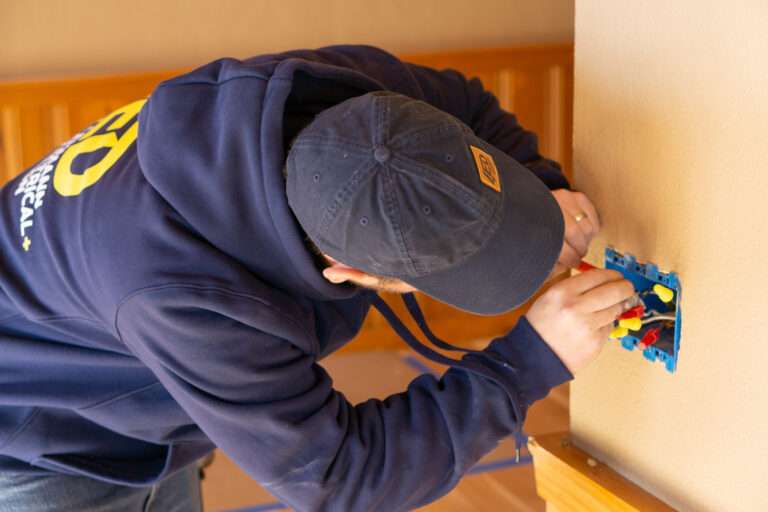
If the pattern is abnormal, the next step is verifying AC power at the device and tracing the circuit back toward its source. That means checking voltage at the detector connector, confirming the neutral and ground connections at the junction box, and looking for a shared or open neutral further upstream. Where several detectors are interconnected, each connection point gets checked, and mismatched brands on one interconnect get sorted out.
From there the scope depends on what turns up. A single failed unit gets replaced with one matched to the rest of the string. A circuit with a loose connection gets repaired at the fault. A house that keeps losing electronics gets a conversation about protection at the panel, which is licensed work done with the panel cover off. Even with the main breaker switched off, the service conductors and the main breaker’s line-side lugs stay live, and only the utility can take those dead.
Lehmann Electrical & Design is led by master electrician Jacob Lehmann and works across Milwaukee, Wauwatosa and Waukesha County from 12012 W Fairview Ave, Wauwatosa. Work carries a 12-month workmanship warranty, and the company holds 4.9 stars on Google.
If a detector in your home is blinking in a way you cannot explain, you can request an estimate or call 414-207-0109 and describe what you are seeing.
Why homeowners call Lehmann Electrical & Design
- Led by licensed master electrician Jacob Lehmann
- A+ rating with the BBB and 4.9 stars on Google
- 12-month workmanship warranty on the work we do
- Permits pulled and inspections scheduled as part of the job
- Milwaukee, Wauwatosa and Waukesha County, from 12012 W Fairview Ave, Wauwatosa
Want the alarms checked properly?
Tell us how many are affected, whether they are hardwired, and how old they are.
Licensed master electrician. 12-month workmanship warranty.
Frequently asked questions
▾Why is my smoke detector blinking a green light?
On hardwired models it means the unit has mains power. Manufacturers use the green LED as a power-on indicator, and many blink it at intervals rather than leaving it lit so it is less distracting at night. The legend printed on the back of that specific unit is the authority, because the same blink means slightly different things across brands.
▾Why is my smoke detector blinking green after changing the battery?
Usually because the unit is re-initialising or charging its backup. Many hardwired detectors run a self-check after the battery door closes, and models with rechargeable backups blink while charging from the AC supply. Check the manufacturer’s stated charge window on the label. If the green blink has not returned to its normal interval well past that window, the backup battery or the detector itself is likely the problem.
▾Does a green light mean my smoke detector is working?
It means the detector has AC power. It does not confirm the smoke sensor is functional. Those are two separate things. Press the test button to confirm the horn and sensing circuit respond, and check the date of manufacture printed on the back. A powered detector past its ten-year service life can show a healthy green light and still have a drifted sensing chamber.
▾What does it mean if the green light goes out completely?
It means that detector has lost AC power while the backup keeps it alive, which is why a chirp usually follows. One unit going dark suggests a connection at that device. Several going dark together suggests the branch circuit feeding them, or a breaker. Either way it is a wiring question rather than a detector question, and it is worth resolving quickly, because the alarms are running on battery alone until it is fixed.
▾Is a green light on a smoke detector supposed to blink or stay solid?
Both are normal, depending on the model. Some manufacturers specify a steady green for mains power, others a brief blink at regular intervals. What matters is consistency over time. A unit that has always been steady and is now blinking, or has always blinked slowly and is now rapid, has changed, and that change is the thing worth investigating rather than the colour itself.
Next step
Get the alarms checked
Tell us how many are affected and whether they are hardwired.
Licensed master electrician12-month warranty4.9 on Google
Milwaukee, Wauwatosa and Waukesha County. Prefer to talk? Call 414-207-0109