Licensed master electrician · Call 414-207-0109
An electrical inspection on a home purchase looks at the service and panel, the grounding and bonding, the condition and type of branch wiring, the presence and function of GFCI and AFCI protection, outlet and switch wiring, smoke and carbon monoxide alarms, and any sign of overheating or amateur work. The inspector is establishing three things: whether the system is safe, whether it is adequate for how the house is now used, and whether it was legally installed.
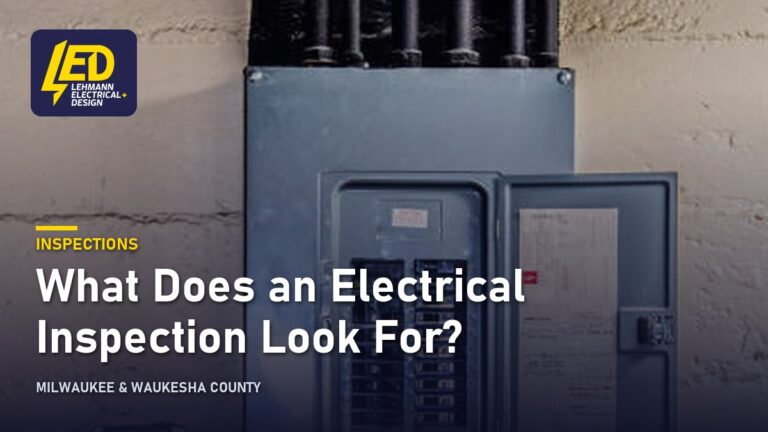
A home inspector’s electrical section and a licensed electrician’s dedicated electrical inspection cover roughly the same ground, but at different depths. Both start at the outside and work inward.
| Area inspected | What they are looking for |
|---|---|
| Service entrance (the wires and equipment bringing utility power into the house) | Frayed or low-hanging drop, damaged mast, loose weatherhead, corroded meter base |
| Service size (amperage, the current-carrying capacity of the service) | 60 A or unknown-capacity service in a house with modern loads; 100 A or 200 A rating confirmed at the main breaker |
| Panel interior | Double-tapped breakers, missing breaker ties, oversized breakers on undersized wire, scorch marks, moisture, rust, aluminum branch wiring |
| Grounding and bonding | Missing or disconnected grounding electrode conductor, unbonded water and gas piping, no ground at the panel |
| Branch wiring | Knob and tube, cloth-insulated conductors, open splices outside a box, staples through insulation, extension cords used as permanent wiring |
| GFCI protection (ground-fault circuit interrupter, trips on 4 to 6 mA of leakage by any path, including through a person) | Missing or non-functioning protection at kitchens, bathrooms, laundry, garage, basement, exterior |
| AFCI protection (arc-fault circuit interrupter, detects the signature of an arcing fault) | Missing on 120 V branch circuits serving living areas, where required by the code edition the work was permitted under |
| Devices | Reverse-polarity outlets, ungrounded three-prong receptacles, loose receptacles, broken plates, painted-over outlets |
| Alarms | Smoke alarms missing from bedrooms and each level, missing CO alarms, units past their service life |
Two things an inspection does not do. It does not open walls, and it does not guarantee that every circuit in the house will be fine for the next ten years. It is a snapshot of visible and testable conditions on one day.
What is usually causing the problems that show up
Most electrical findings on a house sale trace back to one of four causes, and knowing which one you are looking at tells you how much money is in play.
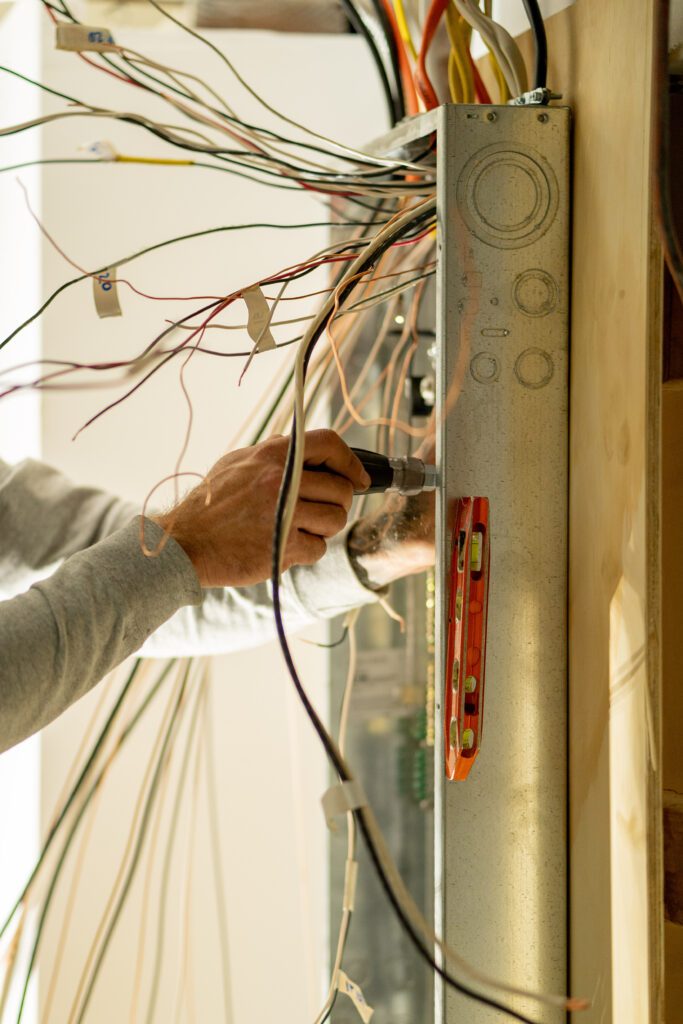
The house is simply older than its wiring standards. A 1920s Milwaukee bungalow with original knob and tube, a 1950s ranch with a 60 A fuse panel, a 1965 house with two-prong receptacles everywhere: none of that was wrong when installed. Existing installations are not required to be brought up to a newer code edition unless the circuit is altered. That matters for financing and insurance more than it does for legality.
Loads were added without capacity being added. A finished basement, a hot tub, a window AC on a bedroom circuit, a second refrigerator. Breakers trip above their rating per their trip curve, so a chronically loaded circuit shows up as nuisance tripping or warm devices. The fix for an overloaded circuit is a new circuit. Never a larger breaker, because the breaker exists to protect the wire, not the appliance.
Someone did the work themselves. This is the category that costs the most to unwind. Junction boxes behind drywall, splices in an attic with wire nuts and tape and no box, a 30 A breaker feeding 14-gauge wire, a subpanel with neutrals and grounds on the same bar in a panel that should separate them. None of it is visible from the living room.
Devices have aged out. GFCI receptacles have a finite life and fail. Smoke alarms have a service life printed on the back. Federal Pacific Stab-Lok and Zinsco panels, both found in houses across Waukesha County and Milwaukee, have a documented history of breakers that fail to trip, and many insurers now flag them.
> If an inspection report notes a burning or hot-plastic smell, scorch marks, discoloration around a breaker or outlet, buzzing or crackling, treat that as a stop-work item, not a negotiating line. Stop using that circuit or device, leave the breaker off, and have a licensed electrician look at it before closing. Those four signs are the ones that precede a fire.
What is safe for you to check yourself, and what is not
You can do a useful walk-through of your own during a second showing. Nothing below requires a tool more serious than a plug-in outlet tester.
Safe for a buyer or homeowner:
- Read the number on the main breaker handle. That is your service amperage.
- Look at the panel door from a step back. Note rust, water staining, a door that will not close, or a directory that is blank or in three different handwritings.
- Count empty breaker spaces, and count tandem (twin) breakers. A tandem is perfectly acceptable where the panel is listed for it, but a panel packed with them usually means it ran out of room years ago.
- Press TEST then RESET on every GFCI receptacle you can find. If it will not hold after one reset, there is a real leakage fault or a failed device. Stop there.
- Plug an outlet tester into receptacles throughout the house. It will show open grounds and reversed hot and neutral.
- Press the test button on every smoke and CO alarm, and read the manufacture date.
- Look for extension cords feeding anything permanent, and for outlets with scorch marks or a plug that falls out under its own weight.
Not safe, and not yours to do:
- Removing the panel cover. With the main breaker off, the service conductors and the main breaker’s line-side lugs stay energized. A homeowner cannot de-energize them. The utility can, usually by pulling the meter, and so can a separate service disconnect if one is fitted ahead of the panel.
- Any work on the line side of the meter, on the service entrance, or on grounding electrode conductors.
- Opening devices or junction boxes to trace a circuit.
- Resetting a breaker more than once. Push firmly to OFF, then ON, one time. If it trips again, leave it off until it has been inspected.
Do not touch a panel, outlet or appliance to judge how hot it is. Use smell, discoloration and sound instead. A breaker running mildly warm under sustained load is normal and tells you nothing.
Buying a house and want the wiring checked?
A licensed electrician looks at the service, the panel and a sample of the circuits, and tells you what is a bargaining point and what is a safety issue.
Licensed master electrician. 12-month workmanship warranty.
When a finding points to a bigger problem
Some items are a single afternoon. Others mean the whole system needs attention, and those are the ones worth pricing before your inspection contingency expires.
| Finding on the report | Usually means |
|---|---|
| One ungrounded three-prong outlet | A device swap or GFCI protection on that circuit |
| A handful of missing GFCI locations | Device-level work, straightforward |
| Double-tapped breakers, no panel directory | Panel servicing and circuit tracing |
| 60 A service, panel full, multiple double-taps | Service capacity is the real issue; everything else is a symptom |
| Knob and tube in the attic and the basement | Partial or whole-house rewire, and a conversation with your insurer |
| Aluminum branch-circuit wiring (mid-1960s to mid-1970s) | Specialized termination repairs at every device |
| Federal Pacific or Zinsco panel | Equipment replacement, often insurer-driven |
| Burning smell, scorching, buzzing | Immediate attention before occupancy |
The tell that you are looking at a systemic problem rather than a punch list: the same root cause appears in more than one room. Two open splices in an attic is one person’s bad afternoon. Open splices in the attic, the basement and behind a bathroom vanity means nobody ever pulled a permit in this house, and the parts you can see are a sample of the parts you cannot.
A proper evaluation at that point includes a load calculation, which is the arithmetic that compares the house’s actual connected load against the service rating. A related sizing rule is worth knowing because it explains a lot of findings: a breaker on a continuous load, meaning three hours or more at maximum current, may be worked at no more than 80 percent of its nameplate rating, because the overcurrent device must be rated at no less than the noncontinuous load plus 125 percent of the continuous load (NEC 210.20(A)). Fixed heating, larger lighting runs and EV charging all qualify. A correctly paired load does not trip.
What an electrician does about it
An electrician’s job on a purchase is to turn a home inspector’s list of observations into a scope, a sequence and a number you can take to the negotiating table.

That means verifying the service rating at the equipment rather than guessing from the panel’s age, pulling the cover under safe conditions to inspect terminations and conductor sizes, testing grounding and bonding continuity, checking GFCI and AFCI function circuit by circuit, and tracing anything the report flagged as unknown. It also means checking what permits exist with the municipality. Permits are issued locally, by Milwaukee, Wauwatosa, Waukesha and the other municipalities in the area, and each enforces Wisconsin SPS 316, which adopts the 2023 NEC (in effect since September 1, 2026). Work permitted before that date was done under the 2017 NEC, and Wisconsin skipped the 2020 cycle entirely.
Then the findings get sorted into three buckets: safety items that need doing before anyone moves in, code and capacity items that need doing before the next project, and cosmetic items that can wait. A buyer’s electrical inspection gives you that in writing, which is what a seller’s agent will actually respond to. If the house has an existing array on the roof, a separate solar system inspection covers the inverter, disconnects and racking, which a general electrical inspection does not.
Work performed by Lehmann Electrical & Design carries a 12-month workmanship warranty. The company holds an A+ rating with the Better Business Bureau and 4.9 stars on Google.
Thinking about an offer, or sitting on an inspection report you cannot read? A licensed electrician can tell you in an hour whether you are looking at a punch list or a rewire. Call 414-207-0109 or request an estimate and we will look at the report with you.
Why homeowners call Lehmann Electrical & Design
- Led by licensed master electrician Jacob Lehmann
- A+ rating with the BBB and 4.9 stars on Google
- 12-month workmanship warranty on the work we do
- Permits pulled and inspections scheduled as part of the job
- Milwaukee, Wauwatosa and Waukesha County, from 12012 W Fairview Ave, Wauwatosa
Want it looked at before you commit?
Send the address, the age of the house and your inspection deadline.
Licensed master electrician. 12-month workmanship warranty.
Frequently asked questions
▾How much does an electrical inspection cost?
Cost depends on the size and age of the house, how much of the wiring is accessible, and whether you need a full written report for a lender or insurer or a focused look at items a home inspector flagged. We do not publish a flat figure, because quoting a home with a visible 60 A fuse panel differently from a 2015 build is how you avoid surprises. Call for a quote on your specific address.
▾How long does an electrical inspection take?
A dedicated electrical inspection on an average Milwaukee-area single-family home typically runs one to three hours. Houses with multiple panels, a finished basement of uncertain vintage, knob and tube, or accessory structures take longer. Verifying a short punch list from a home inspector’s report can be considerably faster. An electrician will usually give you a time estimate when they see the address and the report.
▾How many electrical inspections are involved in buying a house?
Usually one, sometimes two. The general home inspection includes an electrical section, which is a visual overview by a generalist. If that section raises concerns, the second inspection is a licensed electrician’s evaluation of those specific items, which goes deeper and produces a scope you can act on. New construction and permitted remodels involve separate municipal inspections, which are a different process entirely.
▾How long is an electrical inspection good for, and how often should you have one?
A report reflects conditions on the day it was written, so treat it as current for the transaction and no longer. For an owner-occupied home with no changes, every ten years is a reasonable interval, and sooner if you buy an older house, finish a basement, add major appliances, notice recurring tripping, or your insurer asks. Any inspection should be read alongside a current evaluation if the house has changed hands since.
▾What does “electrical inspection” actually mean?
Two different things share the name. A municipal inspection is a code official checking permitted work against the adopted code before it is closed up. A private inspection is a licensed electrician or home inspector assessing an existing system’s safety and capacity for a buyer, owner or insurer. House purchases involve the second kind. Work performed by a licensed master electrician will involve the first.
Next step
Book an inspection
Send the age of the house and your deadline.
Licensed master electrician12-month warranty4.9 on Google
Milwaukee, Wauwatosa and Waukesha County. Prefer to talk? Call 414-207-0109