Licensed master electrician · Call 414-207-0109
When one room loses power and the rest of the house is fine, the utility is not the problem. The circuit feeding that room has opened. Check your electrical panel for a breaker sitting between ON and OFF, and check nearby GFCI outlets for a tripped reset button. Reset either one once. If it trips again, leave it off and call a licensed electrician. If you smell burning or hot plastic, stop using the circuit entirely.
Start with the three checks that are quickest to rule out, in this order:
- Look for a tripped breaker. Open the panel door (the door, not the cover) and look for a breaker handle that is not lined up with the others. Push it firmly to OFF, then back to ON. Do this once. If it trips again, leave it off.
- Look for a tripped GFCI. A GFCI (ground fault circuit interrupter) is the outlet with TEST and RESET buttons. One GFCI often protects several outlets downstream of it, including outlets in another room. Press RESET once.
- Look for a tripped AFCI breaker. An AFCI (arc fault circuit interrupter) breaker protects 120 volt branch circuits in living areas against arcing faults. It looks like a regular breaker with a small test button on the face, and it trips the same way.
If none of those three restores power, or any of them trips again immediately, you have a fault in the wiring or in a device on that circuit. That is the point to stop and have it diagnosed rather than keep cycling the breaker.
> Reset a tripped breaker or GFCI once at most. A breaker that trips a second time is not a nuisance device, it is reporting a condition it was designed to interrupt: too much current, a short, or current leaking to ground. Repeatedly forcing it back on removes the only protection standing between a fault and the wire inside your wall.
What is usually causing it
A single dead room points to one circuit, and circuits open for a short list of reasons.
Overload. Too much load on one circuit for too long. A space heater, a hair dryer, a window air conditioner, and a vacuum are the usual culprits. Breakers are sized so that a continuous load (three hours or more at full current) takes up no more than 80 percent of the breaker’s rating, which is another way of saying the circuit is sized at 125 percent of the continuous load. That sizing rule comes from NEC 210.20(A) and is unchanged in the 2023 NEC that Wisconsin SPS 316 adopts. A load that fits the circuit correctly does not trip the breaker. Something that does trip it is either oversized for the circuit or sharing with too much else.
Ground fault. Current escaping the intended path. A personnel GFCI of the Class A type (UL 943) opens at roughly 4 to 6 milliamps of leakage by any path at all, including through damp drywall, a wet basement wall, or a person. No metal-to-metal contact is needed. Bathrooms, kitchens, garages, basements, and outdoor outlets are where this shows up.
Arc fault. A loose connection, a nicked conductor, or a crushed cord producing a small arc. AFCI breakers are built to catch exactly this on 120 volt living-area circuits.
Short circuit. Hot touching neutral or ground. This is the instant, loud trip, and it will not reset.
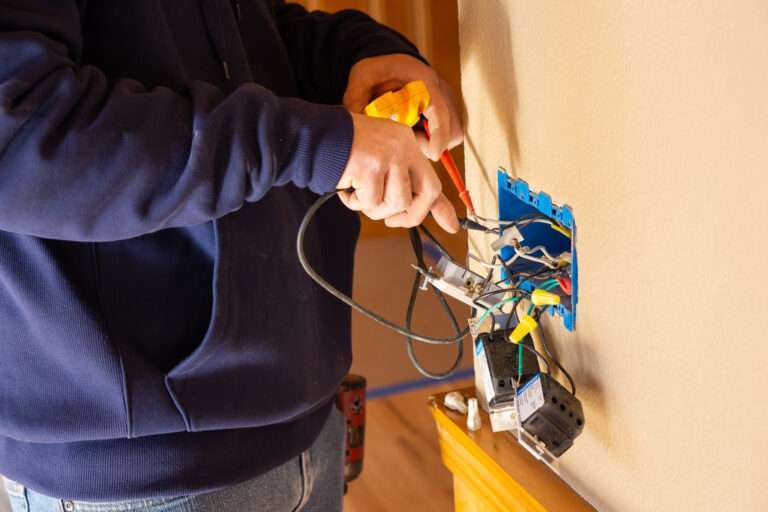
A failed connection with no trip at all. This is the one that fools people. The breaker is on, the GFCI is fine, and the room is still dark. That usually means a broken splice in a junction box, a failed backstab connection in an outlet, a burned-out neutral, or a loose wire at a device. Power stops at the failure point. Everything downstream goes dead.
A worn or failed breaker. Most standard residential breakers are thermal-magnetic: a heat-sensitive strip handles sustained overload and a magnetic coil handles short circuits. Either can degrade. But a breaker that trips with nothing plugged in is far more often reporting a wiring fault than failing on its own.
| What you see | Likely cause | Safe for you to do | Needs an electrician |
|---|---|---|---|
| Breaker handle out of line, resets and holds | Temporary overload | Unplug heavy loads, reset once | Only if it repeats |
| Breaker trips again right away | Short circuit or ground fault | Leave it off | Yes |
| GFCI will not hold its reset | Real leakage fault or failed device | Stop using the circuit | Yes |
| Breaker on, room still dead | Open connection in a box or device | Nothing | Yes |
| Burning smell, scorch marks, buzzing, crackling | Overheating connection or arcing | Turn off that breaker, stop using the circuit | Yes, promptly |
| Half the room dead, other half fine | Two circuits in one room, one has opened | Repeat the breaker and GFCI check | If no trip is found |
What is safe to check yourself, and what is not
Safe, with the panel cover left alone:
- Confirm it is really one room. Walk the house and note exactly which outlets, lights, and switches are dead. That map is the single most useful thing you can hand an electrician.
- Open the panel door and read the breaker positions and the directory. Looking is fine. Removing the cover is not.
- Reset a breaker once, or a GFCI once.
- Unplug everything in the dead room before you reset, then add devices back one at a time. If the circuit holds until a specific device goes in, that device is your fault.
- Test nearby GFCI outlets with their own TEST and RESET buttons.
- Use smell, sight, and sound to judge a problem. A burning or hot-plastic smell, brown or blackened discoloration, scorch marks, buzzing, or crackling all mean stop.
Not safe without a licensed electrician, and, where the work goes beyond inspection, permitted and inspected:
- Removing the panel cover. Behind that cover, bus bars and breaker terminals are live even with individual breakers off.
- Anything on the service entrance, the conductors bringing power from the utility into the house. Turning the main breaker OFF kills the branch circuits, but the service conductors and the main breaker’s line-side lugs stay energized. A homeowner cannot de-energize them. The utility can, usually by pulling the meter, and so can a separate service disconnect if one is fitted ahead of the panel.
- Opening outlets, switches, or junction boxes to look for the loose connection.
- Fitting a larger breaker to stop the tripping. The breaker protects the wire, not the appliance. A 20 amp breaker on 14 gauge wire lets the conductor overheat before anything interrupts it. The fix for a genuinely overloaded circuit is an added circuit, not a bigger breaker.
- Touching a breaker, outlet, or device to judge whether it is hot. A breaker running mildly warm under sustained load is normal, and heat is not a test worth taking a risk for. Judge by smell, discoloration, and sound.
One room still dead after the breakers check out?
A licensed electrician traces the circuit back from the dead outlet to the break, which is usually a loose connection somewhere you cannot see.
Licensed master electrician. 12-month workmanship warranty.
When it points to a bigger problem
One dead room is sometimes a five-minute fix. These signs say it is not. Where a single socket rather than the whole room has died, why an outlet stops working narrows it faster, and a breaker that will not stay on is covered in why a breaker keeps popping.
- The same circuit trips repeatedly over weeks, with different loads plugged in. That pattern points at the wiring, not the appliances.
- A GFCI that will not hold. A GFCI that keeps tripping is not “working correctly.” It is reporting real leakage, or it has failed. Either way it needs eyes on it.
- Burning smell, scorch marks, discoloration, buzzing, or crackling anywhere on the circuit or at the panel. Leave the breaker off and have it looked at promptly. Overheating connections do not improve on their own.
- Lights that dim or flicker in other rooms when something on the dead circuit runs. That can indicate a loose neutral, which is a condition that can damage equipment on more than one circuit.
- Cloth-insulated or knob and tube wiring in an older Milwaukee or Waukesha County home. Those systems have no equipment grounding conductor and the insulation gets brittle. A single failed room is often the first visible symptom.
- Aluminum branch wiring from the 1960s and 1970s, where connections at devices loosen over time.
- Repeated outages during storms or on a generator. If a circuit misbehaves only when the house is running on backup, the transfer equipment or circuit assignment deserves a look. Homeowners who lose power often enough to care usually end up asking about standby generator installation as a separate project.
Existing wiring installed under an earlier code edition does not have to be brought up to the current one just because it is old. Wisconsin SPS 316 adopts the 2023 NEC, in effect since September 1, 2026, and it governs new and altered work. Your local municipality, whether Milwaukee, Wauwatosa, Waukesha, or another community in the county, issues the permit and enforces it. Once a circuit is being altered or extended, the current edition applies to that work.
What an electrician does about it
Diagnosis, not guessing. A licensed electrician arriving for a dead room works backward from the symptom:

- Verifies which outlets and fixtures are on the circuit and where power stops.
- Tests voltage and continuity at the panel and at each device along the run to isolate the open point or the fault.
- Opens devices and junction boxes under safe de-energized conditions to find burned splices, failed backstab terminals, loose neutrals, or damaged cable.
- Checks the breaker itself, including whether an AFCI or GFCI breaker has failed or is responding to a genuine fault.
- Repairs or replaces the failed section, device, or breaker, and retests the whole circuit.
- Where the real issue is capacity rather than damage, calculates the load and recommends a dedicated circuit for the equipment that keeps opening the breaker.
Most single-circuit faults are found and repaired in one visit. Where the cause turns out to be deteriorated wiring across several circuits, the repair is scoped as its own project with a permit.
Work by Lehmann Electrical & Design carries a 12-month workmanship warranty.
Why homeowners call Lehmann Electrical & Design
- Led by licensed master electrician Jacob Lehmann
- A+ rating with the BBB and 4.9 stars on Google
- 12-month workmanship warranty on the work we do
- Permits pulled and inspections scheduled as part of the job
- Milwaukee, Wauwatosa and Waukesha County, from 12012 W Fairview Ave, Wauwatosa
Want it found and fixed properly?
Tell us which room, what still works, and whether a breaker or GFCI has tripped.
Licensed master electrician. 12-month workmanship warranty.
Frequently asked questions
▾What counts as an electrical emergency?
An electrical emergency is a condition that can start a fire or shock someone if it is left alone: a burning or hot-plastic smell, smoke, scorch marks or discoloration at a panel or outlet, buzzing or crackling from a panel or device, exposed or damaged conductors, water contacting electrical equipment, or a breaker that will not stay off. A single dead room with none of those signs is urgent-ish, not an emergency.
▾When should I call an emergency electrician instead of waiting?
Call right away if you smell burning, see scorch marks or discoloration, hear buzzing or crackling, see smoke or sparks, or have water near energized equipment. Also call right away if a breaker trips again immediately after one reset and you cannot identify the load causing it. A dead room with no smell, no sound, and no visible damage can usually wait for a scheduled appointment.
▾What does an emergency electrician actually do?
The same diagnostic work as a scheduled visit, on a faster response: isolate the fault, make the circuit safe, and either repair it on the spot or de-energize it until a full repair is possible. The immediate priority is removing the hazard. That sometimes means leaving one circuit off overnight rather than restoring power to wiring that is not safe to energize.
▾How much does an emergency electrician cost, and how long does it take?
Cost depends on the fault, the time of day, and how much of the circuit has to be opened to find it, so no honest figure can be quoted before someone has seen the symptom. Call 414-207-0109 and describe what is dead and what you can smell or hear, and you will get a straight answer on scope. Most single-circuit diagnosis and repair is completed in one visit.
▾How long will the repair last?
A properly repaired splice, replaced device, or replaced breaker is a permanent fix, not a patch. What does not last is a repair made to wiring that has failed from age across the house. In that case the same circuit, or the one next to it, tends to fail again. That is why diagnosis matters more than speed.
▾Does a generator help with this?
Not with this problem. A backup generator covers utility outages, not a fault inside your own branch circuit, and a dead room while the rest of the house is lit is the second kind. If repeated utility outages are the larger frustration, backup power options are worth reviewing as a separate conversation.
One room dark and the breaker will not hold? Lehmann Electrical & Design, led by master electrician Jacob Lehmann, troubleshoots and repairs branch circuit faults across Milwaukee and Waukesha County, with an A+ rating from the BBB and 4.9 stars on Google. Call 414-207-0109 or request an estimate and tell us what is dead and what you are hearing or smelling.
Next step
Get the circuit traced
Tell us which room and what still works.
Licensed master electrician12-month warranty4.9 on Google
Milwaukee, Wauwatosa and Waukesha County. Prefer to talk? Call 414-207-0109