Licensed master electrician · Call 414-207-0109
A dead outlet usually comes down to one of five things: a tripped GFCI outlet somewhere else in the house, a tripped breaker, a loose or failed connection inside the outlet box, a worn-out receptacle, or a wall switch that controls the outlet. Many of these are cheap and fast to fix. A few of them, especially a loose connection quietly heating up behind the wall, are the early stage of a fire hazard and need a licensed electrician.
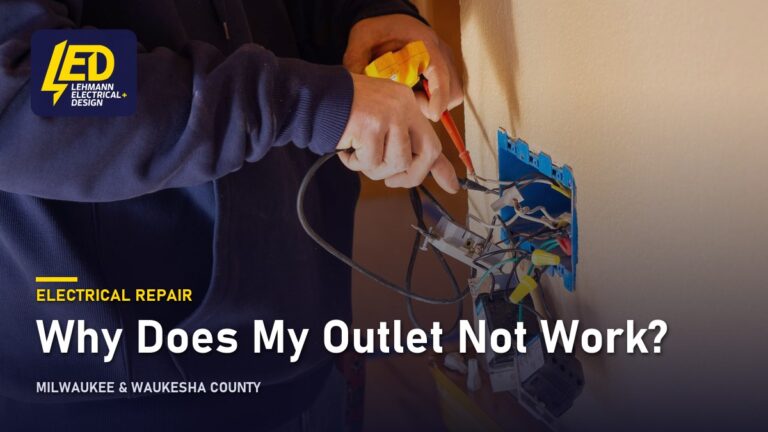
One outlet that quit working is usually a local problem: the receptacle itself, the wire connection behind it, or a GFCI that shut off the circuit downstream. Several outlets that quit at once points upstream, to a breaker, a GFCI, or a single bad connection in the first box on that circuit.
Before anything else, use your nose and your ears. If you notice a burning or hot-plastic smell, brown or black scorch marks, discoloration around the slots, buzzing, or crackling, stop using that outlet and anything plugged into it, switch the breaker for that circuit off, and call an electrician. Do not put your hand on the outlet or the panel to check how warm it is. Smell, sight, and sound tell you what you need to know without touching anything.
If there are no warning signs, the troubleshooting below is reasonable for a homeowner, as long as it stays on the room side of the wall.
What is usually causing it
Here are the causes worth ruling out, starting with the ones that are easiest to confirm.
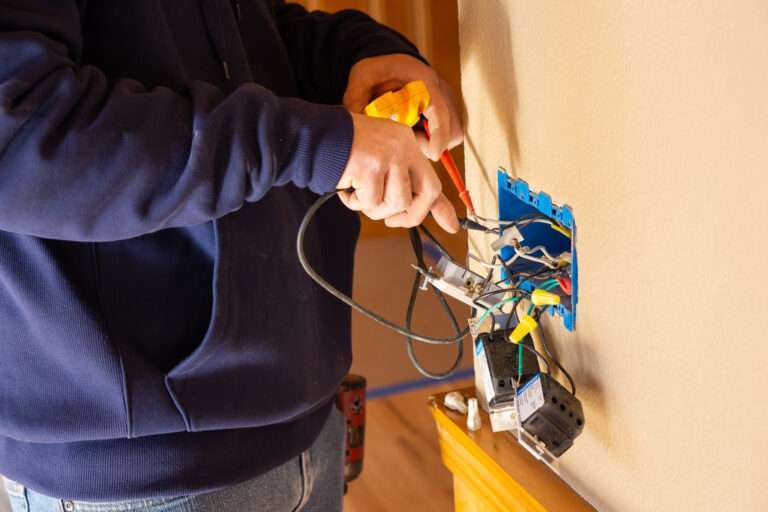
A GFCI has tripped somewhere else. GFCI stands for ground-fault circuit interrupter. It is the outlet with the TEST and RESET buttons. Under Wisconsin SPS 316, which adopts the 2023 NEC (in effect since September 1, 2026), GFCI protection is called for at receptacles in bathrooms, kitchens, garages, unfinished basements, crawl spaces, laundry areas, and outdoors, per NEC 210.8(A). That applies to new and remodeled work. It does not force every existing outlet in an older house to be upgraded unless the circuit is altered.
A GFCI trips when it detects 4 to 6 milliamps of current leaking out of the circuit by any path, including through a person or through damp material. No metal contact is needed. One GFCI often protects several ordinary outlets wired after it, so a dead bedroom or garage outlet can trace back to a tripped GFCI in a bathroom or on an exterior wall. Check every GFCI in the house, not just the one in the room with the problem.
Wisconsin gives these devices a hard time. Receptacles in unheated garages and on open porches go through repeated freeze and thaw cycles, and the moisture that condenses inside a box or a weatherproof cover is enough leakage to trip a GFCI without anything being broken. Outdoor and garage outlets are often the first to go dead in spring and fall for that reason.
A breaker has tripped. A tripped breaker is often not obviously out of line with its neighbors, so look closely. Reset a tripped breaker once at most: push it firmly to OFF, then to ON. If it trips again, leave it off and have the circuit inspected. Never fit a larger breaker to stop the tripping. The breaker protects the wire, and a bigger one just lets the wire get hotter than it was designed for. The fix for a genuinely overloaded circuit is a new circuit.
A loose connection in the box. This is the cause that matters most. Many outlets are wired with “backstab” push-in terminals rather than screw terminals, and those connections can loosen with heat cycling over the years. A loose connection arcs, heats the plastic, and eventually stops passing current. If the failed connection is in the line-to-load path through the device, everything wired after that outlet goes dead too. If the box is pigtailed, meaning the circuit continues through wire nuts and the device is a tap off them, a loose device screw kills only that one receptacle. Aluminum branch wiring, used in some homes wired roughly between 1965 and 1973, is a known trouble spot for loosening connections at device terminals.
A worn-out receptacle. The internal contacts are springs. After decades of plugs going in and out, they stop gripping. A plug that falls out of its own weight, or works only when you hold it at an angle, is a receptacle at the end of its life.
A switched outlet. Half-hot outlets turn up in older living rooms and bedrooms: one half of the receptacle is controlled by a wall switch for a floor lamp. Flip every switch in the room before assuming anything is broken.
An open (broken) neutral. This is the answer to a question we get in almost those words: why does my outlet not work but has power? Every 120-volt circuit needs a complete path out and back. If a tester or a non-contact pen shows voltage but nothing runs, the hot side is live and the return path through the neutral is broken, often at a loose connection upstream. That is not a nuisance, it is a fault, and it needs diagnosis rather than a new outlet.
What is safe to check yourself, and what is not
Safe for a homeowner, with the cover plate left on:
| Check | Safe to do yourself? | Why |
|---|---|---|
| Try a different lamp or device in the outlet | Yes | Rules out a failed appliance or cord |
| Press RESET on every GFCI in the house, once each | Yes | Designed to be reset by the occupant. If it will not hold on the first try, stop |
| Flip every wall switch in the room | Yes | Finds a switched half-hot outlet |
| Look at the breaker panel for a tripped breaker, reset once | Yes | Resetting once is normal use |
| Unplug a few things on that circuit, then reset | Yes | Confirms a simple overload |
| Remove the cover plate and pull the outlet out of the box | No | Live conductors, no safe way for an occupant to confirm the circuit is dead |
| Tighten or replace terminal screws | No | Requires de-energizing and verifying first. Your municipality decides whether a like-for-like device swap needs a permit; most do not, but the diagnosis still has to come first |
| Open the panel cover | No | See below |
| Anything on the meter, service conductors, or line side of the main breaker | No | Cannot be de-energized by the homeowner |
That last row deserves plain language. Turning the main breaker off does not make the panel safe to work in. The service conductors coming into the house and the line-side lugs on the main breaker stay energized with the main off. A homeowner cannot de-energize them. Only the utility can, usually by pulling the meter, or a separate service disconnect if one is fitted ahead of the panel. That is the reason panel work is licensed work: the hazard does not go away when you flip the switch.
Two more limits on the homeowner side. A GFCI resets once, the same as a breaker. If it will not hold, there is a real leakage fault or the device itself has failed, and continuing to press RESET is not troubleshooting.
And a word on search results that are not about your house. If you landed here after looking up how to repair an electrical outlet in House Flipper, or what an electrical repair kit fixes in DayZ, those are game mechanics with no bearing on real wiring. In a game you hold a part and a progress bar fills. In a house, the same job means identifying the circuit, de-energizing it, verifying with a tester that it is actually dead, and remaking connections to the standard the inspector will hold you to. There is no single part you buy that fixes an outlet.
Outlet still dead after the resets?
A licensed electrician traces the circuit back to the break, checks every termination along it and tests the outlet under load.
Licensed master electrician. 12-month workmanship warranty.
When it points to a bigger problem
A single dead outlet with no other symptoms is usually a small repair. The picture changes when any of these show up:
- Outlets go dead and come back on their own. Intermittent operation is a loose connection making and breaking contact, which means arcing.
- Several outlets across different rooms are dead at once, with no breaker tripped.
- Lights dim or brighten when a large appliance starts.
- A GFCI or breaker trips again as soon as it is reset, or trips with nothing plugged in. Most residential breakers are thermal-magnetic, with a heat-sensitive strip for sustained overload and a magnetic coil for short circuits. A breaker that trips with nothing on the circuit is far more likely a wiring fault, a short or a ground fault, than a worn breaker.
- Warm cover plates, discoloration, a smell of hot plastic, buzzing, or crackling.
- Two-slot outlets with no ground, or fabric-insulated wiring visible in the basement. Knob and tube and early cloth-insulated wiring can have insulation that has gone brittle and splices that were never made inside a box, so disturbing one connection can expose others.
- The house has a Federal Pacific Electric (FPE) Stab-Lok or Zinsco panel. Both have a documented history of breakers that fail to trip on an overload or a fault, which defeats the protection the panel is supposed to provide. An original fuse panel is also worth an evaluation.
Any of those is a reason to have the circuit traced rather than to keep swapping devices. A dead outlet is sometimes the only visible symptom of a connection that has been overheating inside a wall for months. Ongoing electrical repair and troubleshooting work on older Milwaukee and Waukesha County homes is largely about finding that one bad joint before it becomes something worse.
What an electrician does about it
Diagnosis first, parts second. An electrician starts by confirming what the outlet is actually doing: measuring voltage hot to neutral and hot to ground, checking for an open neutral or an open ground, and identifying which breaker and which circuit the outlet belongs to. From there the circuit gets traced to find the first point where it fails, which is often not the outlet you noticed. Then the circuit is de-energized and verified dead before anything is opened.
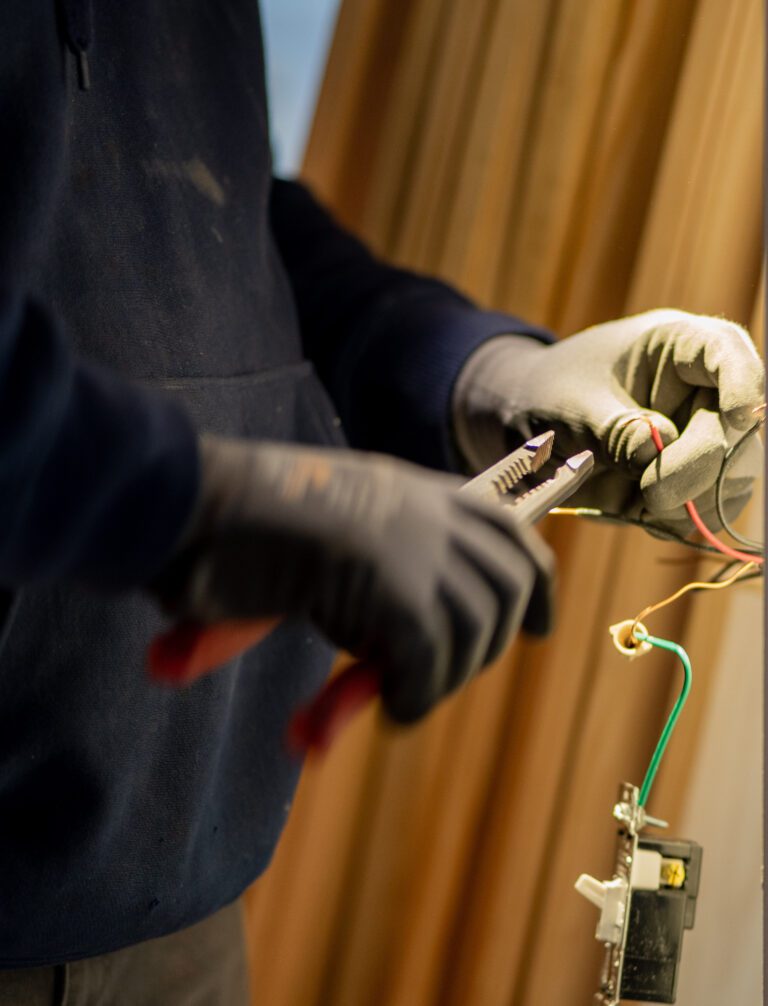
The repair itself depends on what the testing found: a new receptacle, remade connections on screw terminals instead of push-in terminals, a replacement GFCI, a repaired junction, or, where a conductor is damaged beyond repair inside a wall or ceiling, a new run of cable back to the panel for that circuit. That last one is a repair to damaged wiring, which is a different job from adding capacity for new loads.
Timing is the question we get most often in three different wordings, so here they are separately:
| What you are asking about | Typical visit |
|---|---|
| How long does it take to fix electricity at one dead outlet | One visit, often an hour or two, including diagnosis and a new device |
| How long do electrical repairs take when the fault is intermittent or spans rooms | Longer. Tracing comes first, and the repair may be scheduled after it |
| How long does electrical maintenance take | A planned inspection of panel, connections, and devices is scheduled work, not an emergency call, and it is booked as its own visit |
Permits, where a job needs one, are issued by your municipality, which enforces Wisconsin SPS 316, the rule that adopts the 2023 NEC (in effect since September 1, 2026). Work permitted before that date was done under the 2017 NEC, and existing installations do not have to be brought up to the new edition unless they are altered.
If what you actually want is a new outlet rather than a repair, for example on the back of the house for holiday lights or a grill, that is a separate job. Exterior work needs a weather-resistant, tamper-resistant receptacle in a weatherproof cover, with GFCI protection. Expect to be asked three things when you call: roughly how far the spot is from the panel, what the exterior surface is (vinyl, aluminum, wood, brick, or stucco, since masonry changes the method), and whether there is open access on the inside, such as an unfinished basement or garage wall. Those three answers decide most of the labor, and adding an exterior receptacle is often done on the same visit as a repair.
One note on scope. A failing table fan or a dead appliance is not an electrical repair, it is a device problem, and the outlet is innocent. Testing a known-good lamp in the same outlet separates the two in about ten seconds. On the economics: for a plug-in box fan, a bathroom exhaust fan, or a cheap pedestal fan, replacement is normally the sensible call, because the motor, switch, and bearings are the wear items and a service call will often cost more than the unit. Repair earns its keep on fans that are wired in and worth keeping, such as a ceiling fan with a bad capacitor, a failed pull chain, a loose fixture box, or a wall control that has quit, and that last category is wiring work.
Why homeowners call Lehmann Electrical & Design
- Led by licensed master electrician Jacob Lehmann
- A+ rating with the BBB and 4.9 stars on Google
- 12-month workmanship warranty on the work we do
- Permits pulled and inspections scheduled as part of the job
- Milwaukee, Wauwatosa and Waukesha County, from 12012 W Fairview Ave, Wauwatosa
Ready to have it traced?
Tell us which room, what else went out at the same time and whether any GFCI has tripped.
Licensed master electrician. 12-month workmanship warranty.
Frequently asked questions
▾Why do my outlets not work in a whole room?
A whole room going dead points to one cause upstream rather than several failures. The usual suspects are a tripped breaker, a tripped GFCI that protects the room’s outlets from another location, or a failed connection in the first box on that circuit. When everything after one point is dead and everything before it works, the fault is at that transition, which is how an electrician narrows it down quickly.
▾Why does my outlet not work anymore when it worked for years?
Gradual wear explains a lot of these. Receptacle contacts are springs that lose tension, and push-in backstab terminals can loosen through decades of heating and cooling as loads cycle. The outlet did not break suddenly, it degraded until the connection no longer carried current reliably. That is also why replacing the device alone is not always enough: the connection behind it needs to be remade properly.
▾How much electrical service do I have, and how much do I need?
The rating is printed on your main breaker handle, commonly 100, 150, or 200 amps, though the service conductors and meter also cap real capacity, and some pre-1960 Milwaukee homes still have 60-amp fuse panels. How much you need comes from a load calculation, an electrician’s tally of your actual heating, cooling, cooking, and appliance demand. A dead outlet is a branch-circuit problem, not a service problem.
▾Do I need an electrician for one dead outlet?
Not always. Try a known-good lamp, reset every GFCI once, check wall switches, and look for a tripped breaker. If those do not solve it, or if a breaker or GFCI will not hold, stop there. Outlet repair requires de-energizing and verifying the circuit first. Homeowners across the West Allis service area and the rest of the region call for exactly this.
If an outlet in your home has gone dead and the simple checks did not bring it back, Lehmann Electrical & Design, led by master electrician Jacob Lehmann, handles outlet repair and troubleshooting across Milwaukee and Waukesha County. The company holds an A+ rating with the BBB, 4.9 stars on Google, and backs its work with a 12-month workmanship warranty. Call 414-207-0109 or request an estimate for outlet repair and tell us which room is affected.
Next step
Get the circuit traced
Tell us which room it is and what else stopped working at the same time.
Licensed master electrician12-month warranty4.9 on Google
Milwaukee, Wauwatosa and Waukesha County. Prefer to talk? Call 414-207-0109