Licensed master electrician · Call 414-207-0109
A small blue flash at the instant a plug slides into an outlet is usually normal. When a plug contacts the outlet’s internal blades, a tiny amount of current jumps the last fraction of a millimeter, and that arc shows as a quick spark. What is not normal is a spark that repeats, a large or yellow flash, a popping sound, a burning smell, scorch marks, or an outlet that feels loose. Those point to a wiring or device fault and need a licensed electrician.
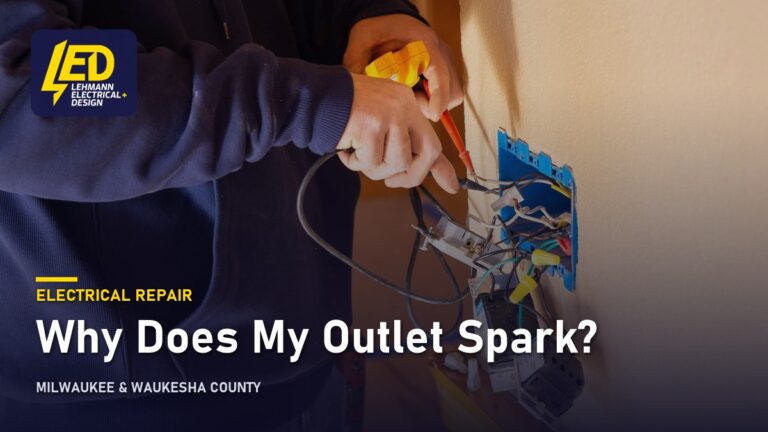
One brief, quiet spark as a plug goes in, with no smell and no mark left behind, is ordinary arcing caused by the sudden connection of a load to a live circuit. It happens more often with devices that draw a surge of current when they first energize, such as a vacuum, a space heater, or a power supply with a capacitor in it.
The spark becomes a warning sign when any of the following is true:
- It sparks every single time, or sparks with nothing more than a phone charger
- The flash is large, yellow or orange, or throws visible sparks out of the slots
- You hear a pop, a buzz, or a crackle from the wall
- There is a smell of burning plastic or an acrid, fishy odor
- The outlet face is discolored, browned, or scorched
- The plug falls out on its own or sits loose in the slots
- The outlet or plug is warm
If you notice a burning or hot-plastic smell, scorch marks, discoloration, buzzing, or crackling, stop using that outlet and anything plugged into it, switch the breaker for that circuit off, leave it off, and call an electrician. Do not put a hand on the outlet to see how hot it is. Smell, sight, and sound tell you what you need to know without touching anything.
What is usually causing it
The cause falls into one of a few categories, and they are not equally serious.
Normal make-and-break arcing. The blades of the plug meet the contacts inside the outlet while the circuit is live. A momentary arc is physics, not a defect. A laptop or phone charger with a switching power supply draws a brief inrush of current to charge its internal capacitor, which is why a spark when you plug in a charger is common and usually harmless.
Worn contacts. Inside a receptacle are metal clips that grip the plug’s blades. After years of plugging and unplugging, those clips lose tension. A loose grip means a small gap, a small gap means repeated arcing, and repeated arcing burns the metal and pits it. That is the difference between an outlet that sparks once when new and an outlet that sparks every time it is used. Worn receptacles are a wear item, and replacement is straightforward for an electrician.
Loose terminations. The wires landing on the back or side of the receptacle can work loose over time, particularly where a push-in “backstab” connection was used instead of the screw terminal. A loose connection heats up under load, and heat accelerates the loosening. This is the version of the problem most likely to leave brown discoloration on the outlet face.
Moisture and contamination. Dust, lint, or dampness across the slots gives current an unintended path. Outdoor receptacles and garage receptacles are the usual suspects. A weather-resistant receptacle in a proper in-use cover is what belongs outside.
A damaged plug or cord. Bent blades, a cracked plug body, or a frayed cord can arc at the outlet even when the outlet itself is fine. Try the same outlet with a different, known-good device before you condemn the wall.
An overloaded or shared circuit. A circuit carrying close to its limit runs hot, and hot connections degrade faster. Breakers are sized so that a continuous load sits at no more than 80% of the breaker rating. A space heater on a circuit already running a window unit is the classic setup for hot outlets and repeat arcing. The fix for an overloaded circuit is a new circuit, never a larger breaker. The breaker exists to protect the wire behind the wall.
| What you observe | Likely cause | How urgent |
|---|---|---|
| One faint blue flash on insertion, no smell | Normal arcing | Not a concern |
| Sparks every time, plug feels loose | Worn receptacle contacts | Replace soon |
| Brown or black discoloration on the face | Loose termination heating up | Stop using it, call now |
| Buzzing or crackling from the wall | Arcing at a connection | Stop using it, call now |
| Burning plastic or fishy smell | Overheated conductor or device | Breaker off, call now |
| Outlet sparks and the breaker trips | Short circuit or ground fault | Leave the breaker off, call now |
| Outdoor outlet sparks after rain | Moisture intrusion, wrong cover | Stop using it, call |
What is safe to check yourself, and what is not
Safe to do: unplug the device and look at its plug and cord for bent blades, cracks, melted spots, or exposed conductor. Look at the outlet face for discoloration or scorching. Try the suspect device in a different outlet and try a different device in the suspect outlet, which tells you whether the problem travels with the device or stays with the wall. Note whether the outlet is on a circuit that also feeds something heavy. Check whether the receptacle is a GFCI, meaning a ground-fault circuit interrupter, the type with TEST and RESET buttons that cuts power when it senses current leaking off the circuit by any path, including through a person, at only 4 to 6 milliamps. Switching off the breaker that feeds a suspect outlet is also safe, and it is the right move when something looks or smells wrong.
Reset a tripped breaker once at most: push it firmly to OFF, then to ON. If it trips again, leave it off and have the circuit inspected. A GFCI gets one reset too. If it will not hold, there is a genuine leakage fault or the device itself has failed. A GFCI that keeps tripping is not “being overly sensitive.”
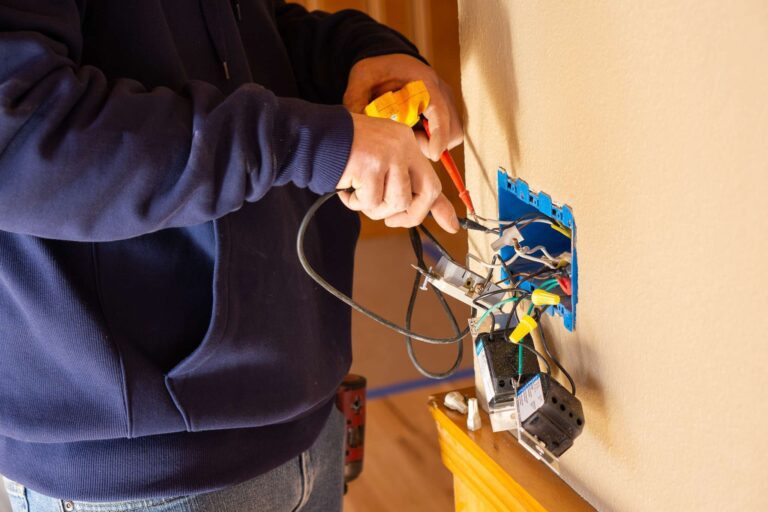
Not safe, and not a homeowner job: removing the cover plate and pulling the receptacle out to inspect or retighten the wires, replacing a receptacle, splicing or re-terminating conductors, opening a junction box, or removing a panel cover. Behind a panel cover, turning the main breaker off does not make everything dead. The service conductors coming into the house and the line-side lugs of the main breaker stay energized. A homeowner cannot de-energize those. Only the utility can, usually by pulling the meter, or a separate service disconnect ahead of the panel if the house has one. That is one reason receptacle and circuit work is left to a licensed electrician and is permitted by the local municipality.
Contact repair of this kind is routine electrical troubleshooting and repair work, and it is far cheaper to correct a hot connection than to repair the damage a hot connection eventually causes.
Still sparking after those checks?
A licensed electrician tests the receptacle and the circuit behind it, and checks every termination for the heat arcing leaves.
Licensed master electrician. 12-month workmanship warranty.
When it points to a bigger problem
A sparking outlet is sometimes just a tired receptacle. Sometimes it is the only visible symptom of something structural in the wiring. Take it seriously when you see these patterns:
- More than one outlet on the same circuit is discolored or warm. That suggests the problem is in the branch circuit wiring, not in one device.
- Two-slot outlets with no ground. Older Milwaukee and Waukesha County homes often have ungrounded branch circuits, sometimes with cloth-insulated or knob-and-tube wiring. Insulation on conductors that old becomes brittle, and receptacles fed by it are a recurring source of arcing.
- Aluminum branch-circuit wiring. Homes wired in the mid-to-late 1960s and 1970s sometimes have solid aluminum branch circuits. Aluminum expands and contracts more than copper, which loosens terminations. Connections on this wiring need listed connectors and devices rated for it.
- Repeated tripping with nothing plugged in. Most residential breakers are thermal-magnetic: a heat-sensitive strip handles sustained overload, and a magnetic coil handles short circuits. A breaker tripping with no load attached usually means a wiring fault somewhere in the circuit rather than a worn-out breaker.
- An outlet that sparks and then the room goes dead. That is an arc that became a short. Leave the breaker off.
- Handyman additions. Outlets added by a previous owner without a permit are a frequent source of loose backstab connections and overfilled boxes.
> A spark you can barely see, that happens once, leaves no mark, and makes no sound, is the circuit doing what electricity does when metal meets metal under voltage. A spark that repeats, smells, sounds, or leaves a mark is energy being released as heat inside a wall cavity where nobody can see it. The first needs nothing. The second is how electrical fires start, and it is worth a service call before it gets there.
What an electrician does about it
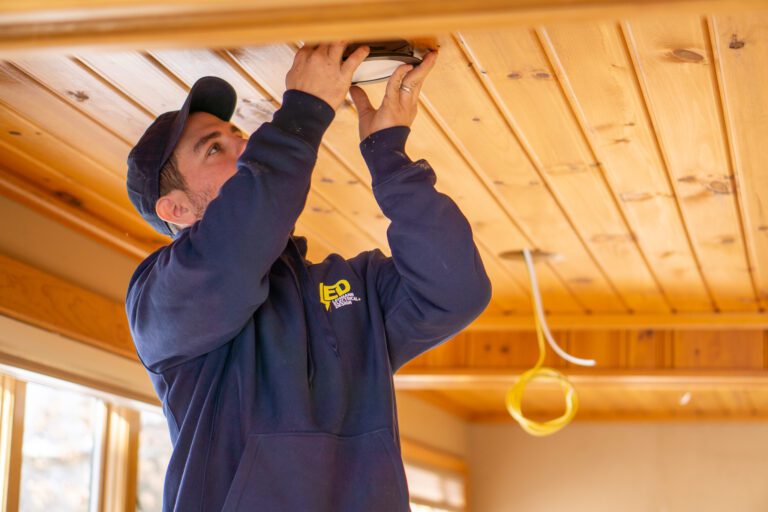
An electrician starts by isolating the circuit and confirming which breaker feeds the outlet, then de-energizes it and inspects the device and the box. The work typically includes checking the conductors for heat damage and correct gauge for the breaker size, confirming terminations are on screw terminals and torqued properly, verifying polarity and grounding, testing for voltage drop under load, and checking whether the circuit is carrying more than it should. If the receptacle is pitted or burned, it gets replaced with a new device, and the box and conductor ends get inspected for scorching.
Where the damage extends past the receptacle, repair moves to the wiring: replacing a damaged section of cable, correcting a bad splice, or running a new dedicated circuit if the existing one is simply carrying too much. In a kitchen, bathroom, garage, basement, laundry, or outdoors, the replacement device will be GFCI-protected. In living areas on 120-volt branch circuits, AFCI protection applies, meaning an arc-fault circuit interrupter, a device that watches the current waveform for the signature of arcing and opens the circuit. Which protection applies where is governed by Wisconsin SPS 316, which adopts the 2023 NEC (in effect since September 1, 2026), enforced through permits issued by your local municipality. Existing installations are not required to be brought up to the newer edition unless they are altered.
Plenty of these calls end with a second request while the electrician is on site, and adding an exterior receptacle on the back of the house is a common one. That is normal outlet installation work, and an exterior location needs a weather-resistant receptacle, a listed in-use cover, and GFCI protection.
Lehmann Electrical & Design is led by master electrician Jacob Lehmann and holds an A+ rating with the BBB and 4.9 stars on Google. Whether you are in Milwaukee or anywhere across Waukesha County, a licensed electrician for repair work can diagnose a sparking outlet without guesswork. Workmanship is backed by a 12-month warranty.
If an outlet in your home is sparking, smells hot, or shows any discoloration, request an estimate or call 414-207-0109. Tell us which outlet, what you had plugged in, and whether the breaker has tripped, and we will know what to bring.
Why homeowners call Lehmann Electrical & Design
- Led by licensed master electrician Jacob Lehmann
- A+ rating with the BBB and 4.9 stars on Google
- 12-month workmanship warranty on the work we do
- Permits pulled and inspections scheduled as part of the job
- Milwaukee, Wauwatosa and Waukesha County, from 12012 W Fairview Ave, Wauwatosa
Ready to have it looked at?
Tell us which outlet, what you were plugging in and whether you saw a flash or heard a snap.
Licensed master electrician. 12-month workmanship warranty.
Frequently asked questions
▾Why does my outlet spark when I plug in my phone or laptop charger?
Chargers use switching power supplies with a capacitor that draws a brief inrush of current the instant it connects. That inrush can produce a small blue flash as the blades meet the contacts. If the flash is faint, silent, and leaves no mark, it is normal. If it is large, loud, repeats every time, or the outlet is warm or discolored, the receptacle contacts are likely worn or a connection is loose.
▾Why does my outlet spark sometimes but not always?
Intermittent sparking usually means the spark depends on how the plug seats. Worn contact clips grip inconsistently, so sometimes the blades land cleanly and sometimes they arc across a gap. A slightly bent plug blade does the same thing. Intermittent is not harmless, because each arc removes a little metal and makes the next one worse. Have the receptacle replaced before it starts leaving marks.
▾How much does it cost to fix a sparking outlet, and how long do outlets last?
We do not publish prices online, because the work ranges from replacing one receptacle to tracing and repairing a damaged branch circuit. Call and describe what you are seeing and we will quote it properly. A standard residential receptacle typically lasts decades, but heavily used ones, especially where large plugs are pulled in and out often, wear out sooner. There is no fixed service life.
▾Is a spark plug the same as an electrical outlet?
No. A spark plug is an automotive ignition component in a gasoline engine, and replacement is an auto repair job. Searches for spark plug cost and spark plug life sometimes land on outlet pages because both involve sparks. If you are dealing with a wall outlet that sparks, smells hot, or shows scorching, that is an electrical issue and the right call is to an electrician, not a mechanic.
▾Should I just put a larger breaker in if the outlet sparks and trips?
No. The breaker is sized to protect the wire behind the wall, not the device plugged in. A larger breaker lets the conductor carry more current than its insulation can tolerate, which turns a nuisance trip into a fire risk. If a circuit is genuinely overloaded, the correct fix is a new dedicated circuit sized for the load. Reset a tripped breaker once at most, then leave it off.
Next step
Get the sparking checked
Tell us which outlet it is and what you were plugging in.
Licensed master electrician12-month warranty4.9 on Google
Milwaukee, Wauwatosa and Waukesha County. Prefer to talk? Call 414-207-0109