Licensed master electrician · Call 414-207-0109
Look at the indicator. Almost every surge protector made in the last two decades, whether it sits at your panel or under your desk, has a light that tells you whether it is still protecting anything. The catch is that a dead protector keeps passing power normally, so nothing about the outlet or the lights will tell you it has stopped doing its job.
A surge protector is a consumable. It works by absorbing energy, and absorbing energy uses it up.
That happens two ways. A single large event, a nearby lightning strike or a utility fault, can finish one instantly. More often it is gradual: the small surges that come from motors starting and stopping inside your own house, and from switching out on the network, each take a little of the protector’s capacity until there is none left.
When it is spent, the protection ends but the power does not. Devices plugged into it still run. The lights on that circuit still work. This is the part people find surprising, and it is why the indicator exists.
So the answer is: check the light. On a whole-house unit at the panel it is usually a small green LED, sometimes with an audible alarm. On a plug-in strip it is normally marked “protected” and sits next to the power light, which is a different light entirely and is not the one to read.
What is usually causing it
If the indicator has changed, something used up the protector. The useful question is what.
| What you see | What it means | What to do |
|---|---|---|
| Green or “protected” lit | Still working | Nothing |
| Indicator off, power still on | Protection spent, device still passing power | Replace |
| Red, amber, or an audible alarm | End of life, varies by maker | Read the legend, then replace |
| Scorching, discolouration or a smell | A serious event, or a failure | Stop using the circuit, call an electrician |
| No indicator at all | Older or basic unit, condition unknown | Treat as unknown and have it assessed |
After a storm or a known event
If you had a strike nearby, a utility outage with a hard return, or several devices in the house died at once, check the indicator afterwards rather than assuming. That is exactly the kind of event a protector is bought for, and exactly the kind that ends one.
The quiet kind of wear
Most protectors do not die dramatically. Compressor motors, well pumps, furnace blowers and air conditioning all put small spikes onto your wiring every time they start, and a protector takes a little damage from each. A house with a lot of motor load consumes protectors faster than a quiet one, with nothing visible happening along the way.
Grounding decides whether it works at all
This is the part that gets missed. A surge protector works by diverting excess energy to ground. If the grounding and bonding at the service are poor, corroded, or were never right, the path the protector needs is compromised. It can still clamp between the line and neutral, but the diversion to ground that handles the largest events is the part that suffers, and the device will show a healthy green light either way.
That is why a competent installation checks the grounding first rather than simply fitting the device.
What is safe to check yourself, and what is not
Safe, and worth doing twice a year: reading the indicator on the panel-mounted unit, reading the “protected” light on plug-in strips, noting the age of anything plugged in, and checking again after any significant electrical event. Reading the label on the unit to find out what its indicator colours mean is also a homeowner task, and the legends differ between manufacturers.
Not a homeowner job: anything involving the panel. A whole-house protector is wired into the service equipment, and even with the main breaker off the service conductors and the main breaker’s line-side lugs stay live until the utility disconnects them. Fitting, replacing or inspecting one is licensed work carried out under a permit from the municipality. In Milwaukee, Wauwatosa and across Waukesha County that falls under Wisconsin SPS 316, which adopts the 2023 NEC and took effect on September 1, 2026.
If a protector, outlet or panel is discoloured, scorched, buzzing, or smells of hot plastic, stop using that circuit and call. Do not judge it by touch.
Indicator off, or not sure you have one?
A licensed electrician checks the protection at the panel and the grounding it depends on, which is the part that decides whether it works at all.
Licensed master electrician. 12-month workmanship warranty.
When it points to a bigger problem
A protector that has quietly expired is routine. A pattern is not.
Protectors that keep failing. If you are on your second or third in a few years, something is producing more surges than a typical house. That can be the utility supply, equipment inside the house cycling hard, or a loose connection generating disturbances of its own. Replacing the protector again treats the symptom.
Electronics dying in clusters. Several devices failing in a short span, especially after storms, suggests either that the protection is already gone or that it was never adequate for what arrives. Smoke alarms are worth including in that count, since they contain electronics too and a run of early failures is a signal. A detector behaving oddly has its own explanations, covered in a smoke detector’s green light.
Nuisance tripping alongside it. A surge can trip a GFCI or AFCI device outright, and repeated tripping afterwards can reflect damage the surge left behind rather than a new fault. A circuit that starts tripping around the time the protector changed state is worth looking at as one problem rather than two. What trips a GFCI outlet covers the overlapping causes.
No protection at the panel at all. Plug-in strips handle small local spikes near a device. They are not designed for what arrives from outside, and a house relying only on strips is only partly covered.
What an electrician does about it
The work begins with the ground, not the device. An electrician checks the grounding electrode system and the bonding at the service, because a protector on a poor ground is decoration. Where the grounding needs attention, that comes first.
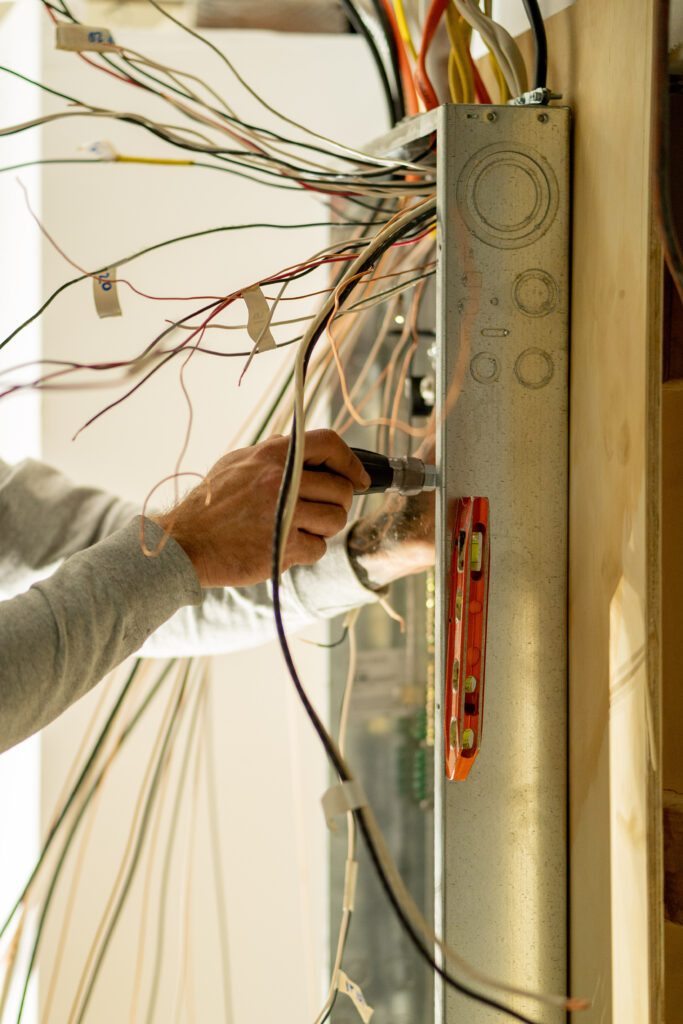
Then the existing protection gets assessed: what is fitted, what its indicator says, whether it is sized sensibly for the service, and whether it has simply reached the end of its life. Replacement is usually a short visit once the panel is accessible and there is breaker space, carried out with the cover off and the circuit isolated, then verified before the panel is closed.
Where protectors have been failing repeatedly, the conversation widens. That means looking at what inside the house generates surges, whether connections at the panel are sound, and whether the problem is arriving from the utility side, which is coordinated with them rather than worked on directly.
Lehmann Electrical & Design is led by master electrician Jacob Lehmann and works across Milwaukee, Wauwatosa and Waukesha County from 12012 W Fairview Ave, Wauwatosa. Work carries a 12-month workmanship warranty, and the company holds 4.9 stars on Google.
You can see what whole-house surge protection involves, or request an estimate and call 414-207-0109.
Why homeowners call Lehmann Electrical & Design
- Led by licensed master electrician Jacob Lehmann
- A+ rating with the BBB and 4.9 stars on Google
- 12-month workmanship warranty on the work we do
- Permits pulled and inspections scheduled as part of the job
- Milwaukee, Wauwatosa and Waukesha County, from 12012 W Fairview Ave, Wauwatosa
Want the protection checked?
Tell us whether you have had a storm or a run of failed electronics, and roughly how old the panel is.
Licensed master electrician. 12-month workmanship warranty.
Frequently asked questions
▾How do I know if my surge protector is working?
Read its status indicator. A whole-house unit at the panel normally has a green LED, and some have an audible alarm as well. A plug-in strip normally has a separate “protected” light, which is not the same as the power light. If the protection indicator is off or has changed colour, the device is still passing power but is no longer protecting anything.
▾How do I know if I even have a surge protector?
A whole-house unit is a small box, usually grey or beige and roughly the size of a paperback, either bolted beside the panel with a short lead or fitted inside it. If you cannot see one, you may only have plug-in strips, which cover local spikes at individual devices rather than what arrives from outside. An electrician can confirm in a couple of minutes during any other visit.
▾How do you know when a surge protector goes bad?
The indicator is the reliable answer, because nothing else changes. The outlets still work and the devices still run, which is exactly why a spent protector goes unnoticed for years. Visible signs such as scorching, discolouration or a smell mean something more serious happened and that circuit should be left alone until it has been checked.
▾How long do whole-house surge protectors last?
There is no fixed figure, because the life depends on how much surge energy the device absorbs rather than on time. A house with frequent utility disturbances or heavy motor loads consumes one faster than a quiet house. Manufacturers publish expected service lives and build in the status indicator precisely because the calendar is not a reliable guide. The indicator is.
▾How does a whole-house surge protector work?
It sits at the service panel and stays effectively out of the circuit until the voltage rises above the level it is built to clamp at. Above that level it becomes conductive and diverts the excess energy away rather than letting it travel down branch circuits into your equipment. It handles the large events that come from outside. Plug-in strips handle smaller local spikes close to a device, so the two are complementary rather than alternatives.
▾How is a whole-house surge protector installed?
It is wired into the service equipment at the panel, on its own overcurrent protection, with leads kept as short and straight as practical because length reduces effectiveness. The grounding and bonding are checked as part of the job. It is licensed work done under a permit, with the panel cover off. On an accessible panel with breaker space free, the fitting itself is typically under an hour, with the rest of the visit going on checking the grounding and bonding and testing afterwards. A panel that is full, or grounding that needs attention first, makes it a longer job.
Next step
Get the protection checked
Tell us if you have had a storm or failed electronics lately.
Licensed master electrician12‑month warranty4.9 on Google
Milwaukee, Wauwatosa and Waukesha County. Prefer to talk? Call 414-207-0109