Licensed master electrician · Call 414-207-0109

A standard 240-volt hot tub needs its own dedicated circuit: typically 50 amps at 240 volts, fed from the main panel, run in conductors sized to the tub’s data plate, protected by a GFCI device, routed through a weatherproof disconnect near the tub, and tied into an equipotential bonding system around the spa. The exact amperage comes from the manufacturer’s nameplate, not a rule of thumb. The work needs a permit from your municipality and a licensed electrician.
What the job actually involves
A hot tub installation is a new branch circuit from start to finish, plus a bonding system most homeowners have never heard of. A branch circuit is the run of wire between a breaker in your panel and the thing it feeds. For a spa, the work breaks into five parts.

The breaker. Most 240-volt tubs call for a 50-amp two-pole breaker, though 40-amp and 60-amp tubs also exist. The heater, pumps and blower together determine which, and the tub’s data plate states the minimum circuit ampacity the installer has to meet.
GFCI protection. GFCI stands for ground fault circuit interrupter, a device that watches for current leaking out of the circuit by any path, including through a person or through damp ground, and cuts power when it finds it. Water and electricity sitting a few feet apart is exactly the situation GFCI protection exists for. Depending on the equipment, that protection lives either in the breaker itself or in the spa disconnect panel.
The disconnect. That is the weatherproof box with a switch or breaker in it, mounted so someone standing at the tub can see it and reach it. It lets anyone shut the tub off instantly without walking to the basement panel.
The wire run. Conductor size is driven by the nameplate minimum circuit ampacity and by the GFCI equipment it feeds, not by guesswork. On a long run, the electrician may go up a size to hold voltage drop within limits, because a spa heater at the end of 90 feet of undersized wire will underperform and run hot. Outdoors that run goes in conduit or direct-burial cable, trenched if it crosses a yard, and sealed where it passes through the wall.
The bonding. This is the part that distinguishes spa wiring from any other 240-volt circuit in the house.
Equipotential bonding: the part people do not expect
Equipotential bonding ties every conductive part in and around the spa to the same electrical potential, so there is no voltage difference between the shell you are touching and the deck you are standing on. A solid copper bonding conductor connects the pump motors, the heater, any metal water piping, metal structural parts and the perimeter surface around the tub, and it is a separate system from the circuit’s grounding conductor.
The point of bonding is not to carry normal current. It is to make sure that if a fault ever energizes a piece of metal near the tub, everything a wet person can touch rises together instead of one part becoming a path to another. Bonding is why a hot tub circuit is not simply a big dryer circuit with a different name, and it is one of the first things a municipal inspector looks for.
Most factory spa packs come with a bonding lug for this purpose. If the tub sits on a concrete pad, the perimeter surface bonding usually has to be handled while the pad is being poured, which is why it pays to involve the electrician before the concrete truck arrives rather than after.
Pulling a panel cover is not a weekend project
Even with the main breaker off, the service conductors feeding the panel and the line-side lugs on the main breaker stay energized. A homeowner cannot de-energize those. Only the utility can, usually by pulling the meter, or a separate service disconnect if one is fitted ahead of the panel. That is the plain reason a 50-amp spa feed is licensed work and why your municipality wants it permitted and inspected.
How to tell if you need it
You need a new circuit if you are installing any 240-volt hot tub, full stop. There is no existing household circuit a spa can borrow.
That settles the question homeowners ask first: does a hot tub need its own circuit? Yes. A 240-volt spa runs its heater, circulation pump, jet pumps and controller off one feed, and that load runs for long stretches. It cannot share with a garage, a shed, a dryer or an outdoor outlet. Sharing means nuisance tripping at best and an overloaded conductor at worst.
A few situations change the scope rather than the answer:
- Plug-in 120-volt spas. The small “plug and play” tubs run on a 15- or 20-amp 120-volt cord. That cord connection has to be GFCI-protected, and where the receptacle sits relative to the water is regulated, not a matter of preference, so the outlet location gets set by the electrician rather than by where the extension lead reaches.
- Replacing an older tub. If a spa circuit already exists, it may be the wrong amperage for the new unit, the GFCI may be failing, or the disconnect may be in the wrong place. The circuit gets tested and evaluated, not assumed.
- A full panel. If there is no room for a two-pole 50-amp breaker, that gets addressed as part of the estimate.
- The existing circuit trips. If a spa circuit trips repeatedly, that is a fault to find, not a breaker to upsize. Never fit a larger breaker to stop tripping: the breaker protects the wire, and a bigger one just lets the wire overheat first. Reset a tripped breaker once at most, pushing firmly to OFF then back to ON. If it trips again, leave it off and have it looked at. The same goes for a GFCI: it resets once, and if it will not hold, there is a genuine leakage fault or a failed device. A GFCI that keeps tripping is not “doing its job correctly,” it is reporting something real.
If you smell burning or hot plastic near the panel, the disconnect or the tub’s control pack, or you see discoloration or scorch marks, or hear buzzing or crackling, stop using the circuit, leave the breaker off, and call an electrician. Do not touch the device to judge how hot it is; smell, sound and appearance tell you more and cost you nothing. Problems like a damaged circuit or failing device are found by testing, not by feel.
What decides the price
Four things move a hot tub estimate more than anything else: amperage, distance, the route, and the condition of your panel.
| Factor | What it means for the job |
|---|---|
| Tub amperage (40A / 50A / 60A) | Set by the data plate. Drives breaker size and wire gauge. Larger wire costs more per foot and is harder to pull. |
| Distance from panel to pad | A tub 10 feet from the panel versus 80 feet across a lawn is the single biggest variable, and a long run may need a conductor upsize for voltage drop. |
| Route and surfaces | Open basement joists are easy. Trenching across sod, cutting concrete or drilling masonry are not. |
| Panel space and condition | A free two-pole slot keeps it simple. A full or obsolete panel adds work. |
| GFCI method | Breaker-style versus a spa disconnect panel with integral protection, depending on the equipment listing. |
| Bonding work | Straightforward if the pad is not poured yet, more involved if the surface and piping are already in place. |
| Indoor versus outdoor | Outdoor runs need weatherproof fittings, burial depth and proper sealing at the wall. |
Load capacity matters too. An electrician will look at what your service already carries before adding 50 amps of spa to it. That look is a load calculation: adding up the demand of what the house already runs against what the service can supply. It is not about whether the lights dim, it is arithmetic done before anything is ordered.
> A hot tub circuit is priced by the run, not by the tub. Two identical spas can differ substantially in installation cost purely because one sits beside the panel wall and the other sits 70 feet away across a finished patio. When you ask for an estimate, the three things worth having ready are the tub’s amperage from the data plate, the distance from your electrical panel to the pad, and what is between them.
We are not publishing a dollar figure here, because a real number comes from seeing the panel and walking the route. Running new circuits and wiring is quoted off the actual conditions, and anyone giving you a firm price over the phone without those three details is guessing.
How long it takes and what is disrupted
A straightforward hot tub circuit is often a one-day job, and two if there is trenching or concrete involved.
A straightforward run with an accessible panel, an open joist bay and a tub close to the house is typically a single visit of several hours. Add a buried run across a yard and you add trenching time plus backfill. Add concrete cutting or a finished ceiling that has to be opened and patched and you are into a second day.
Disruption is modest. It is normal practice to shut the main off while the new breaker is landed, so expect a short power interruption to the house rather than a day without electricity, and you will know in advance when it happens. Note that shutting the main does not make the panel safe to open: the service conductors and the main breaker’s line-side lugs stay energized throughout, which is why the work stays with the electrician.
If a trench is needed, expect a narrow cut across the lawn that is backfilled the same day, with the grass taking a few weeks to recover. Indoor runs may mean a small access hole in drywall, and whether patching is included is worth settling in writing before work starts.
The sequencing to expect:
- Site visit, data plate check, load calculation, route and bonding plan decided.
- Permit applied for with the municipality.
- Circuit installed, disconnect mounted, GFCI protection fitted, bonding connected, tub terminated.
- Inspection by the municipal inspector.
- Tub filled and commissioned.
Many inspectors want to see the trench open or the bonding connections accessible before anything is closed up, so the inspection does not always come last in practice.
Tub arriving before the circuit is in?
Send us the data plate and we will tell you the circuit it needs, the disconnect position and whether the panel has room.
Licensed master electrician. 12-month workmanship warranty.
Permits and inspection
A 240-volt hot tub circuit requires an electrical permit, and the permit is issued by your municipality: Milwaukee, Wauwatosa, Waukesha or whichever one you live in.
Those municipalities enforce Wisconsin SPS 316, which adopts the 2023 NEC and has been in effect since September 1, 2026. Before that date Wisconsin worked from the 2017 NEC. If your existing spa circuit was installed and inspected under the older edition, it is not automatically required to be brought up to the current edition, but once it is altered, the current rules apply to that work.
Two points worth knowing about sizing and placement.
Sizing. The manufacturer’s minimum circuit ampacity printed on the data plate already accounts for the spa’s continuous load, so the installer sizes the breaker and conductors to that figure rather than applying a second 125 percent uplift to the running amps. That is why a correctly matched tub and circuit do not nuisance trip: the tub was never asking for more than the breaker was built to pass.
The disconnect. Under Wisconsin SPS 316, which adopts the 2023 NEC (in effect since September 1, 2026), the spa disconnecting means has to be readily accessible, within sight of the tub, and not less than 5 feet horizontally from the inside walls of the spa, unless a permanent barrier separates it from the water. The barrier exception is what allows a disconnect on a wall or beside a screened enclosure closer than 5 feet in some layouts. It is a judgment the electrician and the inspector make on the actual site, not something to settle from a diagram.
The permit is not paperwork for its own sake. It brings a second set of eyes, someone with no stake in the job, to confirm the wire gauge matches the breaker, the GFCI is the right type and functioning, the disconnect is sited correctly, and the equipotential bonding around the tub is complete. If you ever sell the house, an unpermitted 240-volt circuit to a hot tub is the kind of thing that surfaces in an inspection report.
Choosing an electrician
Ask three questions: who pulls the permit, who holds the license, and what the quote actually covers.
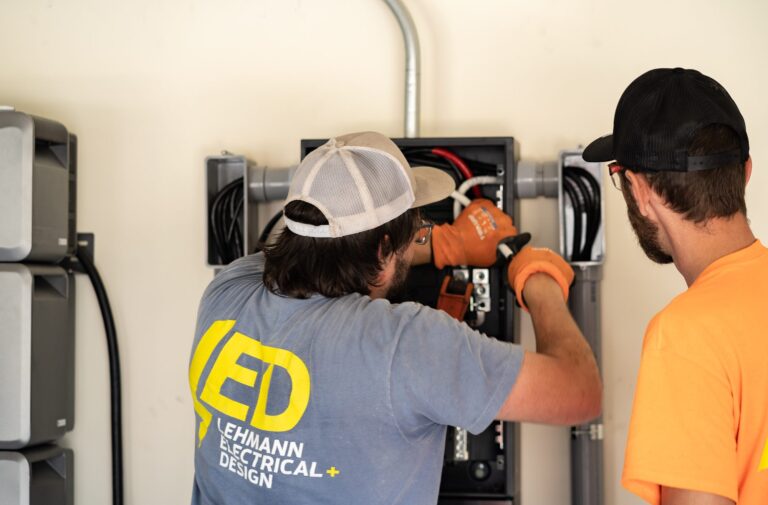
A contractor who says a permit is not needed for a 240-volt spa circuit is telling you something useful about how they work. Ask for the license, and ask whether the quote includes trenching, backfill, drywall patching, the disconnect box and the bonding work, because those are the line items that turn a cheap quote into an expensive one halfway through.
It is also worth asking what else they will look at while the panel cover is off. A spa circuit is a good moment to notice a double-tapped breaker, a corroded bus, or outdoor receptacles without proper protection. Related symptoms like an outlet that runs warm can point to the same underlying wiring problems, and an electrician who flags them rather than working around them is doing you a favor.
Lehmann Electrical & Design is led by Jacob W. Lehmann, a Wisconsin master electrician, license 1283316, working under Wisconsin electrical contractor license 1492849. The company holds an A+ rating with the BBB, 4.9 stars on Google, and backs its work with a 12-month workmanship warranty.
Ready to get your hot tub wired properly? Have your tub’s amperage and the distance from your panel to the pad handy, and request an estimate or call 414-207-0109. We cover Milwaukee and Waukesha County.
Why homeowners call Lehmann Electrical & Design
- Led by licensed master electrician Jacob Lehmann
- A+ rating with the BBB and 4.9 stars on Google
- 12-month workmanship warranty on the work we do
- Permits pulled and inspections scheduled as part of the job
- Milwaukee, Wauwatosa and Waukesha County, from 12012 W Fairview Ave, Wauwatosa
Want the feed, disconnect and bonding done once, properly?
Tell us where the tub is going and how far it sits from the panel.
Licensed master electrician. 12-month workmanship warranty.
Frequently asked questions
▾What electrical do I need for a hot tub?
A dedicated 240-volt circuit sized to the tub’s data plate, most commonly 50 amps, with conductors sized to the nameplate minimum circuit ampacity and the run length, GFCI protection, a weatherproof disconnect sited per the clearance rules, and equipotential bonding of the shell, pumps, metal piping and perimeter surface. Small 120-volt plug-in spas need a GFCI-protected dedicated outlet instead. A permit from your municipality is part of the job.
▾What electric does a hot tub use?
Most full-size spas run on 240 volts and draw between 40 and 60 amps depending on heater and pump count, with 50 amps being typical. Small plug-in models run on 120 volts at 15 or 20 amps. The number that matters is the minimum circuit ampacity on the equipment pack’s data plate, because that figure, not a rule of thumb, sizes the breaker and the wire.
▾Does a hot tub need its own circuit?
Yes. A 240-volt spa requires a circuit dedicated to it alone, with nothing else sharing the breaker. Sharing causes nuisance tripping at best and overheated conductors at worst, since the spa’s heater and pumps draw heavily for long periods. Even small 120-volt plug-in tubs should not share with other loads. Dedication is among the first things an inspector will confirm.
▾What kind of electrical do you need for a hot tub?
Two systems, not one. A dedicated 240-volt GFCI-protected circuit with a disconnect supplies the power. Separately, an equipotential bonding system ties the shell, pump motors, heater, metal piping and the surface around the tub to a common potential so nothing a wet person touches can differ in voltage. That bonding system is the real difference between spa wiring and any other heavy appliance circuit.
▾Can I use an existing hot tub circuit for a new tub?
Only after it is tested and evaluated. An old circuit may be the wrong amperage for the new unit, the GFCI may be faulty, the disconnect may be sited wrong by current standards, or the wire may have been undersized originally. If the new tub’s minimum circuit ampacity exceeds the old one’s, both breaker and conductors need checking, and the bonding gets verified before anything is connected.
Next step
Get your tub circuit quoted
Send the data plate and where the tub goes.
Licensed master electrician12‑month warranty4.9 on Google
Milwaukee, Wauwatosa and Waukesha County. Prefer to talk? Call 414-207-0109