Licensed master electrician · Call 414-207-0109
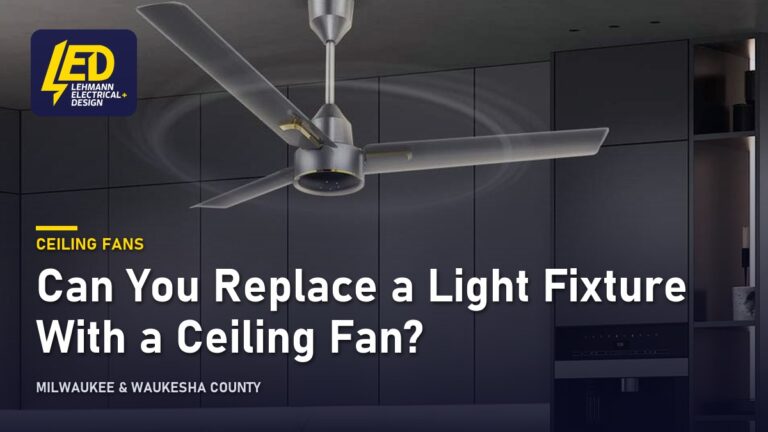
Usually yes, but not always with the existing box and wiring. A ceiling fan weighs far more than a light fixture and it moves, so it has to hang from an electrical box rated and braced for fan support. Many standard light boxes are not. The wiring also has to support the switching you want. Expect a box swap, sometimes a new switch leg, and a permit in most Milwaukee and Waukesha County municipalities.
What the job actually involves
The light comes down, the old box comes out, a fan-rated box goes in, and the fan goes up. That is the short version. The part homeowners underestimate is the box.
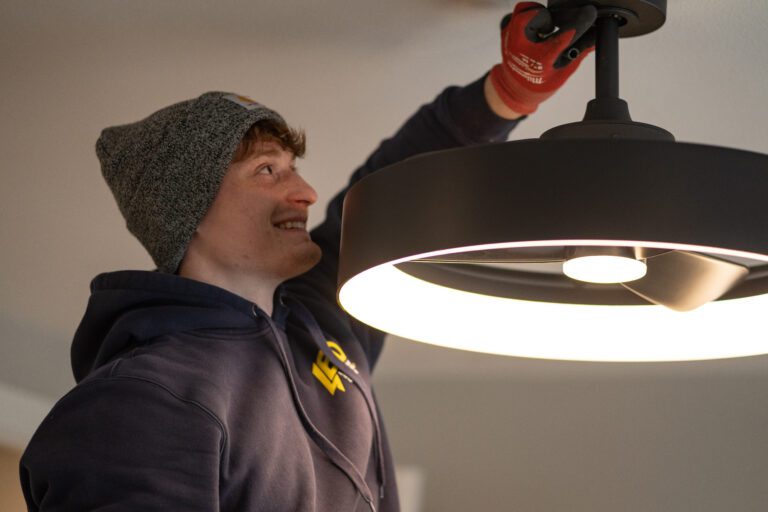
A ceiling light fixture might weigh four pounds. A ceiling fan with a light kit commonly weighs 15 to 50 pounds, and it spins, wobbles slightly, and does so for years. An electrical box listed for luminaire support only is not permitted to carry that. Under NEC 314.27(C), as adopted here through Wisconsin SPS 316, the box must be listed and marked for ceiling-fan support, and it has to be fastened to framing or to a brace bar that spans between joists. In a finished ceiling, that often means working through the existing hole with an expanding brace bar rather than opening drywall, which is one of the reasons this job is worth having done properly rather than improvised, and it is the heart of what ceiling fan installation actually involves.
Then there is the switching. What the fan needs depends on how you want to run it:
| What you want | What the wiring has to provide |
|---|---|
| Fan and light on one wall switch, speed set by pull chain | The existing single switch leg is usually enough |
| Fan and light switched separately at the wall | A second switch leg, or a remote/smart control kit |
| Fan on a wall-mounted speed control | A switch rated for fan motor loads, not a standard dimmer |
| Fan controlled from two doorways | A three-way arrangement at both switch locations, which often rules out a remote receiver: many kits expect one constant feed and do not survive three-way switching |
A standard dimmer must never be used to control a fan motor, whatever it was made to dim. It is the wrong device for an inductive load and can damage both the motor and the control. Wall speed control means a control listed for fan motors. Where a homeowner wants separate wall control of fan and light without opening up a ceiling or a wall, a receiver kit inside the fan canopy paired with a wall-mounted remote is usually the cleaner retrofit answer.
Finally, the fan has to be hung at a workable height. Blades need clearance from the floor and from walls, and a sloped ceiling needs a canopy rated for the pitch plus a downrod. Fan manufacturers’ installation instructions normally call for the blades to sit at least 7 feet above the floor, and the instructions are what the installation has to follow. A flush-mount fan is what you reach for when the ceiling is low, but in a basement with a 7-foot ceiling even a flush mount cannot give you that clearance, and that is usually the point at which a fan stops being the right answer for the room.
How to tell if you need it
Start with what is in the ceiling now, because that tells you most of the story.
A surface-mounted light in the middle of the room. This is the best case. There is a box, there is power, there is a switch. The question is only whether the box is fan-rated and anchored well enough. The marking is stamped on the box itself, so it can only be read with the fixture down, which means the circuit switched off at the breaker and proved dead first. That is a job for the electrician on the estimate visit, not a thing to check on a live circuit. A box being metal and screwed to something is not the same as being listed for fan support.
A track light. Track heads mount to a track that is fed from one box, usually at one end or in the middle of the run. Converting to a fan means the fan has to hang where the feed box is, or the feed has to be relocated to the point in the ceiling where you actually want the fan. That second case is the one that changes the price, because it is a wiring move, not a fixture swap.
Recessed cans. You cannot convert a recessed light into a ceiling fan. A can is a shallow housing mounted at a joist bay, not a load-bearing support, and it is rarely in the center of the room. The realistic path is a new fan-rated box in the right location, fed from an existing circuit, with the cans either kept, capped, or re-switched. Some canless or remodel housings can be removed and patched, though the junction box that fed them has to stay reachable rather than be buried behind the new drywall. That is drywall work as well as electrical work, so plan for both.
A kitchen. Yes, a kitchen ceiling light can be converted, subject to the same box rating and to whatever clearances the fan’s instructions set, which is the part that rules out most positions directly over a cooktop. It is also the room where homeowners most often change their minds. Fans over a work surface and a cooktop collect grease, cast moving shadows over a counter, and complicate the lighting that actually matters in a kitchen. If what you want is better light rather than air movement, a lighting layout change is usually the stronger investment, and our residential lighting work is a better starting point than a fan.
A dining room. A fan over a dining table is a genuine preference question. It works, but it competes visually with a pendant or chandelier, and most dining rooms that get a fan end up with a fan-and-light combination on a remote.
A bedroom. The most common and most straightforward conversion in our area, particularly in master bedrooms with one center light and one switch at the door.
> If you are replacing a single surface-mounted ceiling light with a fan in the same spot, and the circuit is sound, the job is mostly a box swap and a hang. If you are moving the location, converting from track or recessed lighting, or adding separate wall control of fan and light, it becomes a wiring job with a drywall consequence. Those two versions of “replace a light with a fan” look identical in a photograph and are not the same job.
What decides the price
We do not publish prices, and we will not quote one over a blog post, because the variables below swing the number more than the fan does.
Whether the existing box can stay. A fan-rated box retrofit through an existing hole is routine. A box that has to be relocated, or a ceiling with no accessible framing above it, is not.
Ceiling height and access. A standard 8-foot ceiling in a bedroom is quick. A two-story foyer, a vaulted great room, or a stairwell landing means staging, sometimes scaffolding, and a downrod sized for the drop.
Number of fixtures. A homeowner who asks about the kitchen, the living room track light, the master bedroom and the dining room in one call is describing four separate pieces of work with four different answers. Grouping them into one visit almost always costs less in total than four trips, which is why we prefer to walk the whole house once.
The switching you want. Keeping the single existing switch is cheapest. A remote receiver kit is next. Pulling a second switch leg through a finished wall and ceiling is the most involved.
Whether a new circuit or a new drop is needed. If the room has no ceiling box at all, that is a different article, and the factors behind a ceiling light install with no existing wiring apply to a fan too, with the added requirement that the box be fan-rated.
Fixture supply. Homeowner-supplied fans are fine. We do ask to see the model before the visit, because downrod length, canopy type, sloped-ceiling rating and remote compatibility all affect what we bring.
Condition of what is behind the box. Older Milwaukee and Waukesha County housing stock turns up cloth-insulated conductors, no ground conductor at the box, undersized boxes, and spliced-together switch legs. None of that is a crisis, but it has to be dealt with before a fan goes up, and it is a frequent reason a 90-minute job becomes a half-day job.
If a box, switch or circuit shows a burning or hot-plastic smell, scorch marks, discoloration, buzzing or crackling, stop using that circuit, leave the breaker off and call an electrician before any fixture work is scheduled.
How long it takes and what is disrupted
In our experience a straightforward single-fan conversion in a bedroom runs to a one to two hour visit. Four fixtures in different rooms is usually most of a day.
What that looks like in the house:
- The circuit for that room is off while work is in progress, not the whole house.
- Drop cloths go down and furniture directly below the fixture needs to move. A bed or dining table gets slid out, not removed from the room.
- There is dust. Cutting or enlarging a ceiling hole makes drywall dust in a small radius under the work.
- If a box has to be relocated or a switch leg pulled, there will be patch work. We cut cleanly and keep it small, but we are not drywall finishers, and a painted ceiling will need touching up by whoever does your painting.
- Fans are commissioned before we leave: direction switch set, speeds run, remote paired, light tested, balance checked for wobble.
Blade wobble after the fact is almost always a blade set or mounting issue rather than a wiring one, and it is usually fixed with a balancing kit. If a fan light stops working later, the troubleshooting path overlaps heavily with the usual causes behind a ceiling light that quit.
Not sure the box above your light will take a fan?
A licensed electrician can tell you from the box marking and the framing above it, which is the one thing a photograph cannot settle.
Licensed master electrician. 12-month workmanship warranty.
Permits and inspection
Permits for electrical work are issued by your municipality, not by the state. Milwaukee, Wauwatosa, Waukesha and the surrounding Waukesha County communities each run their own permitting and inspection process, and they enforce Wisconsin SPS 316, which adopts the 2023 NEC and has been in effect since September 1, 2026.
A like-for-like fixture swap is treated differently from one jurisdiction to the next. Once the job involves a new or relocated box, a new switch leg, a new circuit, or any alteration to the branch circuit wiring, a permit is the normal expectation. We pull the permit as part of the job rather than leaving it with the homeowner, and we schedule the inspection.
One point worth being plain about: existing installations are not required to be brought up to the current code edition just because a newer edition has been adopted. They are required to be brought up to it when they are altered. Replacing a light with a ceiling fan is an alteration of that outlet, so the box, support and connections at that location get held to the current standard even if the rest of the circuit does not change.
Choosing an electrician
Ask three questions before anyone touches the ceiling.

- Who is licensed, and under what number? Wisconsin issues a master electrician license to a person and an electrical contractor license to a business, and you should be able to be told both. Jacob W. Lehmann holds Wisconsin master electrician license 1283316, and Lehmann Electrical & Design works under Wisconsin electrical contractor license 1492849.
- Who pulls the permit? If the answer is “you don’t need one” before anyone has seen the ceiling, that is not an answer.
- What happens if the box is not fan-rated? The right response is a specific plan for a fan-rated box and brace, not a reassurance that the existing box “will hold it.”
Lehmann Electrical & Design holds an A+ rating with the BBB and 4.9 stars on Google, and the work carries a 12-month workmanship warranty.
Book an estimate. Tell us which rooms you are thinking about, send a photo of each existing fixture and the switch beside the door, and we will tell you which are simple swaps and which involve wiring. Request a quote or call 414-207-0109.
Why homeowners call Lehmann Electrical & Design
- Led by licensed master electrician Jacob Lehmann
- A+ rating with the BBB and 4.9 stars on Google
- 12-month workmanship warranty on the work we do
- Permits pulled and inspections scheduled as part of the job
- Milwaukee, Wauwatosa and Waukesha County, from 12012 W Fairview Ave, Wauwatosa
Want to know which rooms are simple swaps?
Tell us the rooms you are thinking about and what is on the ceiling now.
Licensed master electrician. 12-month workmanship warranty.
Frequently asked questions
▾Can you replace any light fixture with a ceiling fan?
No. A surface-mounted light in the middle of a room is the easy case. Recessed cans, track lighting, and fixtures that are not centered in the room all require a new fan-rated box in a different location, which means wiring work and some patching. The deciding factors are box location, box rating, and whether there is framing above it to anchor to.
▾Can I replace a light fixture with a ceiling fan without new wires?
Often yes, if you accept pull-chain control of speed and light with everything fed from the one existing switch. The existing circuit and switch leg usually carry a fan fine. New wire becomes necessary when you want separate wall switching for fan and light, a wall speed control, three-way control from two doorways, or the fan in a different spot.
▾Can you replace recessed lighting with a ceiling fan?
Not directly. A recessed can housing is not a support for a fan and is rarely in the room’s center. The work is installing a new fan-rated, braced box in the correct position, feeding it from a suitable circuit, and then deciding whether to keep, cap or re-switch the remaining cans. Budget for drywall patching as well as electrical work.
▾How is a light fixture actually converted to a ceiling fan?
A licensed electrician de-energizes the circuit and verifies it is dead, removes the fixture, removes the existing box, installs a box listed and marked for ceiling fan support anchored to framing or a brace bar, makes up the connections, hangs the mounting bracket and fan, sets the downrod and canopy, then tests direction, speeds, light and any remote. It is not homeowner work.
▾Does a ceiling fan need its own circuit?
No. A ceiling fan with a light kit typically draws well under an amp at 120 volts and normally shares the existing lighting circuit in that room. What matters is that the circuit is in sound condition and not already loaded with a long run of other fixtures and receptacles. If several rooms are being converted at once, we check the circuit’s existing load as part of the estimate.
Next step
Get your ceiling checked
Tell us what is on the ceiling now.
Licensed master electrician12‑month warranty4.9 on Google
Milwaukee, Wauwatosa and Waukesha County. Prefer to talk? Call 414-207-0109