Licensed master electrician · Call 414-207-0109
No. Burying active knob and tube wiring in insulation is not safe, and it is the reason an electrician will not sign the work off. Knob and tube was designed to shed heat into open air, so packing insulation around it traps that heat against conductors whose rubber-and-cloth covering is already brittle with age. The accepted fix is not to insulate carefully around the wiring. It is for a licensed electrician to replace the active knob and tube circuits with modern cable, after which the attic can be insulated like any other.
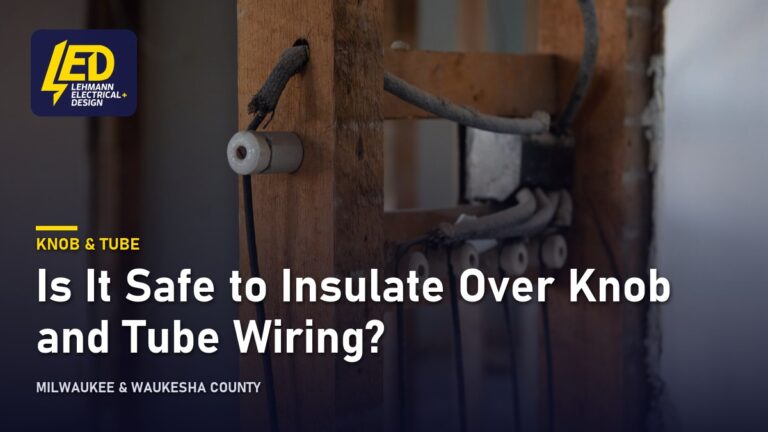
Knob and tube wiring (often shortened to K&T) is the open wiring method used in American houses from roughly the 1880s through the 1940s, with stragglers into the early 1950s. Individual conductors ran through ceramic knobs for support and ceramic tubes where they passed through joists, spaced apart from each other and from wood. Air is part of the system. The conductors are rated on the assumption that heat escapes freely in all directions.
Blown-in cellulose, fiberglass batts, or spray foam remove that air. The conductor still carries the same current, but now it has nowhere to send the heat, so the insulation on the wire runs hotter than it was ever designed to run. On wiring that is seventy to a hundred-plus years old, the covering is often already cracking, powdery, or flaking off where it was handled during past attic work. Heat accelerates that.
> Knob and tube wiring cools itself by radiating heat into open air. Covering it with insulation removes the only cooling the system has. The conductors keep carrying current, the heat stays trapped against insulation that has already aged past its service life, and the margin of safety that the original design depended on disappears. That is why “insulate carefully around it” is a workaround rather than a solution: the right answer is to replace the live circuits, then insulate the attic the way it should have been insulated in the first place.
There is one narrow exception worth naming honestly. If a knob and tube circuit has been properly disconnected at both ends and is genuinely dead, it is just abandoned wire in the attic and insulation over it is a non-issue. Proving a circuit is dead at both ends is not something to assume from a dark attic. An electrician verifies it.
What is usually causing it
Almost always, the situation arrives the same way. A homeowner in an older Milwaukee or Waukesha County neighborhood wants a warmer house and lower heating bills, calls an insulation contractor, and the contractor opens the attic hatch, sees ceramic knobs, and stops. Sometimes an energy audit or a weatherization program turns up the same thing. Sometimes a home inspector flags it during a sale, or an insurance carrier asks about it at renewal.

What sits underneath is a hundred-year-old wiring system that has usually been modified by several generations of owners. The original K&T is rarely the whole story. Typical findings include:
- Modern NM cable (Romex) spliced onto knob and tube in the attic, often with twisted joints and tape rather than a junction box
- Added outlets and lighting hung off original two-wire circuits that have no equipment ground
- Fabric and rubber conductor covering that has gone brittle, cracked, or fallen away near fixtures and splice points
- Earlier insulation already dumped over part of the wiring by a previous owner
- Circuits that are carrying far more load than a 1920s household put on them, because a 1920s household had a few lamps and a radio
The absence of a ground wire matters on its own. A ground gives fault current a deliberate path back to the panel so a breaker or fuse opens. Two-wire knob and tube has no such path, which is also why three-prong outlets on K&T circuits are frequently ungrounded despite looking normal at the wall plate. The broader picture of why these systems age out is covered in our rundown of the risks these older circuits carry in local homes.
What is safe to check yourself, and what is not
You can look, you can photograph, and you can take notes. That is where it stops.
Safe for a homeowner:
- Look at the attic from the hatch or a safe walkway with a flashlight, without stepping between joists or moving insulation
- Identify the visual signature: single conductors, white or brown ceramic knobs nailed to joists, ceramic tubes where wires pass through wood, cloth-covered wire with no outer jacket
- Check the basement ceiling and the outside of the service panel for the same pattern
- Count how many two-prong outlets the house still has
- Note where insulation already sits on top of wiring, and photograph it from a distance
- Note whether any room’s lights dim when a vacuum or space heater runs
Not safe, and not legal without a license and a permit:
- Pulling the panel cover off, or probing anything inside it
- Opening, splicing, taping, or re-supporting any K&T conductor
- Pushing insulation aside with your hands to “clear” the wire
- Deciding a circuit is dead and burying it
- Installing new insulation over or near live wiring on the strength of a YouTube video
If you find a burning or hot-plastic smell, scorch marks, discoloration around an outlet or fixture, buzzing, or crackling, stop using that circuit or device, leave the breaker off, and call an electrician. A tripped breaker may be reset once: push it firmly to OFF, then to ON. If it trips again, leave it off until someone has inspected the circuit. Never install a larger breaker or fuse to stop nuisance tripping. The breaker is sized to protect the wire, and a bigger one simply removes the protection.
Knob and tube in the attic you want to insulate?
A licensed electrician establishes what is still live and what can be removed before anything is covered over.
Licensed master electrician. 12-month workmanship warranty.
When it points to a bigger problem
Insulation is usually the trigger, not the real finding. If knob and tube surfaces during an attic project, it is reasonable to assume the rest of the house’s wiring is the same vintage and has the same limitations, which is also why insurers ask about it. Watch for these signals that the scope is larger than one attic run:
| What you notice | What it usually indicates |
|---|---|
| Insulation already covering live K&T | Prior work done without an electrician; heat exposure of unknown duration |
| Two-prong outlets throughout | Circuits with no equipment ground anywhere in the house |
| Three-prong outlets on old circuits | Receptacles swapped without adding a ground, so the ground pin does nothing |
| Fuses rather than breakers, or oversized fuses | Overcurrent protection that may not match the conductors it is protecting |
| Lights dimming when an appliance starts | Loaded circuits, long runs, or deteriorating connections |
| Romex spliced to cloth wire outside a box | Unprotected splices, a common ignition point |
| Flaking or missing conductor covering | Wiring past its serviceable life, regardless of insulation |
Insurance and financing come up constantly here. Some carriers decline to write or renew on active knob and tube, some surcharge, and some are indifferent. Lenders vary too. We will not generalize, because policies differ by carrier and by product. Ask your agent directly and get the answer in writing before you plan around it.
A note on code. Existing installations in Wisconsin are not required to be brought up to the current edition simply because they are old. New and altered work is. Wisconsin SPS 316 adopts the 2023 NEC, in effect since September 1, 2026, and your local municipality, whether that is Milwaukee, Wauwatosa, Waukesha, or a surrounding village, issues the permit and inspects the work. Work permitted before that date fell under the 2017 NEC. Practically, that means insulating an attic does not force a rewire by itself, but rewiring that attic does have to be done to the current standard.
What an electrician does about it
The visit starts with assessment, not a sales pitch, and it covers the same ground as an inspection before a sale. An electrician traces which circuits are still active knob and tube and which are abandoned, checks the panel and overcurrent protection, inspects accessible splices, looks for prior insulation contact, and tests for grounding at receptacles. That produces a map: what is live, what is dead, what is loaded, and what is unsafe now versus what is simply old.
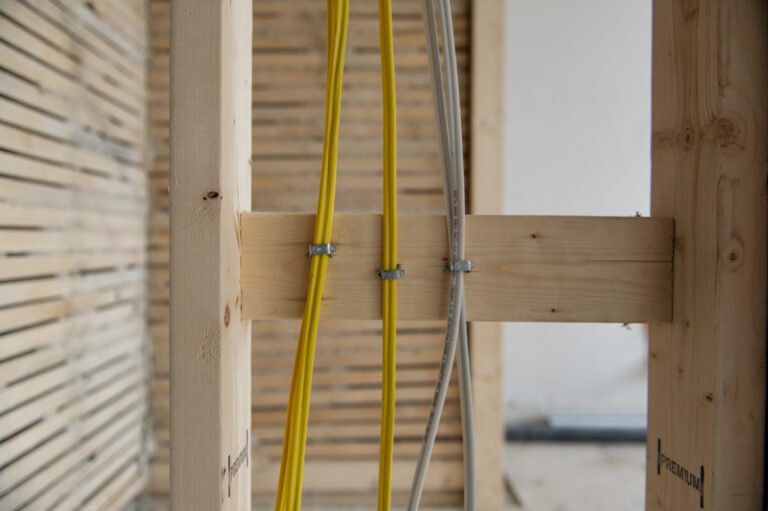
From there, the typical sequence on a replacement is:
- A permit pulled with the municipality that has jurisdiction
- New cable run to replace the active K&T circuits, with an equipment ground
- Splices and connections landed in accessible junction boxes
- Existing abandoned conductors disconnected at both ends and removed where reasonably accessible
- Devices and fixtures reconnected, with GFCI protection (a device that opens the circuit when a small amount of current leaks by any path, including through a person) and AFCI protection (which detects the arcing signature of a damaged connection on 120-volt branch circuits in living areas) installed where the current code edition calls for it
- Inspection, then the attic is cleared for insulation
Scope drives cost, and scope varies enormously: a two-circuit attic is a different job from a full 1915 four-square with plaster walls, no attic access over part of the house, and three previous rounds of amateur additions. We do not publish price ranges, and any figure quoted without someone having seen your house is a guess. A walkthrough gives you a real number, and we will tell you plainly if partial replacement of the active circuits makes more sense than a whole-house rewire.
If the insulation crew stopped work and you need to know what you are dealing with, we can look at it. Our work on knob and tube replacement starts with assessment, and homeowners across Milwaukee and Waukesha County deal with this same attic discovery every year, often in houses where the wiring has outlasted everyone who installed it. You can book a time to have it looked at or call 414-207-0109. Lehmann Electrical & Design is led by master electrician Jacob Lehmann, holds an A+ rating with the BBB, and is rated 4.9 stars on Google.
Why homeowners call Lehmann Electrical & Design
- Led by licensed master electrician Jacob Lehmann
- A+ rating with the BBB and 4.9 stars on Google
- 12-month workmanship warranty on the work we do
- Permits pulled and inspections scheduled as part of the job
- Milwaukee, Wauwatosa and Waukesha County, from 12012 W Fairview Ave, Wauwatosa
Planning insulation work?
Tell us the age of the house, which areas are involved, and whether any knob and tube is still energised.
Licensed master electrician. 12-month workmanship warranty.
Frequently asked questions
▾Is it dangerous to have knob and tube wiring?
Intact, unmodified, lightly loaded knob and tube that has never been covered with insulation can still function. The risk comes from age and alteration: brittle conductor covering, unprotected splices to newer cable, no equipment ground, and loads far beyond what the circuits were built for. They often appear together. The honest answer is that it is a system past its design life that needs an electrician’s assessment, not a blanket yes or no.
▾Can you insulate around knob and tube wiring?
Keeping insulation physically clear of the conductors is sometimes proposed, but it is fragile. Any future attic work, settling, or added blown-in material closes the gap, and the wiring is then buried with nobody aware of it. It also does nothing about the brittle covering, missing ground, or spliced-on cable. Replacing the active circuits first, then insulating without restriction, is the approach that actually resolves the conflict.
▾How long does knob and tube wiring last?
It was installed from about the 1880s to the 1940s, so the newest examples are around eighty years old and many are well past a century. There is no fixed service life, but rubber and cloth insulation on the conductors degrades with heat, handling, and time, and it is the covering that fails rather than the copper. Once the covering is flaking or cracking, the wiring has reached the end of its usable life.
▾How does knob and tube wiring work?
Two separate conductors, a hot and a neutral, run parallel through the structure with a few inches of air between them. Ceramic knobs hold them away from framing; ceramic tubes line the holes where they pass through joists and studs. Loads were tapped by soldering and taping a connection directly onto the run rather than in a box. There is no third wire, so there is no equipment ground anywhere in the system.
▾What does knob and tube wiring look like?
Look for single wires, not a jacketed cable. Each conductor is covered in cloth over rubber, usually black, brown, or gray with age, running alone across the tops of joists. White or brown ceramic spools about an inch tall are nailed along the route, with the wire looped and tied to them. Where a wire crosses framing, a ceramic sleeve protrudes from the hole. The county-specific look and local variations are described in more detail in our overview of these systems in area homes.
Next step
Get the wiring assessed
Tell us the age of the house and which areas are involved.
Licensed master electrician12-month warranty4.9 on Google
Milwaukee, Wauwatosa and Waukesha County. Prefer to talk? Call 414-207-0109