Licensed master electrician · Call 414-207-0109
Start by narrowing the fault. If one ceiling light stopped working, replace the bulb first, then check whether the switch feels loose or the breaker for that room has tripped. If several lights on the same circuit went out together, or the fixture buzzes, flickers, hangs loose from the ceiling, or smells hot, the problem is in the wiring or the box, not the bulb. That work belongs with a licensed electrician.

Ceiling light problems fall into two groups: the ones a homeowner can rule out in five minutes, and the ones that need a meter, a ladder, and a license.
The first group is bulbs, a loose bulb in the socket, a dimmer that has been turned down, and a breaker that has tripped. The second group is anything involving the fixture’s wire connections, the ceiling box it hangs from, the switch itself, or the circuit feeding it.
Here is the honest answer to “is it hard to replace a ceiling light?” Swapping a like-for-like fixture is not conceptually complicated. The risk is not in the complexity, it is in what you cannot see: aluminum branch wiring, a fixture box that was never rated to carry weight, brittle insulation on 1950s conductors, a neutral shared between two circuits, or a switch loop with no neutral in the box. Those are invisible until the canopy comes down, and they are why a job that looks like twenty minutes turns into rewiring a section of ceiling.
> If there is a burning or hot-plastic smell coming from a ceiling fixture, or you see scorch marks, browned plastic around the socket, or hear buzzing or crackling from the fixture or its switch, stop using that circuit. Turn the breaker off, leave it off, and call an electrician. Those symptoms mean heat is being generated somewhere it should not be, and a bulb change will not address it.
What is usually causing it
Different symptoms point to different parts of the system. Matching the symptom to the likely cause saves time on the estimate.
| Symptom | Likely cause | Who should handle it |
|---|---|---|
| One fixture dead, others fine | Burned-out bulb, bulb loose in socket | Homeowner |
| Dead after a storm or an appliance kicked on | Tripped breaker | Homeowher can reset once |
| Flickers when you walk across the floor | Loose wire connection in the fixture or box | Electrician |
| Dims or buzzes with an LED bulb | Dimmer not rated for that LED driver | Electrician |
| Several ceiling lights out at once | Open neutral, failed splice, or a shared circuit fault | Electrician |
| Fixture sagging or pulled partly out of the ceiling | Box not fan/fixture rated, or stripped mounting | Electrician |
| Pull chain will not click, or clicks with no result | Worn internal switch in the fixture | Electrician (usually fixture replacement) |
| Works only when you jiggle the wall switch | Failing switch | Electrician |
| Dead on an old porcelain or keyless fixture | Deteriorated socket, cloth-insulated conductors | Electrician |
A few of these deserve explaining.
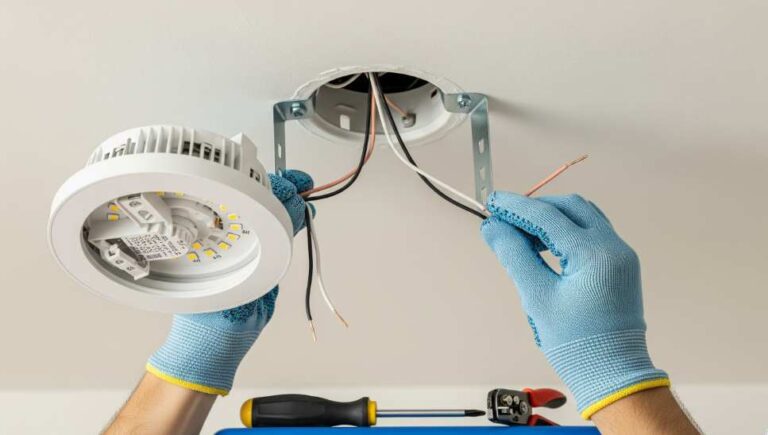
The pull chain. On a ceiling fixture or fan light with a pull chain, that chain operates a small mechanical switch built into the fixture body. When it stops clicking, or clicks and does nothing, the switch has worn out. On most inexpensive fixtures the switch is not economically replaceable, so the practical fix is a new fixture. On a quality fan, the pull-chain switch module can often be swapped. Either way, the fixture has to come down and the wires have to be disconnected, which means power off at the breaker and confirmed dead with a meter.
Multiple rooms at once. When a kitchen light, a living room track light, a bedroom light, and a dining room light all misbehave, that pattern usually means one circuit or one shared neutral connection, not four separate failures. A neutral is the return conductor that completes the circuit, and when a neutral splice loosens upstream, every fixture downstream of it acts strangely: dim, flickering, or dead. Chasing that from the fixture end rarely works. An electrician traces it from the circuit.
LEDs and dimmers. A perfectly good LED bulb will flicker, buzz, hum, or refuse to go fully dark on a dimmer designed for incandescent loads. That is a compatibility mismatch, not a fault. Replacing the dimmer with one listed for LED drivers fixes it. If you are updating several rooms anyway, this is often the moment people look at dimming and scene control that works from a phone, because the switch is already coming out.
What is safe to check yourself, and what is not
You can safely do four things.
- Change the bulb. With the switch off, replace it with a known-good bulb of the correct type and wattage for the fixture’s label. Seat it firmly; a bulb that is only half threaded in looks installed and does nothing.
- Check the dimmer or switch position. Some dimmers have a small preset trim wheel that can be knocked down low.
- Look at the breaker panel door, not inside it. Open the door, read the labels, and see whether a breaker handle is sitting between on and off. If one has tripped, push it firmly to OFF, then to ON. Reset it once at most. If it trips again, leave it off and have the circuit inspected, because a breaker that will not hold is reporting a fault in the wiring, not a nuisance.
- Note the symptoms. When it started, what else is on the circuit, whether anything changed in the house recently. This makes the diagnosis faster.
Everything else is off the list, and the reasons are specific, not generic caution.
Do not remove a fixture canopy to look at the wiring. The box above a ceiling light can contain wires from more than one circuit, so switching off the breaker you think serves it does not guarantee the conductors in that box are dead. Do not work on a switch, a dimmer, or a fixture’s splices. Do not remove the cover from your electrical panel. Behind that cover, the service conductors and the line-side lugs of the main breaker remain energized even with the main breaker switched off. A homeowner cannot de-energize them. Only the utility can, usually by pulling the meter, or a separate service disconnect ahead of the panel if one is fitted.
And do not solve a repeatedly tripping breaker by fitting a larger one. The breaker is sized to protect the wire behind the wall, not the light. A bigger breaker lets that wire overheat before anything shuts off. If a circuit is genuinely overloaded, the answer is a new circuit.
Light still dead after a new bulb and a breaker reset?
A licensed electrician confirms the circuit is dead, then works back through fixture, switch and splices until the break shows itself.
Licensed master electrician. 12-month workmanship warranty.
When it points to a bigger problem
A single dead ceiling light is a repair. A pattern is a symptom.
The fixture fell out of the ceiling. This is the one that most often reveals a real defect. Ceiling fixtures are supposed to be mounted to a box that is listed and secured for the weight it carries, and ceiling fans need a box specifically rated for fan support. In older Milwaukee and Waukesha County homes, fixtures are sometimes hung from a box nailed to lath, from a pancake box with no structural backing, or from the plaster itself. When it lets go, the conductors become the only thing holding the fixture, and they will be stretched or nicked. That is a re-mount with a proper box and a wiring inspection, not a re-screw.
There is now a hole in the ceiling. When a fixture pulls out, or when you remove a large old fixture and the new one has a smaller canopy, you are left with an opening. The electrical part of that fix is installing a correct box and a fixture or blank cover listed to close the opening, because an open box with live splices inside it is not acceptable. The drywall or plaster patch around it is a separate trade, and we will tell you plainly which part we handle.
Cloth-insulated or knob-and-tube wiring at the fixture. If the conductors feeding the light are cloth-covered and crumbling, the fixture is the least of it. That is a rewiring conversation.
Lights dimming when the furnace or a motor starts. This can mean a loose connection or an undersized feed, and it is worth having looked at properly.
Recurring flicker across the house. A connection somewhere upstream is loose, and loose connections generate heat.
What an electrician does about it
If the fixture itself has reached the end of its life rather than developed a fault, the job becomes a replacement rather than a repair, which our lighting team handles as part of the same visit.
The first visit is diagnosis, not guessing. A licensed electrician confirms which circuit feeds the fixture, de-energizes it, verifies with a meter that the conductors in the box are actually dead, and then works backward: fixture, switch, box, splices, circuit. The symptom tells us where to start, and the testing tells us where to stop.
From there, the work is one of a handful of outcomes: tightening or re-making failed splices, replacing a worn socket or pull-chain switch, replacing a switch or an incompatible dimmer, installing a properly rated and secured fixture box, or repairing a section of damaged branch wiring. All of it is done to Wisconsin SPS 316, which adopts the 2023 NEC and has been in effect since September 1, 2026. Permits are issued by your local municipality, Milwaukee, Wauwatosa, Waukesha and the surrounding communities, which enforces that code. Existing installations do not have to be brought up to the new edition unless they are being altered, which is why an honest scope matters: altered circuits get held to current rules.
Because the ladder and the drop cloths are already out, most people bundle. A request to look at the kitchen cans, a track light in the living room, a bedroom fixture and a dining room light is one visit, and the per-fixture labor drops accordingly. The same applies to anything nearby that was already on the list, like one more exterior receptacle on the back of the house, or a fixture over the patio and back steps while someone is already working on that wall. Ask about all of it when you book, not after we arrive.
On cost: we quote the actual fixture, the actual box, and the actual circuit in front of us, rather than publishing a number that will not match your ceiling. Pricing for repairs, replacements and new installs is given after we see the work, and our interior and exterior lighting work carries a 12-month workmanship warranty.
Lehmann Electrical & Design is led by master electrician Jacob Lehmann, holds an A+ rating with the BBB, and is rated 4.9 stars on Google. If you have a ceiling light that stopped working, a fixture that has come loose, or a list of rooms you want handled in one visit, tell us what is happening and request an estimate or call 414-207-0109.
Why homeowners call Lehmann Electrical & Design
- Led by licensed master electrician Jacob Lehmann
- A+ rating with the BBB and 4.9 stars on Google
- 12-month workmanship warranty on the work we do
- Permits pulled and inspections scheduled as part of the job
- Milwaukee, Wauwatosa and Waukesha County, from 12012 W Fairview Ave, Wauwatosa
Ready to have it looked at?
Tell us which room, what you have already tried and whether anything else on that circuit went out.
Licensed master electrician. 12-month workmanship warranty.
Frequently asked questions
▾How do you fix a ceiling light that stopped working?
Work from simplest to hardest. Replace the bulb with a known-good one, seated firmly. Check that the dimmer is not turned to its lowest trim setting. Check the panel for a tripped breaker and reset it once; if it trips again, leave it off. If none of that restores the light, the fault is in the fixture, switch, box, or circuit wiring, and that requires a licensed electrician with a meter.
▾How much does it cost to fix, replace, or install a ceiling light?
It depends on what is actually wrong and what the box above the fixture turns out to be. A straightforward like-for-like swap into a sound, correctly rated box is very different from installing a fan-rated box where none exists, or repairing damaged branch wiring. We give a firm price after seeing the fixture and the ceiling, which is more useful to you than a range that assumes conditions your house may not have.
▾My ceiling light fixture fell out. Is the wiring still safe?
Assume it is not. When a fixture drops, the conductors take the weight, so insulation gets stretched, pinched, or nicked, and the splices get pulled. Leave the breaker for that room off and do not push the fixture back up. The repair is a correctly rated and properly secured box, re-made connections, and an inspection of the wiring that was stressed.
▾Can a pull-chain ceiling light be repaired instead of replaced?
Sometimes. On a good quality ceiling fan, the pull-chain switch is a replaceable module and swapping it is worthwhile. On most budget ceiling fixtures the switch is integral and the fixture itself costs less than the labor to rebuild it, so replacement is the practical choice. Either way the fixture has to be de-energized, dropped, and disconnected, which is not a bulb-change task.
▾Several lights in different rooms are acting up. Is that one problem or many?
Usually one. Lights across multiple rooms often share a circuit, and a single loose neutral or failed splice upstream makes everything downstream of it dim, flicker, or go dead. Replacing bulbs in four rooms will not help. An electrician identifies the shared circuit, finds the failed connection, and repairs it at the source, which is both faster and cheaper than treating each fixture separately.
Next step
Get the light checked
Tell us which room and what you have already tried.
Licensed master electrician12-month warranty4.9 on Google
Milwaukee, Wauwatosa and Waukesha County. Prefer to talk? Call 414-207-0109