Licensed master electrician · Call 414-207-0109
A standby generator that will not start or will not stay running usually comes down to one of five things: a dead or weak battery, a fuel supply problem, a control switch left in the wrong position, a tripped breaker or fuse at the generator, or an automatic transfer switch that is not sensing the utility outage. The battery is the first thing to suspect. Most of the diagnosis belongs to a licensed electrician, because the transfer switch is energized from both the utility and the generator.
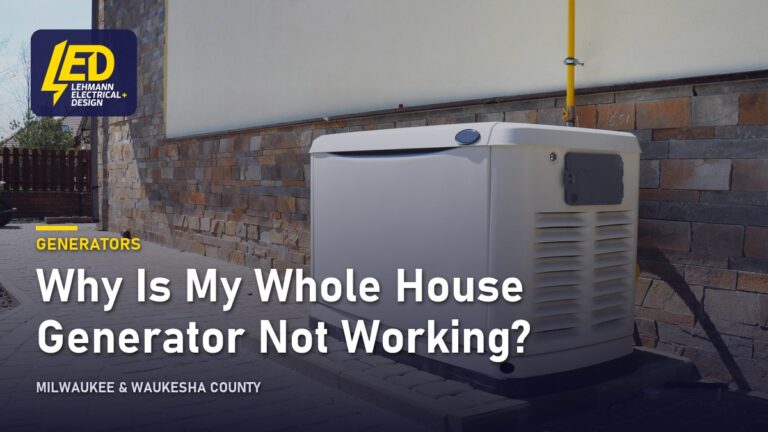
Your generator did not fail “for no reason.” Standby units run on a programmed exercise schedule, commonly weekly, and when something is wrong they usually tell you: a red alarm light, an error code on the controller, or a status display reading something other than “Ready.” If your unit has been showing an alarm for weeks and nobody noticed, the outage did not cause the failure. It revealed it.
A whole house generator is a small engine, plus a control system, plus a switching device, and all three need service. A unit that has never been maintained will eventually refuse to start. One that is exercised, load-tested, and has its battery replaced on schedule almost always starts.
If you smell burning, hot plastic, or fuel near the generator or the transfer switch, or you see scorch marks or discoloration, or you hear buzzing or crackling, stop. Leave the generator’s breaker off, do not attempt a restart, and call a licensed electrician. That is not a maintenance issue. That is a fault.
What is usually causing it
Why won’t your generator work? In plain terms: either it cannot start, it cannot keep running, or it is running fine and the switching equipment is not handing your house over to it. Here is what typically sits behind each symptom.

It will not start at all, no crank and no click. The battery is the first suspect. Standby generator batteries live outdoors through Wisconsin winters, they carry a constant small load from the controller, and they last a few years, not forever. A battery can read 12 volts and still be too weak to turn a cold engine over, which is why a technician load-tests it at the unit rather than relying on a voltage reading. The second suspect is the control switch left in OFF or MANUAL after a service visit.
It cranks but will not fire. This is almost always fuel. Natural gas units can be starved by a closed shutoff valve, a regulator that cannot keep up in deep cold, or a gas pressure problem that only appears under load. Propane units run out, or the tank cannot deliver: a low tank in cold weather is the real limiter, because vapor is drawn off the top of the liquid and a nearly empty tank in single-digit temperatures cannot vaporize propane fast enough to feed a running engine. Propane tanks have a gauge that nobody checks until the power is out.
It starts, runs, then shuts down after a few seconds or minutes. That pattern points to the generator protecting itself: low oil pressure, high coolant or engine temperature, overcrank (the controller cranked for its full allowed time without the engine catching, and gave up), or an overload. Air-cooled units pull cooling air through the enclosure, and a unit crowded by shrubs, stored items, or snow drifted against the louvers after a lake-effect squall will overheat and shut down.
Why is my whole house generator not kicking on when the power goes out? If the engine never turns over during an outage but the unit looks healthy otherwise, the automatic transfer switch is the place to look. That switch is the device that senses utility loss, signals the generator to start, and physically moves your house from utility power to generator power. If it is not sensing the outage, the engine never gets the start command.
The engine runs fine but the house stays dark. The generator is working and the handover is not. On some models the transfer switch has a field-replaceable control fuse that can blow, while many residential units use a control board with nothing serviceable at that level. The generator’s main output breaker may also simply be off. Either way the engine will happily run and deliver nothing indoors.
It only powers part of the house. That is often not a fault at all. If your system was installed with a managed or partial-load design, only selected circuits are backed up, and which circuits those are depends on what the system was sized for. If you are not sure what yours covers, working through a generator sizing estimate is a useful reality check before you assume something is broken.
| Symptom | Most likely area | Can a homeowner check it? |
|---|---|---|
| No crank, no sound | Battery, control switch position | Partly, visually only |
| Cranks, will not start | Fuel supply or gas pressure | Fuel valve and tank gauge, yes |
| Starts then quits | Oil, coolant, airflow, overload | Oil level and clearance, yes |
| Runs but no power indoors | Transfer switch or output breaker | No |
| Alarm light or error code | Varies by code | Read and report it, do not clear it |
| Only some circuits live | System design, not a fault | Review your circuit list |
What is safe to check yourself, and what is not
Three things are genuinely safe for a homeowner, and they resolve a fair number of calls.
Check the control switch. Every standby unit has a three-position switch or button set: AUTO, OFF, and MANUAL. It must be in AUTO to start on its own. Service work sometimes ends with it left elsewhere.
Check the fuel. If you are on propane, read the tank gauge. If you are on natural gas, confirm nobody closed the shutoff valve at the generator during yard work or an appliance repair.
Check the clearance and read the display. Clear snow, leaves, and stored items away from the enclosure so it can breathe. Then photograph whatever the controller display says, including any error code. That photograph saves real diagnostic time.
> Everything past those three checks belongs to a licensed electrician. The transfer switch sits between your utility service and your panel, which means it is energized from two directions, the utility and the generator. Turning the generator off does not de-energize it, and turning your main breaker off does not either: the service conductors feeding your home and the line-side lugs of the main breaker stay live until the utility pulls the meter or a separate service disconnect ahead of the panel is opened. A homeowner cannot make that equipment safe to open.
Also: do not reset a breaker repeatedly. If you find the generator’s output breaker tripped, it may be reset once, pushed firmly to OFF and then to ON. If it trips again, leave it off and have it inspected. A breaker that trips a second time is reporting a fault, not being stubborn. And never fit a larger breaker to stop the tripping. The breaker is sized to protect the wire behind it.
On the famous reset question: most Generac units do not have a single labeled reset button. What you have is the AUTO/OFF/MANUAL control. Clearing a stored alarm should be done exactly as your owner’s manual describes, or left to the technician, and only after the underlying fault has been corrected. Clearing an alarm without fixing the cause just hides the message.
Generator still not starting when the power goes?
A licensed electrician runs it under load, reads the fault log and checks the transfer switch that decides whether the house ever sees the power.
Licensed master electrician. 12-month workmanship warranty.
When it points to a bigger problem
Some failures are a battery. Some are a symptom of how the system was installed or how it has aged. And some failures are gradual rather than sudden: stale propane or contaminated fuel, oil that has never been changed, a slowly degrading gas regulator, or a controller board that starts throwing intermittent faults before it quits for good.
Watch for these patterns:
- It overloads or trips every time a large appliance starts. The system may be undersized for the circuits actually connected to it, or load management may have been configured at install and then defeated by later electrical work.
- It has never been serviced. A unit running ten years on original oil, plugs, filters, and battery is a generator in name only.
- The exercise cycle has not been heard in months. That cycle is your early warning system. Silence usually means the system has been failing quietly.
- Corrosion, moisture, or insect nests inside the enclosure. Mice and wasps can damage standby generator wiring, and that damage can show up as an intermittent no-start.
- The transfer switch is original and the house has been remodeled since. Circuits added or moved after installation change what is backed up and what the generator sees as load.
A generator that was correctly sized, correctly installed, and maintained will usually last well over a decade. The ones that die young almost always died of neglect, or of being asked to carry a load they were never sized for.
What an electrician does about it
A proper service call on a dead standby generator is a sequence, not a guess.
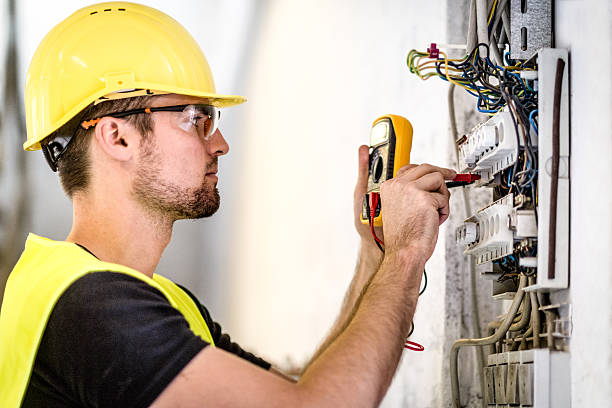
An electrician will read the controller history and any stored fault codes, load-test the battery rather than just measuring its voltage, verify fuel supply and gas pressure at the unit while it runs, check oil and coolant condition, inspect the enclosure and wiring for rodent damage and corrosion, test the transfer switch’s utility-sensing circuit and its control fuse or board, and then run the generator under actual house load to confirm it holds. If sizing turns out to be the real problem, that is a design conversation, not a repair.
If you are shopping rather than troubleshooting, a new standby installation is three pieces of work: setting the generator on a pad with the clearances the manufacturer requires, running a gas line sized for the unit’s demand (for most homes here that means coordinating a natural gas supply with the utility, or a propane tank large enough to hold pressure in January), and installing the automatic transfer switch between your service and your panel. Sizing comes from the circuits you want to keep alive, not from your square footage, so the first real step is a load calculation, which is an itemized tally of the actual loads to be backed up. A standby system installation starts with that list, and you can sketch your own version first with the load estimate tool.
Permits for generator and transfer switch work are issued by your local municipality, which enforces Wisconsin SPS 316, the state’s electrical code. SPS 316 adopts the 2023 NEC, in effect since September 1, 2026. Work permitted before that date was done under the 2017 NEC, and an existing, properly installed system does not generally have to be brought up to the newer edition unless it is being altered, though your municipal inspector has the final say on what a given repair scope triggers.
Jacob Lehmann is a master electrician, and Lehmann Electrical & Design holds a 4.9-star rating on Google and an A+ rating with the BBB. Our work carries a 12-month workmanship warranty.
If your standby unit will not start, will not hold, or you are weighing a new one, tell us what your generator is doing and we will schedule a look anywhere in Milwaukee and Waukesha County. You can also call 414-207-0109.
Why homeowners call Lehmann Electrical & Design
- Led by licensed master electrician Jacob Lehmann
- A+ rating with the BBB and 4.9 stars on Google
- 12-month workmanship warranty on the work we do
- Permits pulled and inspections scheduled as part of the job
- Milwaukee, Wauwatosa and Waukesha County, from 12012 W Fairview Ave, Wauwatosa
Ready to have it tested?
Send the model, when it was last serviced and what it does when the power drops.
Licensed master electrician. 12-month workmanship warranty.
Frequently asked questions
▾How do I know if my Generac generator is working?
Listen for the exercise cycle: the unit should start, run for several minutes, and shut down on its own at the programmed day and time, commonly weekly. Then read the controller display. It should show a ready status with no alarm light. If you have not heard an exercise cycle in months, or the display shows a code, the system is not ready even though nothing looks wrong from the outside.
▾How often should a whole house generator be serviced?
Once a year at minimum, with the battery evaluated at every visit. Annual service typically covers oil and filter, spark plugs, air filter, a battery load test, a fuel pressure check, and a test of the transfer switch under load. Units that log heavy run hours during outages need service sooner. The exercise cycle is not a substitute: it confirms the engine starts, not that it will carry your house.
▾How long can a whole house generator run continuously?
A natural gas standby unit can run for days because its fuel supply is continuous, but it still needs oil service at the interval the manufacturer specifies, often after a set number of run hours. Propane units are limited by tank size. The practical limit is oil, not fuel. During a multi-day outage, plan on checking the oil level and arranging a mid-outage service stop.
▾How long does a whole house generator battery last?
Usually a few years, and Wisconsin winters shorten it. The battery sits outdoors, carries a constant small load from the controller, and is asked to crank a cold engine. Because a weak battery is the first thing to suspect when a generator fails to start during an outage, replacing it on a schedule rather than waiting for failure is the cheapest reliability improvement available on these systems.
▾Why won’t my generator stay on?
Short run-then-shutdown cycles mean the generator is shutting itself down to prevent damage: low oil pressure, high temperature, overcrank, or overload. Check the oil level and clear snow, leaves, or stored items away from the enclosure so it can pull cooling air. If it still quits, the controller has logged a fault code that identifies the cause. Photograph it and have the unit diagnosed rather than repeatedly restarting it.
▾What causes a generator to stop working over time?
Gradual failures look different from sudden ones. Oil that has never been changed, stale or contaminated fuel, a propane tank that has sat partly full for years, a gas regulator drifting out of spec, corroded connections inside the enclosure, and an aging controller board all degrade slowly. The unit may start and run during an exercise cycle but fail under real house load, which is why an annual load test matters more than hearing the engine run.
Next step
Get the generator tested
Send the model and what it does when the power drops.
Licensed master electrician12-month warranty4.9 on Google
Milwaukee, Wauwatosa and Waukesha County. Prefer to talk? Call 414-207-0109