Licensed master electrician · Call 414-207-0109
Some warmth is normal in an EV charger, because pushing 30 to 48 amps through a cable and connector for hours generates heat. Overheating is different. It usually means a loose or corroded connection, an undersized or damaged circuit, a plug-in charger on a receptacle not rated for continuous use, poor ventilation, or a failing charger. If you smell hot plastic or see scorch marks or discoloration, stop charging, leave the breaker off, and call a licensed electrician.
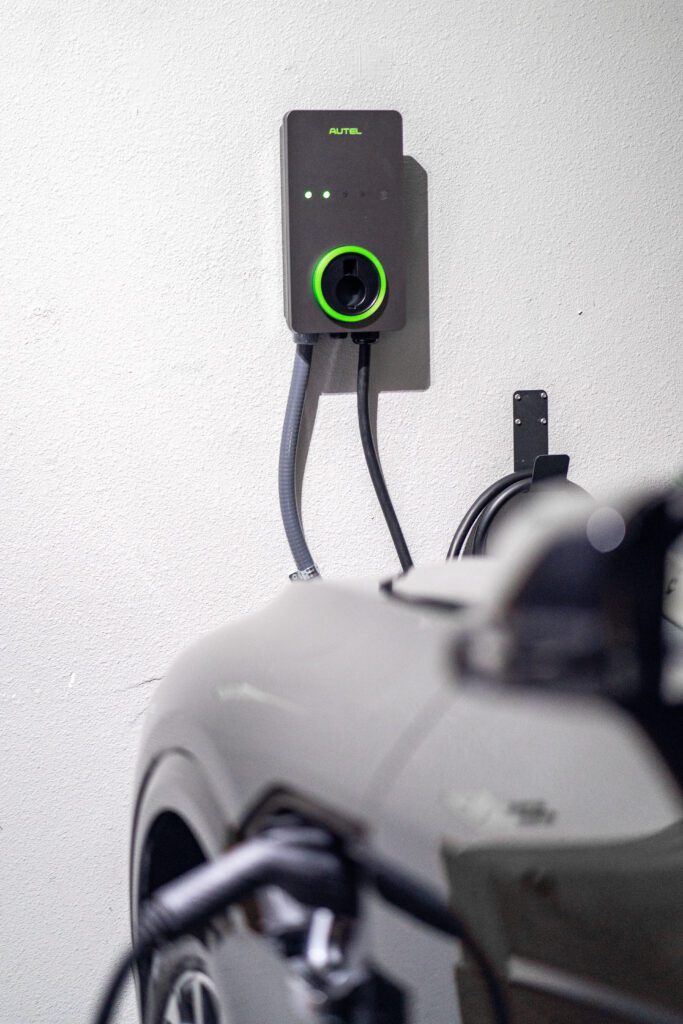
An EV charger is one of the largest and longest-running loads in a house. A Level 2 charger may draw 24, 32, 40, or 48 amps for four to eight hours straight. Anything that adds resistance in that path, such as a screw terminal that was never fully tightened, a corroded pin in a plug, or a wire that is too small for the load, turns into heat at exactly that point.
So the right question is not “is it warm” but “is the heat where it belongs.” A charger housing that feels like a laptop power brick after three hours of charging is behaving as designed. Heat concentrated at a plug face, at a receptacle, at the connector handle, or at the breaker is a warning. Melted or browned plastic, a persistent burning smell, buzzing, or crackling means something in the circuit is failing.
Here is the part worth remembering:
> Warmth spread evenly across a charger’s body during a long charge is normal. Heat concentrated at one connection point is not. Resistance creates heat, and a single hot spot is telling you where the resistance is. Do not touch the charger, the plug, or the panel to judge how hot it is. Judge by smell, by discoloration or melted plastic, and by sound instead.
What is usually causing it
The causes fall into a handful of groups, and they are not equally likely on every install.
Loose or degraded terminations. Every screw terminal in the path matters: inside the charger, at the receptacle if the unit plugs in, and at the breaker. A terminal that is slightly loose carries the same current through less metal contact, and that spot heats up. Thermal cycling over years can loosen terminations that were tight on day one.
A plug-in charger on the wrong receptacle. Many homeowners plug a Level 2 unit into a NEMA 14-50 receptacle. Standard-grade 14-50 receptacles were designed for occasional use, such as a range or an RV hookup, not for four-plus hours of near-continuous draw every night. Repeated heating and cooling relaxes the contacts, the contacts get hotter, and the cycle accelerates. This shows up as a browned or melted receptacle face and a discolored plug.
Undersized or damaged conductors. The wire gauge must match the breaker and the load. A circuit that was run with wire too small for the amperage, or wire that was nicked, kinked, or overheated during installation, runs hot along its length and especially at the ends.
Extension cords and adapters. These are the most common thing we tell people to remove. Most extension cords and third-party adapters are not rated for a continuous 240-volt, 32-amp-plus load, and each added connection is another place for heat to build.
Heat the charger cannot shed. A unit mounted in direct afternoon sun, crammed into a tight cabinet, or set behind boxes in a garage corner cannot dump its own waste heat. Many chargers respond by throttling their output, which is the unit protecting itself.
A failing charger or connector. Internal relays, contactors, and the pins in the vehicle connector wear. A connector that has been dropped on concrete repeatedly, or one with pitted or discolored pins, can heat at the handle even on a perfect circuit.
Ambient conditions. Wisconsin garages swing from below zero to 95 degrees plus. Summer heat narrows the margin a charger has to work with, and some units will reduce current on the hottest days.
| What you are seeing | Likely area | What it points to |
|---|---|---|
| Whole housing evenly warm after hours of charging | Normal operation | No action needed |
| Plug face or receptacle browned, melted, or hot | Receptacle and plug connection | Worn receptacle, loose contacts, wrong receptacle grade |
| Connector handle hot at the car | Vehicle connector or pins | Worn or damaged connector, dirty or pitted pins |
| Breaker area warm, plus buzzing | Breaker or panel termination | Loose termination or a failing breaker |
| Charger keeps reducing its output | Charger’s own thermal protection | Heat it cannot shed, or a circuit problem |
| Burning smell with no visible cause | Anywhere in the circuit | Stop charging and get it inspected |
What is safe to check yourself, and what is not
Safe to check: the obvious, visible, outside-the-enclosure things.
- Look at the charger’s own app or display for a fault or temperature code. Most Level 2 units log why they throttled or stopped.
- Look, without touching, at the plug and receptacle for browning, melting, soot, or a distorted face.
- Look at the connector pins at the car end for discoloration or pitting.
- Remove any extension cord or adapter from the setup and stop charging through it.
- Clear anything stacked against or over the charger and improve airflow around it.
- Check whether the problem tracks with heat, such as only on hot afternoons, only at maximum current, or only when the sun hits the unit.
- Check the charger’s current setting against what the installer set it to. Some units let an app raise output beyond what the circuit was built for.
Not safe, and not yours to do:
- Do not open the panel cover. Turning the main breaker off does not make the panel safe. The service conductors coming in and the line-side lugs of the main breaker stay energized. A homeowner cannot de-energize those. Only the utility can, usually by pulling the meter, or a separate service disconnect ahead of the panel if the house has one.
- Do not open the charger’s enclosure or the receptacle box.
- Do not tighten terminals, replace a receptacle, or swap a breaker.
- Do not install a larger breaker to stop nuisance tripping. The breaker protects the wire. A bigger breaker on the same wire removes the protection and leaves the heat.
- Do not touch a suspect charger, plug, outlet, or panel to gauge temperature.
If the breaker for the charger has tripped, you may reset it once: push firmly to OFF, then to ON. If it trips again, leave it off and have it inspected. If there is a burning or hot-plastic smell, scorch marks, discoloration, buzzing, or crackling anywhere in the circuit, stop using it, leave the breaker off, and call an electrician.
One clarification worth making, because it confuses people: a correctly matched charger does not trip its breaker under normal use. Continuous loads are limited to 80 percent of the breaker rating, so 24 amps on a 30-amp breaker, 32 amps on a 40, and 48 amps on a 60 are all correct pairings. If a properly paired charger is tripping, something is wrong in the circuit, not in the math.
Charger still running hot?
A licensed electrician tests the circuit under load and checks every termination from the panel to the charger.
Licensed master electrician. 12-month workmanship warranty.
When it points to a bigger problem
Overheating is sometimes just a tired receptacle. Sometimes it is the visible end of something structural.
Watch for these:
- Heat at the breaker or panel, not the charger. A warm breaker under sustained load is normal. A hot one with buzzing or a hot-plastic smell is not, and it suggests a loose termination or a breaker that is no longer making good contact.
- The charger shares a circuit. A Level 2 charger must be on its own dedicated circuit under Wisconsin SPS 316, which adopts the 2023 NEC (in effect since September 1, 2026), per NEC 625.40. A shared circuit is both an overheating source and a code problem.
- Other things in the house misbehave while charging. Lights dimming, other appliances acting up, or a panel that buzzes during a charge session points at the feeder or the service entrance, the point where utility power enters the house.
- The circuit was never load-calculated. A load calculation adds up the home’s expected demand to confirm the existing service can carry another 40 or 60 amps. Charger amperage depends on the panel’s spare capacity, which is why no installer can promise a particular charge speed before looking at the panel.
- Aluminum branch wiring, or old wiring on the charger circuit. Aluminum conductors need specific connectors and torque, and older splices in the path can overheat.
- It keeps coming back after the receptacle was replaced. A second and third meltdown at the same spot means the real fault is upstream.
If the setup started with a plug-in unit on a garage receptacle, moving to a hardwired unit removes the weakest link entirely. That is a common outcome when we look at a melted 14-50, and it is a normal part of installing a home EV charger properly.
What an electrician does about it
A licensed electrician works the circuit from the panel out, not from the symptom in.
The visit generally covers: confirming what the charger is actually drawing and what it is set to; checking voltage drop under load, because a sagging voltage during charging points to an undersized or long conductor run; inspecting and torquing terminations at the breaker, the receptacle or junction, and the charger to the manufacturer’s specification; checking the breaker itself and the panel bus for heat damage; verifying the conductor size and type against the breaker and the load; confirming the circuit is dedicated; and performing a load calculation on the service before recommending any change in charger amperage.
The fix depends on what is found. Sometimes it is retorquing a termination and replacing a worn receptacle with an industrial-grade one. Sometimes it is converting a plug-in unit to hardwired. Sometimes it is a new correctly sized dedicated circuit, which requires a permit from the local municipality, such as Milwaukee, Wauwatosa, or Waukesha, enforcing Wisconsin SPS 316. Existing installations are not required to be brought up to the 2023 NEC unless they are altered, but altered work is held to the current edition.
Lehmann Electrical & Design is led by master electrician Jacob Lehmann and holds a 4.9-star rating on Google. Our work carries a 12-month workmanship warranty. If your charger is running hot, talk to us about the charger circuit or call 414-207-0109 and we will schedule a look at it.
Why homeowners call Lehmann Electrical & Design
- Led by licensed master electrician Jacob Lehmann
- A+ rating with the BBB and 4.9 stars on Google
- 12-month workmanship warranty on the work we do
- Permits pulled and inspections scheduled as part of the job
- Milwaukee, Wauwatosa and Waukesha County, from 12012 W Fairview Ave, Wauwatosa
Ready to have the charger checked?
Send the charger brand, the breaker size and how long it runs before it gets hot.
Licensed master electrician. 12-month workmanship warranty.
Frequently asked questions
▾Is it normal for a charger to heat up?
Yes, within limits. Any charger converting and delivering power loses some of it as heat, so a warm housing during a long charge session is expected. What is not normal is heat concentrated at a plug, receptacle, connector handle, or breaker, or heat accompanied by a burning smell, discoloration, melted plastic, buzzing, or crackling. Even warmth across the body is fine. A hot spot is a fault telling you where it is.
▾Is it bad if my charger gets hot?
It depends where. A Level 2 unit that is uniformly warm to the touch and charging normally is doing its job. A unit so hot that the plastic has browned or deformed, or one that has begun to smell, is failing and is a fire risk. Stop charging, leave the breaker off, and have it inspected. Do not touch it to test the temperature; use what you can see and smell.
▾Why does my phone charger overheat?
Phone chargers heat for the same physical reason, resistance in a small package, but the stakes and the fixes differ. A hot phone charger usually means a cheap or damaged unit, a frayed cable, fast charging in a hot room, or a swollen phone battery. Replace the charger and cable with manufacturer-approved ones and stop using anything that smells or discolors. Small chargers are a replace item, not a repair item.
▾Can chargers overheat badly enough to cause a fire?
Yes. A connection carrying 32 to 48 amps for hours with added resistance can reach temperatures that char insulation and ignite nearby material. This is why melted receptacles and burning smells are treated as stop-now conditions rather than annoyances. The risk is real but it is also preventable: correct conductor size, a dedicated circuit, quality hardware, and properly torqued terminations remove almost all of it.
▾How much does EV charger installation cost?
It depends on the distance from the panel, the spare capacity in the service, the conductor size needed, whether the run is surface-mounted or concealed, and local permit fees, so an honest number needs a look at the panel and the route. We will not quote a range sight unseen. Our page on EV charger installation explains what goes into a quote, and an on-site estimate gives you a firm figure.
▾Does the brand of charger change whether it overheats?
Build quality matters, especially in the connector and the internal contactor, but the circuit matters more. A well-made unit on an undersized or loosely terminated circuit will still overheat at the weak point, and a modest unit on a correctly sized dedicated circuit usually will not. We work with a range of hardware, including Tesla wall connector installs, and the circuit work is what determines whether it runs cool.
Next step
Get the charger checked
Send the charger brand, the breaker size and how long it runs before it heats up.
Licensed master electrician12-month warranty4.9 on Google
Milwaukee, Wauwatosa and Waukesha County. Prefer to talk? Call 414-207-0109