Licensed master electrician · Call 414-207-0109
A small amount of warmth at an outlet that is powering a large load, like a space heater or a hair dryer, can be normal. Anything beyond mildly warm is not. Heat at an outlet usually means electricity is meeting resistance somewhere it should not: a loose wire connection, worn contacts inside the receptacle, an overloaded circuit, or a damaged plug. Heat is how a connection fails. If the outlet is hot, unplug what is in it, stop using it, and have it looked at.
Electricity makes heat wherever it has to push through a poor connection. A properly wired outlet with tight terminals and healthy internal contacts moves current with almost no resistance, so it stays close to room temperature. Once a screw terminal loosens, a backstab connection wears out, or the metal contacts inside the receptacle lose their grip on the plug blades, current has to jump a small gap of higher resistance. That resistance turns electrical energy into heat right at the weak point.
That is why a hot outlet is treated as a fault rather than a quirk. The heat is not a side effect of the problem, it is the problem. Left in service, that hot spot cooks the plastic around it, which makes the connection worse, which makes more heat. Enough cycles of that and you get scorched terminals, a melted receptacle face, or a fire inside the wall box.
If you notice a burning smell, a hot-plastic or fishy chemical smell, brown or black discoloration around the slots, scorch marks, buzzing, or crackling: stop using that outlet and anything on the circuit, switch the breaker for it off and leave it off, and call a licensed electrician. Do not keep testing it by touch.
What is usually causing it
Most hot outlets trace back to one of a handful of conditions. Several can be present at once.
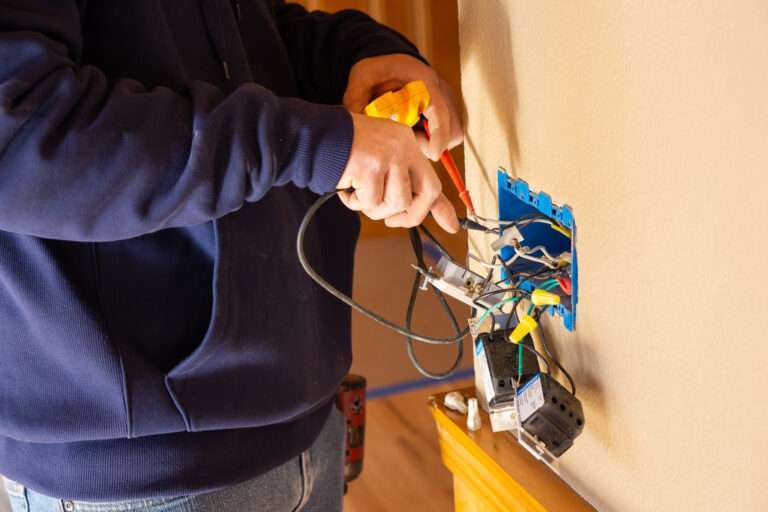
A loose or failing connection at the outlet. The wires land on the receptacle either under screw terminals or pushed into spring-loaded holes on the back, often called backstabs. Screws work loose over decades of thermal expansion. Backstab springs weaken. Aluminum branch wiring from the mid-1960s to mid-1970s is especially prone to loosening at terminals. Any of these creates a high-resistance joint that heats up under load.
Worn contacts inside the receptacle. Plug something in and out a few thousand times and the brass contacts that grip the plug blades lose tension. A plug that feels loose or falls out on its own is telling you the grip is gone. Loose grip means less metal-to-metal contact area, which means more resistance and more heat. This is the reason an outlet that has held a vacuum or a phone charger for twenty years starts running warm.
Too much load for the circuit, or too much load on one outlet. A 15-amp circuit on 14-gauge wire and a 20-amp circuit on 12-gauge wire each have a ceiling. Amperage is the rate of current flow, and continuous loads should not exceed 80 percent of the breaker rating. Stack a heater, a dehumidifier, and a window air conditioner on one bedroom circuit and everything in the path runs hot, including the receptacle. The fix for an overloaded circuit is a new circuit. It is never a bigger breaker, because the breaker exists to protect the wire behind it.
The device or its plug, not the outlet. Chargers and power adapters convert voltage and give off waste heat by design. An iPad or laptop charger that is warm to the touch while charging, and cools down when the battery is full, is behaving normally. What is not normal is a plug that is hot at the blades, a plug that is hotter than its own body, discoloration on the prongs, or a charger that smells. Damaged or counterfeit adapters are a real cause of hot plugs.
Heat conducted from somewhere else. Sunlight on the wall, a nearby heat register, or a hot appliance behind the outlet can raise the faceplate temperature with nothing wrong electrically. This is the least likely explanation and the easiest to rule out, because the warmth will be even across the plate rather than concentrated at the slots.
| What you observe | Most likely explanation | What to do |
|---|---|---|
| Charger body warm, plug blades cool | Normal adapter waste heat | Nothing |
| Plug blades hot, outlet face hot | Loose terminal or worn receptacle contacts | Stop using it, call an electrician |
| Plug falls out or feels loose | Worn internal contacts | Replacement receptacle |
| Warm only when several things are running | Circuit overload | Redistribute load now, new circuit long term |
| Any smell, scorch mark, buzz, or crackle | Active fault | Breaker off, do not use, call immediately |
| Whole faceplate evenly warm, nothing plugged in | External heat source | Rule out sun or heat register |
What is safe to check yourself, and what is not
Safe: look, smell, listen, and unplug. You can unplug everything from the outlet and see whether it cools down over the next hour. You can check whether the same device runs hot in a different outlet, which points at the device. You can count what else is on the circuit by noting which lights and outlets die when you switch off that breaker. You can smell for hot plastic and look for browning around the slots. You can move a heavy load to a different circuit.
If a breaker has tripped, reset it once at most: push it firmly to OFF, then back to ON. If it trips again, leave it off and have the circuit inspected. If a GFCI outlet, the kind with TEST and RESET buttons that cuts power when it detects 4 to 6 milliamps of current leaking out of the circuit by any path, will not hold its reset, that is a real leakage fault or a failed device, not a false alarm.
Not safe, and not a homeowner job: removing the faceplate and pulling the receptacle out of the box, replacing the receptacle, tightening terminals, or opening the panel. The wiring at a hot outlet is already compromised, and the box may contain more than one circuit. Turning the outlet’s breaker off does not make the box unconditionally dead if it is fed by more than one circuit or has a shared neutral. And behind a panel cover, the service conductors and the line-side lugs of the main breaker stay energized even with the main breaker off. A homeowner cannot de-energize those. Only the utility can, usually by pulling the meter, or a separate service disconnect ahead of the panel if one is fitted.
There is also a permit and code dimension. Electrical work in Milwaukee and Waukesha County is permitted by the local municipality, which enforces Wisconsin SPS 316, the state’s electrical code. SPS 316 adopts the 2023 NEC, in effect since September 1, 2026. Work permitted before that date was done under the 2017 NEC, and existing installations do not have to be brought up to the new edition unless they are altered. Once a receptacle or circuit is altered, the current edition applies to that work. Diagnosing and correcting a hot outlet is exactly the kind of job that belongs with a licensed electrician doing electrical repair and troubleshooting.
Outlet still warm with nothing plugged in?
A licensed electrician pulls the receptacle, checks every termination for heat damage and measures what the circuit is actually carrying.
Licensed master electrician. 12-month workmanship warranty.
When it points to a bigger problem
One hot outlet is usually one bad connection. Several hot outlets, or a hot outlet plus other symptoms, suggests something upstream.
Watch for these patterns:
- Multiple warm outlets on the same circuit. Points to a shared problem: a failing connection at a device early in the daisy chain, an undersized conductor, or chronic overload. Everything downstream of a bad splice heats up.
- Warm outlets plus dimming or flickering lights when an appliance kicks on. Suggests a loose neutral connection or resistance at the panel or service entrance, the point where the utility’s wires enter the house and connect to your equipment.
- A warm outlet on a circuit that also trips its breaker. Thermal-magnetic breakers, the standard residential type, use a heat-sensitive strip for sustained overloads and a magnetic coil for short circuits. A trip with nothing plugged in more often means a wiring fault than a tired breaker.
- Cloth-insulated or knob-and-tube wiring anywhere in the house. Older insulation embrittles. Heat accelerates that, and these systems have no equipment grounding conductor, so a fault has no safe path back.
- Aluminum branch-circuit wiring. Requires specific listed connectors and terminations at every device. Homeowner-grade receptacles are usually not rated for it.
- Any burning smell you cannot locate. A smell coming from a wall rather than a specific outlet means heat is being generated inside a box or a splice you cannot see.
None of these are reasons to panic. They are reasons to book a real diagnosis rather than swap a receptacle and hope.
What an electrician does about it
An electrician starts with the symptom and works outward, because replacing the receptacle without finding the cause just moves the fault. The visit typically covers:
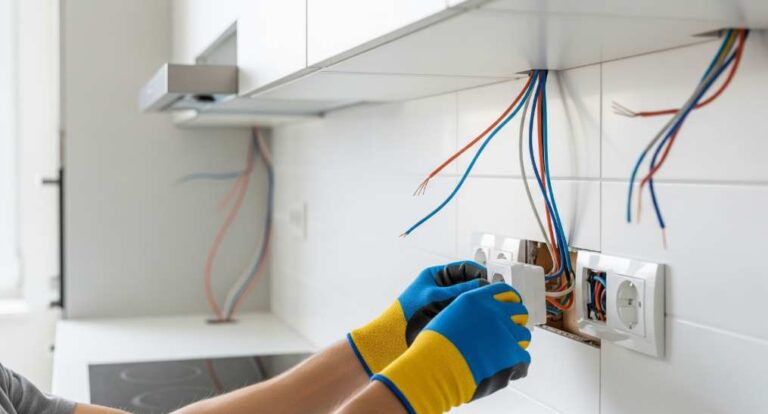
Confirming which circuit feeds the outlet and what else is on it. Measuring voltage under load and looking for voltage drop, which is the telltale sign of resistance in the path. Pulling the device and inspecting the terminals, the conductors, and the box for heat damage, undersized wire, backstab failure, or a bad splice. Checking that the connection type matches the wire, which matters with aluminum. Checking the circuit’s protection, including whether AFCI protection, which stands for arc-fault circuit interrupter and detects the erratic current signature of arcing, is present where the current code edition calls for it on 120-volt living-area circuits. Then correcting what is actually wrong: a new listed receptacle, re-terminated conductors, a repaired splice, or a dedicated circuit if the load is simply too large for what is there.
When the real answer is that a room has one outlet doing the work of three, the repair is often paired with adding a properly sized receptacle so the load spreads out. That includes exterior receptacles on the back of a house, which need weather-resistant devices and an in-use cover, and GFCI protection outdoors.
Lehmann Electrical & Design is led by master electrician Jacob Lehmann and holds a 4.9-star rating on Google. Work is backed by a 12-month workmanship warranty. Homeowners across Milwaukee and Waukesha County call us for this, whether the house is a 1920s bungalow or a newer build, and we also handle repair calls for homeowners in West Allis.
If an outlet in your house is running hot, tell us what you are seeing and we will schedule a look, or call 414-207-0109.
Why homeowners call Lehmann Electrical & Design
- Led by licensed master electrician Jacob Lehmann
- A+ rating with the BBB and 4.9 stars on Google
- 12-month workmanship warranty on the work we do
- Permits pulled and inspections scheduled as part of the job
- Milwaukee, Wauwatosa and Waukesha County, from 12012 W Fairview Ave, Wauwatosa
Ready to have that outlet looked at?
Send the room, what was plugged into it and any discolouration you can see. The electrician arrives knowing what to test.
Licensed master electrician. 12-month workmanship warranty.
Frequently asked questions
▾Why does my outlet smell like fish?
A fishy or urine-like chemical smell from an outlet is a recognized warning sign of overheating. Many of the flame-retardant compounds in receptacle and wire insulation give off that odor when they get hot, before you see any visible scorching. Treat it the same as a burning smell: unplug everything, switch the circuit’s breaker off, leave it off, and have an electrician find the source before you use that outlet again.
▾Why is my outlet warm to the touch but not hot?
Slightly warm while a heavy load is running, then cool within an hour of unplugging, is often just normal heating of the plug and adapter. Warm with nothing plugged in, warm with only a small load, or warm along with a loose-feeling plug is a fault forming. Warm today tends to become hot later, because heat degrades the connection that is causing it. Have it checked rather than waiting for a smell.
▾Why does my plug get hot when charging an iPad?
Charging adapters convert AC to low-voltage DC and shed waste heat doing it, so a warm charger body during a fast charge is expected and it should cool once the battery fills. The blades of the plug should stay near room temperature. If the metal prongs themselves are hot, if the prongs look discolored, or if the charger is hot when the device is already full, retire that adapter and have the outlet inspected too.
▾Can I just replace the hot outlet myself?
We do not recommend it. The wiring at a hot outlet is already damaged, the box may carry more than one circuit so switching off one breaker does not guarantee it is dead, and the actual fault is often a splice or conductor rather than the receptacle. Getting the device swapped but leaving a loose upstream connection in place means the heat comes back somewhere you cannot see it.
▾Does one hot outlet mean my whole house needs rewiring?
Usually no. A single hot outlet is most often a single bad connection at that device, and the repair is limited to that box. A rewire enters the conversation only when the diagnosis turns up a systemic issue: knob-and-tube or brittle cloth insulation, aluminum branch circuits with unsuitable terminations, or multiple heat-damaged points on the same run. An electrician can tell you which situation you are in after inspecting it.
Next step
Get that outlet checked
Send the room, what was plugged in and any marks around the slots.
Licensed master electrician12-month warranty4.9 on Google
Milwaukee, Wauwatosa and Waukesha County. Prefer to talk? Call 414-207-0109