Licensed master electrician · Call 414-207-0109
A licensed electrician can tie a new outlet into a knob and tube circuit. Most will argue against it, and the reasons are worth understanding before you ask. Knob and tube has no ground wire, it was designed for the small lighting loads of a century ago, and adding receptacles loads an already marginal circuit while hiding the oldest wiring deeper inside the walls. Replacing the circuit with modern cable is usually the better repair and often costs less than a patchwork of extensions.

Adding an outlet to knob and tube wiring is possible, and electricians do occasionally extend one when a house is mid-rewire and a circuit is scheduled for replacement anyway. As a standalone project, it creates more problems than it solves.
Here is the core of it, in plain terms:
> Knob and tube wiring is a two-wire system with no equipment ground, which means a standard three-prong outlet fed from it has nothing to connect its ground pin to. The circuit itself was sized for a few light fixtures, not for a space heater, a window air conditioner, or a home office full of equipment. Every outlet you add is an invitation to put more load on wiring that has no margin left, and most of the splices and connections sit inside walls and ceilings where nobody will ever see them overheat.
That is why most electricians will quote you a new circuit instead of an extension. A dedicated run of modern cable back to the panel gives you a grounded, properly protected outlet and takes load off the old wiring at the same time.
What Is Usually Causing It
The request almost always traces back to one of a handful of situations in older Milwaukee and Waukesha County homes.
Too few outlets. A 1920s bedroom may have one receptacle, or none at all. Extension cords and power strips fill the gap, which is exactly the load pattern knob and tube handles worst.
A remodel that touched an old circuit. Someone opens a wall for a kitchen, bath, or basement finish and finds ceramic knobs and tubes running through the joists. Now the plan needs a receptacle in a place the original wiring never served.
An appliance that keeps tripping or blowing. A microwave, a dehumidifier, or a window unit draws more than the old circuit can carry, so the homeowner wants “one more outlet somewhere else” on the same run.
Previous extensions already made. It is common to open a junction box and find modern cable spliced onto knob and tube by a previous owner, sometimes with no box at all. The new section looks fine. The 100-year-old section feeding it does not.
How knob and tube actually works
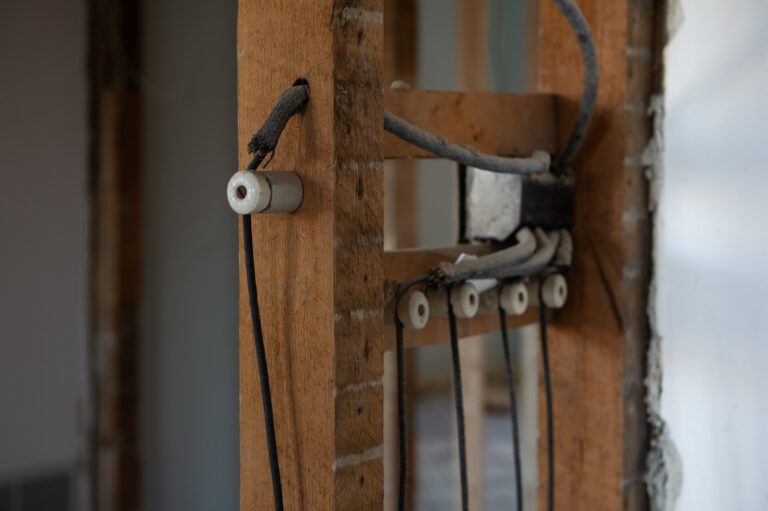
Knob and tube uses two separate single conductors, a hot and a neutral, run several inches apart. Porcelain knobs hold the wire away from framing, and porcelain tubes line the holes where a wire passes through a joist or stud. The separation is the insulation strategy: air does the work. Splices were soldered and taped rather than made inside a box. Visually, you are looking for white or gray ceramic cylinders nailed to joists in a basement or attic, with cloth or rubber-insulated wire looped over them, and no cable sheath or ground wire anywhere.
Because the two conductors are separated and uncovered, anything that fills the cavity around them, insulation, stored boxes, or a finished ceiling, removes the air that was keeping them cool. That is where the heat problems start.
What Is Safe to Check Yourself, and What Is Not
You can safely gather information. You cannot safely work on it.
Safe to do:
- Look at exposed joists in the basement or attic and note whether you see ceramic knobs and tubes.
- Count outlets per room and note which ones have two slots instead of three.
- Check whether the panel uses fuses or breakers, and note the number printed on each fuse or breaker handle.
- Look for insulation packed around old conductors, which is a real heat concern.
- Note any burning or hot-plastic smell, discoloration, scorch marks, buzzing, or crackling at an outlet, switch, or fixture. If you find any of those, stop using that circuit or device, leave the breaker off, and call an electrician before anything else.
- Test three-prong outlets with an inexpensive plug-in tester. A “no ground” or “open ground” reading on an old circuit is common and worth writing down.
Not safe to do:
- Opening the panel cover. With the main breaker off, the service conductors feeding the panel and the line-side lugs on that main breaker stay energized. Only the utility, usually by pulling the meter, or a separate service disconnect ahead of the panel can take those dead.
- Splicing new cable onto old conductors, inside a wall or anywhere else.
- Swapping a two-prong outlet for a three-prong one. That puts a ground pin in front of an appliance with nothing behind it.
- Pulling insulation away from, or stuffing insulation around, old wiring.
If a breaker trips, reset it once at most: push it firmly to OFF, then to ON. If it trips again, leave it off and have the circuit inspected. Never fit a larger breaker or a larger fuse to stop the tripping. The breaker protects the wire, and the wire behind knob and tube is small and old.
Need another outlet in a room on old wiring?
A licensed electrician works out whether that circuit can carry it at all, and what the alternative looks like if it cannot.
Licensed master electrician. 12-month workmanship warranty.
When It Points to a Bigger Problem
A request for one more outlet is often the visible edge of a wiring system that is at the end of its service life.
Knob and tube was installed in American homes from roughly the 1880s into the 1940s, with the tail end running later in some rural construction. The conductors themselves, bare copper, can outlast everyone reading this. The insulation cannot. Rubber and cloth insulation dries out, cracks, and falls off in flakes, especially where it passed near a hot fixture or inside a wall that cycles through Wisconsin winters and summers. So the honest answer to “how long does knob and tube wiring last” is that the copper is not the limit. Insulation condition, splice condition, and how much load the circuit has been asked to carry decide whether a given run is still serviceable.
Signs that the problem is the system, not the outlet count:
- Fuses or breakers that trip on ordinary use
- Lights that dim when a motor starts
- Insulation flaking off conductors where you can see them
- Modern cable spliced onto old conductors, particularly outside a junction box
- Blown-in or batt insulation surrounding old conductors
- Fabric-covered lamp cord used as permanent wiring
Two more points worth knowing. First, insurance and lender treatment of knob and tube varies a great deal by carrier and by underwriter, and some do ask questions at renewal or at closing. That is a conversation with your own agent, not something we can generalize about. Second, work that alters an existing circuit is permitted and inspected by your municipality, Milwaukee, Wauwatosa, Waukesha and the rest, which enforces Wisconsin SPS 316, the state’s electrical code. SPS 316 adopts the 2023 NEC, in effect since September 1, 2026. Existing installations are not forced up to a new edition just because the edition changed, but the moment a circuit is altered, the altered work is judged against the current edition. For a deeper look at how these circuits fail, our overview of aging knob and tube circuits covers the failure modes in more detail.
What an Electrician Does About It
The work starts with looking, not quoting. A licensed electrician traces which circuits are still knob and tube and which have been partially replaced, checks insulation condition at every accessible point, inspects the panel and overcurrent protection, and performs a load calculation, which is the arithmetic that compares what a circuit or a service can carry against what the house actually demands.
From there the options usually look like this:
| Approach | What it gives you | Honest drawback |
|---|---|---|
| Extend an existing knob and tube circuit | An outlet, quickly | No ground, more load on old wire, new splices hidden in walls |
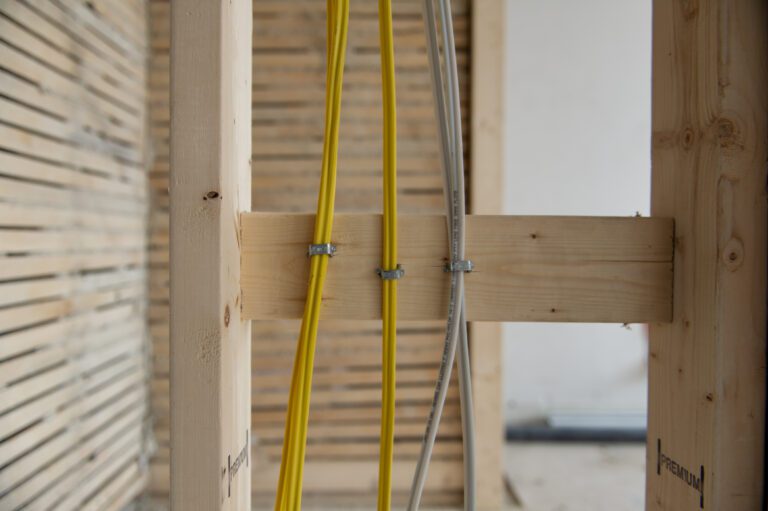
| Run one new dedicated circuit in modern cable | A grounded, protected outlet; less load on the old circuit | Access and patching where cable must be fished |
| Replace the circuit from panel to last device | Entire run is new; old wiring removed from service | More access work than a single new circuit |
| Rewire affected areas or the whole house | Grounded wiring throughout, AFCI and GFCI protection where applicable | Largest scope, phased over multiple visits on bigger homes |
AFCI means arc-fault circuit interrupter, a breaker that watches for the electrical signature of arcing and shuts the circuit down. GFCI means ground-fault circuit interrupter, a device that trips when a small amount of current leaks out of the circuit by any path, including through a person or damp material. Neither one needs a ground wire to function, which is why a GFCI is sometimes used as an interim measure on an ungrounded circuit, with the outlet labeled “No Equipment Ground.” That is a legitimate improvement in shock protection. It is not a substitute for a ground, and it does nothing about brittle insulation or an overloaded run.
Work is permitted through the local municipality and inspected, and the completed circuit is tested before anyone calls it done. Our rundown of the specific risks in older homes with original wiring and the companion piece on what inspectors flag in county houses go through what typically turns up on these inspections.
If you have an older home and you are deciding between adding an outlet and replacing the circuit behind it, an on-site look will tell you which one you actually need. Lehmann Electrical & Design is led by master electrician Jacob Lehmann, holds a 4.9-star rating on Google, and backs its work with a 12-month workmanship warranty. Request an estimate or call 414-207-0109.
Why homeowners call Lehmann Electrical & Design
- Led by licensed master electrician Jacob Lehmann
- A+ rating with the BBB and 4.9 stars on Google
- 12-month workmanship warranty on the work we do
- Permits pulled and inspections scheduled as part of the job
- Milwaukee, Wauwatosa and Waukesha County, from 12012 W Fairview Ave, Wauwatosa
Want to know what your options are?
Tell us which room, what you want to plug in, and the age of the house.
Licensed master electrician. 12-month workmanship warranty.
Frequently Asked Questions
▾Can you put a GFCI outlet on knob and tube wiring?
Yes. A GFCI does not need an equipment ground to work, because it compares current leaving on the hot with current returning on the neutral and trips when a small amount goes missing. An electrician can install one on an ungrounded circuit, and it must be labeled “No Equipment Ground.” It improves shock protection, but it does not ground the outlet and does not address deteriorated insulation or overloading.
▾Can knob and tube wiring be used with circuit breakers?
It can be fed from breakers, and many homes with knob and tube have had the old fuse panel replaced at some point. Breakers do the same job as fuses, just resettably. What a breaker cannot do is make old conductors safer: it protects the wire from overcurrent, not from cracked insulation, hidden splices, or insulation packed around the conductors.
▾How many amps is knob and tube wiring?
Individual knob and tube branch circuits were typically protected at 15 amps, and the conductors are usually 14 gauge or similar. The bigger limitation is the whole service. Many homes of that era started with 30 or 60 amp service, and some still have it. An electrician’s load calculation compares what the house now demands against what the existing wiring and service can actually deliver.
▾How long was knob and tube wiring used?
It was the standard residential wiring method in the United States from roughly the 1880s through the 1930s, phasing out as sheathed cable took over, with some installations continuing into the 1940s and later in rural construction. If your home predates about 1950 and has never been rewired, there is a reasonable chance some original knob and tube is still in service somewhere in the walls or attic.
▾How can I tell what knob and tube looks like?
Look at exposed framing in a basement or unfinished attic. You are looking for white or gray porcelain knobs nailed to joists, with a single wire looped around each one, and porcelain tubes sleeving the holes where wires pass through framing. The hot and neutral run as separate wires several inches apart, with no outer cable jacket and no ground conductor. Insulation is cloth or rubber, often brittle.
Next step
Get the circuit assessed
Tell us which room and what you want to plug in.
Licensed master electrician12‑month warranty4.9 on Google
Milwaukee, Wauwatosa and Waukesha County. Prefer to talk? Call 414-207-0109